
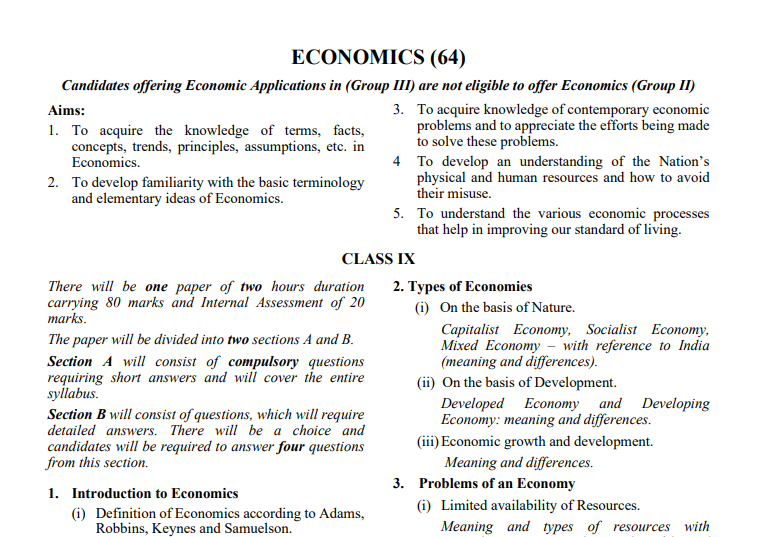
The syllabus for ICSE Class 10 Economics provides students with a foundation in economic principles and practical applications. The exam consists of an 80-mark written paper lasting two hours, with an additional 20 marks allocated for internal assessment. The exam is structured to assess students’ grasp of production, demand and supply, market types, banking, public finance, inflation, and consumer rights.
ICSE Class 10 Economics Syllabus 2026
The ICSE Class 10 Economics Syllabus for 2025-26 aims to introduce students to fundamental economic concepts like demand and supply, market structures, banking, and inflation. The syllabus is divided into two sections—Section A covers the full syllabus with short-answer questions and is compulsory, while Section B offers long-answer questions where students can choose four questions to answer.
ICSE Class 10 Economics Syllabus 2025-26: Structure
| Component | Details |
|---|---|
| Total Marks | 100 (Written Exam: 80 marks; Internal Assessment: 20 marks) |
| Exam Duration | 2 hours |
| Section A | Compulsory; short-answer questions covering the full syllabus |
| Section B | Optional; long-answer questions, with students choosing four questions to answer |
ICSE Class 10 Economics Syllabus 2026: Chapterwise Topics
-
The Productive Mechanism
- Factors of Production: Overview of land, labor, capital, and entrepreneurship, and their impact on economic production.
- Land: Definition, characteristics, productivity, and factors affecting productivity.
- Labor: Definition, characteristics, types of labor division, and reasons for low efficiency in Indian labor.
- Capital: Types of capital, capital formation process, and importance.
- Entrepreneur: Role and functions of entrepreneurs in economic development.
-
Theory of Demand and Supply
- Demand and Supply: Definitions, laws, and determinants with individual and market demand and supply curves. Exceptions to the law of demand.
- Elasticity: Meaning, types, factors affecting elasticity, and percentage method to measure elasticity.
-
Market Structure
- Market Types: Definitions and characteristics of perfect competition, monopoly, monopolistic competition, and oligopoly.
-
Banking in India
- Money: Evolution, functions, and types of money.
- Commercial Banks: Definitions, types of deposits, loan methods, and credit creation.
- Central Bank: Functions, public debt, and monetary policy tools.
- Demonetization: Overview and impacts.
- Public Finance: Revenue and expenditure, tax types, GST, and progressive taxes.
-
Inflation
- Inflation Indices: Concepts of WPI, CPI, and food basket.
- Stages of Inflation: Creeping, walking, running, and hyperinflation.
- Types of Inflation: Cost-push and demand-pull inflation, their causes, and impacts.
-
Consumer Awareness
- Consumer Exploitation: Forms and reasons.
- Consumer Rights and Duties: Overview of COPRA, RTI, and food adulteration.
- Consumer Protection Measures: PDS, BIS, AGMARK, and ECOMARK.
Internal Assessment and Evaluation
Students complete one assignment, which is assessed by both an internal and an external examiner. Assignments may involve field surveys, industrial visits, or analysis of GST impact on products. Marks are entered by the school on the Council’s portal.
| Assessment Component | Marks |
|---|---|
| Internal Examiner (Teacher) | 10 |
| External Examiner | 10 |
| Total | 20 |
Marking Guidelines
| Grade | Preparation/Research | Information | Observation | Inference | Presentation | Marks |
|---|---|---|---|---|---|---|
| I | Follows instructions, well-organized | Relevant and in-depth research | Systematic data recording | Shows understanding and clarity | Clear, neat, optimal skills | 4 |
| II | Minimal help required | Relevant information, limited sources | Correct data arrangement | Accurate information, minor help | Clear but less organized | 3 |
| III | Constant guidance required | Limited, sketchy information | Assistance required in data handling | Grasps basic info with assistance | Reasonably clear, some disorganization | 2 |
| IV | Major guidance needed, copies references | Irrelevant/sketchy matter | Frequent mistakes in data handling | Lacks information processing ability | Acceptable sequence, poor neatness | 1 |
| V | Cannot follow instructions | Copied without understanding | Unable to organize data, even with help | Faulty conclusions | Disorganized and untidy | 0 |
ICSE Class 10 Economics Syllabus 2025-26 PDF Download
Students can download the comprehensive PDF of the ICSE Class 10 Economics Syllabus for 2025-26, which includes exam format, topics, and internal assessment criteria to aid their study and preparation.
ICSE Class 10 Economics Syllabus- Click Here To Download PDF
FAQs
1. What is included in the ICSE Class 10 Economics syllabus for 2025-26?
The syllabus covers topics like the productive mechanism (factors of production), theory of demand and supply, market types, banking in India, public finance, inflation, and consumer awareness.
2. How many marks is the Economics exam, and what is the structure?
The external written exam is 80 marks, and there is an internal assessment of 20 marks (project work), total of 100 marks.
3. How is the question paper divided?
-
Section A: Short answer and structured questions — compulsory.
-
Section B: Long/ descriptive answers with some choice provided.
4. What types of questions are asked in the Economics paper?
Questions include short definitions, explanations, comparisons, and longer analytical answers. There are also questions based on real-life economic issues like banking, inflation, and consumer rights.
5. What is the purpose of internal assessment in Economics?
Internal assessment usually involves project work or assignments given by the teacher. These are based on practical economic issues such as surveys, visits, and analyses of economic activities.
6. Do students need to prepare real-life examples?
Yes! The syllabus encourages students to relate theory to real-life situations — for example, effects of GST, consumer exploitation, inflation changes, etc.
7. Are numerical problems asked in Economics?
In the ICSE Economics (Group II) syllabus numerical problems are generally not included for things like elasticity; instead, understanding concepts is emphasized.
8. Is Economics only optional?
Yes — Economics is offered as an elective Group II subject under the ICSE curriculum. It can be taken in addition to compulsory subjects.
9. Is the syllabus changed much this year?
For 2025-26, there are no major changes compared to recent years — but always check the official CISCE syllabus for any updates.
10. How should I prepare for the Economics exam?
Focus on:
-
Understanding key economic concepts clearly.
-
Practicing demand and supply diagrams and their shifts.
-
Relating topics like inflation and consumer rights to current examples.
-
Solving past question papers and specimen papers to build confidence.
11. Where can I find the official syllabus or specimen paper?
The CISCE website publishes the official syllabus and specimen papers — sample papers are available (e.g., on Aglasem) for exam practice.
12. Is learning Economics useful for future studies?
Yes — it provides a strong foundation for commerce, humanities, and for understanding national and global economic issues.
About The Author
