
The Kerala PSC Research Officer Syllabus 2026 is designed to assess candidates’ analytical abilities, research aptitude, and subject knowledge relevant to the post of Research Officer in various departments under the Kerala Public Service Commission. The exam pattern focuses on evaluating a candidate’s understanding of social, economic, and administrative structures, along with research methodologies and statistical analysis. The syllabus generally includes sections on General Knowledge, Current Affairs, Quantitative Aptitude, Logical Reasoning, and Subject-specific topics such as Research Methods, Data Interpretation, and Report Writing.
Candidates are expected to possess a strong foundation in general studies as well as a sound grasp of research principles and social development concepts. The examination aims to identify individuals capable of handling policy research, evaluation, and analysis efficiently in government projects and departments. Aspirants should focus on enhancing their comprehension skills, data analysis, and general awareness of national and international events. Understanding the detailed syllabus and exam pattern will help candidates create a well-structured preparation strategy and improve their chances of success in the Kerala PSC Research Officer exam 2026.
Kerala PSC Research Officer Syllabus 2026
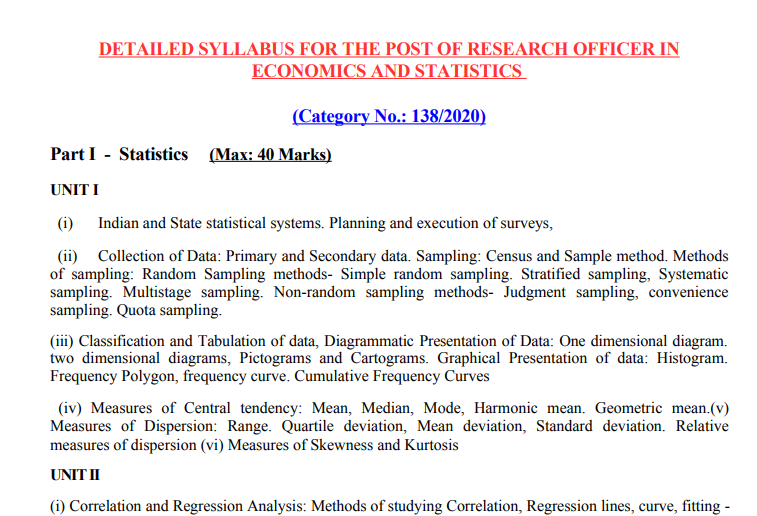
The detailed syllabus and exam pattern for the post of Kerala Public Service Commission (KPSC) Research Officer – Economics & Statistics (Category No. 138/2020), which you can use for preparation for 2026. Note: Always check for the latest notification for any changes.
Kerala PSC Research Officer Exam Pattern 2026
From the official syllabus document for the Research Officer post:
-
The exam is divided into three parts:
-
Part I – Statistics (Max: 40 marks)
-
Part II – Economics (Max: 30 marks)
-
Part III – Mathematics / Quantitative Aptitude (Max: 20 marks)
-
General Knowledge & Current Affairs & Kerala Renaissance (Max: 10 marks)
-
-
Total marks = 100 (40 + 30 + 20 + 10)
-
The mode of paper (objective/descriptive) isn’t explicitly specified in the summary, so check the notification for that.
-
Medium and other details will be given in the notification.
Details Kerala PSC Research Officer Syllabus 2026
Part I – Statistics (40 marks)
Key topics:
-
Indian & State statistical systems; planning and execution of surveys; primary & secondary data collection
-
Sampling methods: simple random, stratified, systematic, multistage; non-random methods like judgement, convenience, quota sampling
-
Classification & tabulation of data; diagrammatic & graphical presentation (histogram, frequency polygon, cumulative frequency curves)
-
Measures of central tendency (mean, median, mode, harmonic mean, geometric mean)
-
Measures of dispersion (range, quartile deviation, mean deviation, standard deviation, relative measures)
-
Measures of skewness and kurtosis
-
Correlation & regression: methods of studying correlation, fitting linear/non-linear curves, multiple correlation & regression, basics of multicollinearity, heteroscedasticity, autocorrelation
-
Optimization: equality & inequality constraints, linear programming (basic)
-
Time-series analysis: trend components, measurement of trend, growth curves
-
Index numbers: methods, CPI etc.
-
Vital statistics: methods for obtaining, fertility rates, birth/death rates, infant mortality, maternal mortality, net migration, etc.
-
Probability: classical & axiomatic definitions, basic theorems, conditional probability, Bayes theorem
-
Random variables: discrete & continuous, expectation
-
Standard distributions: binomial, Poisson, normal (basic concepts)
-
Sampling distributions: t-distribution, chi-square, F-distribution (basic concepts only)
-
Theory of estimation: point & interval estimation for means/proportions/variances
-
Hypothesis testing: large & small samples, proportions, variances; chi-square test of independence & goodness of fit.
Part II – Economics (30 marks)
Key topics:
-
Planning and decentralised planning in India & Kerala; Panchayati Raj; Finance Commissions; fiscal devolution
-
Budget: preparation and execution
-
National income: concepts, methods of calculation, trends & patterns
-
Sectors of Indian economy: primary, secondary, tertiary; structural transformation; state domestic product of Kerala
-
Successes & failures of planning; alternatives to planned development
-
Demographic trends & patterns in India & Kerala
-
Poverty, unemployment & inflation in India: causes, effects; poverty alleviation measures; educated unemployment; manpower planning in Kerala
-
Organised & unorganised sectors in India & Kerala; internal & external migration; employment causation; labour welfare measures; labour market reforms
Part III – Mathematics / Quantitative Aptitude (20 marks)
Key topics:
-
Quantitative aptitude: ratio, proportion, variation; LCM, HCF; laws of exponents; square & cube roots; logarithms; percentages; simple & compound interest; profit & loss; discounts; time & distance; time & work; averages
-
Algebra: number system; integers, rationals, irrationals; set theory; operations on sets; laws of logarithms; linear & quadratic equations & their roots; system of inequalities (two variables)
-
Sequence & series: AP, GP, HP; permutation & combination; binomial theorem
-
Matrices: concepts, order, types, basic operations; determinant; inverse; system of linear equations (Cramer’s rule, matrix inversion)
-
Calculus: functions & relations; limit & continuity; derivative & second-order derivatives; applications (rate of change, maxima/minima, marginal cost/revenue)
-
Integration: basic idea; definite integrals; applications (total revenue / cost)
-
Differential equations: formation & solution of first order ODEs
-
Coordinate geometry: 2-D coordinate system; distance formula; section formula; straight lines; circles; conic sections
-
Basic computer knowledge: OS, MS Office; mathematical/statistical functions in packages (Excel, SPSS)
Part IV – General Knowledge & Current Affairs & Kerala Renaissance (10 marks)
Key topics:
-
General knowledge and current affairs (India & Kerala)
-
Renaissance in Kerala: social & religious reform movements; awakening through literature; women & social change; role of press; major personalities and movements in Kerala history, etc.
Preparation Tips
-
Since this is a specialized post combining statistics, economics, and quantitative aptitude, give balanced attention across all parts – don’t overly focus on only one section.
-
For Part I (Statistics) and Part III (Mathematics), strengthen your fundamentals – these form the backbone of analytical questions.
-
For the economics section, stay current with state, national, and Kerala-specific economic trends.
-
The General Knowledge section may often include Kerala‐specific content (social reform movements, local history) – don’t ignore it.
-
Use previous years’ question papers of KPSC Research Officer (Economics & Statistics) to understand the pattern & difficulty level.
-
Organise a timetable so that you revise and practice each section repeatedly; mock tests and timed practice will help.
-
Keep track of notifications from KPSC in case any changes occur in the pattern/syllabus.
Kerala PSC Research Officer Syllabus PDF
Download Full syllabus by clicking on this link:
Research Officer Syllabus PDF
Books to Cover Kerala PSC Research Officer Syllabus
FAQs
Q1. What is the exam pattern for the Kerala PSC Research Officer exam?
Ans. The Kerala PSC Research Officer exam typically consists of a single written/OMR/online test comprising objective-type questions. The paper covers subjects like Research Methodology, Statistics, Current Affairs, General Knowledge, and questions related to the candidate’s specialization.
Q2. What are the main topics covered under the Research Methodology section?
Ans. The Research Methodology section includes topics like research design, sampling methods, hypothesis testing, qualitative and quantitative research, data collection techniques, and report writing.
Q3. Does the syllabus include general knowledge and current affairs?
Ans. Yes, questions on current affairs, Kerala Renaissance, Indian Constitution, and general science are included to test the candidate’s awareness of the world around them.
Q4. What subjects are included in the core syllabus for Research Officer?
Ans. The core subjects include:
-
Research Methodology
-
Statistics and Data Interpretation
-
Social and Economic Development
-
Kerala Economy and Planning
-
Government Policies and Programmes
-
Analytical and Logical Reasoning
Q5. What is the level of difficulty of the Kerala PSC Research Officer exam?
Ans. The exam is generally of graduate or postgraduate level, depending on the qualification required for the post. Questions test conceptual clarity and analytical ability.
Q6. How can I prepare effectively for the Kerala PSC Research Officer exam?
Ans. Focus on understanding research concepts, revise basic statistics, and keep updated with Kerala’s socio-economic developments. Regularly practice previous-year papers and mock tests.
Q7. Is there any negative marking in the Kerala PSC Research Officer exam?
Ans. Yes, typically 0.33 marks are deducted for each wrong answer, though candidates should check the latest notification for confirmation.
Q8. What are the eligibility qualifications for the Kerala PSC Research Officer post?
Ans. Candidates must hold a Postgraduate degree in Economics, Statistics, or related social science disciplines, depending on the department’s requirements.
Q9. Does the exam include descriptive questions?
Ans. Usually, it is an objective-type examination, but if a descriptive test is conducted, it may include essay-type questions on research and development topics.
Q10. What are the best reference books for the Kerala PSC Research Officer exam?
Ans.
-
Research Methodology by C.R. Kothari
-
Statistical Methods by S.P. Gupta
-
Indian Economy by Ramesh Singh
-
Kerala Economy by B.A. Prakash
-
Kerala PSC General Knowledge question banks and current affairs magazines
About The Author
