
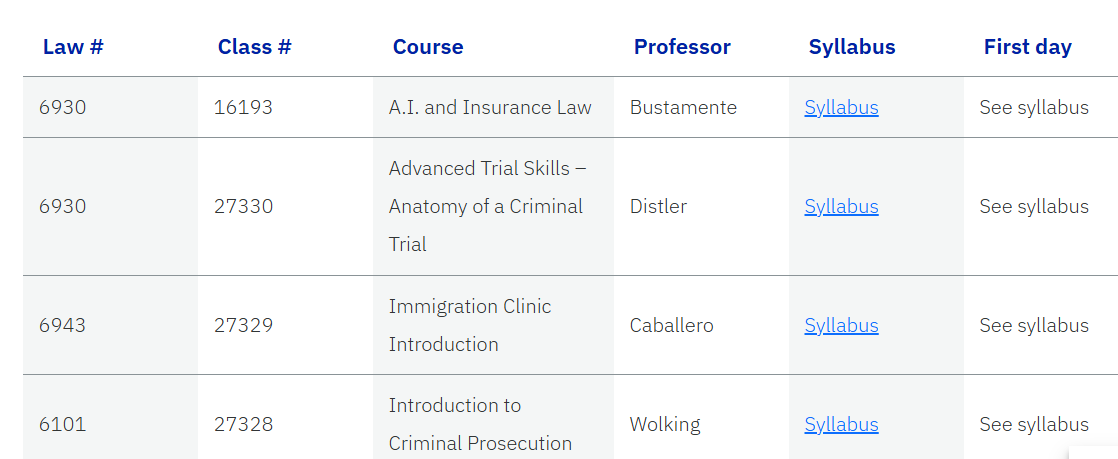
The University of Florida Levin College of Law (UF Law) syllabus/course structure information that’s publicly available for the 2025–2026 academic year, including Spring 2026. Specific detailed syllabi (PDFs with week-by-week topics) are usually published on UF’s site for each course and updated close to the start of the term, but the course listings and categories give a clear picture of what the law curriculum includes.
The official syllabi for specific classes in Spring/Fall 2026 are posted by UF Law as they become available, usually just before the semester starts.
UF Law J.D. Program – Overall Curriculum Structure (2026)
The Juris Doctor (J.D.) at UF is a three-year (full-time) professional law degree. Students complete required foundational courses in the first year and then take upper-level electives, skills courses, and experiential opportunities in the 2L and 3L years.
Typical Sequence by Year / Semester (Guide)
🧑🎓 1L – First Year (Fall & Spring)
Core foundational legal courses required for all JD students:
Fall 1L
-
Contracts (LAW 5000) – typically 4 credits
-
Torts (LAW 5700) – typically 4 credits
-
Legal Research (LAW 5803) – typically 1 credit
-
Legal Writing (LAW 5792) – typically 2 credits
-
Introduction to Lawyering (LAW 5755) – typically 2 credits
Spring 1L
-
Civil Procedure (LAW 5301) – typically 4 credits
-
Constitutional Law (LAW 5501) – typically 4 credits
-
Property (LAW 5400) – typically 4 credits
-
Criminal Law (LAW 5100) – typically 3–4 credits
-
Appellate Advocacy or Legal Writing II (for persuasive writing)* – typically 2–3 credits
Students enrolling after August 2020 take Legal Writing II: Persuasive Writing instead of Appellate Advocacy.
2L – Second Year (Fall & Spring)
After completing 1L, students choose from upper-level electives (examples below). Many students also begin skills/clinics and satisfy additional requirements.
Typical courses include (you choose):
-
Professional Responsibility – required (LAW 6750)
-
Legal Drafting – required practical credit (LAW 6955)
-
Experiential Learning (clinics/externships/simulations)
-
Electives such as:
-
Administrative Law
-
Business Associations
-
Evidence
-
Bankruptcy
-
Antitrust
-
International Human Rights
-
Trial Practice
-
Environmental Law
-
Negotiation
-
Taxation
-
Other seminars & topics based offerings
-
(Actual course offerings vary each semester — UF publishes schedules for Spring 2026 and Fall 2025 which preview many courses likely to appear again in 2026.)
3L – Third Year (Fall & Spring)
In the final year students continue electives, clinics, advanced seminars, and required experiential/legal drafting credits and finish any outstanding degree requirements.
Typical courses include:
-
Upper-level electives in areas like:
-
Constitutional Law theory seminars
-
Health Law
-
Intellectual Property
-
Corporate Taxation
-
Trial Practice
-
Field placements / externships
-
-
Advanced writing seminars to satisfy the Advanced Writing Requirement (e.g., LAW 6936 seminars or equivalent practical writing).
Requirements to Graduate
To earn the J.D. degree at UF, students must:
• Complete all required first-year courses
• Complete upper-level requirements:
-
Legal Drafting
-
Professional Responsibility
-
Experiential credits (clinic, externship, simulation)
-
Advanced writing requirement (seminar, journal article, or course with writing component)
• Complete all required credit hours according to UF Law policy
UF Law (Levin College of Law) Spring 2026 Syllabus Overview
First-Year Required JD Courses
These are typically taken by all full-time JD students in their first year:
-
Civil Procedure
-
Property
-
Torts (multiple sections)
-
Legal Research
-
Legal Writing
-
Introduction to Lawyering
(Syllabi available closer to term start; each includes topics, assignments, and assessment info)
Upper-Level JD Courses
Students in second and third year may take (but are not limited to) the following:
-
Administrative Law
-
Antitrust
-
Bankruptcy
-
Business Associations
-
Complex Civil Litigation
-
Criminal Procedure – Adversary System
-
Accounting for Lawyers
-
Artificial Intelligence, Technology, and the Law
-
Condo & Community Development
(Individual syllabus PDFs list detailed readings & assignments)
Seminars & Advanced Study
Seminars usually require more writing and research:
-
Advanced Constitutional Theory
-
Appellate Law and Policy
-
Constitutional Change
-
Economic, Social, and Cultural Rights
-
Historic Preservation
-
Supreme Court Controversies (topics vary by semester)
Seminars typically involve weekly readings, discussions, and a research paper or major project outlined in the syllabus.
Practice/Skills Courses
These focus on practical, “lawyering” skills:
-
Arbitration Law
-
Electronic Discovery
-
Legal Drafting
-
Negotiation
-
Pre-Trial & Trial Practice sections
(Each skills syllabus details exercises, projects, and evaluation criteria)
MSL (Master of Studies in Law) Courses
For non-JD students, separate syllabi include topics such as:
-
Introduction to Contracts
-
Health Law Survey for Non-Lawyers
-
Introduction to U.S. Legal System (M.S.L.)
-
Professional Communication
-
Incorporated Business for Non-Lawyers (Spring 2026)
Where to Get the Detailed 2026 Syllabi
UF Law maintains a Syllabi page where downloadable PDFs are posted for each course (with reading lists, schedule, grading methods, policies, etc.). You can check directly here:
🔗 UF Levin College of Law — Courses and Syllabi Page
📍 https://law.ufl.edu/academics/courses-and-syllabi
FAQs
1. What information must be included in every UF Law course syllabus?
Every UF course syllabus — including UF Law — must follow the University of Florida syllabus policy, which requires clearly stated details such as:
-
Course title and description
-
Instructor contact information (email, office location, phone)
-
Required and recommended texts
-
Grading methods and evaluation criteria
-
Important academic dates (exams, assignments)
This is part of UF’s general academic policy and applies across all schools including the law college.
2. Are UF Law syllabi publicly available before classes start?
Yes. UF Law posts syllabi online for all enrolled courses prior to the first day of class. Typically:
-
Syllabi are posted at least three days before classes begin each semester.
-
This applies to JD, LLM, and MSL courses.
3. Where can I find the UF Law 2026 course syllabi?
Syllabi are available on the UF Levin College of Law website under Courses & Syllabi. You’ll find syllabi listed by semester, including:
-
Required first-year courses
-
Upper-level electives
-
Skills and practicum courses
-
MSL and LLM offerings
You can also access previous semesters’ syllabi for reference.
4. How is the law course schedule structured?
UF Law follows a semester system with:
-
Fall Semester (usually starting in August)
-
Spring Semester (usually starting in January)
Some courses (like compressed courses) run in intensive shorter blocks early in the term.
5. What type of courses are offered in UF Law?
Common categories include:
-
First-Year Required Courses: e.g., Civil Procedure, Torts, Property, Legal Writing
-
Upper-Level Electives: e.g., Administrative Law, Antitrust, Bankruptcy
-
Skill-Based Courses: Legal Drafting, Negotiation, Trial Practice
-
Specialized & Clinic Courses: Immigration Clinic, Arbitration Law
-
Graduate Levels: LLM and MSL courses with specific professional focus
All are listed with instructor and syllabus links online.
6. Do syllabi list textbooks and reading materials?
Yes — each course syllabus generally lists:
-
Required textbooks
-
Casebooks by edition and ISBN
-
Additional readings (statutes, articles, etc.)
Some instructors also post materials on the Canvas LMS or link to public PDFs.
7. How does grading and assessment information appear in syllabi?
Most law syllabi detail how students are evaluated, including:
-
Weight of midterm and final exams
-
Paper or project grading
-
Participation and class performance
Details vary by course and instructor, so check syllabi for specifics.
8. What policies are typically included in UF Law syllabi?
Syllabi often include or reference:
-
Academic Honesty & UF Honor Code
-
Attendance and participation policies
-
Accommodations for students with disabilities
-
Grading breakdown and exam schedules
These are standardized across UF courses but can also include instructor-specific expectations.
9. Where do law students find key academic dates?
While syllabi list course-specific dates, the UF Law academic calendar provides semester-wide key dates for:
-
Start/End of classes
-
Add/Drop deadlines
-
Exam periods
-
University holidays
This calendar is also posted on the law school website.
10. Do syllabi change once the semester starts?
Syllabi are considered a contract between students and instructors, so major changes are rare. However:
-
Minor scheduling tweaks (assignment date shifts) may occur
-
Instructors usually notify students of changes in class or via Canvas
About The Author
