
The Gujarat Police Constable Syllabus 2026 is an important resource for candidates preparing for recruitment to the Lokrakshak and Police Constable posts. Before beginning preparation, candidates should understand not only the subjects but also the weightage, marking scheme and qualifying requirements of the written examination.
The Gujarat Police Recruitment Board (GPRB) conducts recruitment for different Police Constable/Lokrakshak cadre posts. The current examination rules provide for a selection process that includes a Physical Test followed by an Objective MCQ Test.
Candidates should note that the 2026 recruitment notification should be treated as the final authority if any detail differs from earlier recruitment rules.
Gujarat Police Constable Syllabus 2026: Overview
| Particulars | Details |
|---|---|
| Exam Conducting Body | Gujarat Police Recruitment Board (GPRB) |
| Post | Police Constable/Lokrakshak |
| Examination | Combined Competitive Examination |
| Written Exam | Objective MCQ Test |
| Mode | OMR-based |
| Total Questions | 200 |
| Total Marks | 200 |
| Duration | 3 Hours |
| Parts | Part A and Part B |
| Negative Marking | 0.25 mark for an incorrect attempted answer |
| Qualifying Requirement | Separate qualifying standard for Part A and Part B |
| Selection Stages | Physical Test, Written Test and subsequent recruitment formalities |
The 2024 examination rules, which form the basis of the current Lokrakshak/Police Constable examination structure, specify a 200-question, 200-mark objective test divided into Part A and Part B.
Gujarat Police Constable Exam Pattern 2026
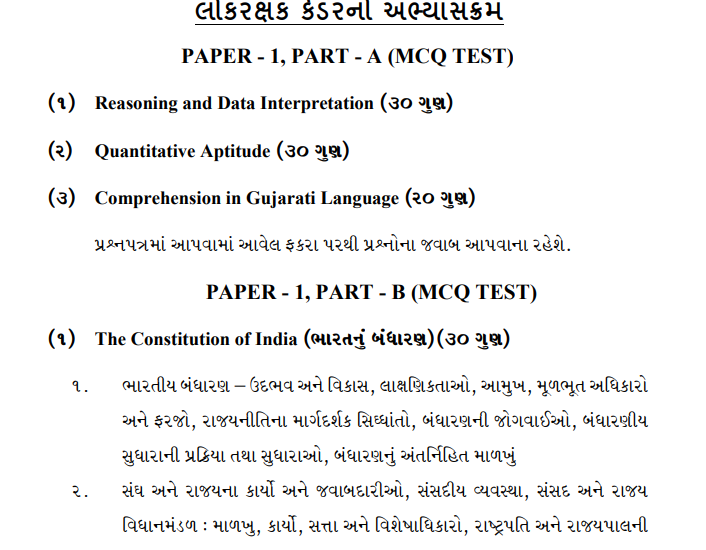
Understanding the exam pattern is just as important as knowing the syllabus. The written examination is divided into two parts, with Part A carrying 80 marks and Part B carrying 120 marks.
| Part | Subject | Questions | Marks |
|---|---|---|---|
| Part A | Reasoning and Data Interpretation | 30 | 30 |
| Quantitative Aptitude | 30 | 30 | |
| Comprehension in Gujarati Language | 20 | 20 | |
| Part A Total | 80 | 80 | |
| Part B | Constitution of India | 30 | 30 |
| Current Affairs, Science & Technology, General Knowledge | 40 | 40 | |
| History, Cultural Heritage & Geography of Gujarat and Bharat | 50 | 50 | |
| Part B Total | 120 | 120 | |
| Grand Total | 200 | 200 |
The examination rules specify one mark for each question and a 0.25-mark deduction for an incorrectly attempted question. An “E”/Not Attempted option is provided, allowing candidates to leave a question unanswered without incurring the negative mark applicable to a wrong attempted answer.
Part A: 80 Marks
Part A tests the candidate’s basic analytical ability, numerical aptitude and Gujarati-language comprehension. It carries 80 marks in total.
- Reasoning and Data Interpretation – 30 marks
- Quantitative Aptitude – 30 marks
- Gujarati Language Comprehension – 20 marks
Candidates should not ignore Part A simply because Part B has a higher overall weightage. The qualifying requirement applies separately to the two parts, making balanced preparation important.
Part B: 120 Marks
Part B carries the largest share of the written examination. It focuses mainly on the Constitution, current affairs, science and technology, general knowledge, and the history, culture and geography of Gujarat and India.
- Constitution of India – 30 marks
- Current Affairs, Science & Technology and General Knowledge – 40 marks
- History, Cultural Heritage and Geography of Gujarat and Bharat – 50 marks
For this reason, candidates should give special attention to Gujarat-specific general knowledge and current affairs while preparing for the examination.
GP Constable Selection Process 2026
The recruitment usually follows these stages:
- Physical Efficiency Test (PET) – Qualifying
- Physical Standard Test (PST) – Qualifying
- Written Examination (Objective MCQ) – Merit-deciding
- Document Verification
- Medical Examination
Only candidates who clear the physical tests are called for the written exam. Final merit is prepared mainly on the basis of written exam marks (plus any additional marks as per rules).
Physical Efficiency Test (PET) – Qualifying Nature
| Category | Distance | Time Limit |
|---|---|---|
| Male | 5000 metres | 25 minutes |
| Female | 1600 metres | 9 minutes 30 seconds |
| Ex-Servicemen | 2400 metres | 12 minutes 30 seconds |
You must complete the run within the given time. This stage is only qualifying — marks are not added to the final merit.
Physical Standard Test (PST)
For Male Candidates:
| Category | Height | Chest (Unexpanded) | Chest (Expanded) |
|---|---|---|---|
| Scheduled Tribe (Gujarat origin) | 162 cm | 79 cm | 84 cm |
| Others | 165 cm | 79 cm | 84 cm |
For Female Candidates:
| Category | Height |
|---|---|
| Scheduled Tribe (Gujarat origin) | 150 cm |
| Others | 155 cm |
(Minimum weight requirements may also apply as per the specific notification. Chest measurement is only for males, with at least 5 cm expansion.)
Gujarat Police Constable Syllabus 2026: Subject-Wise
1. Reasoning and Data Interpretation
The reasoning section evaluates how effectively candidates can understand relationships, identify patterns and reach logical conclusions. Regular practice is useful because many questions can be solved quickly once the basic concepts are clear.
Important areas include:
- Logical reasoning
- Number and alphabet series
- Coding-decoding
- Analogy
- Classification
- Blood relations
- Direction and distance
- Venn diagrams
- Syllogism
- Seating arrangement
- Puzzles
- Data sufficiency
- Data interpretation
- Tables, charts and graphs
- Statement and conclusion
- Statement and assumption
- Ranking and ordering
- Non-verbal reasoning
Candidates should initially focus on accuracy and then gradually improve their solving speed.
2. Quantitative Aptitude
Quantitative Aptitude tests fundamental mathematical concepts and their practical application. The preparation does not require learning extremely advanced mathematics; instead, candidates should develop command over basic arithmetic and calculation.
Major topics include:
- Number system
- HCF and LCM
- Simplification
- Percentage
- Ratio and proportion
- Average
- Profit and loss
- Simple interest
- Compound interest
- Time and work
- Time, speed and distance
- Algebra
- Geometry
- Mensuration
- Trigonometry
- Probability
- Data interpretation
- Basic statistics
Aspirants should maintain a separate formula notebook and revise it regularly.
3. Gujarati Language Comprehension
Gujarati comprehension carries 20 marks in Part A. Candidates should develop the ability to understand passages quickly and identify the correct answer from the information provided.
Preparation should cover:
- Reading comprehension
- Main idea of a passage
- Meaning of words from context
- Vocabulary
- Sentence-based questions
- Interpretation of passages
- Basic Gujarati language understanding
Reading Gujarati newspapers, magazines and quality study material can help improve comprehension speed.
4. Constitution of India
The Constitution section carries 30 marks and is an important component of Part B. Candidates should focus on fundamental constitutional concepts rather than trying to memorise every provision.
Important areas include:
- Historical background of the Constitution
- Preamble
- Fundamental Rights
- Fundamental Duties
- Directive Principles of State Policy
- President
- Vice-President
- Prime Minister and Council of Ministers
- Parliament
- Supreme Court
- High Courts
- Governor
- State Legislature
- Constitutional bodies
- Election Commission
- Emergency provisions
- Centre-State relations
- Constitutional amendments
- Local self-government
Questions may test both factual knowledge and basic understanding of constitutional provisions.
5. Current Affairs, Science & Technology and General Knowledge
This section carries 40 marks, making it one of the major scoring areas of the paper.
Candidates should regularly cover:
Current Affairs
- National events
- International events
- Government schemes
- Important appointments
- Awards and honours
- Sports events
- Important reports and indexes
- Books and authors
- Important days
- Defence developments
- Economic developments
- Science and technology updates
- Gujarat-related current affairs
General Knowledge
- Indian polity
- Indian economy
- General science
- Environment
- Geography
- History
- Important institutions
- National symbols
- Important personalities
Science and Technology
Basic concepts from:
- Physics
- Chemistry
- Biology
- Space technology
- Information technology
- Biotechnology
- Digital technology
- Recent scientific developments
Current affairs preparation should ideally cover the months immediately preceding the examination rather than relying only on static GK books.
6. History, Cultural Heritage and Geography of Gujarat and Bharat
This is the highest-weightage section, carrying 50 marks. Candidates preparing for Gujarat Police Constable recruitment should therefore give considerable attention to Gujarat-specific topics.
Indian History
Important areas include:
- Ancient India
- Medieval India
- Modern India
- Indian freedom movement
- Important historical personalities
- Major movements and events
- British rule in India
- Important historical organisations
Gujarat History
Candidates should study:
- Ancient Gujarat
- Medieval Gujarat
- Gujarat under different dynasties
- Important rulers and historical personalities
- Gujarat’s role in the freedom movement
- Important historical places
- Major social and political movements
Cultural Heritage
Important topics include:
- Folk dances
- Folk music
- Traditional festivals
- Handicrafts
- Art and architecture
- Literature
- Important fairs
- Religious and cultural places
- UNESCO-related heritage
- Famous personalities of Gujarat
Geography of India
- Physical geography
- Rivers
- Mountains
- Climate
- Soils
- Agriculture
- Natural resources
- Industries
- Population
- Transport
- Important geographical locations
Geography of Gujarat
Special attention should be given to:
- Rivers of Gujarat
- Major dams
- Districts
- Major cities
- Climate
- Soil
- Agriculture
- Minerals
- Industries
- Forests and wildlife
- National parks and sanctuaries
- Coastal geography
- Important geographical locations
Gujarat Police Constable Syllabus: Important Topics
1. Reasoning and Data Interpretation (30 Marks)
- Data Interpretation (Tables, Graphs, Charts, Bar, Pie, Line)
- Logical Reasoning
- Data Sufficiency
- Seating Arrangements (Linear, Circular, etc.)
- Syllogism
- Blood Relations
- Direction & Distance
- Venn Diagrams
- Puzzles
- Coding-Decoding
- Input-Output
- Series (Number, Alphabet, Figure)
- Analogy, Classification, Odd One Out
2. Quantitative Aptitude (30 Marks)
- Number System, HCF & LCM
- Simplification & Approximation
- Percentage, Profit & Loss
- Ratio & Proportion
- Average
- Simple Interest & Compound Interest
- Time, Speed & Distance
- Time & Work
- Mensuration (Area, Volume, Perimeter)
- Basic Algebra & Quadratic Equations
- Geometry & Trigonometry (basic level)
- Probability
- Data Interpretation related numerical questions
Focus on Class 10 level concepts. Speed and accuracy matter a lot here.
3. Comprehension in Gujarati Language (20 Marks)
- Reading comprehension passages in Gujarati
- Questions based on the given paragraphs (main idea, vocabulary, inference, etc.)
Regular practice of Gujarati reading and understanding is essential.
4. The Constitution of India (30 Marks)
- Preamble, Citizenship
- Fundamental Rights, Directive Principles of State Policy, Fundamental Duties
- President, Prime Minister, Council of Ministers, Parliament
- Judiciary (Supreme Court, High Courts)
- State Governments, Union Territories
- Emergency Provisions
- Amendment Procedure
- Constitutional & Statutory Bodies
- Panchayati Raj and Local Self-Government
- Basic concepts of Public Administration and Governance
5. Current Affairs, Science & Technology, General Knowledge (40 Marks)
- National & International Current Affairs (last 6–12 months)
- Important events related to Gujarat
- Science in everyday life
- Latest developments in Science & Technology
- Environment, Climate Change, Biodiversity, Pollution
- Government schemes (Central + Gujarat)
- Sports, Awards, Books & Authors, Important Days
- Basic Computer awareness (sometimes included)
6. History, Cultural Heritage and Geography of Gujarat and Bharat (50 Marks)
This is the highest-weightage section in Part B, so give it special attention.
History
- Ancient India (Indus Valley, Vedic Age, Jainism, Buddhism, etc.)
- Medieval India
- Modern India & Freedom Struggle
- History of Gujarat (important dynasties, freedom fighters, social reformers)
Geography
- Physical Geography of India with special focus on Gujarat
- Climate, Soil, Rivers, Crops, Natural Resources
- Biosphere reserves, deserts, major landforms of Gujarat
Cultural Heritage
- Art, Architecture, Literature, Folk Culture of Gujarat
- Festivals, Religions, Social Reform Movements in Gujarat
- Important historical sites and cultural contributions of the state
Gujarat Police Constable Physical Test
The physical stage is designed to assess whether candidates possess the fitness required for police duties. The exact standards, including running requirements and physical measurements, should be checked against the applicable 2026 recruitment notification because requirements can differ by category/post.
Candidates should begin running practice early and gradually increase endurance rather than attempting intense training immediately before the physical test.
Gujarat Police Constable Negative Marking 2026
Negative marking makes intelligent question selection important.
According to the applicable examination rules:
- Each question carries 1 mark.
- A wrong attempted answer attracts a 0.25-mark deduction.
- The examination includes a Not Attempted/“E” option.
- Selecting the Not Attempted option does not attract the negative mark applicable to a wrong attempted answer.
For example, if a candidate answers four questions incorrectly, 1 mark can be deducted in total.
Therefore, candidates should avoid blind guessing, particularly when they have no idea about the correct answer.
How to Prepare for Gujarat Police Constable Exam 2026?
A good preparation strategy does not necessarily mean studying for 10–12 hours every day. Consistency, revision and regular practice are more important.
1. Understand the syllabus first
Print or save the syllabus and divide it into small topics. Mark the areas you already know and identify the topics requiring more attention.
2. Give priority according to marks
Part B carries 120 marks, including 50 marks for Gujarat and India history, culture and geography. Give adequate time to these high-weightage areas while continuing regular practice of Part A.
3. Practise mathematics daily
Even 30–45 minutes of daily numerical practice can make a significant difference. Focus on calculation speed, formulas and frequently repeated question types.
4. Solve reasoning questions regularly
Rather than reading reasoning concepts repeatedly, solve questions. Keep track of the types of questions in which you make mistakes.
5. Follow current affairs consistently
Study current affairs every day and revise them weekly. Last-minute accumulation of current affairs can become difficult to manage.
6. Focus on Gujarat GK
A Gujarat Police recruitment exam naturally makes state-specific knowledge particularly important. Study Gujarat’s history, geography, culture, important places, personalities and current affairs systematically.
7. Take mock tests
Begin with topic-wise tests and later move to complete 200-question mock papers. After each test, analyse incorrect and unattempted questions.
8. Practise with negative marking in mind
Do not measure preparation only by the number of questions attempted. The goal is to maximise correct answers and overall marks.
Gujarat Police Constable Syllabus 2026: Important Topics at a Glance
| Subject | Marks | Priority Areas |
|---|---|---|
| Reasoning & Data Interpretation | 30 | Series, puzzles, coding-decoding, blood relations, DI |
| Quantitative Aptitude | 30 | Percentage, ratio, average, profit-loss, time-work, speed-distance |
| Gujarati Comprehension | 20 | Passages, vocabulary, interpretation |
| Constitution of India | 30 | Fundamental Rights, DPSP, Parliament, President, Judiciary |
| Current Affairs, Science & Technology, GK | 40 | Current events, Gujarat GK, science, schemes, awards |
| History, Cultural Heritage & Geography | 50 | Gujarat history, culture, geography, Indian history and geography |
Gujarat Police Constable Syllabus 2026: Preparation Strategy
Candidates can divide their daily study schedule into four broad sessions:
| Study Area | Suggested Daily Focus |
|---|---|
| Mathematics | Concepts + 25–40 questions |
| Reasoning | Concepts + practice sets |
| GK/Current Affairs | Daily news + revision |
| Gujarat/India History & Geography | Static GK + short notes |
| Constitution | One topic + MCQs |
| Mock Test | Full/sectional test at regular intervals |
Along with written preparation, candidates should maintain a regular physical training routine.
Common Mistakes to Avoid During GP Constable Exam
Many candidates lose valuable marks not because the syllabus is difficult, but because their preparation is poorly organised. Avoid these common mistakes:
- Starting preparation without checking the official syllabus
- Ignoring Gujarat-specific GK
- Studying only current affairs and neglecting static GK
- Avoiding mathematics because it appears difficult
- Taking mock tests without analysing mistakes
- Depending entirely on one source for current affairs
- Ignoring physical preparation
- Guessing too many answers despite negative marking
- Revising only at the end of preparation
Gujarat Police Constable Syllabus 2026 PDF
Candidates should download the syllabus and examination rules from the official Gujarat Police Recruitment Board whenever the relevant 2026 recruitment document is available. The GPRB maintains an official examination-rules section containing rules for the Lokrakshak cadre and other police recruitments.
Gujarat Police Recruitment Board – Examination Rules
Candidates should always compare third-party syllabus summaries with the latest official notification before starting preparation, particularly if a new recruitment advertisement changes the examination structure.
Final Words
The Gujarat Police Constable Syllabus 2026 covers a balanced mix of reasoning, quantitative aptitude, Gujarati comprehension, constitutional knowledge, current affairs, science and technology, general knowledge, and Gujarat/Indian history, culture and geography. The written examination carries 200 marks and is divided into Part A and Part B, with separate qualifying requirements.
The biggest advantage for a candidate is to start preparation with a clear understanding of the weightage. Give extra attention to the 50-mark history, cultural heritage and geography section, while keeping mathematics and reasoning in daily practice. At the same time, do not treat the physical test as a last-minute task. A combination of written preparation, regular revision, mock-test practice and physical fitness will provide a much stronger foundation for the Gujarat Police Constable recruitment process.
FAQs
1. What is the Gujarat Police Constable Syllabus 2026?
The syllabus includes Reasoning and Data Interpretation, Quantitative Aptitude, Gujarati Language Comprehension, Constitution of India, Current Affairs, Science and Technology, General Knowledge, and History, Cultural Heritage and Geography of Gujarat and Bharat.
2. How many marks is the Gujarat Police Constable written exam?
The objective written examination is structured for 200 marks, comprising 80 marks in Part A and 120 marks in Part B.
3. Is there negative marking in the Gujarat Police Constable exam?
Yes. Under the applicable examination rules, an incorrectly attempted question attracts a 0.25-mark deduction. A Not Attempted/“E” option is also provided.
4. Which section carries the highest marks?
History, Cultural Heritage and Geography of Gujarat and Bharat carries the highest individual weightage, with 50 marks.
5. Is Gujarat GK important for the Police Constable exam?
Yes. Gujarat’s history, geography, cultural heritage, and current affairs form a substantial part of the syllabus, so candidates should give them dedicated preparation time.
6. How should I prepare for Gujarat Police Constable 2026?
Start by understanding the official syllabus, divide topics according to marks, practise mathematics and reasoning daily, revise Gujarat and India GK, follow current affairs, take mock tests and simultaneously prepare for the physical stage.
7. Where can I check the official Gujarat Police Constable syllabus?
Candidates should refer to the official Gujarat Police Recruitment Board’s examination-rules and recruitment notifications for the latest applicable syllabus and exam pattern.
About The Author
