
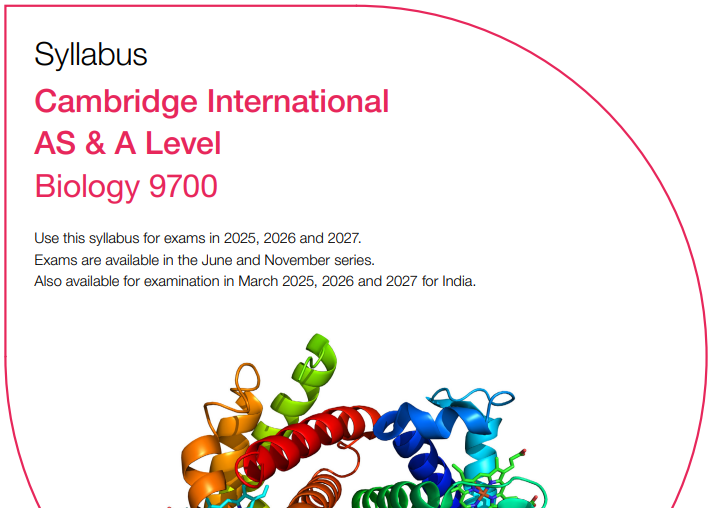
Cambridge International AS & A Level Biology (9700) is an internationally recognised qualification designed by Cambridge Assessment International Education (CAIE) for students typically aged 16–19. The syllabus builds a deep conceptual understanding of biological principles, encourages scientific inquiry, and prepares students for higher education in biology, medicine, and related fields.
9700 Syllabus: Overview of Cambridge International AS & A Level Biology Syllabus
| Topic No. | Topic Title | Level | Sub-topics / Key Concepts (Indicative) |
|---|---|---|---|
| 1 | Cell structure | AS & A | Microscopy; prokaryotic and eukaryotic cells; organelles and functions. |
| 2 | Biological molecules | AS & A | Carbohydrates, lipids, proteins, water; tests for biomolecules. |
| 3 | Enzymes | AS & A | Mode of action; factors affecting enzyme action. |
| 4 | Cell membranes and transport | AS & A | Fluid mosaic model; diffusion, osmosis, active transport. |
| 5 | The mitotic cell cycle | AS & A | DNA replication; mitosis stages. |
| 6 | Nucleic acids and protein synthesis | AS & A | DNA/RNA structure; replication; protein synthesis. |
| 7 | Transport in plants | AS & A | Xylem/phloem structure; transpiration; translocation. |
| 8 | Transport in mammals | AS & A | Circulatory system; heart; blood vessels; gas transport. |
| 9 | Gas exchange | AS & A | Structure of gas exchange systems; ventilation; diffusion. |
| 10 | Infectious diseases | AS & A | Pathogens; transmission; antibiotics. |
| 11 | Immunity | AS & A | Immune response; antibodies; vaccination. |
| 12 | Energy and respiration | A only | ATP; aerobic and anaerobic respiration. |
| 13 | Photosynthesis | A only | Light reactions; limiting factors; energy transfer. |
| 14 | Homeostasis | A only | Regulation in mammals and plants. |
| 15 | Control and coordination | A only | Nervous and hormonal coordination; plant responses. |
| 16 | Inheritance | A only | Genes, alleles, phenotype, genetic control. |
| 17 | Selection and evolution | A only | Natural & artificial selection; speciation. |
| 18 | Classification, biodiversity & conservation | A only | Taxonomy; ecosystems; conservation principles. |
| 19 | Genetic technology | A only | Genetic engineering; applications in medicine & agriculture. |
9700 Syllabus Structure
The syllabus is split into two progressive levels:
AS Level
This covers the first half of the Biology course and includes foundational topics essential for understanding life processes.
A Level (Full Course)
Includes all AS topics plus additional advanced topics that extend understanding to more complex biological concepts and real-world applications.
AS Level Biology (Topics 1–11)
These topics build the core biological knowledge and practical skills:
1. Cell Structure
-
Explores the structure and function of cells — the basic units of life.
-
Microscopy skills, differences between prokaryotic and eukaryotic cells, organelles, and ultrastructure.
2. Biological Molecules
-
Focus on carbohydrates, lipids, proteins, and their roles in living organisms.
-
Understand how molecular structure relates to biological function.
3. Enzymes
-
Study how enzymes act as biological catalysts.
-
Factors affecting enzyme activity and enzyme kinetics.
4. Cell Membranes and Transport
-
Membrane structure, diffusion, osmosis, and active transport.
-
Importance of membranes in nutrient, gas, and ion movement.
5. The Mitotic Cell Cycle
-
Cell division, stages of mitosis, and significance in growth and repair.
6. Nucleic Acids and Protein Synthesis
-
Structure and function of DNA and RNA.
-
Gene transcription and translation processes.
7. Transport in Plants
-
How water, minerals, and nutrients move in vascular plants.
-
Transpiration, xylem, phloem, and root pressure.
8. Transport in Mammals
-
Circulatory system structure and function.
-
The heart, blood vessels, and blood components.
9. Gas Exchange
-
Respiratory systems in humans and other organisms.
-
Mechanisms of breathing and gas transport.
10. Infectious Diseases
-
Pathogens and disease transmission.
-
Immune responses and disease control.
11. Immunity
-
Body’s defense mechanisms — innate and adaptive immunity.
-
Antibodies, vaccination, and immune system function.
A Level Biology (Topics 12–19)
After completing AS content, A Level candidates extend their understanding with deeper biological concepts:
12. Energy and Respiration
-
Cellular respiration as an energy-releasing process.
-
Aerobic and anaerobic respiration pathways.
13. Photosynthesis
-
Light-dependent and light-independent reactions.
-
Factors affecting photosynthesis and its ecological importance.
14. Homeostasis
-
Maintaining internal stability (e.g., temperature, blood glucose) in organisms.
-
Regulatory mechanisms and feedback control.
15. Control and Coordination
-
Nervous system, hormones, and plant responses.
-
Signal transmission and coordination in complex organisms.
16. Inheritance
-
Genetic information flow from parents to offspring.
-
Mendelian genetics, chromosomal basis of inheritance.
17. Selection and Evolution
-
Natural and artificial selection.
-
Mechanisms of evolution, speciation, and adaptation.
18. Classification, Biodiversity and Conservation
-
Taxonomy, phylogeny, and the importance of biodiversity.
-
Conservation strategies and ecological significance.
19. Genetic Technology
-
DNA technology applications — from medicine to agriculture.
-
Ethical considerations of biotechnology.
Practical Skills and Assessment
Practical Skills
-
Students must develop hands-on skills through laboratory work.
-
Practical lessons integrate into teaching and help with Paper 3 (AS) and A Level practical papers.
Assessment Structure
Assessments are designed to test both knowledge and scientific practice:
AS Level
-
Paper 1: Multiple Choice
-
Paper 2: Structured Short and Long Answers
-
Paper 3: Practical Test
A Level
In addition to AS papers:
-
Paper 4: A Level Structured Questions
-
Paper 5: Planning, Analysis, and Evaluation
Students are assessed on their theoretical knowledge and application, including data interpretation and experimental design.
9700 Syllabus PDF Official
Get free PDF of the 9700 Syllabus by clicking on the link. 9700 Syllabus-2025-2027 Biology
Source: https://www.cambridgeinternational.org/
Why 9700 Syllabus Is Important
Global Recognition
Cambridge International AS & A Level Biology is accepted by universities worldwide and valued for its scientific rigor and relevance.
Deep Conceptual Understanding
The course goes beyond memorisation — it builds the ability to apply biological concepts in novel contexts.
Preparation for University
Students develop analytical thinking, practical skills, and research competencies, essential for higher studies in biology, medicine, biotechnology, ecology, and related fields.
Study Tips for Success
-
Focus on concepts not just definitions.
-
Practice past papers to understand question styles and examiner expectations.
-
Develop practical skills; practical exams are a key component.
-
Create summary notes and diagrams for each topic.
9700 Syllabus: FAQs
1. What is the Cambridge 9700 Biology syllabus?
The Cambridge International AS & A Level Biology (9700) syllabus is an advanced biology qualification that builds on IGCSE/Foundation concepts and prepares students with deeper biological understanding, practical skills and analytical abilities useful for university or science careers.
2. What topics and structure does the syllabus cover?
Cambridge Biology covers major biological themes such as:
-
Cell structure and function
-
Biological molecules
-
Enzymes
-
Transport in organisms
-
Genetics and evolution
-
Energy, respiration and photosynthesis
-
Homeostasis and coordination
-
Biodiversity and conservation
The course is structured for both AS Level and A Level (full A2) depth, with the AS content forming the foundation.
3. How is Cambridge Biology assessed?
Assessment includes:
-
Multiple-Choice Paper
-
Structured Written Paper(s)
-
Advanced Practical Skills Paper
-
Planning, Analysis & Evaluation Paper
The practical skills are taken seriously and assessed separately as part of the qualification.
4. Why are practicals important in 9700 Biology?
The syllabus emphasizes practical and investigative science skills. Practical assessments may include advanced experiments, use of laboratory equipment (like microscopes), and data analysis. Practical skills are assessed in timetabled practical exams under controlled conditions.
5. Is there a difference between AS and A Level content?
Yes.
-
AS Level includes foundational topics and assessments up to a certain depth.
-
A Level includes all AS topics plus deeper content and additional paper(s) to give the full qualification.
Typically, understanding the AS content thoroughly helps before tackling the full A Level specification.
6. Where do I get the official syllabus and specimen papers?
Cambridge provides the official syllabus PDFs, specimen papers and past papers on its programme page and through official downloads. These show detailed content, assessment formats, examiner guidance, command words and practical requirements.
7. Are there endorsed textbooks or resources?
Yes. Cambridge endorses several books like Cambridge University Press coursebooks and other student/teacher resources to support this syllabus. These brochures offer structured learning and examples.
8. Can private candidates take the practical exams?
Yes, but centres must support access to practical assessments. Cambridge’s FAQ section answers how private candidates can be entered or what alternatives exist.
9. Where can I find support for practical exams?
FAQs on the Cambridge International support portal address practical delivery, equipment supplies (like prepared slides and chemicals), and practical organisation protocols.
10. Do I have to memorize mathematical formulae or statistics?
Some mathematical calculations and use of statistics form part of the syllabus; the official syllabus document outlines how maths is integrated.
11. Will universities accept Cambridge A Level Biology?
Yes — the Cambridge International A Level Biology qualification is widely recognised by universities worldwide for entry into undergraduate science and related courses. Specific university requirements vary by institution but the qualification is generally considered robust for academic progression.
12. Where can I practice past papers?
Cambridge provides past papers and marking schemes through its official site. These are crucial for familiarising yourself with question styles, time management, and command terms.
13. What’s the difference between key command words like “state”, “suggest”, “compare”?
Cambridge’s FAQ defines various command words used in exam questions — understanding these helps you tailor answers correctly (e.g., “state” vs. “suggest”).
About The Author
