US Grade 3 ELA Curriculum 2026–27: The 2026–27 school year marks a period of significant evolution for English Language Arts (ELA) education across the United States. At the third-grade level—a pivotal year when students transition from “learning to read” to “reading to learn”—the curriculum is increasingly shaped by the Science of Reading and a renewed focus on knowledge-building. While the national Common Core State Standards (CCSS) remain a foundational blueprint for many states, a wave of updated state-specific standards is being implemented, each with its own nuances and emphases.
The US Grade 3 English Language Arts (ELA) Curriculum 2026–27 is designed to strengthen students’ foundational literacy skills while helping them transition into more independent readers and writers. At this stage, learners move beyond basic decoding and begin to analyze texts, express ideas clearly, and develop structured writing skills.
The curriculum is largely aligned with Common Core State Standards (CCSS) and updated state frameworks (2026 revisions), ensuring a balanced approach to reading, writing, speaking, and language development.
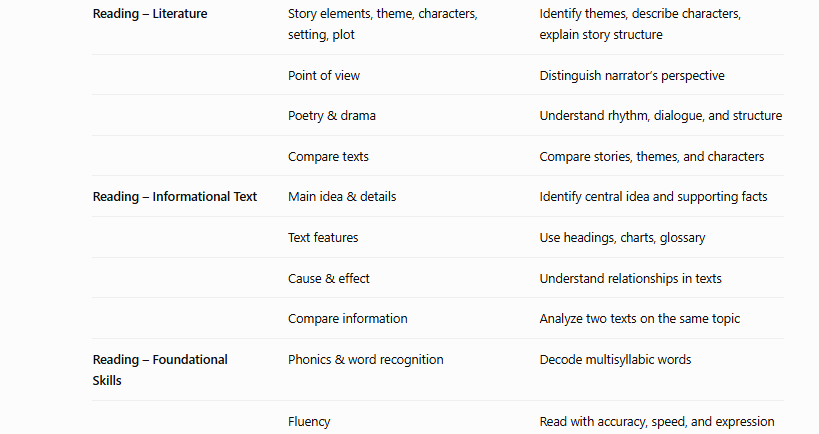
US Grade 3 ELA Curriculum 2026–27
| Strand | Key Topics / Standards | Learning Outcomes / Skills |
|---|---|---|
| Reading – Literature | Story elements, theme, characters, setting, plot | Identify themes, describe characters, explain story structure |
| Point of view | Distinguish narrator’s perspective | |
| Poetry & drama | Understand rhythm, dialogue, and structure | |
| Compare texts | Compare stories, themes, and characters | |
| Reading – Informational Text | Main idea & details | Identify central idea and supporting facts |
| Text features | Use headings, charts, glossary | |
| Cause & effect | Understand relationships in texts | |
| Compare information | Analyze two texts on the same topic | |
| Reading – Foundational Skills | Phonics & word recognition | Decode multisyllabic words |
| Fluency | Read with accuracy, speed, and expression | |
| Sight vocabulary | Improve automatic word recognition | |
| Writing | Narrative writing | Write stories with clear sequence and details |
| Informative writing | Write explanatory texts with facts | |
| Opinion writing | Express opinions with reasons | |
| Writing process | Plan, draft, revise, edit, publish | |
| Research skills | Conduct short research projects | |
| Language (Grammar & Usage) | Parts of speech | Use nouns, verbs, adjectives, adverbs correctly |
| Sentence structure | Write simple, compound, complex sentences | |
| Verb tenses | Use past, present, future forms correctly | |
| Plurals & pronouns | Apply correct grammar usage | |
| Language (Vocabulary) | Word meanings | Use context clues, prefixes, suffixes |
| Synonyms/antonyms | Understand word relationships | |
| Academic vocabulary | Use grade-appropriate words | |
| Dictionary skills | Use reference tools for meaning/spelling | |
| Speaking & Listening | Discussions | Participate in group discussions |
| Listening skills | Ask/answer questions, follow instructions | |
| Presentation | Present ideas clearly with details | |
| Collaboration | Work effectively in groups | |
| Cross-Curricular Literacy | Reading across subjects | Apply reading skills in science/social studies |
| Critical thinking | Analyze and interpret information | |
| Media literacy | Understand visuals and multimedia texts |
Highlights of Grade 3 ELA
- Focus shifts from “learning to read” → “reading to learn”
- Strong emphasis on comprehension, vocabulary, and structured writing
- Introduction to multi-paragraph writing and research basics
- Development of grammar accuracy and communication skills
Curriculum Structure (Typical US Schools)
- Daily ELA Block: ~90–120 minutes
- Balanced Literacy Approach:
- Reading Workshop
- Writing Workshop
- Phonics & Vocabulary
- Speaking & Listening Activities
Key Learning Objectives
By the end of Grade 3, students are expected to:
- Read and comprehend grade-level texts independently
- Identify main ideas, themes, and key details
- Write organized paragraphs (opinion, narrative, and informative)
- Use correct grammar, punctuation, and spelling
- Participate in discussions and present ideas clearly
- Build vocabulary using context clues and word analysis
Curriculum Structure (Strands Overview)
| Strand | Focus Area | Skills Developed |
|---|---|---|
| Reading Literature | Stories, poems, drama | Theme, characters, plot, moral |
| Reading Informational Text | Non-fiction texts | Main idea, facts, text features |
| Foundational Skills | Phonics & fluency | Decoding, word recognition |
| Writing | Composition | Opinion, narrative, and informative writing |
| Speaking & Listening | Communication | Discussion, presentation |
| Language | Grammar & vocabulary | Sentence structure, word usage |
1. Reading Literature (RL)
Students engage with stories, fables, folktales, and poems to understand deeper meanings.
Key Topics:
- Asking and answering questions from texts
- Identifying theme, moral, and lesson
- Character analysis (traits, actions, motivations)
- Understanding story structure (beginning–middle–end)
- Comparing stories by same author
Students learn to refer directly to text for answers and explanations.
2. Reading Informational Text (RI)
Focus shifts to understanding factual texts such as articles, biographies, and reports.
Key Topics:
- Identifying the main idea and supporting details
- Understanding headings, diagrams, and charts
- Comparing two texts on the same topic
- Understanding cause-effect and sequence
Emphasis is on evidence-based comprehension and analysis.
3. Foundational Skills (RF)
This strand strengthens reading fluency and decoding skills.
Key Topics:
- Prefixes, suffixes, and root words
- Multisyllabic word decoding
- Reading irregular words
- Fluency (speed, accuracy, expression)
Students read grade-level texts with purpose and understanding.
4. Writing (W)
Writing becomes more structured and purposeful in Grade 3.
Types of Writing:
| Type | Description |
| Opinion Writing | Express views with reasons |
| Informative Writing | Explain topics with facts |
| Narrative Writing | Write stories with sequence and details |
Writing Process:
- Planning → Drafting → Revising → Editing → Publishing
Students learn to support opinions with reasons and use linking words.
5. Speaking & Listening (SL)
Communication skills are developed through collaboration and presentations.
Key Skills:
- Participating in group discussions
- Listening actively and responding appropriately
- Asking and answering questions
- Presenting information with clarity
Students build confidence in expressing ideas and collaborating with peers.
6. Language (L)
This strand focuses on grammar, vocabulary, and conventions of English.
Grammar & Usage:
- Parts of speech (noun, verb, adjective, etc.)
- Verb tenses (past, present, future)
- Subject-verb agreement
- Sentence types (simple, compound, complex)
Mechanics:
- Capitalization and punctuation
- Spelling patterns and word families
- Use of commas and quotation marks
Vocabulary:
- Context clues
- Prefixes and suffixes
- Synonyms, antonyms, shades of meaning
Students demonstrate command over grammar and vocabulary usage.
Assessment & Evaluation
Assessment Types:
- Reading comprehension tests
- Writing assignments and projects
- Oral presentations
- Vocabulary quizzes
- Classroom participation
Performance Indicators:
- Ability to explain ideas with evidence
- Clarity in writing and speaking
- Fluency in reading
- Correct use of grammar and vocabulary
Suggested Yearly Learning Plan
| Term | Focus Areas |
| Term 1 | Phonics, basic reading comprehension, sentence writing |
| Term 2 | Paragraph writing, vocabulary building, story analysis |
| Term 3 | Advanced comprehension, essay writing, presentations |
Skills Developed by the End of Grade 3
- Independent reading and comprehension
- Logical thinking and text analysis
- Creative and structured writing
- Effective communication
- Strong vocabulary and grammar foundation
The National Foundation: Common Core State Standards (CCSS)
For most states, the Grade 3 ELA curriculum is anchored in the Common Core State Standards. These standards are organized into four major strands: Reading (Literature, Informational Text, and Foundational Skills), Writing, Speaking and Listening, and Language. Third grade is characterized by a rapid expansion of literacy skills, moving students towards more independent and analytical engagement with text.
Foundational Skills: A Sharp Focus on Decoding and Fluency
In 2026–27, the teaching of foundational skills is perhaps more prominent than ever, heavily influenced by the Science of Reading. The standards emphasize that students in Grade 3 must:
-
Know and apply grade-level phonics and word analysis skills: This involves decoding multi-syllable words, understanding common prefixes (e.g., *un-*, *re-*), and derivational suffixes (e.g., -ful, -less) .
-
Read with sufficient accuracy and fluency: Students are expected to read on-level text with purpose, understanding, and appropriate expression. The goal is for fluent reading to support comprehension, with students using context to self-correct and reread as needed .
Reading Literature and Informational Text
The reading standards for Grade 3 push students toward deeper comprehension and more complex text structures.
-
Key Ideas and Details: Students are expected to ask and answer questions by referring explicitly to the text, recount stories and determine the central message or moral, and describe characters by explaining how their actions contribute to the sequence of events . They also learn to determine the main idea of an informational text and recount the key details that support it .
-
Craft and Structure: A major focus is on distinguishing literal from non-literal language, such as idioms and figurative speech. Students also learn to distinguish their own point of view from that of the narrator or characters.
-
Integration of Knowledge and Ideas: This is a key area for 2026–27. Students are challenged to compare and contrast the most important points and key details presented in two texts on the same topic. They also analyze how illustrations contribute to the meaning, mood, or setting of a story.
Writing: From Opinion to Narrative
Third-grade writing expectations are comprehensive, requiring students to write in three major text types:
-
Opinion Writing: Students introduce a topic, state an opinion, and create an organizational structure that lists reasons to support their opinion. They are taught to use linking words and provide a concluding statement.
-
Informative/Explanatory Writing: Students examine a topic and convey ideas clearly by introducing a topic, grouping related information, and developing it with facts, definitions, and details.
-
Narrative Writing: Students develop real or imagined experiences by establishing a situation, introducing a narrator or characters, and using dialogue and descriptions to show the response of characters to events.
State-Level Implementations and Shifts for 2026–27
While the CCSS provides the backbone, many states have adopted revised standards, with the 2026–27 school year being a key implementation milestone.
Georgia: The New Standards of Excellence (GSE)
Georgia is implementing its 2025-2026 Georgia Standards of Excellence (GSE) for Grade 3 . The new curriculum is designed with specific domains and “Big Ideas,” moving away from a simple list of skills to a more integrated approach.
-
Structured Domains: The curriculum map for Georgia divides instruction into domains such as Foundations (Phonics, Fluency, Handwriting), Language (Grammar, Vocabulary), and a domain for Practices which emphasizes the relationship between reading and writing. These practices include “Engagement and Intention for Comprehension and Composition,” “Situating Texts,” and “Author’s Craft,” focusing on higher-level thinking and active text production.
-
Cursive Handwriting and Digital Skills: Notably, the new GSE includes standards for handwriting, specifying expectations for cursive writing, a skill that has seen a resurgence in many state standards.
Iowa: Revised ELA Standards
Iowa is in its first full year of implementing revised ELA standards adopted in mid-2024. A significant change is the reintroduction of cursive handwriting, which must be taught by the end of third grade. The revisions also emphasize complex texts, evidence-based writing, and literacy integration across all subjects, aligning with the Science of Reading framework.
North Carolina: Content-Rich Units
In North Carolina, the third-grade ELA curriculum is often organized into thematic modules. For instance, students might begin the year with a module on “The Sea,” where they analyze literature and informational texts about ocean life. Later in the year, they move to “Outer Space” and then “A New Home,” which explores the history and experiences of immigration. This knowledge-building approach ensures that reading and writing skills are taught within engaging, content-rich contexts.
Curriculum Models and Instructional Approaches
To deliver these standards, schools are adopting specific curricula and instructional models.
-
Knowledge-Building Curricula: Programs like Benchmark Advance ©2026, a comprehensive core program for K-5, are gaining traction. This program is “rooted in and responsive to science of reading research” and organizes instruction into ten three-week units that build knowledge across science and social studies content. The program’s explicit instruction covers phonemic awareness, phonics, fluency, vocabulary, comprehension, and writing in a spiraling scope and sequence.
-
Balanced Literacy Models: Other classrooms continue to use workshop models, such as The Daily 5 and CAFE. This approach focuses on building student stamina in reading and writing through routines like “Read to Self,” “Work on Writing,” and “Word Work,” allowing for differentiated instruction and reading conferences.
Conclusion
The US Grade 3 ELA curriculum for the 2026–27 school year is a dynamic blend of rigorous national standards and state-level innovation. The overarching trend is a move toward explicit, systematic instruction in foundational skills coupled with content-rich, knowledge-building units. Students are no longer just learning to read; they are using their reading, writing, speaking, and listening skills to explore complex topics, compare and contrast information, and express their own ideas with clarity and evidence. With states like Georgia, Iowa, and others implementing new standards, the 2026–27 school year represents a pivotal moment in shaping how young learners become proficient, critical, and engaged readers and writers.
About The Author
