
The Madhya Pradesh Employees Selection Board (MPESB) has officially announced the recruitment for 2,784 Agriculture Extension Officer (AEO) posts under Group-2, Sub-Group-1 . The online examination is scheduled to commence from August 2, 2026 . This comprehensive guide provides the detailed MPESB Agriculture Extension Officer Syllabus 2026 and exam pattern to help you structure your preparation effectively.
MPESB Agriculture Extension Officer Exam 2026: overview
| Particulars | Details |
|---|---|
| Conducting Body | Madhya Pradesh Employees Selection Board (MPESB), Bhopal |
| Post Name | Agriculture Extension Officer (AEO) / Rural Agriculture Extension Officer (RAEO) |
| Total Vacancies | 2,784 |
| Application Dates | July 3, 2026 to July 17, 2026 |
| Exam Date | From August 2, 2026 onwards |
| Exam Mode | Online Computer-Based Test |
| Selection Process | Written Exam + Document Verification |
MPESB Agriculture Extension Officer Exam Pattern 2026
Understanding the exam pattern is the first step toward strategic preparation. The exam consists of a single paper divided into two sections, with objective-type multiple-choice questions.
Key Highlights
| Feature | Details |
|---|---|
| Total Questions | 200 |
| Total Marks | 200 |
| Time Duration | 3 Hours (combined for both sections) |
| Question Type | Objective Multiple Choice Questions (MCQs) |
| Marking Scheme | +1 mark for each correct answer |
| Negative Marking | 0.25 marks deducted for each incorrect answer |
| Minimum Qualifying Marks (UR) | 50% |
| Minimum Qualifying Marks (Reserved) | 40% (SC/ST/OBC/PwD) |
Section-Wise Exam Pattern
| Section | Subjects | Questions | Marks |
|---|---|---|---|
| Section A | General Knowledge, Hindi, English, Mathematics, Logical Ability, Science, Computer Knowledge | 100 | 100 |
| Section B | Subject-Specific Agriculture (Concerned Subject) | 100 | 100 |
| Total | 200 | 200 |
Source:
Note: Some sources indicate the exam may be conducted as two separate papers of 2 hours each, totaling 4 hours . Candidates are advised to refer to the official notification for confirmation.
Detailed Syllabus for MPESB Agriculture Extension Officer 2026
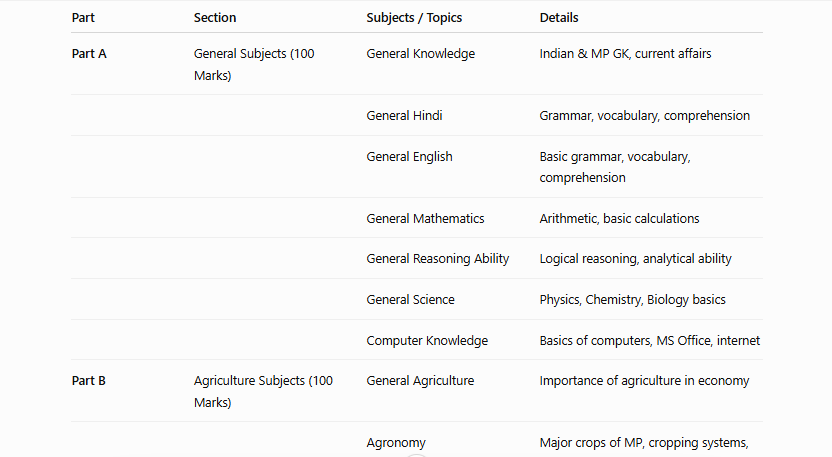
The syllabus is divided into two parts. Candidates must prepare both General Subjects and Agriculture-specific topics thoroughly.
Section A: General Subjects (100 Questions, 100 Marks)
This section tests your foundational knowledge and aptitude across seven subjects.
1. General Knowledge
Focus on both national and state-level topics, with an emphasis on Madhya Pradesh:
-
Madhya Pradesh Specific: Major rivers, National Parks & Wildlife Sanctuaries, Tourist Places & Historical Sites, Irrigation planning, Major personalities (Political, Social, Cultural)
-
National & International: Current events, Indian History, Indian Constitution, Indian Polity, Geography, Environment, Sports, Awards & Honours, Books & Authors, Important Days
2. General Hindi
-
समानार्थी और विलोम शब्द (Synonyms & Antonyms)
-
वाक्य सुधार (Sentence Correction)
-
मुहावरे और वाक्यांश (Idioms & Phrases)
-
एक शब्द प्रतिस्थापन (One Word Substitution)
-
शब्द निर्माण (Word Formation)
-
भाव पल्लवन आधारित प्रश्न
-
अनुवाद-आधारित प्रश्न
-
रिक्त स्थान पूर्ति (Fill in the Blanks)
3. General English
-
Reading Comprehension
-
Spot the Error / Error Detection
-
Fill in the Blanks
-
Cloze Passage
-
Synonyms & Antonyms
-
One Word Substitution
-
Sentence Improvement
-
Active/Passive Voice
-
Direct & Indirect Speech
-
Idioms & Phrases
-
Jumbled Sentences
4. General Mathematics
-
Percentage
-
Simplification
-
Average
-
Profit & Loss
-
Time & Work
-
Simple & Compound Interest
-
Time, Speed & Distance
-
Problem on Ages
-
HCF & LCM
-
Area, Volume & Mensuration
-
Data Interpretation (Bar Graph, Pie Chart, Pictorial Graph)
5. Logical Ability / General Reasoning
-
Analogy
-
Coding-Decoding
-
Number & Non-verbal Series
-
Syllogistic Reasoning
-
Arithmetic Reasoning
-
Problem Solving & Decision Making
-
Similarities & Differences
-
Blood Relations
-
Direction Sense
-
Statement & Conclusion
-
Puzzles & Seating Arrangement
-
Classification (Verbal & Figure)
6. General Science
-
Physics: Laws of Motion, Gravitation, Refraction & Reflection, Weight & Mass
-
Chemistry: Chemical Reactions, Acids, Bases & Salts, Metals & Non-metals, Chemical Formula Balancing
-
Biology: Human Body Structure, Diseases & Symptoms, Nutrition, Bacteria & Viruses
7. Computer Knowledge
-
Computer Fundamentals
-
Operating System (MS-Windows)
-
MS Office: MS-Word, MS-Excel, MS-PowerPoint
-
Internet Usage & Services
-
Communication Technology
-
Networking Concepts
-
E-mail & Cyber Security
Section B: Agriculture Subject (100 Questions, 100 Marks)
This section assesses your in-depth knowledge of agriculture and related sciences. It is the most critical section for securing a high rank.
| Unit | Topic | Key Sub-Topics |
|---|---|---|
| 1 | General Agriculture | Agriculture and its importance in the national economy |
| 2 | Agronomy | Major crops of MP, Agrotechniques of major field crops, Farming systems and sustainable agriculture, Introductory Agro Meteorology, Agro-climatic and Agro-ecological zones |
| 3 | Soil Science | Soil composition and its role in crop production, Physical, Chemical & Biological properties of soil, Essential plant nutrients (function & dynamics), Integrated Nutrient Management (INM), Problem soils and their management |
| 4 | Soil & Water Conservation / Watershed Management | Soil erosion and control measures, Water conservation techniques, Watershed management concepts, Rainwater harvesting, Sustainable water use in agriculture |
| 5 | Plant Physiology | Absorption, translocation and metabolism of nutrients, Photosynthesis and respiration, Growth and development, Growth regulators |
| 6 | Crop Improvement | Elements of genetics and plant breeding as applied to crop improvement |
| 7 | Horticulture | Package of practices for important fruits, vegetables, spices & flowering plants, Nursery management and propagation methods, Problems (unfruitfulness, alternate bearing, fruit drops) and physiological disorders, Post-harvest management and value addition |
| 8 | Plant Protection | Important insect pests and diseases affecting crops, Integrated Pest Management (IPM), Integrated Disease Management (IDM), Spray equipment (selection & maintenance), Rodent management, Safety precautions during pesticide usage |
| 9 | Agricultural Economics | Principles of economics as applied to agriculture, Farm planning and resource management, Farming systems and their economic role, Marketing of agricultural produce, Regulated markets in MP (including e-chaupal initiatives), Price of agricultural produce |
| 10 | Agricultural Extension Education | Philosophy, objectives and principles of extension, Extension organizations at state/district/block levels (structure, functions, responsibilities), Methods of communication, Role of farmers’ organizations, Role and importance of training, Important rural development programmes in India |
Preparation Strategy
-
Prioritize Section B: With 100 marks dedicated to agriculture, focus significantly on this section. Study agronomy, soil science, horticulture, and plant protection in depth, with special attention to MP-specific crops and practices .
-
Master MP GK: General Knowledge heavily emphasizes Madhya Pradesh—rivers, national parks, personalities, and irrigation projects .
-
Practice Data Interpretation: Mathematics includes graphs and charts; regular practice is essential .
-
Solve Mock Tests: Familiarize yourself with the 3-hour duration and negative marking pattern .
-
Refer to Official Notification: The most authoritative syllabus will be in the official rulebook available.
About The Author
