
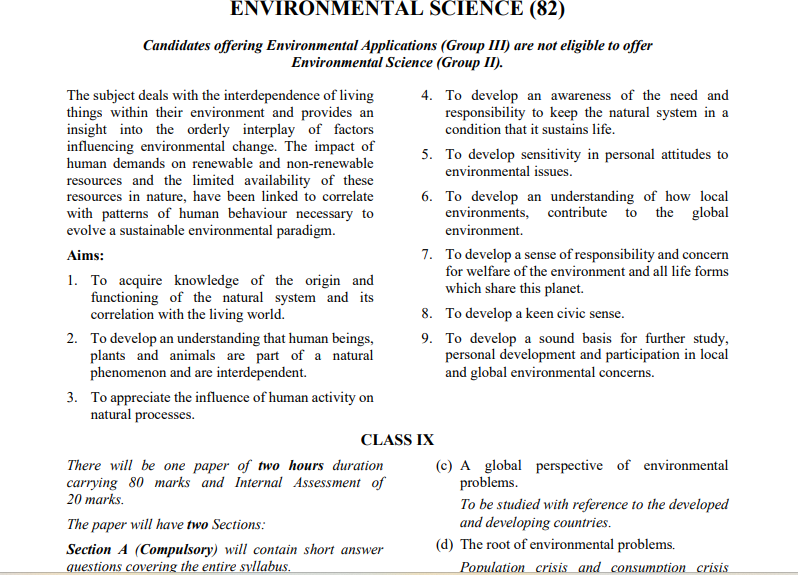
ICSE Class 10 Environmental Science Syllabus 2026-27: The ICSE Class 10 Environmental Science syllabus covers 10 core units. Students study Controlling Air Pollution (sources and mitigation from homes, industries, vehicles), Population and environmental impact, Urban environment management, Soil and land conservation, Food and sustainable agriculture, Biodiversity and conservation strategies, Energy resources and sustainable energy, Waste management (solid waste, reduce-reuse-recycle), Environment and Development (global pollution, trade, MNCs), and Towards a Sustainable Future (global cooperation, sustainable development, technology). The board exam is typically 80 marks theory + 20 marks internal assessment.
ICSE Class 10 Environmental Science Syllabus 2026-27
The ICSE Class 10 Environmental Science Syllabus for 2026-27 focuses on creating awareness and solutions for environmental issues like pollution control, urban planning, soil conservation, sustainable agriculture, and biodiversity conservation. It provides a balanced approach between theory and practical assessments, equipping students with knowledge of global environmental concerns and sustainable development strategies.
ICSE Class 10 Environmental Science Syllabus 2026 Details
Assessment Structure:
| Assessment Type | Marks | Duration |
|---|---|---|
| Written Paper | 80 | 2 hours |
| Internal Assessment | 20 | Project-based |
Written Paper Structure
- Section A (Compulsory): Short answer questions covering all topics.
- Section B: Six questions (answer any four).
ICSE Class 10 Environmental Science Syllabus 2026-27: Important Topics
- Controlling Air Pollution
- Domestic Combustion: Reducing pollution from cooking with cleaner fuels like kerosene.
- Industrial Pollution: Technological solutions, zoning strategies, penalties, and incentives.
- Vehicle Emissions: Emission control through engine modification, cleaner fuels, public transport, and traffic management.
- Case Study: The Taj Trapezium.
- Addressing Population Growth and its Effects
- Population Growth and Environment: Links between population growth, environmental degradation, and economic policy.
- UN Population Projections for 2050: Implications on climate and alternative futures.
- Strategies for Population Control: Family planning, healthcare, education, women-centered human development.
- Poverty Alleviation Framework: Social mobilization, agriculture development, small-scale industries.
- Urban Environment Management
- Challenges of Urbanization: Planning sustainable cities.
- Environmental Improvement Planning: Efficient land use, energy, water, and waste management.
- Rural Development and Migration: Strategies for reducing urban migration by developing rural and secondary cities.
- Community and Private Enterprise Involvement: Roles in city improvement and cleanliness.
- Soil and Land Management
- Soil Conservation: Erosion control techniques like terracing, tree planting, and wind-breaks.
- Land Reforms: Land redistribution in India.
- Rural Development: Self-help and forestry projects.
- Community and Women’s Role in Conservation.
- Deforestation Control: Reforestation, forest product management, alternative livelihoods.
- Forest Grazing Management: Controlled grazing under the National Forest Policy, 1988.
- Timber Alternatives: Recycling of timber and paper.
- Food Security and Sustainable Agriculture
- Sustainable Agriculture: Integrated pest management, genetically modified crops, high-yield varieties, and organic fertilizers.
- Irrigation Techniques: Conservation tillage and drip irrigation.
- Food Security and Aid: Addressing global food imbalance through food aid.
- Biodiversity Conservation
- Human Impact on Biodiversity: Loss of biodiversity due to human activities, economic and ecological importance.
- Genetic Resource Conservation: In-situ (wildlife reserves) and ex-situ (botanical gardens, gene banks) conservation methods.
- National and International Conservation Efforts: Wildlife Protection Act, Project Tiger, IUCN, Ramsar Convention, CITES.
- Energy Resources and Management
- Fossil Fuels: Impact of fossil fuel use for electricity production.
- Nuclear Energy: Fission, fusion, and associated risks like the Chernobyl disaster.
- Sustainable Energy Future: Conservation, alternative energy sources (solar, wind, hydro, geothermal, biofuels).
- Waste Management
- Solid Waste Disposal: Understanding biodegradable vs. non-biodegradable waste and its disposal methods.
- Future Waste Solutions: Reducing, reusing, recycling, composting, vermiculture, and finding material alternatives.
- Environment and Development
- Global Pollution Responsibility: Cooperation between developed and developing countries.
- Economic Development and Environmental Degradation: The “debt trap” of developing countries.
- International Trade and Environment: Impact of MNCs, Bhopal gas tragedy case study, regulation of MNC activities.
- Towards a Sustainable Future
- Global Interdependence: Environmental and economic interdependence, shared responsibilities.
- International Cooperation: Montreal Protocol, Earth Summit, Kyoto Treaty.
- Sustainable Development: Sustainable practices in both developed and developing nations.
- NGO Role in Sustainability.
- Sustaining Technology: Use of satellite data for environmental monitoring, alternative technologies for sustainable development.
Internal Assessment (20 Marks)
Students must complete a minimum of three assignments. Suggested assignments include field studies on environmental impacts, project reports, and creative models showcasing environmental concerns.
Suggested Assignments:
- Field study on human impact on the environment with a 1,500-word report.
- Original essay (2,000 words) on a syllabus-related topic with a functional model.
Evaluation Criteria for Internal Assessment:
| Criteria | Grade I (4 Marks) | Grade II (3 Marks) | Grade III (2 Marks) | Grade IV (1 Mark) | Grade V (0 Mark) |
|---|---|---|---|---|---|
| Preparation | Fully follows instructions, high awareness | Good awareness | Basic awareness | Minimal awareness | Lacks awareness |
| Data Gathering | Asks relevant questions, handles data well | Handles two variables | Needs guidance | Requires detailed guidance | Confused, requires full guidance |
| Analysis/Inference | Systematic, separates fact from opinion | Fair analysis | Needs help | Requires guidance | Analysis unclear |
| Solutions/Innovation | Innovative, feasible solutions | Practical but less innovative | Obvious solutions | Guided solutions only | No solutions |
| Presentation | Accurate, organized, with diagrams | Neat and organized | Some organization | Poorly organized | Very disorganized |
Internal Assessment Grading:
| Examiner | Marks |
|---|---|
| Internal Examiner | 10 |
| External Examiner | 10 |
About The Author
