
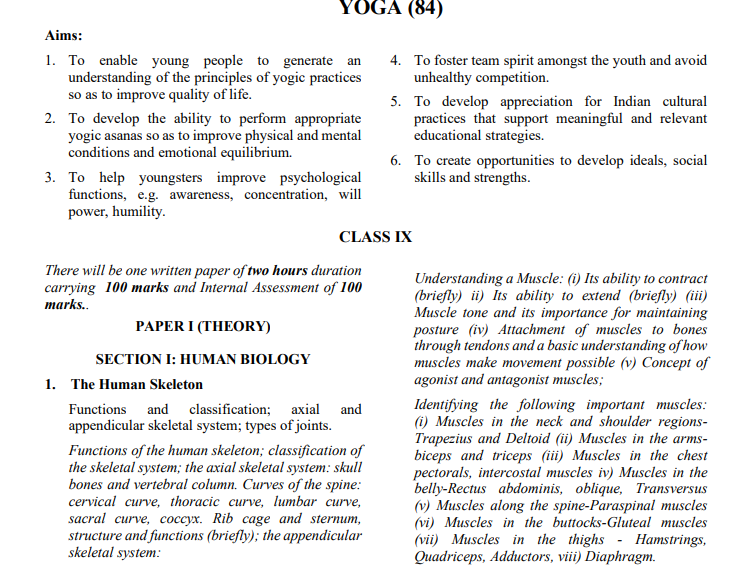
The ICSE Class 10 Yoga syllabus 2026-27 emphasizes holistic development, combining traditional Indian wisdom with modern scientific understanding. It cultivates discipline, physical fitness, mental clarity, and spiritual awareness. Through theoretical studies and practical exercises, students learn to integrate yoga into daily life, promoting health and self-realization.
ICSE Class 10 Yoga Syllabus 2026-27
The ICSE Class 10 Yoga syllabus 2026-27 provides a comprehensive understanding of yoga practices, human biology, and Indian philosophical teachings. It integrates theoretical knowledge and practical skills to promote physical health, mental well-being, and spiritual growth. The syllabus is divided into four sections:
- Human Biology: Focuses on the nervous, endocrine, circulatory, and excretory systems, including the role of yoga in maintaining their health.
- Sages of India: Covers the lives and teachings of significant Indian sages.
- Yoga Sutras of Patanjali: Introduces key yoga concepts from Patanjali’s Sutras.
- Philosophical Schools: Explores orthodox, heterodox, and contemporary philosophies.
ICSE Class 10 Yoga Syllabus 2026-27: Detailed Explanation
The ICSE Class 10 Yoga syllabus is designed to integrate theoretical knowledge and practical skills, fostering physical health, mental stability, and spiritual understanding. It emphasizes holistic education by focusing on biological systems, ancient Indian philosophies, and yoga practices, enabling students to lead healthier lives while exploring spiritual growth.
Section 1: Human Biology
This section explores human anatomy and physiology, highlighting how yoga benefits various systems and sensory organs. It includes:
1. Nervous System
- Key Topics:
- Neurons: Structure (cyton, axon, synapse, myelin sheath) and function (electrical impulse transmission).
- Types of Neurons: Sensory, motor, and association neurons.
- Central Nervous System (CNS):
- Brain: Structure and function of cerebrum, diencephalon, midbrain, hindbrain (cerebellum, pons, medulla oblongata).
- Spinal Cord: Structure, reflex actions (simple and conditioned reflexes).
- Peripheral Nervous System (PNS):
- Somatic Nervous System: Cranial and spinal nerves.
- Autonomic Nervous System: Sympathetic and parasympathetic systems.
- Yoga’s Role: Enhances nervous system health, improves coordination, and reduces stress.
2. Sense Organs
- Topics:
- Eyes: Structure, functions, and common defects (myopia, hyperopia, cataract).
- Ears: Outer, middle, inner ear functions, and the Eustachian tube’s role in balance.
- Taste and Smell: Function of olfactory nerves and taste buds.
- Touch: Skin nerve endings for pressure, pain, heat, and cold.
- Yoga’s Role: Practices like Trataka (eye exercise) and pranayama improve sensory organ health.
3. Endocrine System
- Topics:
- Glands: Pituitary, Thyroid, Adrenal, and Pancreas (location, hormones, effects of over/under secretion).
- Yoga’s Role: Regulates hormonal balance and promotes endocrine system health.
4. Circulatory System
- Topics:
- Heart: Structure, chambers, blood vessels, valves, blood circulation process (systole and diastole).
- Blood: Composition (plasma, RBC, WBC, platelets) and related disorders (anemia, hemophilia).
- Disorders: Atherosclerosis, arteriosclerosis, myocardial infarction.
- Yoga’s Role: Improves blood circulation and strengthens immunity.
5. Excretory System
- Topics:
- Organs: Lungs, skin, kidneys, bladder.
- Disorders: Kidney failure, kidney stones, gout.
- Yoga’s Role: Aids detoxification and supports waste elimination.
6. Personal Hygiene Through Yoga
- Focus: Practices for cleansing sense organs (e.g., tongue cleaning, ear cleaning) and maintaining overall health.
Section 2: Sages of India
This section emphasizes the teachings and contributions of Indian sages to spirituality and philosophy.
| Sage | Key Contributions |
|---|---|
| Vyasa | Mahabharata, Puranas, Guru Purnima. |
| Yagnavalkya | Yajurveda, Yoga Yagnavalkya Samhita, interactions with King Janaka and Gargi. |
| Narsi Mehta | Composed “Vaishnava Jan To”, preached devotion and service. |
| Sri Aurobindo | Integral Yoga, writings on conscious evolution, established Auroville and Sri Aurobindo Ashram. |
| Swami Vivekananda | Vedanta teachings, World Parliament of Religions, Ramakrishna Mission. |
| Ramana Maharishi | Philosophy of self-inquiry (“Who am I?”), founded Ramana Ashram. |
Section 3: The Yoga Sutras Of Patanjali
This section introduces students to the foundational text of yoga philosophy.
1. Samadhi Pada
- Topics:
- Chitta Vrittis (mental fluctuations): Klishta (painful) and Aklishta (non-painful).
- Obstacles to practice: Vyadhi (illness), Styana (laziness), etc.
- Types of Samadhi: Sabeej (with seed), Nirbeej (without seed).
2. Sadhana Pada
- Topics:
- Kriya Yoga and Ashtanga Yoga.
- Overcoming ignorance through knowledge (Kaivalya).
3. Vibhuti Pada
- Topics:
- Powers attained through Samyama (concentration and meditation).
4. Kaivalya Pada
- Topics:
- Liberation through self-realization and destruction of ignorance.
Section 4: Schools of Philosophy
This section explores Indian philosophical schools and their significance in yoga.
Orthodox Schools
- Sankhya: Dualism of Purusha (soul) and Prakriti (matter).
- Vedanta: Concepts like Brahman, Maya, and Moksha.
- Yoga: Ashtanga Yoga and Patanjali’s principles.
Heterodox Schools
- Buddhism: Four Noble Truths, Eightfold Path, Mahayana and Hinayana traditions.
- Jainism: Ahimsa, three jewels (right belief, knowledge, conduct).
Contemporary Philosophy
- Eckhart Tolle: “The Power of Now,” focusing on present awareness and detachment from thoughts.
Practical Assessment
Tests
| Test | Details |
|---|---|
| Test 1 (30 Marks) | Perform six predetermined asanas. |
| Test 2 (20 Marks) | Directed asanas chosen by the examiner. |
| Test 3 (10 Marks) | Two asanas of student’s choice. |
Practical Components
- Asanas: Includes Ardha Chandrasana, Parivritta Trikonasana, Paschimottanasana, and more.
- Pranayama: Focus on breathing techniques like Brahmari.
ICSE Class 10 Yoga Exam Pattern 2026
The ICSE Class 10 Yoga Exam Paper Pattern for the 2026 board exam (based on latest available syllabus and pattern updates from the Council for the Indian School Certificate Examinations – CISCE):
1. Total Marks & Assessment Structure
-
External Written Exam (Theory): 100 marks
-
Internal Assessment / Practical: 100 marks
This means overall 200 marks for the Yoga subject, included under Group III (optional subjects) where external and internal assessment carry equal weightage of 50% each.
2. Theory Paper Pattern
-
Duration: ~2 hours
-
Total Marks: 100 marks (theory)
-
The theory paper is divided into 4 sections:
Section A (Compulsory):-
All questions must be attempted.
-
Carries 40 marks.
Sections B, C & D:
-
Each section carries 20 marks.
-
Students are generally required to attempt any two questions from each of these sections.
-
Choice is provided within each section.
-
3. Question Types by Section
While exact section titles/types can vary slightly from year to year, for Yoga Class 10 the typical pattern (based on the 2025–26 syllabus and specimen guidance) is:
Section A – Human Biology & Yoga Concepts
-
Focus on yoga-related human biology topics (nervous system, endocrine, circulation, excretory system etc.) and role of yoga in health.
-
All questions compulsory.
-
~40 marks.
Section B – Sages & Philosophy
-
Questions on lives and teachings of key Indian sages related to yoga philosophy.
-
Choice within section; attempt required number of questions.
Section C – The Yoga Sutras of Patanjali
-
Questions on the four padas (Samadhi, Sadhana, Vibhuti, Kaivalya).
-
Choice of questions.
Section D – Schools of Philosophy & Important Sutras
-
Covers key orthodox and heterodox Indian philosophies, some sutras, and conceptual understanding.
-
Choice of questions.
Typically in Sections B–D, candidates attempt questions from any two out of the three sections offered, choosing from provided options in each.
4. Internal Assessment
-
100 marks which is usually based on:
-
Practical record / Class work
-
Assignments / Projects
-
Teacher’s assessment of participation and performance
-
-
Internal assessment requirements are set by CISCE and conducted through the school.
5. Section Summary (Quick)
| Component | Marks | Attempt Requirement |
|---|---|---|
| Theory (Written) | 100 | All of Section A; choose from Sections B–D |
| Internal Assessment | 100 | As per school evaluation |
| Total | 200 | — |
6. Tips for Preparation
Focus on understanding the role of yoga and applications in health (Human Biology)
Prepare detailed notes on philosophical schools and Yoga Sutras
Use specimen papers to understand question style (CISCE specimen for Yoga also exists from previous years)
ICSE 10th Class Yoga Marking Scheme
The ICSE Class 10 Yoga marking scheme (as per Council for the Indian School Certificate Examinations – CISCE) is divided into Theory + Practical (Internal Assessment). Here is the complete and clear breakdown:
ICSE Class 10 Yoga Marking Scheme
Overall Marks Distribution
| Component | Marks |
|---|---|
| Theory (Paper I) | 100 |
| Practical / Internal Assessment (Paper II) | 100 |
| Total | 200 |
Yoga is a Group III subject, so marks are divided equally between theory and practical (50% + 50%).
Paper I: Theory (100 Marks)
- Duration: 2 hours
- Divided into 4 sections
| Section | Topic | Marks |
|---|---|---|
| Section I | Human Biology | 40 |
| Section II | Sages of India | 20 |
| Section III | Yoga Sutras of Patanjali | 20 |
| Section IV | Schools of Philosophy & Sutras | 20 |
Key Points:
- Section I is compulsory
- In Sections II–IV, choice of questions is given
Paper II: Internal Assessment / Practical (100 Marks)
Section A: Course Work (40 Marks)
Assessed by school teachers based on:
- Regular yoga practice & improvement
- Participation in yoga activities
- Effort and discipline
- Assistance in yoga therapy sessions
Section B: Practical Exam (60 Marks)
Assessed by an external examiner:
| Test | Marks | Details |
|---|---|---|
| Test 1 | 30 | Perform 6 pre-decided asanas |
| Test 2 | 20 | Perform asanas given by examiner |
| Test 3 | 10 | Viva / practical understanding |
ICSE Class 10 Yoga Syllabus 2026-27 PDF Download
To access the syllabus in a simplified and detailed format, download the official PDF. It covers the theoretical framework, practical components, and assessment guidelines to help students excel in yoga practice and knowledge.
ICSE Class 10 Yoga Syllabus- Click Here To Download PDF
Best Books for ICSE Class 10 Yoga Syllabus
FAQs
1. What is included in the ICSE Class 10 Yoga syllabus?
The ICSE Class 10 Yoga syllabus focuses on theoretical understanding and practical application of Yoga. It includes topics such as the concept of Yoga, Asanas, Pranayama, meditation, Yogic diet, stress management, and yoga for physical and mental well-being.
2. Is Yoga a compulsory subject in ICSE Class 10?
Yoga is offered as a subject under SUPW/Health and Physical Education in ICSE schools. Whether it is compulsory or optional depends on the school’s academic structure, but assessment is usually mandatory where Yoga is prescribed.
3. What are the main theoretical topics in ICSE Class 10 Yoga?
Key theory topics include:
-
Meaning and importance of Yoga
-
Eight limbs of Yoga (Ashtanga Yoga)
-
Benefits of Yoga for health
-
Yogic lifestyle and diet
-
Stress, anxiety, and their management through Yoga
4. Which Asanas are important for the Class 10 Yoga exam?
Commonly practiced and assessed Asanas include:
-
Tadasana
-
Vrikshasana
-
Bhujangasana
-
Paschimottanasana
-
Vajrasana
-
Shavasana
Students should know steps, precautions, and benefits of each Asana.
5. What role does Pranayama play in the syllabus?
Pranayama is a crucial part of the syllabus and includes:
-
Anulom Vilom
-
Bhastrika
-
Kapalbhati
-
Bhramari
Questions may be asked on technique, advantages, and contraindications.
6. Is meditation included in the ICSE Class 10 Yoga syllabus?
Yes, meditation (Dhyana) is included. Students learn its meaning, methods, and benefits, especially for improving concentration, memory, and emotional balance.
7. Are practical exams conducted for Yoga?
Yes, most ICSE schools conduct practical assessments. Students may be evaluated on:
-
Performance of Asanas
-
Breathing techniques
-
Discipline, posture, and awareness
-
Viva-voce based on theory
8. How are marks distributed in ICSE Class 10 Yoga?
Marks are generally divided between theory and practical/internal assessment. Exact distribution may vary by school but usually emphasizes regular practice and understanding rather than rote learning.
9. What type of questions are asked in the Yoga examination?
The exam may include:
-
Short answer questions
-
Descriptive questions
-
Benefits and precautions of Asanas
-
Application-based questions on stress and health
10. How should students prepare for ICSE Class 10 Yoga?
Students should:
-
Practice Asanas daily
-
Revise theory concepts regularly
-
Learn correct terminology
-
Understand health benefits practically
-
Refer to school notes and ICSE-recommended material
11. Does Yoga help in overall academic performance?
Yes, Yoga helps improve concentration, memory, emotional stability, and physical fitness, which indirectly enhances academic performance and exam readiness.
12. Is the ICSE Class 10 Yoga syllabus useful beyond exams?
Absolutely. The syllabus promotes lifelong health habits, stress management skills, and mental discipline, making it beneficial well beyond school education.
About The Author
