
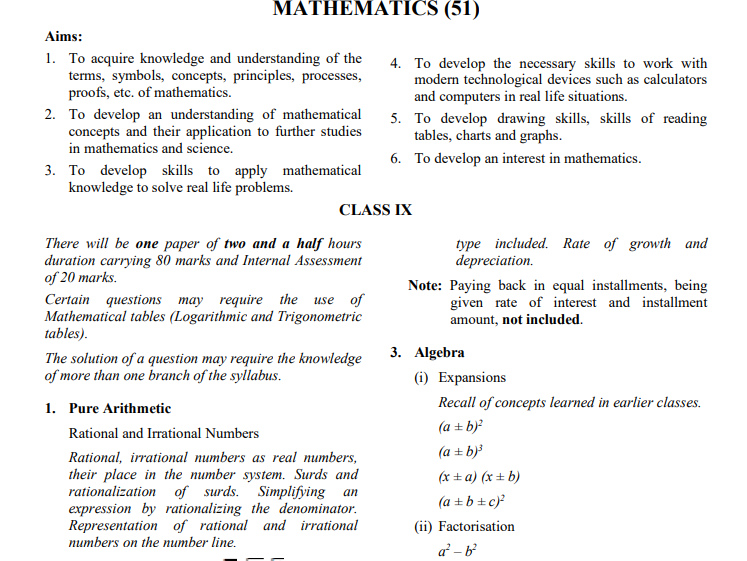
The ICSE Class 10 Mathematics syllabus is carefully designed to strengthen students’ conceptual understanding and problem-solving abilities. It focuses on building a solid foundation in mathematical reasoning, logical thinking, and real-life application of concepts. The syllabus covers key areas such as algebra, geometry, trigonometry, mensuration, statistics, and probability, ensuring balanced academic development. Emphasis is placed on accuracy, step-wise solutions, and analytical skills, which are essential for higher studies. With a mix of theoretical concepts and practical problems, the ICSE Class 10 Maths syllabus prepares students effectively for board examinations and future competitive exams.
ICSE Class 10 Maths Syllabus 2026-27
The ICSE Class 10 Mathematics Syllabus for 2026-27 covers a wide range of topics designed to enhance students’ mathematical skills. It includes commercial mathematics, algebra, geometry, mensuration, trigonometry, statistics, and probability. Below is a breakdown of the syllabus for better clarity:
1. Commercial Mathematics
- Goods and Services Tax (GST): Computation of tax, including problems with discounts, list price, profit, loss, and cost price, including inverse cases. Students will also calculate the price after paying SGST and CGST for different items.
- Banking: Understanding Recurring Deposit accounts with calculations of interest and maturity value using provided formulas.
- Shares and Dividends: Calculating income and return based on share-related problems.
2. Algebra
- Linear Inequations: Solving linear inequalities in one variable for various sets (natural, whole, integer, real numbers).
- Quadratic Equations: Finding nature of roots, solving quadratic equations by factorization or formula, and solving related problems.
- Ratio and Proportion: Understanding and applying properties like componendo, dividendo, and others.
- Factorization of Polynomials: Using the Factor Theorem and Remainder Theorem for factorization.
- Matrices: Operations like addition, subtraction, and multiplication of 2×2 matrices.
- Arithmetic and Geometric Progressions: Finding general terms and sums of terms, with simple applications.
- Coordinate Geometry: Understanding reflection, section and midpoint formula, and equations of straight lines.
3. Geometry
- Similarity: Understanding similar triangles and their properties like Basic Proportionality Theorem.
- Loci: Theorems and constructions based on loci, such as the locus of a point equidistant from two points.
- Circles: Angle properties, cyclic properties, and tangent and secant properties.
- Construction: Construction of tangents to circles and circumscribing/inscribing circles in polygons.
4. Mensuration
- Calculation of area and volume of solids such as cylinders, cones, and spheres. Problems may involve combinations of solids and applications like cost calculations and volume measurements.
5. Trigonometry
- Using identities to solve algebraic trigonometric expressions and solving problems related to heights and distances using trigonometric tables.
6. Statistics
- Calculating mean, median, and mode for both raw and grouped data. Students will represent data using histograms and ogives.
7. Probability
- Understanding random experiments, sample space, events, and calculating probabilities of single events.
ICSE Class 10 Maths Exam Pattern 2026
Detailed and up-to-date overview of the ICSE Class 10 **Mathematics Exam Pattern for the 2026 Board Exams conducted by the Council for the Indian School Certificate Examinations (CISCE) — including structure, marking scheme, duration, and section-wise breakdown:
ICSE Class 10 Maths Exam Pattern Overview
Total Marks: 100
• Theory Paper (External): 80 marks
• Internal Assessment/Project Work: 20 marks
Duration: Generally 2 ½ to 3 hours (often 15 min reading time plus writing time)
Conducted By: Council for the Indian School Certificate Examinations (CISCE)
Mode: Offline (Pen & Paper)
Medium: English/Hindi (as applicable)
Paper Structure
The theory paper is usually divided into two main sections:
Section I (Typically 40 marks)
-
Contains compulsory questions.
-
Includes Objective/MCQs, short answer, and some long answer questions.
-
All questions in this section must be attempted.
Section II (Typically 40 marks)
-
Long-answer questions with internal choice.
-
Students may be asked to attempt a selected number of questions (e.g., answer any 4 out of 6–7).
Total Theory Marks: 80
Internal Assessment: 20 (based on assignments/projects evaluated by teachers and possibly external examiners)
Types of Questions
-
Objective/Multiple Choice Questions (MCQs)
-
Short Answer Questions
-
Long/Descriptive Answer Questions
-
Some competency-based and application-focused questions to assess conceptual understanding.
Duration Details
-
Students are typically given 15 minutes to read the paper before writing.
-
The writing time is generally 2 ½ to 3 hours depending on official CISCE instructions.
Marking & Section Rules (Typical)
| Section | Marks | Nature |
|---|---|---|
| Section I | ~40 | Compulsory (includes MCQs/Short Answers) |
| Section II | ~40 | Long answers with internal choice |
| Internal Assessment | 20 | Project/Assignments |
All questions in Section I are compulsory
In Section II, students choose among several questions (e.g., any 4 out of 7)
Topic & Unit Weightage (Indicative)
The CISCE doesn’t officially publish exact marks per chapter, but based on official specimen papers and past trends, the approximate weightage is:
| Unit / Topic | Approx Marks (Theory) |
|---|---|
| Algebra | 18–22 marks |
| Geometry | 15–20 marks |
| Mensuration | 8–10 marks |
| Trigonometry | ~8 marks |
| Statistics & Probability | ~10–15 marks |
| Commercial Mathematics (GST, Banking, Shares) | ~10–15 marks |
ICSE Class 10 Maths Marking Scheme
Overall Marks Distribution
| Component | Marks |
|---|---|
| Theory (Written Exam) | 80 Marks |
| Internal Assessment | 20 Marks |
| Total | 100 Marks |
The subject follows an 80 + 20 pattern, where internal marks are school-based (projects, assignments, tests).
Theory Paper Pattern (80 Marks)
The written paper is divided into two sections:
Section I (Compulsory) – 40 Marks
- All questions are compulsory
- Contains short-answer questions
- Usually:
- 2–4 marks per question
- Covers entire syllabus
- Tests basic concepts & speed
Important: No chapter can be skipped.
Section II (Choice-Based) – 40 Marks
- Attempt 4 questions out of 7
- Each question = 10 marks
- Each question is from a specific topic like:
- Algebra
- Geometry
- Trigonometry
- Statistics, etc.
Questions are divided into parts (a, b, c).
Step-wise Marking (Very Important)
ICSE follows a step-marking system, especially in Section II:
| Step | Marks |
|---|---|
| Correct formula/theorem | 1 mark |
| Method & substitution | 3–4 marks |
| Calculation | 2–3 marks |
| Final answer (with units) | 1–2 marks |
Even if the final answer is wrong, you still get marks for correct steps.
Internal Assessment (20 Marks)
- Conducted by school
- Includes:
- Projects / Investigations
- Practical applications (statistics, data handling)
- Class tests
Easy scoring: Students can usually secure 18–20 marks with proper submission.
Important Topic-wise Weightage (Approx.)
| Unit | Weightage |
|---|---|
| Algebra | 20–25% |
| Geometry | 15–20% |
| Mensuration | 10–15% |
| Trigonometry | 10–15% |
| Statistics & Probability | 10–15% |
| Commercial Maths | 10–15% |
Algebra + Geometry carry the highest marks every year.
ICSE Class 10 Mathematics Syllabus 2026-27 PDF Download
The ICSE Class 10 Mathematics syllabus for 2026-27 is available for download in PDF format. Students can access the complete syllabus document, which outlines all topics, sub-topics, and related learning outcomes. It’s a useful resource to understand the subjects that will be taught and to plan the academic year effectively.
ICSE Class 10 Maths Syllabus Click Here To Download PDF
Books to cover ICSE 10th Maths Syllabus
Some of the best books to cover the ICSE Class 10 Mathematics syllabus comprehensively — including theory, practice questions, solved examples, and board-oriented practice:
Top Recommended Books (Core + Reference)
1. Selina Concise Mathematics for ICSE Class 10
-
A widely recommended core textbook that covers the entire syllabus clearly with plenty of examples and exercises.
-
Great for understanding concepts and building basics.
2. “Understanding ICSE Mathematics”, M.L. Aggarwal
-
Excellent for concept clarity with a wide variety of practice problems from easy to challenging.
-
Often used by students aiming for strong preparation and deeper practice.
3. ICSE Mathematics Class 10, Asit Das Gupta (Bharati Bhawan)
-
Detailed explanations and good mix of practice questions.
-
Useful as a supplementary reference if you want additional solved examples.
4. Arihant All In One Mathematics Class 10
-
Combines theory notes, practice questions, and sample papers in one book.
-
Very helpful for revision and exam pattern practice.
5. Arihant ICSE Mathematics Chapterwise Solved Papers
-
Focuses on past board questions chapter-wise with solutions, great for actual board exam practice.
6. Almond Books ICSE Class 10 Maths Study Guide
-
A study-guide-style book with quick notes, MCQs, important questions, and exam tips.
7. Fundamentals of Mathematics: Anil K. Sharma
-
Balanced mix of theory, examples, and exercises with step-by-step solutions — helps build confidence.
How to Use These Books Effectively
Start with a strong base: Use Selina Concise or M.L. Aggarwal for core concepts & thorough practice.
Practice board-style questions: Use Arihant’s solved papers and sample papers for exam pattern familiarity.
Revise and reinforce: Use a study guide like Almond Books to quickly revise concepts and formulas.
Solve plenty of examples: Work through solved examples and unsolved exercises in Aggarwal and Arihant to build speed and accuracy.
FAQs Based on ICSE Class 10 Maths Syllabus
1. What are the main units in the ICSE Class 10 Maths syllabus?
The ICSE Class 10 Maths syllabus includes Algebra, Geometry, Trigonometry, Mensuration, Statistics, Probability, and Commercial Mathematics. Key chapters are Quadratic Equations, Linear Inequations, Similarity, Trigonometric Identities, Heights & Distances, Coordinate Geometry, Circles, Statistics, and Probability.
2. Is the ICSE Class 10 Maths syllabus tough compared to CBSE?
Yes, ICSE Maths is generally considered more application-based and concept-oriented than CBSE. It includes deeper geometry proofs, word problems, and analytical questions that test conceptual clarity.
3. Which topics carry the highest weightage in ICSE Class 10 Maths?
High-weightage topics usually include:
-
Geometry (Circles, Similarity, Constructions)
-
Algebra (Quadratic Equations, Progressions)
-
Trigonometry
-
Mensuration
-
Statistics & Probability
Geometry alone contributes a significant portion of the paper.
4. Are constructions important for the ICSE Class 10 Maths exam?
Yes, Geometrical Constructions are very important. Students must practice accurate diagrams, use proper instruments, and follow step-wise construction methods, as marks are awarded for both accuracy and method.
5. Is there any choice in the ICSE Maths question paper?
Yes, the ICSE Maths paper provides internal choices in several questions. Students can attempt questions based on their strengths, especially in sections like Geometry, Trigonometry, and Mensuration.
6. How much emphasis is given to word problems?
ICSE Maths gives strong emphasis on word problems, especially in Algebra, Trigonometry, and Commercial Mathematics. These problems test real-life application and logical reasoning.
7. Are proofs compulsory in ICSE Class 10 Maths?
Yes, geometry proofs are an essential part of the syllabus. Students must write logical, step-by-step proofs using correct theorems and statements.
8. Is calculator allowed in ICSE Class 10 Maths?
No, calculators are strictly not allowed. Students must be quick and accurate with mental calculations, simplification, and square roots.
9. How can students score 90+ in ICSE Class 10 Maths?
To score high:
-
Master Geometry theorems and proofs
-
Practice previous 10 years’ question papers
-
Focus on step-wise presentation
-
Revise formulas regularly
-
Avoid calculation mistakes by double-checking answers
10. Are previous years’ questions repeated in ICSE Maths exams?
Yes, ICSE often repeats similar patterns and concepts, especially in Geometry, Trigonometry, and Statistics. Practicing past papers is extremely beneficial.
11. Which topics are considered most difficult by students?
Students often find these topics challenging:
-
Circle theorems
-
Similarity proofs
-
Trigonometric identities
-
Heights and Distances
Regular practice helps overcome difficulty.
12. Is Statistics and Probability easy to score?
Yes, Statistics and Probability are scoring topics if formulas are applied correctly and steps are clearly shown.
13. Does ICSE Class 10 Maths help in competitive exams?
Yes, the ICSE Maths syllabus builds a strong foundation for competitive exams like Olympiads, NTSE, and even future entrance exams due to its analytical approach.
14. How important is presentation in ICSE Maths?
Presentation is very important. Marks are awarded for:
-
Proper steps
-
Neat diagrams
-
Logical flow
-
Correct mathematical symbols
15. What is the best way to revise ICSE Class 10 Maths syllabus?
The best revision strategy includes:
-
Formula sheets
-
Daily problem practice
-
Weekly mock tests
-
Revising weak chapters more frequently
About The Author
