
The AMCAT (Aspiring Minds Computer Adaptive Test) is one of India’s most widely recognized employability assessments, designed to evaluate a candidate’s skills for campus placements and off-campus job opportunities. With the increasing competition in the job market, understanding the AMCAT Syllabus 2025 has become essential for students pursuing Computer Science Engineering (CSE) and MBA. The exam assesses job readiness by testing candidates across multiple domains such as quantitative ability, reasoning skills, English communication, and subject-specific competencies.
For CSE students, AMCAT focuses on core technical skills including computer programming, data structures, algorithms, operating systems, databases, and networking. This helps recruiters evaluate whether a candidate is equipped for software development, IT services, and tech-based roles. On the other hand, the MBA AMCAT syllabus emphasizes business communication, logical reasoning, quantitative aptitude, and domain-specific modules such as marketing, finance, operations, and human resources.
Understanding the detailed syllabus allows candidates to plan an effective preparation strategy, focus on important topics, and practice relevant questions. This article provides a comprehensive overview of the AMCAT Syllabus 2025 for both CSE and MBA, helping aspirants strengthen their preparation and boost their chances of securing top placement opportunities.
AMCAT Syllabus 2025
The detailed breakdown of the AMCAT 2025 syllabus for candidates from CSE (Computer Science) / IT background and for MBA / general-management background. I’ve separated “core/compulsory” parts from “domain-specific / optional” ones — that way you can see what applies to whom.
Common (Compulsory) Sections — for all AMCAT takers (CSE, MBA, others)
These sections are mandatory regardless of your degree or specialization.
| Section | Key Topics / Syllabus Content |
|---|---|
| English (Verbal Ability / Comprehension) | Vocabulary (synonyms, antonyms, contextual usage), Grammar (error-identification, sentence correction / improvement), Sentence construction / ordering, Reading Comprehension / passages. |
| Quantitative Ability / Aptitude | Number systems; fundamentals (numbers, HCF–LCM, divisibility, decimals); Arithmetic / basic maths; Percentages, Profit & Loss, Simple & Compound Interest; Time, Speed & Distance; Algebra; (in some versions) Geometry; Data interpretation / word-problems etc. |
| Logical Ability / Reasoning | Pattern recognition, series/completion, puzzles, coding/decoding-type logic, data-sufficiency, syllogisms / deduction, logical-word sequence, decision tables, series-based reasoning (non-verbal or number), inductive/deductive reasoning etc. |
| Personality Inventory (AMPI — Aspiring Minds Personality Inventory) | Tests based on “Big Five” personality traits: Extraversion, Conscientiousness, Neuroticism, Openness to Experience, Agreeableness. This module is part of the core AMCAT for placement-oriented assessment. |
⚠️ Note: The number of questions, time per section may vary depending on whether you are engineering (CSE) or general/management graduate.
Domain-Specific / Optional Modules — What varies for CSE vs MBA
Depending on your educational background (or the profile you target), you will choose 1–2 optional/domain-specific modules.
🔹 If you are CSE / Computer Science / IT
For CSE / Computer-Science / IT graduates, typical optional modules include “Computer Programming / CS & IT” (and similar) covering:
-
Programming concepts (languages like C, C++, Java)
-
Data Structures & Algorithms
-
Database Management Systems (DBMS) — SQL, normalization, relational algebra, indexing, etc.
-
Operating Systems (OS fundamentals, process management, memory / I-O management)
-
Computer Networks / Basics of networking & communication protocols
-
Software Engineering / Web Technologies / general CS fundamentals
Thus, if you are from CSE, AMCAT tests both your core aptitude + CS-domain knowledge via this module.
🔹 If you are MBA / Management / General Graduate
For MBA / management-stream candidates (or those aiming for non-CS roles), optional modules may include Finance, Marketing, HR, Operations, Banking & Financial Services, Economics / Taxation, etc.
Some typical topics under MBA / Business-stream modules:
-
Basic Accounting & Finance, Banking & Financial Services (stocks, bonds, mutual funds, debt, derivatives, banking products)
-
Macro Economics, Taxation / Basic Economics (depending on module)
-
Marketing Fundamentals: market types, consumer behavior, STP, marketing mix (4Ps), product strategy, pricing, promotion, distribution, brand management, media planning, advertising, lifecycle of product, etc.
-
Human Resources: HR planning, training & development, compensation & performance appraisal, organizational behaviour, labour welfare/industrial relations etc.
-
Operations / Basic Statistics / General management fundamentals (depending on module combinations)
Key Differences: CSE vs MBA in AMCAT
| Feature / Module | For CSE / IT | For MBA / Management |
|---|---|---|
| Optional / Domain Module | Computer Programming / CS & IT (DSA, OS, DBMS, Networks, etc.) | Modules like Finance, Marketing, HR, Banking & Financial Services, Economics, etc. |
| Focus Area | Technical and core CS-IT knowledge + aptitude & reasoning | Business / management fundamentals + aptitude/reasoning/communication |
| Use Case / Target Jobs | Software Development, IT, technical roles | Management roles: HR, Marketing, Finance, Business/Operations, etc. |
Full AMCAT Syllabus 2025
-
English
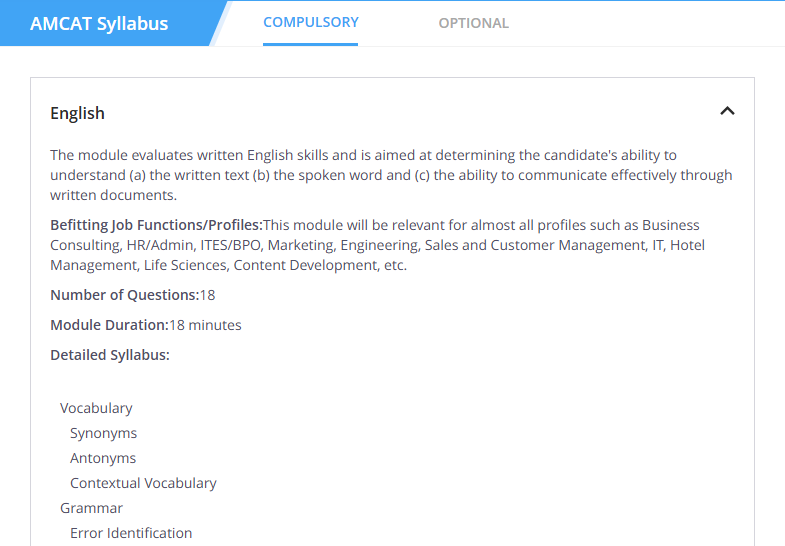
The module evaluates written English skills and is aimed at determining the candidate’s ability to understand (a) the written text (b) the spoken word and (c) the ability to communicate effectively through written documents.
Befitting Job Functions/Profiles:This module will be relevant for almost all profiles such as Business Consulting, HR/Admin, ITES/BPO, Marketing, Engineering, Sales and Customer Management, IT, Hotel Management, Life Sciences, Content Development, etc.
Number of Questions:18
Module Duration:18 minutes
Detailed Syllabus:
- Vocabulary
- Synonyms
- Antonyms
- Contextual Vocabulary
- Grammar
- Error Identification
- Sentence Improvement and Construction
- Comprehension
- Reading Comprehension
- Vocabulary
-
Quantitative Ability Tech
The module is ideal to evaluate the numerical ability of an individual and is available in both technical and non technical flavor.
Befitting Job Functions/Profiles:This module will be relevant for almost all profiles such as Content Development, Business Consulting, HR/Admin, ITES/BPO, Marketing, Engineering, Sales and Customer Management, IT, Hotel Management, Life Sciences, etc.
Number of Questions:16
Module Duration:20 minutes
Detailed Syllabus:
- Basic Mathematics
- Divisibility
- HCF and LCM
- Numbers
- Decimal fractions
- Power
- Applied Mathematics
- Profit and Loss
- Simple and CompoundInterest
- Time, Speed and Distance
- Inverse
- Engineering Mathematics
- Logarithms
- Permutation and Combinations
- Probability
- Basic Mathematics
-
Logical Ability
The module assesses capacity of an individual to interpret things objectively, to be able to perceive and interpret trends to make generalizations and be able to analyze assumptions behind an argument/statement.
Befitting Job Functions/Profiles:This module will be relevant for almost all profiles such as Content Development, Business Consulting, HR/Admin, ITES/BPO, Marketing, Engineering, Sales and Customer Management, IT, Hotel Management, Life Sciences etc.
Number of Questions:12
Module Duration:15 minutes
Detailed Syllabus:
- Deductive Reasoning
- Coding deductive logic
- Data Sufficiency
- Directional Sense
- Logical Word Sequence
- Objective Reasoning
- Selection decision tables
- Puzzles
- Inductive reasoning
- Analogy Pattern Recognition
- Classification Pattern Recognition
- Coding Pattern Recognition
- Number Series Pattern Recognition
- Deductive Reasoning
-
Quantitative Ability
The module is ideal to evaluate the numerical ability of an individual and is available in technical flavor.
Befitting Job Functions/Profiles:This module will be relevant for almost all profiles such as Content Development, Business Consulting, HR/Admin, ITES/BPO, Marketing, Engineering, Sales and Customer Management, IT, Hotel Management, Life Sciences etc.
Number of Questions:14
Module Duration:20 minutes
Detailed Syllabus:
- Basic Numbers
- Numbers
- Decimal Fractions
- Applied Mathematics
- Word Problem Interest
- Word Problem Inverse
- Word Problem Profit
- Word Problem Speed
- Word Problems
- Number Theory
- Divisibility
- HCF and LCM
- Basic Numbers
-
Information Gathering & Synthesis
The module tests the candidate’s ability to gather, comprehend and evaluate information from single or multiple source(s). This checks whether the candidate is able to locate relevant information, order and classify data, interpret graphs, charts and tables and make rule based deductions. The information and data could be presented in any format: text, numbers, tables, figures, etc.
Befitting Job Functions/Profiles:This module will be relevant for almost all profiles such as Content Development, Business Consulting, HR/Admin, ITES/BPO, Marketing, Engineering, Sales and Customer Management, IT, Hotel Management, Life Sciences, etc.
Number of Questions:12
Module Duration:15 minutes
Detailed Syllabus:
- Data Interpretation
- Information Ordering
- Information Processing
-
AMPI
The module does an overall personality assessment of the candidate and is used to assess candidates in people-interaction and people-management roles.
Befitting Job Functions/Profiles:
Number of Questions:90
Module Duration:20 minutes
Detailed Syllabus:
AMPI is based on the five-factor model of Personality. AMPI measures five broad based traits:
- Extraversion
- Conscientiousness
- Neuroticism
- Openness to Experience
- Agreeableness
Best Books to prepare for AMCAT Syllabus 2025 for CSE and MBA
If you’re preparing for AMCAT 2025 — whether you are from a CSE background (so programming + aptitude + reasoning) or MBA (or planning MBA-level aptitude / general modules) — it’s smart to use books that target English / Verbal, Quantitative Ability, Logical / Analytical Reasoning, and basic aptitude, Below are some of the widely recommended books that fit AMCAT’s syllabus and are good regardless of whether you are CSE or MBA. I group them by purpose to help you choose systematically 👇
Recommended Books for AMCAT Preparation
English / Verbal Ability & Reading Comprehension
-
Objective General English by S. P. Bakshi — good for grammar, vocabulary, sentence correction, and general English practice.
-
Word Power Made Easy — classic book for building vocabulary, understanding usage, improving overall English skills. Great for verbal and comprehension parts.
-
For reading comprehension + verbal-ability practice: How to Prepare for Verbal Ability and Reading Comprehension for CAT by Arun Sharma & Meenakshi Upadhyay — though it’s for CAT, the sections overlap a lot with AMCAT’s English/verbal requirements.
Quantitative Ability / Basic Maths / Aptitude
-
Quantitative Aptitude for Competitive Examinations by R. S. Aggarwal — solid for covering most basic and intermediate math topics (number systems, percentages, time-speed, averages, probability, etc.) that appear in AMCAT’s quantitative section.
-
How to Prepare for Quantitative Aptitude for CAT by Arun Sharma — useful if you want to sharpen your math ability, even at advanced level; it helps build speed and accuracy for aptitude tests.
-
Quantitative Aptitude Quantum CAT by Sarvesh K. Verma — frequently recommended for aptitude and numeric reasoning; good for comprehensive practice across difficulty levels.
Logical / Analytical Reasoning & Data Interpretation / Logical Ability
-
A Modern Approach to Logical Reasoning by R. S. Aggarwal — covers reasoning, puzzles, non-verbal reasoning, and logical ability that aligns well with AMCAT’s Logical Ability module.
-
Logical Reasoning and Data Interpretation for CAT by Nishit K. Sinha — though aimed at CAT, its DI + reasoning sets are excellent for building speed and analytical thinking for AMCAT-style logical and data interpretation questions.
For MBA-oriented Modules (Finance / Marketing / HR Fundamentals, if you take optional MBA-related AMCAT modules)
AMCAT’s optional modules for MBA/finance/management — as mentioned in recent syllabus outlines — may include basic accounting, financial analysis, marketing, and HR fundamentals.
While there are no “official AMCAT MBA books,” standard management-entry preparation books (like those used for MBA entrance or basic business-studies) could help, depending on the topics you expect. For aptitude + reasoning + English you can rely on books above; for domain knowledge you may need reference textbooks or your class materials.
How to Use These Books Effectively for AMCAT
-
Start with basics: If your fundamentals are weak — especially in mathematics or grammar — begin with R.S. Aggarwal (Quantitative Aptitude, or A Modern Approach for reasoning), Objective General English, and Word Power Made Easy.
-
Practice regularly: AMCAT tests speed + accuracy. Use books like Quantitative Aptitude Quantum CAT, and Logical Reasoning & DI for timed practice.
-
Simulate AMCAT conditions: Practice full-length mocks (English + Quant + Reasoning) under time constraints to build confidence.
-
Domain-specific prep (for CSE or MBA modules): If you’re a CSE student, brush up on programming, logic, basics of computer science (based on which optional module you pick). For MBA/finance, combine your aptitude practice with standard textbooks or study material for basic accounting/finance/HR/marketing as per the module syllabus.
FAQs
1. What is the AMCAT exam?
AMCAT (Aspiring Mind Computer Adaptive Test) is an employability assessment test that evaluates skills required by companies for hiring fresh graduates. It covers Aptitude, English, Logical Reasoning, and domain-specific subjects.
2. Is the AMCAT syllabus the same for CSE and MBA?
No.
-
CSE candidates get computer science domain modules like OS, DBMS, Networking, Programming, etc.
-
MBA candidates get business- and management-oriented modules like Marketing, HR, Finance, and Operations.
Both streams must answer Aptitude + English + Logical Reasoning.
3. What are the compulsory modules in AMCAT 2025?
All candidates must take:
-
English Comprehension
-
Quantitative Ability (QA)
-
Logical Ability (LR)
4. What is included in the AMCAT CSE domain syllabus?
The CSE module includes:
-
Computer Programming (C/C++/Java/Python basics)
-
Data Structures & Algorithms
-
Database Management Systems (DBMS)
-
Operating Systems
-
Computer Networks
-
Software Engineering
-
OOPS concepts
-
Basic Web Technologies
5. What is included in the AMCAT MBA domain syllabus?
Modules differ by specialization:
Marketing
-
Consumer Behavior
-
Market Segmentation
-
Branding
-
Digital Marketing Basics
-
Marketing Mix
HR
-
Organizational Behavior
-
Recruitment & Selection
-
Training and Development
-
Performance Appraisal
Finance
-
Accounting Basics
-
Ratio Analysis
-
Financial Management
-
Investment Concepts
Operations
-
Supply Chain Management
-
Production Planning
-
Inventory Control
6. How many questions and time per module?
-
English: 18 questions, 18 min
-
Quantitative Ability: 14–16 questions, 20–25 min
-
Logical Reasoning: 12–14 questions, 20 min
-
Domain Module: 20–25 questions, 20–30 min
(Time varies slightly depending on updates.)
7. Is coding compulsory for CSE students?
Yes, basic programming knowledge is tested.
However, AMCAT does not require writing full programs—mostly MCQ-based questions on logic, code snippets, and output prediction.
8. Is there any negative marking?
No.
This is why accuracy + attempting all questions improves your score.
9. Can MBA students skip Quant or Reasoning?
No. These sections are mandatory for all streams.
10. What is the best preparation strategy for AMCAT CSE candidates?
-
Strengthen DSA, DBMS, OS, CN
-
Practise output-based and debugging questions
-
Solve mock AMCAT programming MCQs
-
Revise core engineering basics
11. What is the best preparation strategy for MBA students?
-
Revise management fundamentals
-
Follow NCERT-like clarity for HR/Marketing/Finance basics
-
Practise data interpretation & business aptitude
-
Solve previous AMCAT business modules
12. What companies hire through AMCAT?
A few examples (varies year to year):
-
Accenture
-
Cognizant
-
Wipro
-
Infosys
-
Mindtree
-
TCS (for select profiles)
-
Deloitte (some roles)
-
Startups in tech & management
13. Is AMCAT harder than campus placement exams?
No. AMCAT difficulty is moderate and more predictable. Campus exams can be tougher but vary widely.
14. Can freshers from any stream apply for AMCAT?
Yes. B.Tech, BCA, BBA, MBA, BA, B.Com, etc. can appear.
15. How long is the AMCAT score valid?
One year from the date of the test.
16. Do AMCAT scores guarantee a job?
No.
They increase your shortlisting chances, but interview performance also matters.
17. Is AMCAT conducted online from home?
Yes, AMCAT is available in remote-proctored mode.
18. What is the passing score or cutoff?
No fixed cutoff.
Each company sets its own benchmark (usually 500–700 range).
19. Are MBA candidates asked current affairs?
No, AMCAT does not include GK or current affairs.
20. How many domain modules can be selected?
Typically one primary domain module, but some candidates may opt for multiple based on profile.
About The Author
