
CBSE Class 10 Maths Sample Paper 2026: The Central Board of Secondary Education (CBSE) has released the Class 10 Maths Sample Papers for the academic session 2025–26 in PDF format for both Standard and Basic levels. Practising these CBSE Class 10 Maths sample papers helps students understand the latest exam pattern while improving their speed and accuracy. Students can download and access the online CBSE Class 10 Maths sample papers 2026 for both Basic and Standard Maths through the link provided in the article below.
CBSE Class 10 Maths Sample Paper 2026: Overview
CBSE conducts the Class 10 Mathematics board exam with two levels of papers:
-
Mathematics Standard — for students planning to continue maths in higher classes.
-
Mathematics Basic — simpler, for students focusing on general numeric literacy.
Both papers are based on the CBSE Class 10 syllabus 2025–26 and follow the latest exam pattern designed to test conceptual clarity, reasoning and problem-solving skills.
📅 Exam Date: February 17, 2026.
🕒 Duration: 3 hours.
📊 Marks: 80 marks theory + 20 marks internal assessment/practical (total 100).
Sample Paper Structure (Common for Both Basic & Standard)
The CBSE Class 10 Maths Sample Paper 2026 — for both levels — has 38 compulsory questions divided into 5 sections: A to E.
Section Breakdown
| Section | Question Type | Marks | Description |
|---|---|---|---|
| A | MCQs + Assertion-Reason | 20 | Objective questions (1 mark each) |
| B | Very Short Answer (VSA) | 10 | 2 marks each |
| C | Short Answer (SA) | 18 | 3 marks each |
| D | Long Answer (LA) | 20 | 5 marks each |
| E | Case Study Based | 12 | 4 marks each (sub-parts) |
Total = 80 marks theory.
Internal choice is given in certain questions in Sections B, C and D in most CBSE sample papers.
Difference Between Basic and Standard Paper
Difficulty & Focus
-
Standard Maths:
-
Higher complexity questions.
-
Emphasis on application, reasoning and multi-step problems suitable for future maths studies.
-
Covers all major topics from NCERT in depth.
-
-
Basic Maths:
-
Easier conceptual level.
-
More focus on fundamental understanding and simpler problem-solving.
-
Ideal for students not pursuing advanced maths later.
-
Marks distribution emphasis also differs: Basic has a higher weightage on remembering & understanding questions, while Standard has more application and higher-order thinking items.
Official Sample Papers & Marking Schemes (Where to Download)
You can download the official sample question papers and marking schemes (PDF) for both Basic and Standard from CBSE’s academic website:
Go to cbseacademic.nic.in → Sample Question Paper section → Class 10 → Choose Mathematics (Basic) or Mathematics (Standard).
Alternatively, many educational portals provide direct downloads:
-
Maths Standard Sample Paper 2026 + Marking Scheme — complete set in English/Hindi.
-
Maths Basic Sample Paper 2026 + Marking Scheme — structured questions + solutions.
How to Use Sample Papers Effectively
Practice the full 80-mark paper within 3 hours to simulate the board exam timing.
Use the official marking scheme to evaluate your answers and understand how marks are awarded.
Focus on frequently tested topics like quadratic equations, arithmetic progressions, statistics, geometry and mensuration — these often appear with high weightage.
CBSE 10th Maths Exam Pattern
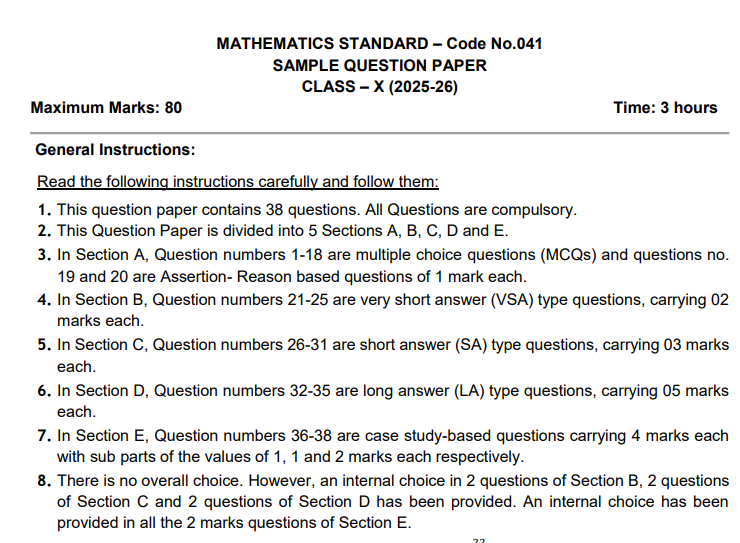
Along with the sample papers, the Central Board has also released the CBSE Class 10th Maths Syllabus and the latest exam pattern at its official website. All Questions are compulsory. The Question Paper will consist of 38 questions that will be further divided into 5 different Sections: A, B, C, D, and E. The paper will have no overall choice. However, internal choices will be provided for a few questions.
- In Section A, Question numbers 1-18 are multiple choice questions (MCQs), and questions no.19 and 20 are Assertion-Reason based questions of 1 mark each.
- In Section B, Question numbers 21-25 are very short answer (VSA) type questions, carrying 02 marks each.
- In Section C, Question numbers 26-31 are short-answer (SA) type questions, carrying 03 marks each.
- In Section D, Question numbers 32-35 are long-answer (LA) type questions, carrying 05 marks each.
- In Section E, Question numbers 36-38 are case study-based questions carrying 4 marks each, with sub parts of the values of 1, 1, and 2 marks each, respectively.
- Students are required to take 𝝅 = 22/7 wherever required if not stated.
Class 10 Maths Sample Paper 2025-26 PDF Download
The Central Board of Secondary Education has released the CBSE Class 10th Mathematics Sample Paper PDF on its official website. To make the process easier for all the students, we have added the direct links connecting with the CBSE Class 10 Basic Maths Sample Paper 2025-26 and CBSE Class 10 Standard Maths Sample Paper 2025-26 has been added ahead.
Maths Basic Sample Paper Class 10 2025 with solutions
| CBSE Class 10th Basic Mathematics Sample Paper 2025-26 PDF Download Link | ||
| Sample Papers | Download Link | MS PDF |
| CBSE Class 10 Basic Maths Sample Paper 2025-26 [English] | MathsBasic-SQP.pdf | MathsBasicpaper1-MS.pdf |
| CBSE Class 10 Basic Mathematics Sample Paper 2025-26 [Hindi] | MathsBasic-SQP_hi.pdf | |
CBSE Sample Paper Class 10 Standard Maths with solution PDF
| CBSE Class 10th Standard Mathematics Sample Paper 2025-26 PDF Download Link | ||
| Sample Papers | Download Link | MS PDF |
| CBSE Class 10 Standard Maths Sample Paper 2025-26 [English] | MathsStandard-SQP.pdf | MathsStandardpaper2-MS.pdf |
| CBSE Class 10 Standard Mathematics Sample Paper 2025-26 [Hindi] | MathsStandard-SQP_hi.pdf | |
CBSE Sample Paper Class 10 Maths 2026
SECTION – A
(Multiple Choice Questions)
Each MCQ of 1mark has four options with only one correct option. Choose the correct option
Q1. The exponent of 3 in the prime factorization of 2025 is
A) 1
B) 2
C) 3
D) 4
Answer: D) 4
Reason: As, 2025 = 34 × 54
So, the exponent of 3 in the prime factorization of 2025 is 4
Q2. If 2024𝒙 + 2025𝒚 = 1 ; 2025𝒙 + 2024𝒚 = −1, then 𝒙 − 𝒚 =
A) 0
B) – 2
C) 2
D) – 1
Answer: B) – 2
Reason: On subtracting the first equation from the second equation, we get
2025𝒙 + 2024𝒚 − 2024𝒙 − 2025𝒚 = −1 − 1 ⟹ (𝒙 − 𝒚) = −𝟐
Q3. The number of polynomials having − 2 and 5 as its zeroes is
A) one
B) two
C) three
D) Infinitely many
Answer: Answer – D
Reason: As, 𝑓(𝑥) = k(x + 2)(x − 5) ⟹ 𝑓(𝑥) = k(𝑥2 − 3x − 10), k ≠ 0
Since k can be any real number. So, there are infinitely many such polynomials
Q4. The value of x for which 2x, (x + 10), and (3x + 2) are the three consecutive terms of an AP is
A) 6
B) − 6
C) −2
D) 2
Answer: A) 6
Reason: As, 2(𝒙 + 10) = (3𝒙 + 2) + 2𝑥 ⟹ 𝑥 = 6
Q5. The co-ordinates of the point which is the mirror image of the point ( −3, 5) about x-axis are
A) (3, 5)
B) (3, −5)
C) ( −3, −5)
D) ( −3, 5)
Answer: C) ( −3, −5)
Reason: We know that, for the coordinates of a mirror image of a point in the x-axis, abscissa remains the same and the ordinate will be of the opposite sign of the ordinate of the given point. So, the Mirror image of the point (−3, 5) about the x-axis is (−3, −5).
Related Sample Paper Links:
FAQs
1. Is the CBSE Class 10 Maths Sample Paper 2026 released?
CBSE generally releases the official Class 10 Maths Sample Paper for the 2025–26 session in the first half of the academic year on its official website. Until then, students should follow the latest syllabus and blueprint announced by CBSE.
2. Is the exam pattern same for Maths Basic and Maths Standard in 2026?
Yes, the exam pattern and marking scheme are the same, but the difficulty level differs:
-
Maths Basic: Easier questions, fewer HOTS
-
Maths Standard: More application-based and higher-order questions
3. How many questions are there in CBSE Class 10 Maths 2026 paper?
The paper usually contains 40 questions divided into 5 sections:
-
Section A: MCQs
-
Section B: Very short answer
-
Section C: Short answer
-
Section D: Long answer
-
Section E: Case-study based questions
4. How many competency-based questions are expected in Maths 2026?
As per CBSE’s assessment reforms, around 50% of the paper is expected to be:
-
Case-study based
-
Assertion-Reason
-
Application-based MCQs
5. Are case study questions compulsory in CBSE Class 10 Maths 2026?
Yes, case-study based questions are compulsory and usually carry 5 marks. These questions test real-life application of concepts.
6. Which chapters are most important for CBSE Class 10 Maths 2026?
High-weightage chapters include:
-
Quadratic Equations
-
Triangles
-
Arithmetic Progressions
-
Circles
-
Surface Areas & Volumes
-
Statistics
-
Real Numbers
These chapters frequently appear in MCQs and case studies.
7. Will Maths Basic students get case study questions?
Yes, both Maths Basic and Maths Standard papers include case-study questions, but Maths Basic questions are simpler and more direct.
8. What type of MCQs are asked in Maths Sample Paper 2026?
MCQs are mainly:
-
Concept-based
-
Assertion-Reason type
-
Case-based MCQs
-
Formula application questions
Direct formula-based MCQs are fewer.
9. Is internal choice available in the Maths 2026 paper?
Yes, internal choices are provided in most sections, especially in:
-
Long answer questions
-
Case study questions
10. Are proof-based questions asked in Maths Standard 2026?
Yes, proof-based questions (especially from Triangles) are asked in Maths Standard, but not usually in Maths Basic.
11. What is the difficulty level of CBSE Class 10 Maths 2026?
-
Maths Basic: Easy to Moderate
-
Maths Standard: Moderate to Difficult
Overall focus is on conceptual clarity and application, not rote learning.
12. How should I prepare using the Maths Sample Paper 2026?
Students should:
-
Solve sample papers in 3-hour time limit
-
Focus on MCQs and case studies
-
Analyze mistakes chapter-wise
-
Practice previous 3–5 years’ papers
13. Is NCERT enough for CBSE Class 10 Maths 2026?
Yes, NCERT textbooks and exemplars are sufficient, as CBSE strictly follows NCERT for:
-
Definitions
-
Examples
-
Case-study contexts
14. Can Maths Basic students switch to Maths Standard later?
No, once a student opts for Maths Basic, they cannot switch to Maths Standard after Class 10.
15. Will the Maths 2026 paper be tougher than previous years?
The paper may feel tougher only if concepts are not clear, as CBSE focuses more on thinking-based questions, not difficulty.
16. How many marks are allotted to MCQs in Maths 2026?
MCQs usually carry 20 marks, forming a significant part of the question paper.
17. Are calculators allowed in CBSE Class 10 Maths exam?
No, calculators or any electronic devices are strictly prohibited.
18. How important are diagrams and steps in Maths answers?
Very important. CBSE awards marks for:
-
Correct steps
-
Proper diagram
-
Logical presentation
Even if the final answer is wrong, step-wise marks are given.
19. What is the best strategy for scoring 90+ in Maths 2026?
-
Master NCERT + Exemplar
-
Practice sample papers weekly
-
Focus on weak chapters early
-
Revise formulas daily
-
Attempt MCQs carefully
20. Where can I get practice questions similar to Sample Paper 2026?
You can practice from:
-
CBSE official sample papers
-
NCERT Exemplar
-
Previous year question papers
-
Chapter-wise case study questions
About The Author
