The CBSE Class 12 Physics Sample Paper 2026 plays a vital role in helping students prepare effectively for their upcoming board examinations. Physics is a concept-driven and application-oriented subject that requires a strong understanding of theory, numerical problem-solving skills, and familiarity with diagrams and derivations. The sample paper is designed strictly according to the latest CBSE syllabus and exam pattern for the academic session 2025–26, giving students a clear idea of how the actual question paper will look.
By practising the sample paper, students become familiar with the types of questions, internal choices, marking scheme, and weightage of different units such as Electrostatics, Current Electricity, Magnetism, Optics, Dual Nature of Radiation, Atoms and Nuclei, and Semiconductor Electronics. It also helps them understand the balance between MCQs, short-answer, and long-answer questions, enabling better time management during the exam.
Moreover, solving sample papers boosts confidence, improves accuracy, and highlights weak areas that need more revision. It encourages students to apply concepts rather than rely on rote learning. For students aiming to score high in the CBSE Class 12 board exams 2026, regular practice of the Physics sample paper, along with proper revision and analysis of mistakes, is an essential step toward achieving academic success.
CBSE Class 12 Physics Sample Paper 2026
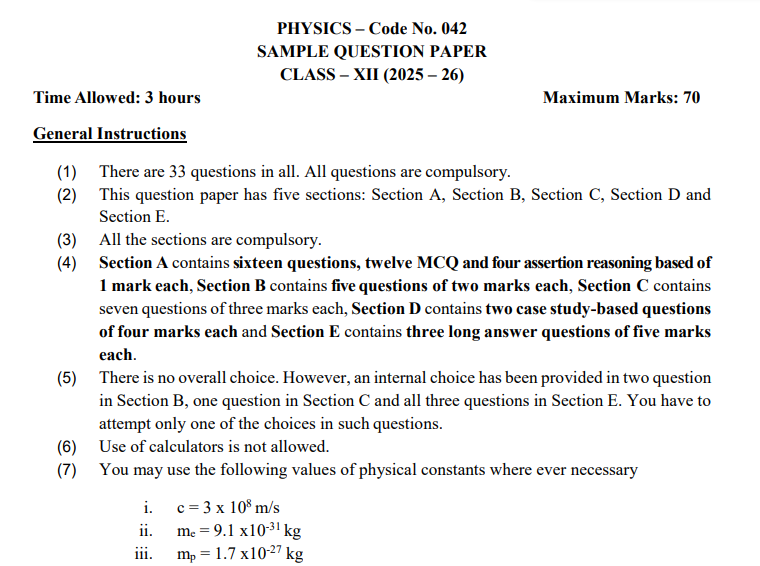
The CBSE Class 12 Physics Sample Paper 2025-26 is the official blueprint for the upcoming board exam (Code 042). It contains 33 compulsory questions divided into five sections (A–E) with MCQs, assertion-reason, very short, short, case-study, and long-answer questions. The paper is for 70 marks theory (with 3 hours duration) and follows the same pattern as last year, with internal choices in select questions. It helps students understand question types, marks distribution, and exam format before the actual board exam. You can download the sample paper and marking scheme from CBSE’s academic website.
CBSE Class 12 Physics Code 042 Exam Pattern 2026
The detailed CBSE Class 12 Physics (Subject Code: 042) Exam Pattern for 2026 presented in tabular form — covering both theory and practical components, question types, marks distribution, and key details you’ll need for preparation:
CBSE Class 12 Physics (042) Exam Pattern – 2026 (Theory + Practical)
📗 Overall Structure
| Component | Marks | Duration | Mode |
|---|---|---|---|
| Theory Paper | 70 | 3 Hours | Offline (Pen & Paper) |
| Practical/Internal Assessment | 30 | As per schedule | School/Board‑conducted |
| Total | 100 Marks | — | — |
Theory Exam Pattern (70 Marks)
| Section | Type of Questions | No. of Questions | Marks Each | Total Marks |
|---|---|---|---|---|
| A | MCQs + Assertion‑Reason | 16 | 1 | 16 |
| B | Very Short Answer (2‑mark) | 5 | 2 | 10 |
| C | Short Answer (3‑mark) | 7 | 3 | 21 |
| D | Case‑Study / Source‑Based | 2 | 4 | 8 |
| E | Long Answer (5‑mark) | 3 | 5 | 15 |
| Total | 33 Questions | — | 70 Marks |
Key points:
-
Section A includes multiple‑choice and assertion‑reason questions.
-
The mix assesses conceptual clarity, application, analysis, and reasoning.
Unit‑Wise Marks Distribution (Theory)
| Unit No. | Unit Name | Approx. Marks |
|---|---|---|
| I | Electrostatics (Electric Charges & Fields; Electrostatic Potential & Capacitance) | 16 |
| II | Current Electricity | 6 |
| III | Magnetic Effects of Current & Magnetism | 9 |
| IV | Electromagnetic Induction & Alternating Current | 6 |
| V | Electromagnetic Waves | 4 |
| VI | Optics (Ray & Wave Optics) | 14 |
| VII | Dual Nature of Radiation & Matter | 5 |
| VIII | Atoms & Nuclei | 7 |
| IX | Electronic Devices | 7 |
| Total (Approx.) | 70 Marks |
Note: Some minor variation may occur in exact breakup, but total remains 70.
Practical / Internal Assessment (30 Marks)
| Component | Marks |
|---|---|
| Two Experiments (one each from two sections) | 7 + 7 |
| Practical Record (Experiments & Activities) | 5 |
| One Activity (any section) | 3 |
| Investigatory Project | 3 |
| Viva (on experiments & project) | 5 |
| Total Practical Marks | 30 |
Practical Details:
-
Students must complete 8 experiments minimum (4 from each section) and 6 activities (3 from each section).
-
Practical includes record work, individual activity, project, and viva.
Question Paper Design – Quick Summary
| Feature | Description |
|---|---|
| Total Theory Questions | 33 |
| Total Theory Marks | 70 |
| Exam Duration | 3 Hours |
| Question Types | MCQs, Assertion‑Reason, Short, Long, Case/Source based |
| Practical Marks | 30 |
Tips for Preparation
-
Focus on high‑weightage units like Electrostatics, Optics, and Electromagnetic Waves.
-
Get comfortable with case‑study and competency based questions as per latest pattern.
-
Complete all required practical experiments and prepare a neat record file.
CBSE Class 12th Physics Sample Paper 2026 with Solution PDF Download
CBSE has released the official Class 12 Physics Sample Question Paper 2026 and its marking scheme/solutions on the CBSE Academic website. These PDFs show the latest exam pattern, question types, and answers so you can practice effectively for the 2026 board exam. You can download the Physics sample paper and solution PDF for free from the official CBSE academic site (cbseacademic.nic.in under Sample Question Paper & Marking Scheme 2025‑26). Solving these will help you understand the structure, difficulty level, and marking scheme before the actual exam.
| CBSE Class 12 Physics Sample Paper 2025-26 with Solution Download Link | ||
| Subject | Sample Paper Download Link | MS Download Link |
| CBSE Class 12th Physics Sample Paper with Solution (English) | Physics-Paper-SQP-2025-26 | Physics-paper-MS-2025-26 |
| CBSE Class 12th Physics Sample Paper with Solution (Hindi) | Physics-Paper-SQP_hindi-2025-26 | Physics-Paper-MS_hindi-2025-26 |
CBSE Class 12 Physics Previous Year Sample Paper PDF
Students who are studying for the Class 12 final exams can download past year’s physics question papers with solutions from the table below. Revising previous years’ papers will also help with practicing the different types of questions and effectively planning for exams. By revising year-wise sample papers, students can look back on the level of their preparation, prioritize difficult topics, and improve on weaker areas. Regular practice will also keep students confident and focused on managing time in the exam. Study these physics papers to prepare well and systematically.
| CBSE Class 12 Physics Previous Year Sample Paper PDF | ||
| Year | Sample Question Paper | Solution PDF |
| CBSE Class 12th Physics Sample Paper 2024-25 | Click Here | Click Here |
| CBSE Class 12th Physics Sample Paper 2023-24 | Click Here | Click Here |
| CBSE Class 12th Physics Sample Paper 2022-23 | Click Here | Click Here |
| CBSE Class 12th Physics Sample Paper 2021-22 Term 1 | Click Here | Click Here |
| CBSE Class 12th Physics Sample Paper 2021-22 Term 2 | Click Here | Click Here |
| CBSE Class 12th Physics Sample Paper 2020-21 | Click Here | Click Here |
| CBSE Class 12th Physics Sample Paper 2019-20 | Click Here | Click Here |
| CBSE Class 12th Physics Sample Paper 2018-19 | Click Here | Click Here |
| CBSE Class 12th Physics Sample Paper 2017-18 | Click Here | Click Here |
| CBSE Class 12th Physics Sample Paper 2016-17 | Click Here | Click Here |
| CBSE Class 12th Physics Sample Paper 2015-16 | Click Here | Click Here |
Class 12th Physics Sample Questions with Solutions
SECTION A
Q1. If a charged hollow sphere and a solid sphere of aluminum and copper of equal radii are in electrostatic equilibrium, then which of the following statements is true?
(A) Both spheres have equal charges.
(B) The hollow sphere will have more charge than the solid sphere at its surface.
(C) The aluminum sphere will have more charge on its surface than the copper sphere.
(D) If a hollow sphere is also made up of aluminum, then it will have more charge.
Answer: (A) Both spheres have equal charges.
Q2. Which of the following statements is true for the radio waves and the gamma rays?
(A) The energy of gamma rays is less than that of the radio waves.
(B) The frequency of the radio waves is higher than that of gamma rays.
(C) The radio waves and the gamma rays have the same energy.
(D) The energy of radio waves is less than that of the gamma rays.
Answer: (D) The energy of radio waves is less than that of the gamma rays.
Q3. A charged particle is projected along the axis of a current-carrying loop. Which of the following statements is true?
(A) The acceleration of the charged particle will depend on the velocity with which it is projected.
(B) The acceleration of the charged particle will depend on the magnitude of the current passing through the coil.
(C) The acceleration of the charged particle will depend on the radius of the coil.
(D) The charged particle will move with constant velocity.
Answer: (D) The charged particle will move with constant velocity.
Q4. Two small identical magnets are allowed to fall freely, one through a vertical solenoid of 20 m made up of copper and another in air through the same vertical distance. The time taken by the two magnets to fall will be
(A) same in both cases.
(B) more for the magnet falling in the air.
(C) more for the magnet falling through the solenoid.
(D) infinite.
Answer: (C) more for the magnet falling through the solenoid.
Q5. The ratio of the nuclear densities of two nuclei having the mass numbers 8 and 27 is
(A) 8:27
(B) 3:2
(C)2:3
(D) 1:1
Answer: (D) 1:1
For Questions 6 to 10, two statements are given, one labelled Assertion (A) and the other labelled Reason (R). Select the correct answer to these questions from the options given below.
(A) Both Assertion and Reason are true, and Reason is the correct explanation of Assertion.
(B) Both Assertion and Reason are true, but Reason is not the correct explanation of Assertion.
(C) Assertion is true but Reason is false.
(D) Both Assertion and Reason are false.
Q6. Assertion (A)The tal energy of an electron in a hydrogen atom is negative.
Reason (R): The centripetal force is provided by the electrostatic force.
Answer: (B) both Assertion and Reason are true, but Reason is not the correct explanation of Assertion.
Q7. Assertion (A): The critical angle of light passing from glass to air is minimum for violet colour.
Reason (R): The wavelength of blue light is greater thanthatt of other colours
Answer: (C) Assertion is true but Reason is false.
Q8. Assertion (A): Two light sources emitting waves of similar wavelengths are coherent.
Reason (R): Two light sources emitting waves having zero or constant phase difference are known as coherent sources.
Answer: (D) Both Assertion and Reason are false
Importance of Solving Class 12 Physics Sample Papers
Solving Class 12 Physics sample papers is crucial for effective exam preparation. It familiarizes students with the exam pattern, marking scheme, and the variety of questions, enhancing time management skills during the actual test. Regular practice helps identify strong and weak areas, allowing focused revision. It reinforces concepts, improves problem-solving speed, and builds confidence. Moreover, attempting previous years’ questions and sample papers reduces exam anxiety, as students get a realistic experience of the pressure and type of questions asked. Overall, consistent practice with sample papers boosts accuracy, speed, and readiness, significantly increasing the chances of scoring high marks.
FAQs
1. What is the exam pattern for Class 12 Physics 2026?
-
The paper is of 70 marks, with a total duration of 3 hours.
-
It consists of four sections: A, B, C, and D.
-
Questions include Very Short Answer (VSA), Short Answer (SA), and Long Answer (LA) types.
-
Internal choices are provided in some questions.
-
Numerical problems carry significant weight.
2. How many questions are there in the sample paper?
-
Typically, the paper has 10–12 questions, divided as:
-
Section A: 5 questions (1 mark each)
-
Section B: 5 questions (2 marks each)
-
Section C: 12 questions (3–5 marks each)
-
Section D: 2 questions (6–7 marks each)
-
-
Exact distribution may vary slightly in the 2026 sample paper.
3. Are there numerical problems in the sample paper?
Yes. Expect 3–5 numerical problems on topics like:
-
Current electricity and Ohm’s law
-
Capacitance and energy stored in capacitors
-
Magnetic effects of current
-
Electromagnetic induction
-
Modern physics (photoelectric effect, nuclear physics)
4. Are derivation questions included?
Yes, derivations from mechanics, electrostatics, and wave optics are commonly asked.
-
Example: Derive the expression for energy stored in a capacitor or the focal length of a combination of lenses.
5. What is the marking scheme?
-
1 mark for VSA questions
-
2–3 marks for SA-I questions
-
3–5 marks for SA-II questions
-
6–7 marks for LA questions
-
Internal choices do not affect the total marks.
6. Are diagrams important in the sample paper?
Yes, diagrams carry marks. You may be asked to:
-
Draw ray diagrams for lenses and mirrors
-
Draw waveforms (e.g., oscillations)
-
Draw circuit diagrams in electricity questions
7. Which chapters are most important?
Based on the sample paper trends:
-
Electrostatics and Current Electricity
-
Magnetism and Electromagnetic Induction
-
Optics (Ray Optics and Wave Optics)
-
Modern Physics (Photoelectric Effect, Atomic and Nuclear Physics)
-
Semiconductors and Communication Systems
8. Are numerical answers expected in standard units?
Yes. Always use SI units. Marks can be deducted for:
-
Wrong units
-
Incorrect significant figures
9. How much time should I spend on each section?
-
Section A (VSA) → 15–20 minutes
-
Section B (SA-I) → 20–25 minutes
-
Section C (SA-II) → 60–70 minutes
-
Section D (LA) → 50–60 minutes
-
Leave 10–15 minutes for revision
10. Any tips for solving the sample paper efficiently?
-
Read questions carefully and highlight key data.
-
Start with numerical and derivation questions first.
-
Draw neat diagrams; label all parts clearly.
-
Use formulas with correct symbols and units.
-
Review previous years’ papers for commonly repeated concepts.
About The Author
