
Grade 3 Math Curriculum 2026: Third grade represents a pivotal shift in elementary mathematics—the year when students move from mastering addition and subtraction to building the multiplicative reasoning that underpins all future algebra and higher math. For the 2025–2026 and 2026–2027 school years, the curriculum remains anchored in the Common Core State Standards, though states like Maryland have recently adopted revised standards that refine expectations . This detailed analysis examines the complete Grade 3 mathematics syllabus, providing parents, educators, and curriculum developers with a thorough understanding of what students learn and why it matters.
Why Grade 3 Is the “Pivot Year”
Grade 3 is widely recognized as the year mathematics fundamentally transforms. Students encounter three major conceptual shifts simultaneously: multiplication, division, and fractions as numbers . These are not merely new topics to memorize—they represent a new way of thinking about quantity and relationships.
Algebra, which students will encounter in middle school, depends entirely on multiplication, division, and fractional reasoning. A student who leaves third grade without fluent multiplication facts spends subsequent years performing slow arithmetic rather than learning new mathematical concepts. Conversely, students who master these foundations position themselves for accelerated pathways and competition mathematics .
Structure of the Grade 3 Math Curriculum
The Grade 3 syllabus is organized around five domains defined by the Common Core State Standards:
-
Operations and Algebraic Thinking (OA) — the heart of the grade
-
Number and Operations in Base Ten (NBT)
-
Number and Operations—Fractions (NF)
-
Measurement and Data (MD)
-
Geometry (G)
Scope and sequence documents for the 2025–2026 and 2026–2027 school years allocate the majority of instructional time—typically over 80%—to the “major work” of the grade, with multiplication, division, and fractions receiving the greatest emphasis .
Detailed Grade 3 Math Curriculum 2026 by Domain
Operations and Algebraic Thinking
This domain receives the greatest instructional focus and represents the defining work of third grade.
Multiplication Concepts (3.OA.A.1, 3.OA.A.3)
Students interpret products of whole numbers as the total number of objects in equal groups. For example, they understand that 5 × 7 means five groups of seven objects each . Instruction uses multiple representations:
-
Equal groups and arrays
-
Repeated addition
-
Number lines
-
Picture and bar graphs as entry points
Division Concepts (3.OA.A.2, 3.OA.A.3)
Division is introduced as both partitive (finding how many in each group) and quotative (finding how many groups). For instance, 56 ÷ 8 can be interpreted as sharing 56 objects equally among 8 groups or as dividing 56 into groups of 8 . The relationship between multiplication and division is emphasized as an inverse operation.
Fact Fluency (3.OA.C.7)
By the end of Grade 3, students must fluently multiply and divide within 100 and know from memory all products of two one-digit numbers . This fluency is typically developed through a carefully sequenced introduction of fact families. The 2026–2027 scope and sequence from Maryland shows this progression :
| Timeframe | Facts Introduced |
|---|---|
| Quarter 1 | Multiplication with 2s, 10s, 5s, 0s, 1s |
| Quarter 2 | Division with 2s, 10s, 5s, 1s |
| Quarter 3 | Multiplication and division with 9s, 4s |
| Quarter 4 | Multiplication and division with 3s, 6s |
Properties of Operations (3.OA.B.5)
Students apply the commutative, associative, and distributive properties as strategies for multiplication and division, though formal terms are not required . This foundational work enables students to break apart unknown facts using known ones—for example, using 8 × 5 = 40 and 8 × 2 = 16 to find 8 × 7 = 56 via the distributive property .
Two-Step Word Problems (3.OA.D.8)
Students solve two-step word problems using all four operations, represent them with equations using letters for unknowns, and assess reasonableness of answers using estimation and rounding . This is frequently cited as one of the most challenging aspects of third grade because it requires students to read a situation, determine which operations to use and their sequence, and check whether the answer makes sense .
Number and Operations in Base Ten
Place Value (3.NBT.A.1)
Students expand their understanding of place value to numbers within 10,000, learning to read, write, compare, and order numbers . Rounding to the nearest 10 and 100 is introduced using place value understanding .
Addition and Subtraction Fluency (3.NBT.A.2)
Students fluently add and subtract within 1,000 using strategies and algorithms based on place value, properties of operations, and the relationship between addition and subtraction. While the standard algorithm is addressed, districts like Maryland explicitly encourage students to use “any efficient strategy that produces an accurate answer,” noting that the US standard algorithm receives less emphasis in the revised 2025 Maryland standards .
Multiplying by Multiples of 10 (3.NBT.A.3)
Students multiply one-digit whole numbers by multiples of 10 in the range 10–90 (e.g., 9 × 80, 5 × 60) using strategies based on place value and properties .
Number and Operations—Fractions
Fractions are a significant new area of study in Grade 3. Expectations are limited to denominators 2, 3, 4, 6, and 8 .
Understanding Fractions as Numbers (3.NF.A.1, 3.NF.A.2)
Students understand a fraction a/b as the quantity formed by a parts of size 1/b. They represent fractions on number line diagrams, marking off equal intervals between 0 and 1 . The 2026 syllabus includes a new emphasis on “fractions of a set,” reflecting updated Maryland standards .
Equivalent Fractions (3.NF.A.3)
Students recognize and generate simple equivalent fractions (e.g., 1/2 = 2/4, 4/6 = 2/3) using visual fraction models. They also express whole numbers as fractions (e.g., 3 = 3/1) and recognize fractions equivalent to whole numbers .
Comparing Fractions (3.NF.A.3d)
Students compare two fractions with the same numerator or same denominator by reasoning about their size, recording comparisons with >, =, or < symbols .
Measurement and Data
Area (3.MD.C.5–7)
Area concepts receive substantial attention, particularly as a way to connect multiplication to geometry. Students measure areas by counting square units, relate area to multiplication of side lengths, and recognize area as additive—finding areas of rectilinear figures by decomposing them into non-overlapping rectangles . This represents a major milestone: understanding that multiplication has a shape .
Perimeter (3.MD.D.8)
Students solve real-world and mathematical problems involving perimeter, including finding unknown side lengths and comparing rectangles with the same perimeter but different areas .
Time, Mass, and Volume (3.MD.A.1–2)
Students tell and write time to the nearest minute, solve elapsed time problems, and measure and estimate liquid volumes and masses using standard units (grams, kilograms, liters) .
Data Representation (3.MD.B.3–4)
Students draw scaled picture graphs and scaled bar graphs, where one picture or square may represent 2, 5, or 10 units. They solve “how many more” and “how many less” problems using these graphs. They also generate measurement data in halves and fourths of an inch and display it on line plots .
Geometry
Classifying Shapes (3.G.A.1)
Students understand that shapes in different categories may share attributes, recognizing rhombuses, rectangles, and squares as examples of quadrilaterals . They draw examples of quadrilaterals that do not belong to these subcategories.
Partitioning Shapes (3.G.A.2)
Students partition shapes into parts with equal areas and express the area of each part as a unit fraction of the whole .
Variations in Scope and Sequence
While the Common Core standards define what students should learn, districts and states organize instruction differently. Several models are used for the 2025–2027 school years:
Illustrative Mathematics Model (used in Maryland and other states): Organizes instruction into eight units over the school year, with significant flexibility built in for teachers. The sequence begins with multiplication, then area, then addition/subtraction within 1,000, then division, fractions, and measurement .
Florida Accelerated Mathematics Plan: Compresses Grade 3 standards into fewer weeks and accelerates advanced students into Grade 4 content, with an emphasis on quarterly fluency expectations .
Virginia and Other State Models: Some districts combine units differently, such as grouping place value, addition, and subtraction together before introducing multiplication, or placing geometry and measurement later in the year .
Despite these variations, the core content remains consistent: multiplication and division facts, fractions, area, and data interpretation are universal priorities.
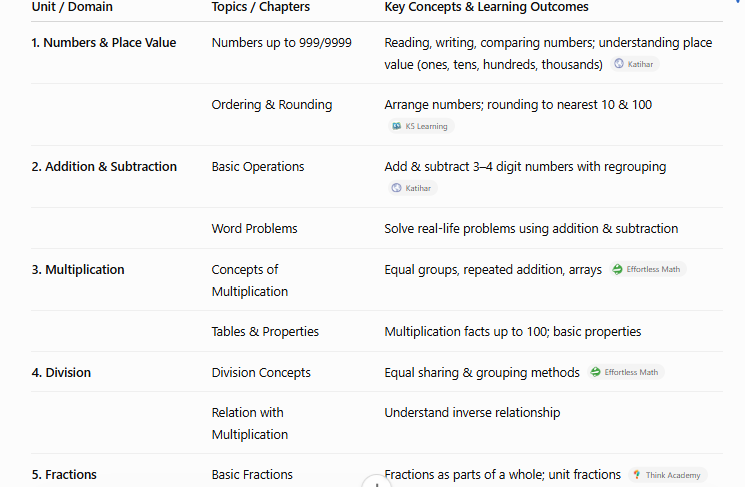
Grade 3 Math Curriculum 2026
| Unit / Domain | Topics / Chapters | Key Concepts & Learning Outcomes |
|---|---|---|
| 1. Numbers & Place Value | Numbers up to 999/9999 | Reading, writing, comparing numbers; understanding place value (ones, tens, hundreds, thousands) |
| Ordering & Rounding | Arrange numbers; rounding to nearest 10 & 100 | |
| 2. Addition & Subtraction | Basic Operations | Add & subtract 3–4 digit numbers with regrouping |
| Word Problems | Solve real-life problems using addition & subtraction | |
| 3. Multiplication | Concepts of Multiplication | Equal groups, repeated addition, arrays |
| Tables & Properties | Multiplication facts up to 100; basic properties | |
| 4. Division | Division Concepts | Equal sharing & grouping methods |
| Relation with Multiplication | Understand inverse relationship | |
| 5. Fractions | Basic Fractions | Fractions as parts of a whole; unit fractions |
| Comparing Fractions | Number line representation, equivalent fractions | |
| 6. Measurement | Length, Weight, Capacity | Use standard units (cm, kg, litre) |
| Time & Money | Read clock (nearest minute), solve money problems | |
| 7. Geometry | 2D & 3D Shapes | Identify shapes, sides, corners, patterns |
| Area & Perimeter | Measure using simple methods (counting squares) | |
| 8. Data Handling | Graphs & Charts | Bar graphs, pictographs, line plots |
| Interpretation | Read and analyze simple data | |
| 9. Patterns & Problem Solving | Number Patterns | Identify and extend patterns |
| Logical Thinking | Solve 1–2 step word problems |
Key Highlights of Grade 3 Math (2026)
- Introduction to multiplication, division, and fractions (major transition year)
- Focus on conceptual understanding + real-life application
- Development of problem-solving and logical thinking skills
- Emphasis on activity-based and NEP 2020-aligned learning
Expected Student Outcomes by Year-End
By the end of Grade 3, students should demonstrate :
-
Fact Fluency: Memorized recall of all products of two one-digit numbers and related division facts
-
Multiplication/Division Application: Solving word problems using all four operations, including two-step problems
-
Fraction Understanding: Representing fractions on number lines, generating equivalent fractions, and comparing fractions
-
Measurement: Telling time to the minute, calculating area and perimeter, interpreting scaled graphs
-
Place Value: Reading, writing, rounding, comparing, and ordering numbers within 10,000
-
Geometric Reasoning: Classifying quadrilaterals and partitioning shapes into equal areas
Readiness and Acceleration Pathways
Grade 3 math readiness depends heavily on fluent addition and subtraction within 100, comfort with three-digit place value, and recognition of equal groups and arrays .
After Grade 3, three pathways emerge :
-
On-grade track: Proceed to Grade 4 multi-digit multiplication, division, and fraction operations
-
Accelerated track: Complete Grade 4 content a year early, positioning for advanced middle school mathematics
-
Competition track: Add Math Kangaroo and AMC 8 preparation while advancing through accelerated content
Conclusion
The US Grade 3 math curriculum for 2026 represents a carefully designed progression from additive to multiplicative reasoning. The syllabus centers on five interconnected domains, with multiplication, division, and fractions as the foundational pillars. While specific scope and sequence arrangements vary by district—reflecting updated state standards like Maryland’s 2025 revisions—the core expectations remain consistent: students must leave third grade with fluent multiplication and division facts, a solid understanding of fractions as numbers, and the ability to solve multi-step problems that integrate all four operations.
For parents and educators, the takeaway is clear: the skills built in Grade 3 are not just grade-level objectives but the bedrock of all future mathematical learning. Mastery of these concepts determines a student’s trajectory through elementary, middle, and high school mathematics—making third grade arguably the most important year in elementary math education.
About The Author
