
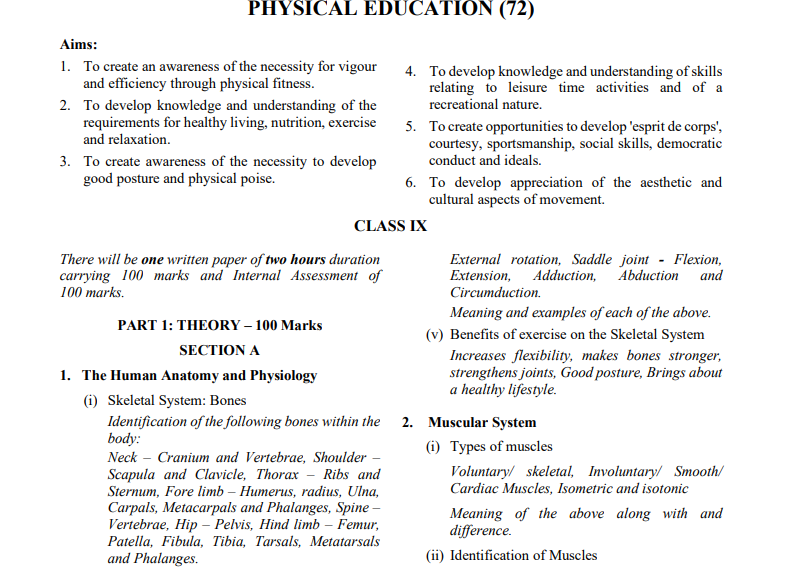
The ICSE Class 10 Physical Education Syllabus for 2025-26 provides a comprehensive understanding of human growth, physical fitness, and sports education. It includes theoretical knowledge and practical skills across various sports, physical fitness tests, health education, and career opportunities in the field of physical education. The syllabus also emphasizes the importance of maintaining physical well-being, safety during sports, and developing key skills like teamwork, coordination, and endurance.
ICSE Class 10 Physical Education Syllabus 2025-26
Part 1: Theory – 100 Marks
Section A
1. Human Growth and Development
(i) Growth and Development
- Meaning: Growth refers to physical changes, while development includes emotional, social, and intellectual changes.
- Difference: Growth is quantitative (e.g., height and weight), while development is qualitative (e.g., behavior, skills).
Stages of Development:
| Stage | Age Range |
|---|---|
| Infancy | 0 to 5 years |
| Childhood | 5 to 12 years |
| Adolescence | 12 to 19 years |
| Adulthood | 19 to 65 years and above |
(ii) Factors Influencing Human Growth and Development:
- Hereditary: Genetic makeup.
- Environment: Surroundings and upbringing.
- Gender: Male/female physiological traits.
- Nationality: Cultural and regional influences.
- Nutrition: Diet and nourishment.
2. Physical Education
(i) Meaning of Physical Education: The process of learning and maintaining physical fitness and health.
(ii) Objectives:
| Development | Key Areas |
|---|---|
| Physical | Body strength, endurance, flexibility. |
| Psychological | Stress relief and mental focus. |
| Social | Teamwork and communication. |
| Emotional | Confidence and self-control. |
3. Body Types
Endomorph (round body), Mesomorph (muscular body), and Ectomorph (slim body).
4. Physical Fitness
(i) Meaning and Importance: Physical fitness improves health, energy levels, and overall well-being.
(ii) Components of Physical Fitness:
| Component | Description |
|---|---|
| Cardiovascular/Respiratory Endurance | Ability of the heart and lungs to perform efficiently. |
| Strength | Muscle power. |
| Flexibility | Range of motion in joints. |
| Speed | Quickness. |
| Agility | Ability to change direction quickly. |
| Balance | Stability during movement. |
(iii) Factors Affecting Physical Fitness: Heredity, nutrition, environment, training, illness, self-motivation, emotional stability, lifestyle, posture.
5. Sports Training
(i) Meaning: A structured program to improve sports skills and fitness.
(ii) Importance and Objectives:
| Benefit | Description |
|---|---|
| Strength & Endurance | Builds physical resilience. |
| Improved Skills | Enhances performance. |
| Mental Confidence | Boosts self-esteem and focus. |
| Injury Prevention | Reduces risks of injury. |
(iii) Principles of Sports Training: Individuality, specificity, progression, overload, adaptation, recovery, and reversibility.
6. Safety in Sports
(i) Sports-Related Injuries: Common injuries include muscle strain, torn ligaments, fractures, and concussions.
(ii) Prevention: Warm-ups, proper training, using protective gear, understanding game rules, and resting between workouts.
7. Health Education
(i) Meaning and Importance: Promotes healthy lifestyles and awareness.
(ii) Nutrition: A balanced diet includes carbohydrates, proteins, fats, vitamins, minerals, water, and fiber.
(iii) Dietary Modification for Sportspersons: Includes specific calorie and nutrient needs for athletes.
8. Careers in Physical Education
Possible careers include coach, teacher, sports manager, commentator, and professional athlete.
Section B: Team Games
Students will study the rules, skills, techniques, and tournaments related to two of the following games:
- Cricket
- Football
- Hockey
- Basketball
- Volleyball
- Badminton
Part 2: Internal Assessment – 100 Marks
Assessment by Teacher (50 Marks)
- Skill and performance in two games or activities of choice.
- Attendance and participation in voluntary activities.
- Representation of the school at different levels.
Assessment by External Examiner (50 Marks)
- Physical Efficiency Tests: Includes 50m run, long jump, shuttle run, sit-ups, and push-ups.
- Specialization Tests: Based on chosen activities like athletics, gymnastics, swimming, yoga, or dance.
ICSE Class 10 Physical Education Syllabus 2026 PDF Download
Students can download the ICSE Class 10 Physical Education Syllabus 2025-26 in PDF format for easy reference. The PDF includes detailed information on theory topics, practical assessments, and game-specific rules. It is a useful guide for preparing effectively for the exams and understanding the requirements of internal and external assessments.
ICSE Class 10 Physical Education Syllabus, Click Here To Download PDF
Books for ICSE Class 10 Physical Education Syllabus
List of books for ICSE Class 10 Physical Education that align with the latest CISCE syllabus and will help you prepare effectively for your exams:
Main Textbooks (Core Study Material)
These books cover the full syllabus — theory, concepts, fitness, health education, sports training, games, etc.
-
Oswal Physical Education Textbook for ICSE Class 10 – Amit Rawat & Vinod Pillai (Oswal Publishers)
– Comprehensive coverage of the latest ICSE Class 10 Physical Education syllabus with theory and games. -
Nootan ICSE Board Physical Education Text Book for Class 10 – M.L. Kamlesh (Nageen Prakashan)
– Simplified language with diagrams, practice questions, objective & subjective questions aligned to ICSE syllabus. -
Evergreen ICSE Candid Physical Education for Class 10 – Evergreen Publications
– Good for understanding fitness, sports, athletics and other topics in a simple way. -
New Saraswati ICSE Physical Education Textbook for Class 10 – Saraswati House
– Another textbook option that follows the current syllabus with clear explanations.
Practice & Revision Books
These are not syllabus textbooks but excellent for exam practice and revision:
-
Oswaal ICSE Class 10 Physical Education Previous Years Solved Papers (Year-wise)
– Helps practise real board questions with solutions from past years. -
Oswaal ICSE Class 10 Physical Education Question Bank (Chapterwise & Topicwise)
– Includes solved papers, competency-based questions, chapter notes & revision tools. -
Oswaal ICSE Class 10 Physical Education Sample Question Papers (for Board)
– Offers full-length practice papers aligned with the latest pattern.
FAQs on ICSE Class 10 Physical Education Syllabus
1. What topics are included in the ICSE Class 10 Physical Education syllabus?
The syllabus includes:
-
Human Growth and Development – meaning, stages and influencing factors
-
Physical Education – meaning and objectives
-
Body Types – endomorph, mesomorph, ectomorph
-
Physical Fitness – components and factors
-
Sports Training – meaning, principles and objectives
-
Safety in Sports – common injuries and prevention
-
Health Education – nutrition, balanced diet, meal planning
-
Careers in Physical Education
-
Team Games (Section B) – rules, skills and training methods for games like Cricket, Football, Hockey, Basketball, Volleyball, Badminton.
2. How is the Physical Education exam structured?
-
One written paper of 2 hours carrying 100 marks.
-
Paper is divided into Section A (theory topics like fitness, training, etc.) and Section B (questions on two team games of choice).
-
There is usually an Internal Assessment/Project or Practical component too as per syllabus guidelines.
3. What types of questions are asked in the exam?
The board may include a mix of:
Short answers
Long answers
Definitions and explanations
Rule-based questions on games
Skill and training-based questions
Practice with specimen and past papers to get familiar with the style of questions.
4. Do I have to write about all the games in Section B?
No, you only need to answer questions on any two team games of your choice (e.g., Cricket, Football, Hockey, Basketball, Volleyball, Badminton).
5. Is Physical Education theory enough, or do I need to study practicals?
Both theory and practical/internal assessment are important.
Internal assessment may include practical activities, projects or participation records. Refer to your school’s guidance for the exact details.
6. How can I prepare effectively for this syllabus?
Read and understand textbook definitions and concepts
Focus on key theory topics like fitness, training, nutrition
Learn rules, skills and techniques of chosen games
Practice past questions and sample papers for pattern awareness
7. Are nutrition and meal planning included in the syllabus?
Yes. Topics like balanced diet, basic food constituents, dietary modification for sportspersons and sample meal plans are part of the syllabus.
8. Where can I find the official syllabus PDF and specimen paper?
-
You can download the official syllabus PDF and specimen papers for practice from CISCE or educational portal links that host the latest board syllabus and question papers.
-
Practising the specimen papers helps understand important questions.
9. Is the Physical Education board exam difficult?
Difficulty varies by student’s preparation. Many students find it manageable if they focus on understanding concepts and memorizing key facts. Practice also builds confidence. (Reddit student discussions reflect mixed student experiences about difficulty based on preparation)
About The Author
