
The SOF International Mathematics Olympiad (IMO) Syllabus 2025–26 serves as a comprehensive guide for students from Class 1 to 12 preparing for one of the most prestigious school-level competitive exams. Designed to strengthen mathematical understanding and analytical thinking, the IMO syllabus is structured according to each class’s curriculum while also introducing logical reasoning and problem-solving concepts that go beyond regular school textbooks. The exam helps students build a strong foundation in mathematics, develop accuracy, and enhance their confidence to tackle complex questions at an early age.
For the academic year 2025–26, the SOF IMO syllabus is divided into three sections for most classes: Logical Reasoning, Mathematical Reasoning, and Everyday Mathematics, with an added Achievers Section that includes higher-order questions to test conceptual clarity. Each class follows a progressive pattern, ensuring smooth learning transitions and holistic development of mathematical skills. Whether a student is in primary school or senior secondary classes, the syllabus is carefully curated to align with major educational boards like CBSE, ICSE, and State Boards, making preparation easier and more relevant.
The SOF International Mathematics Olympiad (IMO) syllabus and exam pattern for Classes 1 to 12, including both Level 1 and Level 2 exams. The information below is based on the official SOF guidelines and trusted educational summaries.
Overview: SOF IMO
The International Mathematics Olympiad (IMO), conducted by the Science Olympiad Foundation (SOF), tests mathematical ability, reasoning skills, everyday math understanding, and higher-order problem-solving through a structured exam format.
Students from classes 1 to 12 can participate:
-
Level 1: All registered students appear.
-
Level 2: Only qualified students from Level 1 (Classes 3–12) appear.
-
Note: Classes 1 & 2 are ranked based on Level 1; they don’t have Level 2.
-
Exam Pattern (Both Levels)
Level 1 (All Classes 1–12)
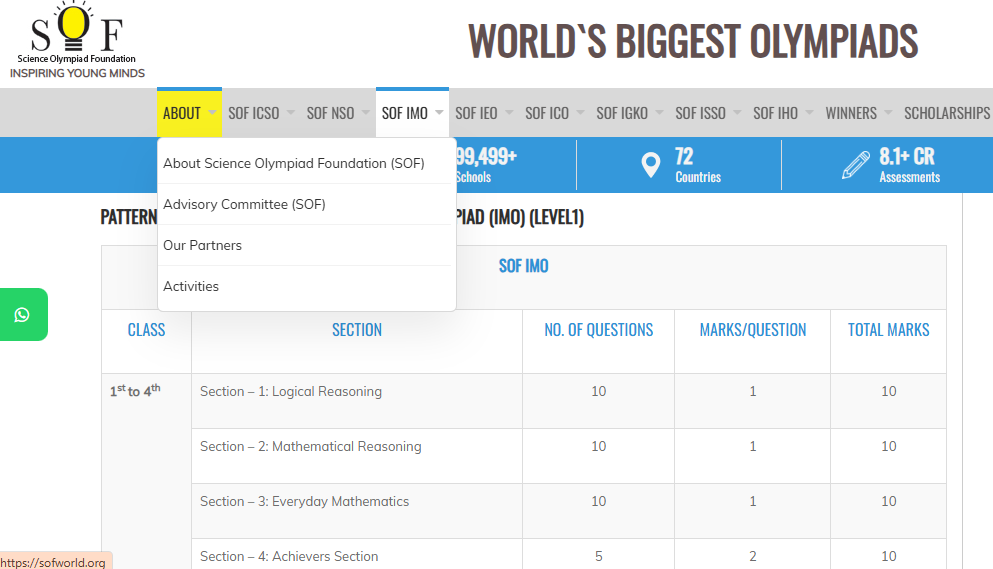
| Classes | Sections | No. of Questions | Marks/Question | Total Marks |
|---|---|---|---|---|
| 1 to 4 | Logical Reasoning | 10 | 1 | |
| Mathematical Reasoning | 10 | 1 | ||
| Everyday Mathematics | 10 | 1 | ||
| Achievers Section | 5 | 2 | ||
| Total | 35 | 40 | ||
| 5 to 10 | Logical Reasoning | 15 | 1 | |
| Mathematical Reasoning | 20 | 1 | ||
| Everyday Mathematics | 10 | 1 | ||
| Achievers Section | 5 | 3 | ||
| Total | 50 | 60 | ||
| 11 & 12 | Logical Reasoning | 15 | 1 | |
| Mathematical Reasoning / Applied Math | 20 | 1 | ||
| Everyday Mathematics | 10 | 1 | ||
| Achievers Section | 5 | 3 | ||
| Total | 50 | 60 |
✔ Questions are multiple-choice (MCQs) with a mix of easy to advanced problems.
✔ Level 1 questions draw 60% from current class syllabus and 40% from previous class (except Achievers Section).
Level 2 (Selected Students — Classes 3–12)
| Classes | Sections | No. of Questions | Marks/Question | Total Marks |
|---|---|---|---|---|
| 3 & 4 | Mathematics | 30 | 1 | |
| Achievers Section | 5 | 2 | ||
| Total | 35 | 40 | ||
| 5 to 10 | Mathematics | 45 | 1 | |
| Achievers Section | 5 | 3 | ||
| Total | 50 | 60 | ||
| 11 & 12 | Mathematics | 25 | 1 | |
| Mathematical Reasoning / Applied Math | 20 | 1 | ||
| Achievers Section | 5 | 3 | ||
| Total | 50 | 60 |
Level 2 is generally harder and focused more on current class syllabus and logical problem-solving.
Section-wise Syllabus Highlights
1) Logical Reasoning
-
Patterns, series, analogies, odd one out
-
Classification, embedded figures, coding-decoding (higher classes include verbal and non-verbal reasoning)
2) Mathematical Reasoning
-
Concepts from classroom mathematics:
-
Counting, number sense, operations, fractions (lower classes)
-
Algebra, geometry, mensuration, data handling, probability (middle)
-
Advanced topics like functions, trigonometry, calculus, matrices (classes 11–12)
-
3) Everyday Mathematics
-
Practical application of mathematical concepts based on (2) above — includes daily life math problems, simple computations, graph reading, etc.
4) Achievers Section
-
Higher-order thinking questions designed to stretch problem-solvers — more challenging than regular MCQs.
SOF IMO Syllabus 2025-26
The SOF IMO Syllabus for 2025–2026 helps students reinforce what they have learned in the classroom by covering the essential mathematical curriculum for each grade. It also includes an Achievers Section to assess higher-order thinking and sophisticated problem-solving abilities, as well as important sections on logical reasoning.
SOF IMO Class 1 Syllabus
-
Section- 1 (Logical Reasoning): Patterns, Odd One Out, Measuring Units, Geometrical Shapes, Spatial Understanding, Grouping of Figures, Analogy, Ranking Test, Problems based on Figures.
-
Section- 2 (Mathematical Reasoning): Numerals, Number Names, Number Sense (2-digit numbers), Addition, Subtraction, Lengths, Weights and Comparisons, Time, Money, Geometrical Shapes and Solids.
-
Section- 3 (Everyday Mathematics): Syllabus as per Section–2.
-
Section- 4 (Achievers Section): Higher Order Thinking Questions – Syllabus as per Section–2.
SOF IMO Class 2 Syllabus
-
Section- 1 (Logical Reasoning): Patterns, Odd One Out, Measuring Units, Geometrical Shapes, Analogy, Ranking Test, Grouping of Figures, Embedded Figures, Coding-Decoding.
-
Section- 2 (Mathematical Reasoning): Numerals, Number Names, Number Sense (3-digit numbers), Computation Operations, Length, Weight, Capacity, Time, Temperature, Money, Lines, Shapes and Solids, Pictographs, Patterns.
-
Section- 3 (Everyday Mathematics): Syllabus as per Section–2.
-
Section- 4 (Achievers Section): Higher Order Thinking Questions – Syllabus as per Section–2.
SOF IMO Class 3 Syllabus
-
Section- 1 (Logical Reasoning): Patterns, Analogy and Classification, Alphabet Test, Coding-Decoding, Ranking Test, Grouping of Figures and Figure Matrix, Mirror Images, Geometrical Shapes, Embedded Figures, Possible Combinations, Clock and Calendar.
-
Section- 2 (Mathematical Reasoning): Numerals, Number Names, Number Sense (4-digit numbers), Computation Operations, Fractions, Length, Weight, Capacity, Temperature, Time, Money, Geometry, Data Handling.
-
Section- 3 (Everyday Mathematics): Syllabus as per Section–2.
-
Section- 4 (Achievers Section): Higher Order Thinking Questions – Syllabus as per Section–2.
SOF IMO Class 4 Syllabus
-
Section- 1 (Logical Reasoning): Patterns, Alphabet Test, Coding-Decoding, Ranking Test, Mirror Images, Geometrical Shapes and Solids, Embedded Figures, Direction Sense Test, Possible Combinations, Analogy and Classification, Clock and Calendar.
-
Section- 2 (Mathematical Reasoning): Numerals, Number Names, Number Sense (more than 4-digit numbers), Computation Operations, Fractions, Length, Weight, Capacity, Time, Money, Geometry, Perimeter of Various Shapes, Symmetry, Conversions, Data Handling.
-
Section- 3 (Everyday Mathematics): Syllabus as per Section–2.
-
Section- 4 (Achievers Section): Higher Order Thinking Questions – Syllabus as per Section–2.
SOF IMO Class 5 Syllabus
-
Section- 1 (Logical Reasoning): Patterns, Analogy, Classification, Geometrical Shapes, Mirror and Water Images, Direction Sense Test, Ranking Test, Alphabet Test, Logical Sequence of Words, Puzzle Test, Coding-Decoding, Clock and Calendar.
-
Section- 2 (Mathematical Reasoning): Numerals, Number Names, Number Sense (7 and 8 digit numbers), Computation Operations, Fractions and Decimals, Measurement of Length, Weight, Capacity, Time, Temperature and Money, Conversions, Angles, Perimeter of Various Shapes & Area of Rectangle and Square, Symmetry, Data Handling.
-
Section- 3 (Everyday Mathematics): Syllabus as per Section–2.
-
Section- 4 (Achievers Section): Higher Order Thinking Questions – Syllabus as per Section–2.
SOF IMO Class 6 Syllabus
-
Section- 1 (Logical Reasoning): Verbal and Non-Verbal Reasoning.
-
Section- 2 (Mathematical Reasoning): Patterns in Mathematics, Lines and Angles, Number Play, Data Handling and Presentation, Prime Time, Perimeter and Area, Fractions, Playing with Constructions, Symmetry, The Other Side of Zero.
-
Section- 3 (Everyday Mathematics): Syllabus as per Section–2.
-
Section- 4 (Achievers Section): Higher Order Thinking Questions – Syllabus as per Section–2.
SOF IMO Class 7 Syllabus
-
Section- 1 (Logical Reasoning): Verbal and Non-Verbal Reasoning.
-
Section- 2 (Mathematical Reasoning): Integers, Fractions and Decimals, Exponents and Powers, Algebraic Expressions, Simple Equations, Lines and Angles, Comparing Quantities, The Triangle and its Properties, Symmetry, Rational Numbers, Perimeter and Area, Data Handling, Visualising Solid Shapes.
-
Section- 3 (Everyday Mathematics): Syllabus as per Section–2.
-
Section- 4 (Achievers Section): Higher Order Thinking Questions – Syllabus as per Section–2.
SOF IMO Class 8 Syllabus
-
Section- 1 (Logical Reasoning): Verbal and Non-Verbal Reasoning.
-
Section- 2 (Mathematical Reasoning): Rational Numbers, Squares and Square Roots, Cubes and Cube Roots, Exponents and Powers, Comparing Quantities, Algebraic Expressions, Linear Equations in One Variable, Understanding Quadrilaterals, Mensuration, Data Handling, Direct and Inverse Proportions, Factorisation, Introduction to Graphs.
-
Section- 3 (Everyday Mathematics): Syllabus as per Section–2.
-
Section- 4 (Achievers Section): Higher Order Thinking Questions – Syllabus as per Section–2.
SOF IMO Class 9 Syllabus
-
Section- 1 (Logical Reasoning): Verbal and Non-Verbal Reasoning.
-
Section- 2 (Mathematical Reasoning): Number Systems, Polynomials, Coordinate Geometry, Linear Equations in Two Variables, Introduction to Euclid’s Geometry, Lines and Angles, Triangles, Quadrilaterals, Circles, Heron’s Formula, Surface Areas and Volumes, Statistics.
-
Section- 3 (Everyday Mathematics): Syllabus as per Section–2.
-
Section- 4 (Achievers Section): Higher Order Thinking Questions – Syllabus as per Section–2.
SOF IMO Class 10 Syllabus
-
Section- 1 (Logical Reasoning): Verbal and Non-Verbal Reasoning.
-
Section- 2 (Mathematical Reasoning): Real Numbers, Polynomials, Pair of Linear Equations in Two Variables, Quadratic Equations, Arithmetic Progressions, Triangles, Coordinate Geometry, Introduction to Trigonometry, Some Applications of Trigonometry, Circles, Areas Related to Circles, Surface Areas and Volumes, Statistics, Probability.
-
Section- 3 (Everyday Mathematics): Syllabus as per Section–2.
-
Section- 4 (Achievers Section): Higher Order Thinking Questions – Syllabus as per Section–2.
SOF IMO Class 11 Syllabus
-
Section- 1 (Logical Reasoning): Verbal and Non-Verbal Reasoning.
-
Section- 2 (Mathematical Reasoning): Sets, Relations and Functions, Logarithms, Complex Numbers, Linear Inequalities, Sequences and Series, Trigonometry, Straight Lines, Conic Sections, Permutations and Combinations, Binomial Theorem, Statistics, Limits and Derivatives, Probability, Introduction to 3-D Geometry.
-
Section- 2 (Applied Mathematics): Numbers, Quantification, Numerical Applications, Sets, Relations and Functions, Sequences and Series, Permutations and Combinations, Mathematical Reasoning, Limits, Continuity and Differentiability, Probability, Descriptive Statistics, Basics of Financial Mathematics, Straight Lines, Circles, Parabolas.
-
Section- 3 (Everyday Mathematics): The syllabus of this section will be based on the syllabus of Quantitative Aptitude.
-
Section- 4 (Achievers Section): Sets, Relations and Functions, Sequences and Series, Permutations and Combinations, Limits and Derivatives, Straight Lines, Circles, Parabola, Probability.
SOF IMO Class 12 Syllabus
-
Section- 1 (Logical Reasoning): Verbal and Non-Verbal Reasoning.
-
Section- 2 (Mathematical Reasoning): Relations and Functions, Inverse Trigonometric Functions, Matrices and Determinants, Continuity and Differentiability, Application of Derivatives, Integrals, Application of Integrals, Differential Equations, Vector Algebra, Three-Dimensional Geometry, Probability, Linear Programming.
-
Section- 2 (Applied Mathematics): Numbers, Quantification, Numerical Applications, Solutions of Simultaneous Linear Equations, Matrices, Determinants, Application of Derivatives, Integration, Application of Integrations, Differential Equations, Probability, Inferential Statistics, Index numbers, Time-based data, Financial Mathematics, Linear Programming.
-
Section- 3 (Everyday Mathematics): The syllabus of this section will be based on the syllabus of Quantitative Aptitude.
-
Section- 4 (Achievers Section): Matrices, Determinants, Application of Derivatives, Integration, Application of Integrations, Differential Equations, Linear Programming, Probability.
Additional Important Points
Duration: 60 minutes for both Level 1 and Level 2.
The Level 1 test is mandatory to qualify for Level 2 (except Classes 1 and 2).
Students must register through their schools.
Curricula followed align broadly with NCERT/CBSE/State boards to ensure relevance.
FAQs
1. What is the SOF IMO syllabus for 2025–26?
The SOF IMO syllabus is based on the respective school curriculum, mainly CBSE, ICSE, and State Boards.
The exam includes:
-
Section 1: Logical Reasoning
-
Section 2: Mathematical Reasoning
-
Section 3: Everyday Mathematics
-
Section 4: Achievers’ Section (Higher-order questions)
2. Is the syllabus the same for all classes?
No. Each class has a different syllabus, but the structure (Sections 1 to 4) remains the same.
3. What type of questions are asked in IMO?
The exam contains:
✔ Multiple-choice questions
✔ Logical & conceptual questions
✔ Higher-order thinking (HOTS) questions in Achievers’ Section
4. What is the marking scheme of IMO 2025–26?
| Class | Total Qs | Total Marks | Marks per Q (Section 1,2,3) | Achievers’ Section |
|---|---|---|---|---|
| 1–4 | 35 | 40 | 1 mark each | 3 marks each |
| 5–12 | 50 | 60 | 1 mark each | 3 marks each |
5. What topics are covered in Logical Reasoning?
-
Patterns & Analogy
-
Classification
-
Series (number/figure)
-
Direction sense
-
Coding-decoding
-
Ranking
-
Non-verbal reasoning
6. What topics are covered in Mathematical Reasoning?
This varies by class but generally includes:
-
Number systems
-
Fractions & decimals
-
Algebra
-
Geometry
-
Mensuration
-
Ratio & proportion
-
Data handling
-
Integers, exponents
-
Coordinate geometry (Higher classes)
-
Trigonometry (Class 9–10)
-
Calculus basics (Class 11–12)
7. What is the Achievers’ Section?
It contains Higher Order Thinking Skills (HOTS) questions.
These are 3-mark analytical questions that test deep understanding of concepts.
8. Is the exam difficult?
The difficulty level is moderate to high, depending on class.
Higher classes (8–12) face tougher HOTS questions.
9. How can I prepare effectively for IMO 2025–26?
-
Study NCERT / school textbook concepts
-
Practice SOF sample papers
-
Solve previous year question papers
-
Focus strongly on concepts + speed + accuracy
-
Give mock tests regularly
10. Does IMO follow CBSE or ICSE pattern?
SOF follows a balanced curriculum, based on CBSE/ICSE/State boards.
It is concept-based, not board-specific.
11. Are calculators allowed in IMO?
❌ No. Calculators or any electronic devices are not allowed.
12. Is there any negative marking?
❌ No negative marking in SOF IMO.
13. What is the level of questions in Class 1 & 2?
IMO questions for Class 1–2 are basic but conceptual, covering:
-
Addition/subtraction
-
Shapes, patterns
-
Simple measurements
-
Number sense
-
Basic logical reasoning
14. How many levels are there in IMO?
-
Level 1: For all students (Classes 1–12)
-
Level 2: Only for Class 3–12 top performers of Level 1
15. Where can I download the official syllabus?
The syllabus is available in the SOF official website → IMO section → Syllabus.
16. Does SOF repeat questions from previous years?
Not exactly repeated, but similar conceptual patterns may appear.
17. Can Class 11 & 12 science students take IMO?
Yes. IMO is open for all streams (PCM, PCB, Commerce).
18. What are the benefits of participating in IMO?
-
Enhances mathematical ability
-
Improves logical and analytical skills
-
Certificates of merit
-
Scholarships & awards for top rankers
-
Boosts competitive exam readiness
19. Do we need coaching for IMO?
Coaching is not necessary.
Strong basics + consistent practice is enough.
20. How important is the Achievers’ Section for ranking?
Very important.
Achievers’ questions carry higher marks (3 marks each) and significantly impact ranking.
About The Author
