
You are going to become a detective of history, a map-reading explorer, and a thoughtful citizen. The third-grade social studies curriculum across the United States has many exciting topics in common, though each state has its own specific plan.
Let’s take a look at the big ideas you will probably learn about this year in Grade 3.
USA Grade 3 Social Studies Curriculum 2026
A big part of third-grade social studies is learning how to think like a historian or a geographer. This is called inquiry. You will learn how to:
-
Ask good questions about a topic you are studying.
-
Gather information from different sources, like books, maps, and maybe even interviews with people in your community.
-
Share facts and opinions and support them with evidence from what you’ve found.
For example, if you are learning about your town’s history, you might start by asking, “Why was this town built right here?” Then, you could look at old maps and read stories from the past to find clues for your answer.
USA Grade 3 Social Studies Curriculum 2026
| Unit / Strand | Key Topics | Learning Outcomes / Skills | Examples of Activities |
|---|---|---|---|
| 1. Civics & Government | – Citizenship & responsibilities – Local government (mayor, council) – Rules & laws – National symbols |
– Understand rights & duties of citizens – Identify roles of local government – Explain why rules are important |
Role-play elections, class constitution, community discussions |
| 2. Geography | – Maps, globes, directions – Continents & oceans – Physical & human features – Climate & environment |
– Use maps and globes – Identify locations using latitude/longitude – Understand how geography affects life |
Map reading, drawing neighborhood maps |
| 3. Economics | – Needs vs wants – Goods & services – Producers & consumers – Saving & spending |
– Explain basic economic concepts – Understand trade and resources – Make simple financial decisions |
Classroom store, budgeting activities |
| 4. History (U.S. & World) | – Communities in the past – Important historical figures – Indigenous peoples – Early civilizations (Egypt, China, Greece, Rome) |
– Understand timelines and past events – Identify contributions of key figures – Compare past and present life |
Timeline creation, storytelling, projects |
| 5. Culture & Society | – Diversity & traditions – Communities and regions – Global awareness |
– Appreciate cultural differences – Understand community roles – Recognize global connections |
Cultural presentations, festivals study |
| 6. Inquiry & Research Skills | – Asking questions – Using sources (maps, books, media) – Interpreting information |
– Develop critical thinking – Analyze simple data and sources – Present findings clearly |
Research projects, group discussions |
| 7. Citizenship & Ethics | – Good citizenship – Responsibility & respect – Community participation |
– Demonstrate ethical behavior – Participate in school/community activities |
Community service, classroom rules |
Typical Yearly Structure (Quarter-wise Example)
| Quarter | Focus Areas |
|---|---|
| Q1 | Citizenship & Government |
| Q2 | Geography & Maps |
| Q3 | History & Ancient Civilizations |
| Q4 | Economics & Culture |
The Story of Our Country
In many states, third grade is a time to start learning about the history of the United States. The curriculum often began before the country was formed.
Here are some of the most common history topics for third graders:
Native American Cultures
You will learn about the different groups of Native Americans who lived in North America long ago. This includes:
-
Comparing and contrasting their diverse cultures, including before they met Europeans.
-
Understanding how the environment and geography affected how they lived, what they ate, and the homes they built.
-
Learning about the different kinds of governments these groups had.
Early Colonial America
You will travel back in time to the start of the colonies:
-
Exploring how geography influenced where people built their settlements.
-
Describing the interactions between the Native Americans and the European settlers.
-
Learning about important documents like the Mayflower Compact, which was an early example of people agreeing to govern themselves.
The Thirteen Colonies
You will learn about the first 13 colonies and how they grew:
-
How people in the different colonies used natural resources, human resources, and capital (like tools and buildings) to make goods and services.
-
The reasons why each colony was established.
-
Understanding a difficult but important part of history: the impact of slavery and how it shaped early America.
It’s important to know that while many states study this early American history, others have a slightly different focus. For example, in some states, third graders learn more about their local community and government, or even study ancient civilizations like Egypt, China, or Rome .
Being a Good Citizen and Understanding Government
As a third grader, you are also a citizen! A big part of your social studies class will be learning about civics.
-
Rules and Laws: You’ll discuss why communities need rules and laws and how they are made.
-
Levels of Government: You’ll learn about the different branches and levels of government, from local to national.
-
Rights and Responsibilities: You’ll talk about what rights citizens have and what responsibilities come with being a part of a community, like voting and volunteering.
-
U.S. Constitution: You’ll also explore the U.S. Constitution and the Bill of Rights and their important roles.
The World Around Us: Geography
Get ready to read maps and explore our world!
-
Map Skills: You will learn to use a compass rose, map key, grid, and scale to find places and understand what a map is showing you.
-
Continents and Oceans: You will learn the names and locations of all seven continents and five oceans.
-
Regions of the U.S.: You will explore the five different regions of the United States: the Northeast, Southeast, Midwest, Southwest, and West.
Money and Choices: Economics
You will also learn some basic economics! This helps you understand how communities get the things they need.
-
Needs and Wants: You will talk about the difference between needs and wants and how people make decisions about money.
-
Spending and Saving: You will learn about saving and spending money to reach goals.
-
Goods and Services: You will learn what goods and services are, who produces them, and who buys them.
-
Understanding Credit: Some states are even introducing the idea of credit and how it can be used.
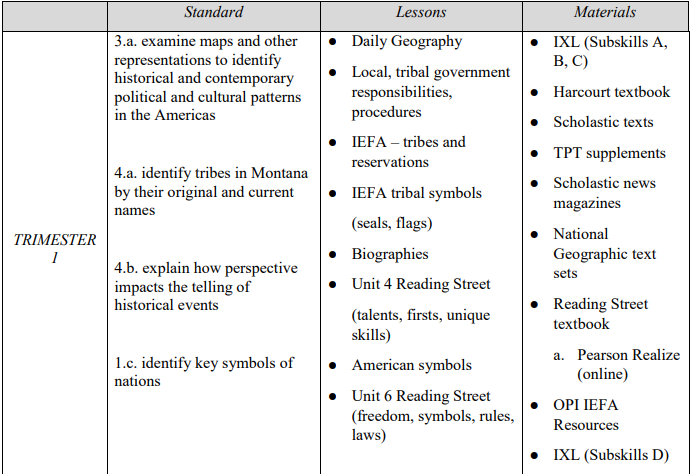
USA Grade 3 Social Studies Curriculum PDF
Download free PDF by Click on this Link: Grade 3 Social Studies Curriculum PDF
Source: Havre Public Schools
Conclusion
Third-grade social studies is about understanding your world—past, present, and future. It’s about discovering the people, ideas, and events that have shaped our country and learning how you can be an active and engaged citizen in your community. Get ready for a year full of exciting discoveries!
About The Author
