
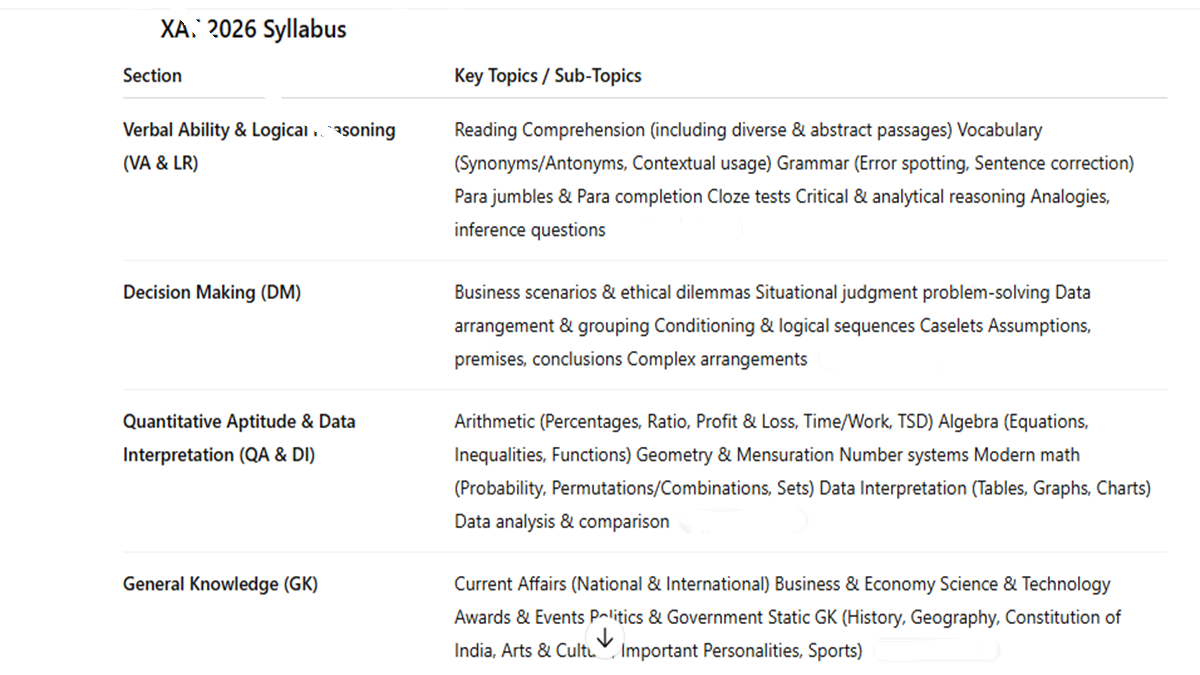
XAT Syllabus
The Xavier Aptitude Test (XAT) 2026 syllabus has four core sections: Verbal Ability & Logical Reasoning (VA & LR), Decision Making (DM), Quantitative Ability & Data Interpretation (QA & DI), and General Knowledge (GK). VA & LR covers reading comprehension, vocabulary, grammar, para-jumbles, and critical reasoning. DM tests ethical dilemmas, business cases, and managerial judgment. QA & DI includes arithmetic, algebra, geometry, mensuration, and data interpretation. GK focuses on current affairs and static GK (economy, polity, science, awards). The exam has ~95 MCQs, and essay writing is not in the main test.
XAT Exam Pattern 2026
The XAT exam pattern is designed to test problem-solving, logical thinking, and decision-making skills. It is a computer-based test held once a year in January, divided into two parts with a total duration of 180 minutes.
Highlights of the XAT Test Pattern:
- Mode of Exam: Online (CBT)
- Duration: Part 1 – 170 minutes; Part 2 (GK) – 10 minutes
- Number of Questions: Around 95 in total
- Total Sections: 3 in Part 1 and 1 in Part 2
Marking Scheme:
- Part 1: +1 mark for correct answers, – 0.25 marks for wrong answers, – 0.10 marks per unattempted question beyond 8
- Part 2 (GK): +1 mark for correct answers, no negative marking for wrong answers
XAT Section-wise Syllabus 2026
XLRI doesn’t officially release the syllabus of XAT. But you can look at past XAT question papers to get an idea of the types of questions and topics covered. Based on trends, you can find the complete section-wise syllabus of XAT below.
XAT Syllabus for Verbal Ability and Logical Reasoning
Every manager and leader needs strong language skills and logical thinking. So, this part of the XAT tests these abilities with 26 questions on logical reasoning and verbal ability. About 1/3 rd of these questions are about reading comprehension. The logical reasoning questions focus on common areas that require deductive skills and making inferences. Find the detailed syllabus below:
| Topics | ||
|---|---|---|
| Vocabulary Based Questions | Fill in the blanks | Synonyms/Antonyms |
| Contextual Meaning of Words | Jumbled Paragraphs | Correction of Errors in Sentences |
| Correct Usage of Words | Completion of Sentences/Paragraph | Critical Reasoning |
| Cloze Test | Poem | Grammar Section |
Question Types based on Reading Comprehension
| Topic | ||
|---|---|---|
| RC Passages on various topics | Main Idea & Purpose-based Questions | Inference-Based Questions |
| Author’s View type of Questions | Explanation of Words/Phrases | Strengthening and weakening arguments |
XAT Syllabus for Decision Making
This is a section that sets XAT apart from other MBA entrance exams. XAT decision-making tests the actual decision-making skills of the candidates based on a given set of information about the situation. You are required to think of answers from all aspects i.e. ethical, profit driver, maximum stakeholders’ satisfaction, etc. Though this section has no specific syllabus, you can understand what type of questions are asked below:
| Topics | ||
| Analytical Reasoning (Decision Making Set) | HR related DM Sets | Ethical Decision-Making Sets |
| Conclusions | Premises | Assumptions |
| Situational Decision Making | Business Issues | Social Dilemma |
XAT Syllabus for Quantitative Aptitude And Data Interpretation
The QADI section in XAT covers two main areas: Quantitative Aptitude and Data Interpretation. In XAT 2026, this section will have 28 multiple-choice questions. The topics in this section are divided into Quantitative Aptitude and Data Interpretation.
| Quantitative Aptitude | ||
| Percentages | Algebra | Number System |
| Geometry | Profit and Loss | Simple and Compound Interest |
| Speed, Time and Distance | Averages | Time and Work |
| Ratio and Proportion | Mensuration | Linear Equations |
| Logarithm | Venn Diagrams | Progressions |
| Binomial Theorem | Inequalities | Trigonometry |
| Probability Functions | Permutation and Combination | Surds and Indices |
XAT Syllabus for Data Interpretation
| Data Interpretation | |
| Bar Diagrams | Pie Charts |
| Data Analysis and Comparison | Graphs |
| Data Charts | Data Tables |
XAT Syllabus for General Knowledge
For this section, there is no negative marking so you are allowed to make guesses. Also, this section is not considered while preparing for the shortlist candidate’s list. This section is evaluated only at the last and that too with narrow weightage. The XAT General Knowledge syllabus will now comprise 20 questions, reduced from 25. This section will include 12 questions on current affairs and 8 questions from static GK, allowing for a balanced evaluation of candidates’ awareness of both ongoing events and foundational knowledge..
| Static GK Topics | ||
| Business, Finance and Economics | The Indian Constitution and Laws | History and Geography |
| Famous Personalities | Awards and Winners | Books and Authors |
| Science and Technology | Important Dates & Events | Art & Culture |
| Current Affairs Topics | ||
| National Current Affairs | International Current Affairs | Political Developments |
| Business and Economic News | Environmental Issues | New Government Schemes |
| Awards and Achievements | Sports News | Science and Tech Updates |
XAT Sections and Structure
The XAT paper format is structured into two parts with four main sections:
Part 1
1. Verbal Ability and Logical Reasoning (VALR)
- Approx. Questions: 26
- Important Topics: Reading Comprehension (poems, cartoons, passages), vocabulary, analogy, parajumbles, grammar, critical & analytical reasoning, cloze tests
- Focus: Tests command over English and logical structuring of thoughts
2. Decision Making (DM)
- Approx. Questions: 21
- Important Topics: Scenarios from personal & professional life, critical thinking, problem-solving, prioritization to make informed decisions
- Focus: Evaluates ethical judgment and real-world decision-making ability
3. Quantitative Aptitude and Data Interpretation (QA & DI)
- Approx. Questions: 28
- Important Topics: Arithmetic, geometry, algebra, mensuration, modern math, and data interpretation requiring insightful analysis
- Focus: Strong numerical ability and analytical skills
Part 2
General Knowledge (GK)
- Approx. Questions: 20 (8 static GK + 12 current affairs)
- Important Topics: Economy, politics, business, sports, awards, science, world events, Constitution of India
- Focus: Gauges awareness; GK scores are used by XLRI for final selection
XAT Syllabus 2026 – Section-Wise Details
Verbal Ability & Logical Reasoning
- Reading comprehension passages (including poems & cartoons)
- Critical & analytical reasoning
- Para-completion and jumbled sentences
- Vocabulary, analogies, idioms & phrases
- Grammar-based questions and cloze tests
Decision Making
- Ethical dilemmas in workplace situations
- Managerial caselets
- Business decision scenarios
- Situations involving fairness, distribution & prioritization
Quantitative Aptitude & Data Interpretation
- Arithmetic: Percentages, Profit & Loss, Ratio & Proportion, Time & Work, Speed, Time & Distance
- Algebra: Equations, Functions, Progressions
- Geometry & Mensuration: Lines, Circles, Polygons, 3D Figures
- Modern Math: Probability, Permutations & Combinations
- Data Interpretation: Graphs, charts, tables requiring insightful analysis
General Knowledge
- Static GK: History, geography, business, economy
- Current Affairs: Indian economy, budget updates, international organizations, awards, books & authors, politics, science
Marking Scheme and Exam Rules
- Each correct answer: +1 mark
- Each wrong answer in Part 1: -0.25 mark
- Unattempted questions beyond 8 in Part 1: -0.10 mark per question
- GK in Part 2: No negative marking
- PwD candidates: Additional 20 minutes per hour
Importance of Decision Making in XAT
The Decision-Making section tests ethical challenges, conflicting interests, and managerial problems. It is a key differentiator that reflects real-world corporate scenarios.
FAQs
1. What is the XAT Syllabus 2026?
The XAT 2026 syllabus is prescribed by XLRI Jamshedpur for admission to MBA/PGDM programs. It broadly includes Verbal & Logical Ability, Decision Making, Quantitative Ability & Data Interpretation, General Knowledge, and Analytical Essay Writing (AEW).
2. Is the XAT 2026 syllabus different from CAT?
Yes, the XAT syllabus is different from CAT. XAT uniquely includes Decision Making and Analytical Essay Writing, which are not part of the CAT exam. Also, XAT focuses more on logic-based and ethical decision-making questions.
3. What are the main sections in the XAT 2026 exam?
The XAT 2026 question paper consists of the following sections:
-
Verbal & Logical Ability
-
Decision Making
-
Quantitative Ability & Data Interpretation
-
General Knowledge
-
Analytical Essay Writing (Essay)
4. What topics are covered in Verbal & Logical Ability for XAT 2026?
This section covers:
-
Reading Comprehension
-
Vocabulary (synonyms, antonyms, fill in the blanks)
-
Grammar and sentence correction
-
Para jumbles
-
Critical reasoning
-
Logical reasoning
5. What is included in the Decision Making syllabus of XAT 2026?
Decision Making includes:
-
Case-based scenarios
-
Ethical dilemmas
-
Business decision problems
-
Situational judgment questions
This section tests analytical thinking, ethics, and managerial decision-making skills.
6. What is the Quantitative Ability & Data Interpretation syllabus for XAT 2026?
Important topics include:
-
Arithmetic (percentage, profit & loss, ratio, time & work)
-
Algebra (linear equations, quadratic equations)
-
Geometry & Mensuration
-
Number System
-
Data Interpretation (tables, graphs, charts)
7. Is General Knowledge important for XAT 2026?
Yes, General Knowledge (GK) is important, especially during final selection and interviews. It includes:
-
Current affairs
-
Business & economy
-
Politics
-
History & geography
-
Static GK
However, GK marks are not counted in percentile calculation.
8. What is Analytical Essay Writing (AEW) in XAT 2026?
In the AEW section, candidates are required to write an essay on a given topic. It tests:
-
Clarity of thought
-
Logical structure
-
Writing skills
-
Opinion formation
The essay is evaluated during the shortlisting and interview process.
9. Is there any negative marking in XAT 2026?
Yes, XAT has negative marking:
-
–0.25 marks for each wrong answer
-
–0.10 marks for leaving more than 8 questions unanswered
10. Has XLRI officially released the XAT Syllabus 2026?
XLRI does not release a fixed syllabus document. The XAT 2026 syllabus is based on previous year exam trends, which remain largely consistent year after year.
11. Which section is considered the toughest in XAT?
Most candidates find Decision Making and Verbal & Logical Ability the toughest due to their unpredictable and logic-intensive nature.
12. How should I prepare for the XAT 2026 syllabus?
Effective preparation includes:
-
Practicing previous year XAT question papers
-
Strengthening decision-making skills through case studies
-
Reading newspapers for GK
-
Writing practice for the essay section
-
Regular mock tests and analysis
13. Is the XAT syllabus same for all XLRI programs?
Yes, the XAT 2026 syllabus is common for all candidates applying to XLRI and other participating institutes.
14. Does XAT 2026 include mathematics at an advanced level?
The mathematics level in XAT is generally moderate to difficult, focusing more on conceptual clarity and application rather than advanced calculations.
15. Where can I download the XAT 2026 syllabus PDF?
Candidates can check the official XAT website or reliable MBA exam preparation portals to download the XAT 2026 syllabus PDF once notifications are released.
About The Author
