
The UPSC Drug Inspector Syllabus 2026 plays a crucial role for aspirants aiming to build a career in drug regulation, public health safety, and pharmaceutical quality assurance. Conducted by the Union Public Service Commission, the Drug Inspector exam ensures that only highly knowledgeable and skilled professionals enter this vital sector. The syllabus has been thoughtfully designed to assess candidates’ understanding of pharmaceutical sciences, drug laws, manufacturing standards, and quality control procedures. It covers a wide range of subjects, including Pharmacology, Pharmaceutics, Pharmaceutical Chemistry, Pharmacognosy, and the Drugs & Cosmetics Act, ensuring a comprehensive evaluation.
With the rising complexities in drug manufacturing, rising global health standards, and increasing need for safe and effective medicines, the importance of Drug Inspectors has grown significantly. Therefore, understanding the syllabus in detail is the first step toward effective preparation. This introduction provides an overview of the major themes and expectations outlined in the 2026 syllabus, helping aspirants plan strategically. A clear grasp of the exam pattern and subject weightage enables candidates to focus on high-priority areas and enhance their chances of success. The UPSC Drug Inspector Syllabus 2026 is not just a guide, it is the roadmap to a prestigious and impactful career.
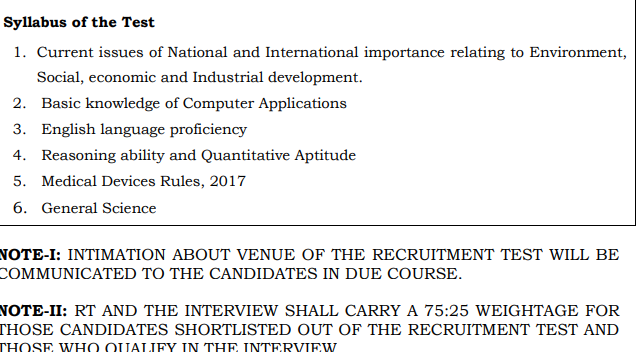
Main Syllabus for UPSC Drug Inspector Post
Syllabus of the Test
1. Current issues of National and International importance relating to the Environment,
Social, economic and Industrial development.
2. Basic knowledge of Computer Applications
3. English language proficiency
4. Reasoning ability and Quantitative Aptitude
5. Medical Devices Rules, 2017
6. General Science
UPSC Drug Inspector Syllabus 2026
the latest known syllabus and exam pattern for Union Public Service Commission (UPSC), UPSC Drug Inspector Exam (2026). Use this as a guide for your preparation, but always cross-check with the official UPSC notification when it is released.
Exam Pattern (2026)
According to recent sources, the exam for Drug Inspector under UPSC (2026) follows this format:
| Paper | Subject / Focus | Total Questions / Marks | Duration |
|---|---|---|---|
| Paper I | Technical / Pharmacy-related (discipline-specific) | ~ 100 MCQs → 200 marks | 2 hours |
| Paper II | General Knowledge / General Awareness / Aptitude | ~ 50 MCQs → 50 marks | 1 hour |
-
Total marks for written test: ≈ 250–300 marks depending on notification.
-
Negative marking: ⅓ mark deducted for each wrong answer (in many past notifications).
-
After the written test, there is an Interview / Personality Test for shortlisted candidates.
Note: Some sources show small variations (e.g. total written marks or distribution). Always refer to the latest UPSC notification for exact details.
UPSC Drug Inspector Syllabus 2026: Subject-wise/Topic-wise Breakdown
The technical (Paper I) syllabus for UPSC Drug Inspector is broad, covering almost all core areas of pharmacy, pharmaceutical science, drug regulation, and quality control. Key subject areas and topics are:
1. Pharmaceutical / Pharmaceutical Chemistry & Analysis
-
Organic & Inorganic Chemistry relevant to drug formulation.
-
Medicinal Chemistry, drug design, structure-activity relationships, mechanism of action.
-
Analytical techniques & quality control: limit tests, sterility tests, bio-assay, microbiological assays (e.g. vitamins, antibiotics), pyrogen test, instrumental methods (colourimeter, fluorimeter, nephelometer, etc.)
2. Pharmaceutics / Manufacturing Pharmacy
-
Pharmaceutical formulations: tablets, capsules, injections (parenterals), suspensions, emulsions, creams/ointments, ophthalmic solutions, surgical dressings, etc.
-
Biological preparations: vaccines, sera & antisera.
-
Biopharmaceutics (drug delivery & absorption, dosage forms, bioavailability etc.)
3. Pharmacology & Toxicology
-
Mechanism of drug action, pharmacodynamics / pharmacokinetics (ADME), drug interactions.
-
Adverse drug reactions, overdose, toxicology, safety, therapeutic index.
4. Pharmaceutical / Forensic Jurisprudence & Regulatory Affairs
-
Laws & Acts relevant to drugs & cosmetics: Drugs and Cosmetics Act, 1940 & Rules, Pharmacy Act, 1948, Drugs and Magic Remedies (Objectionable Advertisements) Act, 1954, Medical and Toilet Preparations (Excise Duties) Act, 1955, Poison Act, 1919, Dangerous Drugs Act, 1930, Drug Price Control Order, 1995, and other related laws/acts.
-
Knowledge of regulatory frameworks, ethics, compliance, licensing, inspections is relevant for inspection roles.
5. Hospital & Clinical Pharmacy / Basic Biomedical & Health Science (as applicable)
-
Basics of anatomy & physiology, human body systems (though weight may vary).
-
Clinical pharmacy aspects: handling prescriptions, drug dispensing, storage conditions, compatibility, hospital-pharmacy operations (especially relevant if role involves inspections in hospitals/medical stores).
6. Good Practices & Quality Assurance / Regulatory Compliance
-
Good Manufacturing Practices (GMP), Good Laboratory Practices (GLP), Good Clinical Practices (GCP) — as applicable.
-
Standards and procedures for testing, storage, manufacturing, import/export, compliance and inspection.
7. General Knowledge / General Awareness (Paper II)
-
Current affairs — especially related to health, pharmaceutical/medical industry, regulatory developments, drug safety, medical devices etc.
-
General science (basic biology, chemistry), economics, banking/finance, national health programs, policies, government schemes, basic polity/governance, environment, social & industrial developments.
-
Basic computer knowledge/applications (sometimes considered) and reasoning/aptitude if mentioned in the notification.
What this Means for Your Preparation
Since you appear to have an interest in many competitive exam syllabi, this syllabus will demand strong pharmacy/pharmaceutical science fundamentals + up-to-date GK/current affairs. As someone preparing for multiple exams, you may already have some strength in general studies, which helps.
-
Give major weight to core pharma topics, laws & regulations (acts), pharmaceutics, analysis, pharmacology — these form the bulk of Paper I.
-
Maintain a steady habit of current affairs + GK, including health/drug/medical-device related news.
-
For regulatory/law-based topics, use standard books + updated amendments (since laws change).
-
Practice MCQs with negative marking in mind; accuracy is critical.
UPSC Drug Inspector Syllabus 2025 (Previous Year)
UPSC Drug Inspector Syllabus 2025 (Previous Year Pattern & Topics) based on the available official-style syllabus (largely unchanged from earlier years like 2012 & recruitment tests).
Paper 1: Pharmacy (Core Subjects)
This is the most important section (major weightage).
1. Pharmaceutical Chemistry
- Organic & Medicinal Chemistry
- Drug design & synthesis
- Structure–activity relationship
- Pharmaceutical analysis techniques
2. Pharmaceutics
- Dosage forms (tablets, capsules, injections, etc.)
- Biopharmaceutics & pharmacokinetics
- Industrial pharmacy & manufacturing
- Quality assurance (QA), GMP, GLP
3. Pharmacology & Toxicology
- Mechanism of drug action
- Adverse drug reactions
- Toxicology & poisoning treatment
- Clinical pharmacology basics
4. Pharmacognosy
- Natural drugs & sources
- Herbal medicines
- Extraction & isolation techniques
5. Pharmaceutical Analysis
- Instrumental methods (HPLC, UV, etc.)
- Quality control of drugs
- Impurity testing
6. Microbiology & Biotechnology
- Sterilization methods
- Microbial contamination
- Vaccines & biotechnology basics
7. Hospital & Clinical Pharmacy
- Drug dispensing
- Patient counseling
- Clinical trials basics
8. Human Anatomy & Physiology
- Body systems
- Basic medical science
9. Forensic Pharmacy (Drug Laws – Very Important)
- Drugs and Cosmetics Act, 1940 & Rules 1945
- Pharmacy Act, 1948
- Drug Price Control Order
- Narcotic Drugs & Psychotropic Substances Act
- Drugs & Magic Remedies Act
This is a high-weightage area in previous papers.
Paper 2: General Knowledge
Topics Covered:
- Current Affairs (National & International)
- Indian Polity & Constitution
- General Science
- History & Geography
- Basic Computer Knowledge
- English Language (basic comprehension)
This paper is qualifying but important for final merit.
Important Highlights (Previous Year Trend)
- Pharmacy subjects carry ~80% weightage
- Drug Laws + Pharmaceutics + Pharmacology are most asked areas
- Questions are conceptual + application-based
- Syllabus remains largely unchanged for years, so PYQs are very important
List of Books to Cover UPSC Drug Inspector Syllabus 2026
List of high-quality books you can use to prepare for the UPSC Drug Inspector exam (covering both technical pharmaceutical subjects and regulatory/legal areas), combining dedicated exam guides with standard pharmacy textbooks:
1. Dedicated UPSC/Drug Inspector Exam Guides
-
EduGorilla UPSC Drug Inspector Book 2023 (Paper I & II with 20 Mock Tests) – Practice + MCQs as per UPSC syllabus and full-length tests.
-
“Mission Drug Inspector” – Previous Years Objective Questions – Helps you understand exam pattern and recurring MCQs with explanations.
-
UPSC Drugs Inspector Preparation Book (Various editions 2025/2026) – Topic-wise preparation material including solved questions.
2. Core Pharmacy & Science Textbooks
These cover the core subjects tested in UPSC Drug Inspector exams (Pharmaceutics, Pharmacology, Pharma Chemistry, etc.):
Pharmacology
-
“K.D. Tripathi – Essentials of Medical Pharmacology” – Standard for pharmacology basics.
-
“Basic & Clinical Pharmacology” by Bertram G. Katzung – Detailed reference for drug actions.
Pharmaceutics & Industrial Pharmacy
-
Lachman’s Theory & Practice of Industrial Pharmacy – Industrial pharmacy principles.
-
Remington’s The Science and Practice of Pharmacy – Broad coverage of pharmaceutical sciences.
Pharmaceutical Chemistry & Analysis
-
Pharmaceutical Chemistry texts (e.g., OP Agarwal, Morrison Boyd) – Useful for synthesis and drug chemistry.
-
Pharmaceutical Analysis by Beckett & Stenlake / Vogel – Key for drug testing, quality control.
Pharmacognosy & Biochemistry
-
Trease & Evans’ Pharmacognosy – Standard for natural products & plant-based drugs.
-
Textbook of Biochemistry (Satyanarayana) – Useful for biological processes & metabolism.
3. Law & Regulatory / Legal References
These are crucial for the regulatory/legal part of the UPSC Drug Inspector syllabus:
-
Drugs & Cosmetics Act, 1940 and Rules, 1945 (Bare Act) – Primary law governing drugs in India.
-
Pharmaceutical Jurisprudence by Dr. B.S. Kuchekar / S.B. Gokhale – Explains legal aspects of drug regulation.
-
DPCO (Drug Price Control Order) Notes – For price control regulations.
4. Practice & Revision Aids
-
MCQ Compilations & Previous Year Papers – very important for objective-type exams.
-
General Studies / GK Books (e.g., Lucent’s General Knowledge, Government publications) – for awareness topics included in some Drug Inspector exams.
FAQs
1. What is the selection process for the UPSC Drug Inspector exam?
The selection process generally includes:
-
Written Examination (Objective/Descriptive as per notification)
-
Interview/Personality Test
-
Document Verification
2. What subjects are included in the UPSC Drug Inspector syllabus 2026?
The syllabus mainly covers:
-
Pharmaceutical Chemistry
-
Pharmacology & Toxicology
-
Pharmaceutics
-
Forensic Pharmacy & Drug Laws
-
Microbiology & Biochemistry
-
Human Anatomy & Physiology
3. Is the syllabus based on the B.Pharm or M.Pharm level?
The UPSC Drug Inspector syllabus is primarily based on the B.Pharm level, but the depth of questions may reach M.Pharm conceptual clarity.
4. What is the weightage of pharmaceutical laws and regulatory affairs?
A significant portion (around 20–25%) of the exam covers:
-
Drugs & Cosmetics Act
-
Pharmacy Act
-
Narcotic Drugs & Psychotropic Substances Act
-
GMP, GLP, GDP
-
Regulatory guidelines (CDSCO, WHO, ICH)
5. Are numerical problems asked in the Drug Inspector exam?
Yes. Numerical questions are usually asked from:
-
Pharmaceutics (dissolution, kinetics, calculations)
-
Pharmaceutical chemistry
-
Biopharmaceutics
These are generally moderate in difficulty.
6. What is the difficulty level of the UPSC DI exam?
The difficulty level is generally moderate to high, similar to the GPAT + Drug Laws level.
7. Are questions asked from clinical pharmacy and hospital pharmacy?
Yes, but the weightage is limited. Questions may come from:
-
Adverse drug reactions
-
Drug interactions
-
Prescription analysis
-
Therapeutic drug monitoring
8. Do I need to study microbiology in detail?
Yes. Microbiology questions are common, especially on:
-
Sterilization techniques
-
Microbial assays
-
Pathogenic microorganisms
-
Culture media & methods
9. Are current developments in the pharma industry asked?
Yes, concepts related to:
-
New drug approvals
-
Vaccines
-
CDSCO/WHO guidelines
-
Pharmacovigilance
may be included.
10. Is there a negative marking in the exam?
Yes, UPSC usually follows the 1/3rd negative marking pattern (as per official guidelines).
11. Is knowledge of Good Manufacturing Practices (GMP) necessary?
Absolutely.
GMP, GLP, GDP, validation, qualification, audits, and documentation form a major scoring section.
12. What are the most important Acts to study for Drug Inspector?
-
Drugs & Cosmetics Act, 1940
-
Pharmacy Act, 1948
-
NDPS Act
-
Drugs & Magic Remedies Act, 1954
-
Medicinal & Toilet Preparations Act
13. Is Pharmacology an important part of the syllabus?
Yes, pharmacology has high weightage, especially:
-
Mechanism of action
-
Adverse effects
-
Drug classifications
-
Autacoids
-
Chemotherapy
-
CNS, CVS drugs
14. Do I need to prepare biostatistics?
Basic understanding of:
-
Mean, median, mode
-
Standard deviation
-
Sampling
-
Types of errors
may be required.
15. What are the best books for preparation?
-
Lachman – Pharmaceutics
-
Goodman & Gilman – Pharmacology
-
KD Tripathi – Pharmacology
-
Lippincott – Biochemistry
-
HQC Textbook – Forensic Pharmacy
-
Indian Acts & Rules – CDSCO website
16. Can I prepare for UPSC Drug Inspector in 3 months?
Yes, with a smart strategy, especially if you have a strong B.Pharm background. Focus more on:
-
Drug laws
-
Pharmacology
-
Pharmaceutics
-
GMP/GLP
17. Are mock tests necessary?
Yes. Regular test practice helps with:
-
Time management
-
Accuracy
-
Understanding the question pattern
18. What is the job role of a Drug Inspector selected through UPSC?
Roles include:
-
Inspecting drug manufacturing units
-
Ensuring quality control
-
Checking compliance with drug laws
-
Monitoring distribution & sale of drugs
-
Taking regulatory action when needed
19. Is there an interview after the written exam?
Yes. The Interview/Personality Test checks:
-
Regulatory knowledge
-
Communication skills
-
Ethical decision-making
-
Situational judgment
20. Is the UPSC Drug Inspector exam tough?
It is competitive because seats are limited, but with proper coverage of the syllabus and laws, candidates can score well.
About The Author
