
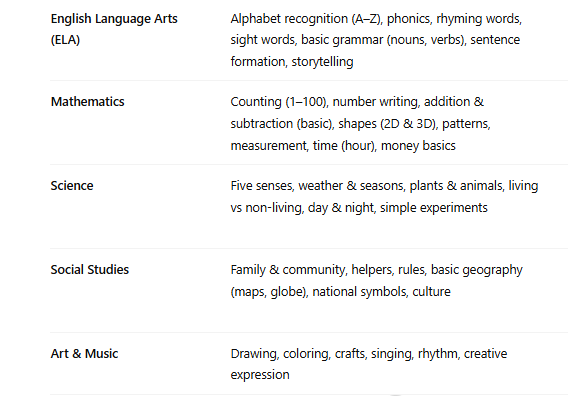
Full USA Kindergarten Syllabus 2026- American Pre Nursry Curriculum
Kindergarten 1 Syllabus
Kindergarten 1 Mathematical development
Numbers
- Rote counting 1-100
- Identify number symbols 1-25
- Associate numbers with quantity 1-25
- Introduction to zero
- Writing numerals 0-25
- Match numbers and objects 0-25
- Backward counting
- Addition and subtraction through rhymes and games
- Count aloud in ones or twos
- Identify before and after numbers
- Identifying missing numbers
Number Concepts
- Matching & sorting by more than one attribute
- Recognize & recreate simple patterns
- Able to seriate more than 2 objects/pictures
Comparative
- fast & slow, heavy & light, few and many
- Use language such as ‘more’ or ‘less’ to compare two numbers
Color, Shape, and Space
- Introduction to primary colors
- The color wheel
- Mixing colors to get new colors- green, orange, and purple
- Shades of colors
- Black and white
- 2-dimensional shapes: triangle, circle, square, rectangle, semicircle, oval, star and diamond
- Use language- left &right, top & bottom, far & near, up & down, above & below
- Find items from positional or directional clues
Measurement
- Measure using familiar objects like blocks, spoons, cups
- Estimate how many objects they can see and check by counting them
Time
- Days of the week
- Months of the year
- Introduction to the calendar
- Use time-related words in conversation
Kindergarten 1 Language Development
Listening Skills
- Link sounds to letters
- Understand and enjoy short stories and non-fiction texts
- Listening to and acting on instructions, questions, and explanations
Speaking Skills
- Begin to frame short, simple sentences with the high-frequency words
- Use spoken language to share experiences through show and tell
- Have confidence to speak to others about their own wants and interests
- Explore the meaning and sounds of new words
- Narrating short stories & incidents
Reading Skills
- Recognizing letters A-Z and their phonics sounds
- Associate upper case & lower case letters
- Sight-read some high-frequency words
- Recognition of the initial sounds of words
- Read short, simple text with help
- Know that print carries meaning and, in English, is read from left to right and top to bottom
Writing Skills
- Writing of small letters a- z
- Tracing shapes, patterns, letters, and numbers in sand and air
- Begin to use written language to recreate real-life experiences during indoor integrated play (writing corner)
- Begin to explore creative writing through Journal writing
Kindergarten 1 Environmental Awareness
- Seasons and weather-build understanding of the main seasons in India, lightning, thunder, and rainbow, rainy creatures, the water cycle, uses and purification of water, conservation of water, floating and sinking
- Trees and forest- exploring trees and wild animals. Habitat and eating habits. Forest conservation and jungle safari
- All about me- examining self and human body. What I can do with my body. the external and internal body parts. Germs and safety habits
- My home and family- name and role of family members. Our responsibilities towards them.Recognizing features of a home.Naming objects associated with rooms
- Bugs and insects- introduction to some common insects and some harmful ones. Observe features like legs, bodies, wings, and eyes. Where are insects found? How do insects move? How to prevent the spread of disease?
- Life cycle -butterfly
- All about flowers and garden- introduction to common flowers around us: orchid, rose, marigold, lotus, sunflower, and hibiscus.Observing parts of a flower and how flowers grow.Uses and importance of flowers.
- Transport-air, water, road, and construction vehicles. Road safety. Explore similarities and differences amongst different modes of transport – cars and bicycles, trains, airplanes. Explore how they work, safety rules, and pollution and the environment
- Ocean and ocean animals-understanding names of the oceans and features like waves, tides, and tsunamis. Explore why oceans are salty and blue. All about ocean creatures and the marine world
- Birds of prey and flightless birds- understanding the term birds of Prey. Observing features of birds os prey and types of these birds.
- Community helpers – understanding the role of people who help us. Who are these people and how do they help?Our responsibility towards them
- Festivals and celebrations – Explore and understand different cultures by celebrating various festivals like Ganesh Chaturthi, Diwali, Christmas, Holi, etc
Kindergarten 1 Physical and Motor Development
Fine Motor
- Use a pencil and hold it effectively to form recognizable letters and numbers, most of which are correctly formed
- Begin to use anticlockwise movement, retrace lines
- Explore and handle tools, objects, construction, and malleable materials safely and with increasing control
Gross Motor
- Experiment with different ways of moving
- Jump off an object and land appropriately
- Move with control and coordination
- Construct with large materials such as cartons, fabric, and planks
- Use increasing control over an object, such as a ball, by touching, pushing, patting, throwing, catching or kicking it
Health & Hygiene
- Show some understanding that good practices with regard to exercise, eating
- sleeping and hygiene can contribute to good health
Kindergarten 1 Creative development
Art
- Express and communicate ideas, thoughts, and feelings using a wide range of materials
- Explore and create new colours and textures. Choose particular colours to use for a purpose
- Use materials creatively
- Create constructions, collages, paintings, and drawings
Music & Movement
- Recognize and explore sounds
- Sing simple songs from memory
- Begin to move rhythmically
- Explore creative movement through music, dance, and role play
Kindergarten 1 Personal, social, and emotional development
Self
- Express needs and feelings in appropriate ways
- Maintain attention, concentrate, and sit quietly when appropriate
- Select and use activities and resources independently
- Practice good self-care
- Appreciate the need for hygiene and manage one’s own personal hygiene
- Is aware and begins to care for the environment
Group
- Value playing with other children and join in shared play. Participate in small group situations
- Take turns and share
- Play alongside children engaged in the same theme
- Is conscious of and curious about sex differences
- Consider the consequences of their words and actions
Kindergarten 2 Syllabus
Kindergarten 2 Mathematical development
Numbers
- Rote counting 100 and beyond
- Identify number symbols 0-100
- Associates and matches the numbers to objects
- Counts irregular arrangements of numbers
- Writing numerals 1-100
- Backward counting
- Begins simple addition (single digits only) through games, word problems & other practical activities
- Count aloud in twos, fives, and tens till 100(skip counting)
- Identify ’before’, ’after’, and ’in between’ numbers
- Begins to write number names ’one’, ‘ two’, till ten.
Comparative
- Wide and narrow, above and below, near and far, rough and smooth, odd and even &many and few, front and back
- Full, half, quarter, and empty
- Color, shape, and space
- Mixing colors to create more colors; primary and secondary through the color wheel
- Sequence colors by their hues, tints (light to dark)
- Begin to use mathematical names for ‘solid’ 3D shapes and mathematical terms to describe shapes: semi-circle, oval, star, diamond, sphere, cylinder, and pyramid
- Find items from positional or directional clues.
Time
- Use everyday language related to time; order and sequence familiar events, and measure short periods of time with a non-standard unit, e.g., with a sand timer
- Introduction to clocks
Kindergarten 2 Language development
Listening skills
- Listening to a second language and identifying sounds
- Listening and identifying beginning, middle, and ending sounds
Speaking skills
- Speaking with correct pronunciation, intonation, and stress
- Recite simple rhymes, songs, days of the week, months of the year, names of fruits and vegetables
- Uses conversation skills to gain attention and also uses action rather than talk to demonstrate or explain to others
- Consistently develops a simple story
Reading skills
- Sight-read a set of 20 high-frequency words
- Sight reading simple phrases and sentences through readers
- Learning to blend the letters together and decode a word
- Reading three-letter words with word families (an, at, et, en, etc.)
- Continue a rhyming string
- Associate upper case & lower case letters
- Recognition of initial, middle, and ending sounds of words
- Reading simple books, recognizing the name of the book, the name of the author, etc
Writing skills
- Writing of capital and small letters a-z
- Writing 3-letter words and beginning, middle, and ending letters by associating with sounds
- Writing words from the word family.
- Writes their own names and other things, such as labels and captions
- Write singular and plural words
- Writing opposite words
- Writing short sentences associated with pictures
- Creative writing through Journal writing
Kindergarten 2 Environmental Awareness
- About myself, my school, and friends, knowledge about my body features, likes, and dislikes, and what I can do with my body. Name of the school and its location, names and roles of people. Names of friends, knowledge about my favorite things and the favorite activities of my friends. Manage feelings and emotions
- All about the neighborhood- notices differences between features of the local environment- a look at buildings, parks, roads, etc. Understand the postal service, the role of a mason, and how a home is constructed. Modes of transport and the role of a traffic police. Other community helpers, like doctors and emergency workers
- Living and non-living things- animals, plants, flowers, and the life cycles of the frog and butterfly, and the various conditions required for them to grow
- Extinct and endangered animals- understand that some animals have become extinct and the reasons for the same, and look at endangered animals. Understand terms like poaching and hunting. Ways of protecting animals
- Investigate countries and cultures, begin to know about their own cultures and beliefs, and those of other people. A look at India, China, and Japan. Understand the culture, food, traditions, clothes, and monuments of the three countries
- Media and entertainment- look at different types of media and the role it plays in our lives – The ill effects of media
- Food that we eat- explore healthy and unhealthy eating habits, look at pulses, grains, fruits and vegetables, milk and milk products. Plan a balanced diet
- Our planet Earth understands that Earth is a unique planet and part of the solar system – Explore space
- Recycle and reduce- look at ways to save our planet. Explore ways to reduce waste and ways to prevent pollution
- Celebrations of festivals and special days
Kindergarten 2 Physical and motor development
Fine Motor
- Explore and handle tools, objects, construction, and malleable materials safely and with a good degree of control
- Manipulates materials to achieve a planned effect
Gross Motor
- Initiate new combinations of movement and gesture in order to express and respond to feelings, ideas and experiences
- Goes backwards and sideways as well as forward while walking
- Fundamentals of throwing, catching, striking, jumping, kicking, and bouncing
- Spatial and directional awareness (right/left) and personal space
- Construct with large materials such as cartons, fabric, and planks
- Use increasing control over an object, such as a ball, by touching, pushing, patting, throwing, catching, or kicking it
- Begins to understand and play organized games
Health & Hygiene
- Shows understanding of the need for safety when tackling new challenges
- Understand good practices towards maintaining health and hygiene, and make others aware of it too
- Dress and undress independently and manage their own personal hygiene
- Practices some appropriate safety measures (avoids dangerous equipment, material) without direct supervision
- Choose healthy foods from the basic food groups
Kindergarten 2 Creative development
Art
- Recognize and describe simple patterns in the environment and works of art
- Use symmetry to create balance in a work of art
- Talk about personal intentions, describing what they were trying to do
- Combine different media to create new effects
- Explore colour, texture, shape, form, and space in two or three dimensions
- Use their imagination in art and design, music, dance, imaginative play, role-play, and stories
- Use tools and processes such as scissors, drawing implements, craft material, glue, and brushes with skill and creativity
- Understand that things can be drawn from life as well as from their imagination. Music & movement
- Begins to build a repertoire of songs and dances
- Develop a sense of auditory discrimination –sound, beat, and melody
- Creates own music and short songs (modifies existing songs)
Kindergarten 2 Personal, social, and emotional development
Self
- Has a sense of personal identity
- Developing awareness of one’s own needs, views, and feelings, and being sensitive to the needs, views, and feelings of others
- Understands when needs are not immediately met
- Can describe self in positive terms and talk about abilities
- Shows compliance with social expectations
- Expresses frustration with words, not physically.
- Respect and care for the classroom environment and materials
- Begin to understand ’big voice’ and ’little voice’ (when it is appropriate to speak loudly and softly)
Group
- Confident to try new activities, initiate ideas, and speak in a familiar group
- Begin to develop respect for their own culture and beliefs and those of other people
- Forms friendships with other children
- Operates independently within the environment and shows confidence in linking up with others for support and guidance
- Begin to develop etiquette such as politeness, good manners
- Abide by rules and form agreements
Pre-Nursery Syllabus
Pre-Nursery Mathematical Development
Pre-Math Concepts
- Begins matching and sorting
- Begins patterning
- Begins sequencing
- One-to-one correspondence
- Comparisons: Big and small, up and down, over and under, inside and outside, wet and dry, tall and short,
Numbers
- Begin to explore numbers through stories, songs, games, and other activities
Colors
- Red, green, yellow
Shapes
- Circle, square, triangle, rectangle
Pre-Nursery Language Development
Listening Skills
- Begins to enjoy short stories
- Begins to follow instructions
- Responds to own name
Speaking Skills
- Begins to show interest in books
- Shows interest in illustrations
Reading Skills
- Begins to show interest in books
- Shows interest in illustrations
Writing skills
- Scribbles spontaneously
- Begins to show interest in the marks they make
- Coloring
Introduction to Letter sounds ( using rhymes and games)
Pre-Nursery Environmental Awareness
- Exploring rhymes, stories, and movement
- Exploring who we are- our body, senses, how we dress up, how we keep ourselves clean
- The rainy season
- Animals -pets
- Creepy crawlies
- Shapes in the environment
- Exploring fruits
- Transport – vehicles on the road, cars, trucks, etc.
- Exploring toys- observing everyday toys in the environment
- Celebrating various festivals like Ganesh Chaturthi, Diwali, Christmas, Holi, Earth Day
Pre-Nursery Physical and Motor Development
Fine motor
- Begins to display eye-hand coordination
- Begins to roll, pound, squeeze, and pull clay
- Begins to fill containers with sand
- Begins to stack blocks one on another or side by side
- Begins to screw and unscrew caps of bottles/pens
- Open and shut the lids of boxes
- Turn the pages of books
- Turns door handles
- Can pick small objects and put them into a container
Fine motor
- Can balance themselves on a balancing beam
- Begins to explore a wide range of movements like walk, hop, run, bend, and stretch
- Moves spontaneously, showing some control and coordination
- Engages in physical activities like baby yoga, action rhymes, music & movement
- Travel around, under, over, and through outdoor equipment
Pre-Nursery Creative Development
Art
- Enjoys exploring different textures, colors, material
- Begin to use material creatively
Music and Movement
- Follows simple dance movement
- Responds to rhythm through movement
- Explores simple imaginary play
Pre-Nursery Personal, social, and emotional development
- Can express basic needs
- Begins to use socially accepted vocabulary-good morning, goodbye, thank you
- Approaches familiar situations with confidence
- Separates from the main caregiver with support
- Initiates own play activities and plays alone
- Begins to participate in small and large group situations
- Engages in parallel play
- Takes turns and shares with adult support
Nursery Syllabus
Nursery Mathematical development
Pre-Number Concepts
- Matching and sorting
- Pairing
- Sequencing
- Introduction to seriation
- One-to-one correspondence
Number
- Rote counting 1-50
- Identify number symbols 1-9
- Associate numbers with quantity 1-9
- Match numbers and objects
- Addition and subtraction through rhymes and games
Comparison
- up/ down, open/ shut, big and small, tall/short, in/out, more/ less, hot/cold, sweet/salty, clean /dirty, wet/dry, over/under, inside/outside, long/short, fast slow.
- Exploring colors – red, black, yellow, blue, green, brown, purple, and orange
- Exploring shapes- circle, triangle, square, and oval
Measurement
- Measure using familiar objects like blocks, spoons, cups
Time
- Days of the week & months of the year through rhymes and games
Nursery Language development
Listening skills
- Link sounds to letters
- Understand and enjoy short stories
- Listen to and act on instructions
- Listen attentively and recognize when it is appropriate to speak
Speaking Skills
- Use personal pronouns-I, you, me
- Begin to use simple spoken language to share experiences
- Explore the meaning and sounds of new words
- Narrate short stories
- Joins in reciting rhymes and songs with repetitive language
- Relate objects and pictures to names
Reading Skills
- Recognize letters A-Z and their phonics sounds
- Know that English is read from left to right and top to bottom
- Is able to hold the book the correct way up and turn pages
- Show interest in illustrations and characters
Writing Skills
- Begin to write patterns
- Demonstrate interest in the marks they make
- Freehand drawing and scribbling
- Developing fine motor and eye-hand coordination
Nursery Environmental Awareness
- Tales from around the world
- Exploring seasons and clothes
- Myself and my family
- Exploring animals on the farm
- Water and its uses
- Go green
- Exploring vegetables
- Transport
- Community helpers
- Explore different cultures by celebrating various festivals like Ganesh Chaturthi, Diwali, Christmas, and Holi
Nursery Physical and motor development
Fine Motor
- Demonstrate a variety of grips
- Displays eye-hand coordination and increasing small muscle coordination
- Play with clay with better hand and finger coordination.
- Draws lines.
- Copy the circle and imitate strokes like a cross.
- Holds a pencil in proper grips and fingers.
- Colors within a large outline, though not neatly.
- Builds a tower of 9 blocks.
- Can pick up pins.
- Threads beads with large holes.
- Tear paper at random.
- Pastes paper on a large outline.
- Paints with circular movements.
Gross motor
- Begins to use their bodies creatively to express ideas, thoughts, and feelings
- Can balance themselves on a balancing beam
- Explores a wide range of movements like jump, gallop, sway, stretch, etc
- Displays increasing control and coordination over movements involving arms, hands, and fingers
- Travel around, under, over, and through a wide range of equipment
Nursery Creative Development
Art
- Express and communicate ideas, thoughts, and feelings through simple art materials
- Explore and create new colors
- Begin to explore material and use it creatively
- Create paintings and drawings
Music & Movement
- Sing simple songs with increasingly complex melodies
- Create movement through music and dance
- Involves imaginary play
- Maintains a beat with body movement
- Works collaboratively on art pieces
Nursery Personal, social, and emotional development
Self
- Begins to express needs and feelings
- Maintain attention, concentrate, for a short while
- Independently initiates self – help tasks
- Begins to develop self- confidence and self- control
- Understands simple essential agreements
- Uses socially accepted vocabulary-good morning, goodbye, thank you, please, sorry
- Able to adjust to new routines and unfamiliar situations
- Begins to develop awareness about caring for the environment
Group
- Participate in small group situations
- Treats other with care and respect
- Begins to take turns and share
Conclusion
The USA Kindergarten Syllabus 2026 is designed to provide a balanced and child-friendly education system. It not only focuses on academics like reading and math but also emphasizes social skills, creativity, and emotional development. Meanwhile, the Pre-Nursery (Preschool) curriculum ensures that children are fully prepared for kindergarten through playful and engaging learning methods.
About The Author
