
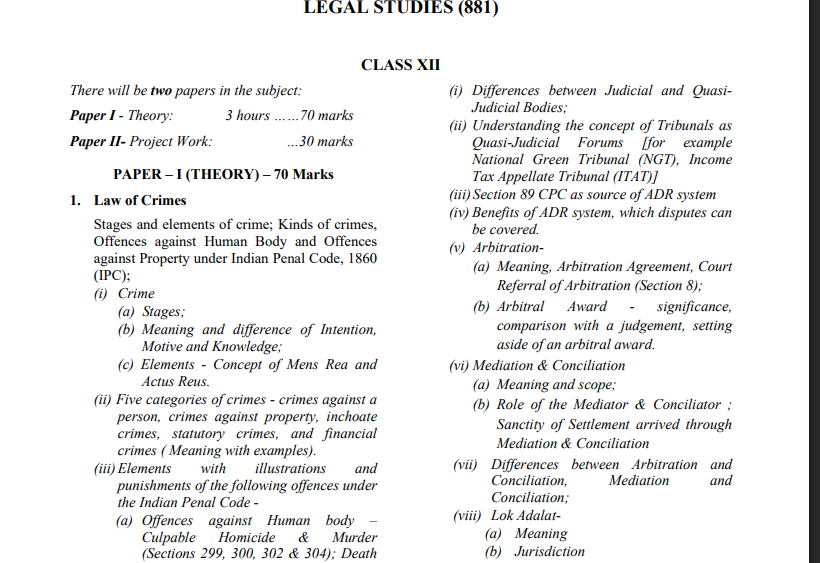
The ISC Class 12 Legal Studies Syllabus 2026-27 covers a wide range of legal topics, focusing on key areas such as the law of crimes, alternate dispute resolution (ADR), the Indian Contract Act, and the law of torts. Students will learn about the stages and elements of crime, various offenses under the Indian Penal Code, and essential legal concepts like Mens Rea and Actus Reus. Additionally, the syllabus introduces ADR mechanisms like arbitration, mediation, conciliation, and Lok Adalats, while also exploring legal aid under the Legal Services Authorities Act, 1987, emphasizing the importance of Article 39A of the Constitution.
ISC Class 12 Legal Studies Syllabus 2026-27
The syllabus also includes an in-depth study of contract law, tort law, and the transfer of property, along with an exploration of fundamental rights, duties, and directive principles as laid out in the Indian Constitution. Through project work, students engage with real-world legal issues, research case studies, and gain practical insights into the legal system. The combination of theoretical knowledge and practical application prepares students for higher studies or careers in law.
ISC Legal Studies Syllabus Class 12
The ISC Class 12 Legal Studies syllabus for 2024-25 consists of two parts:
- Paper I: Theory (70 Marks)
- Paper II: Project Work (30 Marks)
ISC Legal Studies Syllabus Class 12: Paper I (Theory) – 70 Marks
1. Law of Crimes
- Stages and Elements of Crime:
- Stages of crime
- Difference between Intention, Motive, and Knowledge
- Concepts of Mens Rea and Actus Reus
- Five Categories of Crimes:
- Crimes against a person
- Crimes against property
- Inchoate crimes
- Statutory crimes
- Financial crimes
- Offences under the Indian Penal Code (IPC):
- Offences against the human body: Culpable homicide, murder, dowry death, rash and negligent acts, assault, and cruelty by husband or relatives.
- Offences against property: Theft, extortion, robbery, dishonest misappropriation, criminal breach of trust, and cheating.
2. Alternate Dispute Resolution (ADR)
- Judicial and Quasi-Judicial Bodies:
- Differences between judicial and quasi-judicial bodies
- Tribunals such as the National Green Tribunal (NGT) and Income Tax Appellate Tribunal (ITAT)
- Section 89 CPC: Source of the ADR system and its benefits.
- Types of ADR:
- Arbitration: Meaning, arbitration agreement, court referral (Section 8), and arbitral awards.
- Mediation & Conciliation: Meaning, role of the mediator/conciliator, sanctity of settlements.
- Lok Adalat: Meaning, jurisdiction, and significance of awards.
3. Legal Services Authorities Act, 1987
- Article 39A of the Constitution: Importance and objectives.
- Legal Aid: Eligibility and functions of the Legal Services Authorities.
- Role of Educational Institutions and Para Legal Volunteers.
4. Indian Contract Act, 1872
- Essentials of a Valid Contract:
- Offer and acceptance
- Intention to create legal relations
- Consideration, capacity, and free consent
- Legality of the object
- Void Agreements: Sections 23 to 30.
- Differences:
- Coercion vs. undue influence
- Fraud vs. misrepresentation
- Void vs. voidable contracts
- Valid contract vs. void agreement
5. Law of Torts
- Introduction to Tort Law: Definition, intentional torts, negligence, and strict liability.
- Vicarious Liability: Principles such as Quit Facit Per Alium Facit Per Se and Respondeat Superior.
6. Transfer of Property Act, 1882
- Types of Property: Movable and immovable property.
- Transfer of Property: Modes of transfer, doctrine of election, and doctrine of lis pendens.
7. Fundamental Rights, Duties, and Directive Principles
- Fundamental Rights: Right to equality, freedom, religion, cultural rights, and constitutional remedies.
- Directive Principles of State Policy: Justiciability and differences from Fundamental Rights.
- Fundamental Duties: Meaning and enumerations.
8. Important Laws
- The Protection of Human Rights Act, 1993: Definition of human rights, NHRC functions.
- Lokpal and Lokayukta Act, 2013: Meaning, scope, and differences between Lokpal and Lokayukta.
9. Legal Maxims
- Important legal maxims with meanings such as:
- Actus non facit reum nisi mens sit rea
- Audi alterem partum
- Bona fide
- Caveat Emptor
- Res ipsa loquitur
- Stare Decisis
ISC Legal Studies Syllabus Class 12: Paper II (Project Work) – 30 Marks
Students are required to undertake two project studies, each worth 15 marks. The topics should be chosen from the syllabus and can extend areas of personal or group interest. The projects should include information from a variety of sources such as cases, legislation, media, and international instruments to support legal arguments.
Mark Allocation Per Study:
| Evaluation Criteria | Marks |
|---|---|
| Teacher Evaluation | 5 |
| Visiting Examiner Evaluation | 10 |
| Total per Study | 15 |
Breakdown of Visiting Examiner Marks:
| Evaluation Criteria | Marks |
|---|---|
| Presentation | 2 |
| Content | 2 |
| Analysis | 3 |
| Viva-voce | 3 |
| Total | 10 |
Legal Studies Class 12 ISC Syllabus: Project Topics:
- Analyze a situation where an act can be both a civil and criminal wrong.
- Research case studies such as Lalman Shukla v. Gauri Dutt or Balfour v. Balfour.
- Investigate legal issues associated with electronic contracts.
- Attend a court or tribunal session and prepare a report.
- Write a report on Human Rights violations by the police in India.
- Analyze “Free Speech vs. Contempt of Court” in the context of the Prashanth Bhushan case.
ISC Class 12 Legal Studies Syllabus 2026-27 PDF Download
To download the ISC Class 12 Legal Studies Syllabus for 2026-27 in PDF format, students can visit the official CISCE website or obtain it from the link given below. The PDF will provide detailed information on both the theory and project work components.
ISC Class 12 Legal Studies Syllabus -Click Here To Download PDF
Related Post:
| ISC Class 12 Legal Studies Syllabus | ISC Class 12 Biology Syllabus |
| ISC Class 12 Chemistry Syllabus | ISC Class 12 Physics Syllabus |
| ISC Class 12 Maths Syllabus | ISC Class 12 English Syllabus |
ISC Class 12 Legal Studies Syllabus 2026-27: FAQs
Q1. What is the exam pattern for ISC Class 12 Legal Studies 2026–27?
Answer:
The subject consists of:
- Theory Paper: 70 marks (3 hours)
- Project Work: 30 marks
The theory paper includes:
- Short answer questions (compulsory section)
- Descriptive questions where students attempt a limited number of questions
Q2. How many units are there in the ISC Legal Studies syllabus?
Answer:
The syllabus includes multiple core units (around 8–9 major topics) such as:
- Law of Crimes
- ADR (Alternative Dispute Resolution)
- Contract Law
- Tort Law
- Property Law
- Fundamental Rights & Duties
- Legal Maxims
- Important Laws
Q3. What are the important topics in Intellectual Property Laws?
Answer:
Key topics include:
- Copyright Act, 1957
- Trademark Act, 1999
- Patent Act, 1970
- Geographical Indications
- Importance of Intellectual Property Rights
Q4. What is included in Alternative Dispute Resolution (ADR)?
Answer:
ADR covers:
- Arbitration
- Mediation
- Conciliation
- Lok Adalats
- Tribunals and quasi-judicial bodies
Q5. What topics are covered under Law of Crimes?
Answer:
Students study:
- Elements and stages of crime
- Types of offences (against body and property)
- FIR (First Information Report)
- Law of arrest
- Basics of trial and evidence
Q6. Is the Indian Contract Act included in the syllabus?
Answer:
Yes, the Indian Contract Act, 1872 is an important part of the syllabus, covering:
- Essentials of a valid contract
- Types of contracts
- Void agreements
Q7. What is taught in the Transfer of Property unit?
Answer:
This unit includes:
- Ownership and possession
- Types of property transfer
- Sale, lease, mortgage, gift, exchange
- Legal doctrines related to property
Q8. What are Legal Maxims in the syllabus?
Answer:
Legal maxims are important legal principles expressed in Latin, such as:
- Actus non facit reum nisi mens sit rea
- Audi alteram partem
- Res ipsa loquitur
- Ubi jus ibi remedium
Q9. What important laws should students prepare?
Answer:
Key laws include:
- Human Rights Act, 1993
- Lokpal and Lokayukta Act, 2013
- Motor Vehicles Act
- GST (basic concept)
Q10. What is the role of project work in Legal Studies?
Answer:
Project work carries 30 marks and is essential for final evaluation.
It tests:
- Practical understanding
- Case study analysis
- Application of legal concepts
Q11. Is the syllabus difficult for students?
Answer:
No, the syllabus is moderate and concept-based. With regular study, revision, and practice of previous papers, it becomes easy to score well
Q12. Has the ISC Legal Studies syllabus changed for 2026–27?
Answer:
Yes, the CISCE board has revised the syllabus for some subjects including Legal Studies, so students should always follow the latest official syllabus PDF
Q13. How should students prepare for Legal Studies?
Answer:
Best preparation tips:
- Focus on concept clarity
- Learn legal terms and maxims
- Practice case-based questions
- Solve previous year papers regularly
Q14. What should be done after completing the syllabus?
Answer:
After completing the syllabus:
- Solve sample papers
- Practice previous year questions
- Revise important laws and case studies regularly
About The Author

4 thoughts on “ISC Class 12 Legal Studies Syllabus 2026-27”