
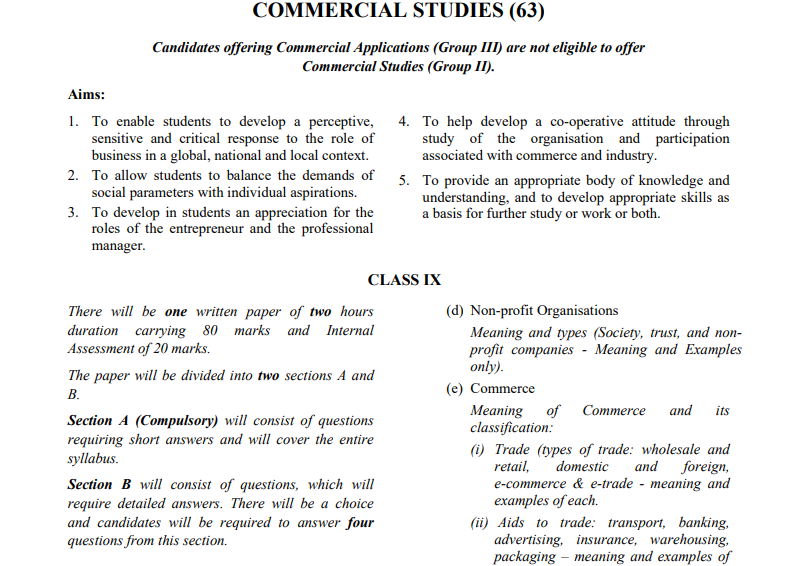
The syllabus for ICSE Class 10 Commercial Studies is designed to provide students with foundational knowledge in areas like finance, human resources, logistics, and environmental policies. The exam is divided into a written paper and internal assessment, with the written paper worth 80 marks and lasting 2 hours, while the internal assessment contributes 20 marks. The written paper includes both compulsory and optional sections to assess a student’s comprehensive understanding.
ICSE Class 10 Commercial Studies Syllabus 2026
The ICSE Class 10 Commercial Studies syllabus for 2025-26 is structured to help students understand core commercial concepts such as marketing, finance, human resources, and banking. It is divided into two sections, Section A, which covers short-answer questions on the entire syllabus and is compulsory, and Section B, which includes detailed questions with some choice.
ICSE Class 10 Commercial Studies Syllabus 2025-26: Paper Structure
| Component | Details |
|---|---|
| Total Marks | 100 (Written Exam: 80 marks; Internal Assessment: 20 marks) |
| Exam Duration | 2 hours |
| Section A | Compulsory; short-answer questions covering the full syllabus |
| Section B | Optional; long-answer questions, with students choosing four questions to answer |
ICSE Class 10 Commercial Studies Syllabus 2025-26: Important Topics
-
Stakeholders in Commercial Organisations
- Meaning of Stakeholder: Definition and types, including internal stakeholders (shareholders, employees, employers) and external stakeholders (suppliers, creditors, government, society).
- Expectations of Stakeholders: Roles and expectations of owners, employees, creditors, suppliers, government, and society.
-
Marketing and Sales
- Marketing: Definition, objectives, and the distinction between marketing and sales.
- Product vs. Service: Explanation with examples.
- Pricing: Definition and objectives of pricing in business.
- Advertising and Sales Promotion: Role and types of advertising, differences between advertising and sales promotion.
- Consumer Protection: Consumer rights under the Consumer Protection Act 2019, and importance of consumer awareness.
- E-Commerce: Types, benefits, e-tailing, e-advertising, e-marketing, and e-security; introduction to ERP.
-
Finance and Accounting
- Capital and Revenue: Definitions and differences between capital and revenue receipts and expenditures.
- Final Accounts of Sole Proprietorship: Structure of Trading, Profit & Loss Account, and Balance Sheet.
- Costs and Budgeting: Basic cost classifications and types of budgets (sales, production, cash, etc.).
- Sources of Finance: Overview of capital markets, shares, debentures, and short-term loans.
-
Human Resources
- Recruitment, Selection, and Training: Meaning, sources, steps, and methods.
- Industrial Relations and Trade Unions: Definitions and objectives.
- Social Security: Overview of Provident Fund, Gratuity, Pension, and other benefits.
-
Logistics
- Transportation and Warehousing: Types and benefits of different transport and warehouse options.
- Insurance: Types of insurance (life, general), and insurance principles.
-
Banking
- Central and Commercial Banks: Roles and differences; online money transfers, NEFT, RTGS, IMPS, and caution with ATM and card usage.
- Financial Fraudulent Practices: Basic understanding of fraud types (e.g., credit card, cyber).
-
Government Initiatives in Environment Protection
- Environment (Protection) Act, 1986: Key features.
- Central Pollution Control Board: Functions.
Internal Assessment and Evaluation
Students are required to complete three assignments, assessed by both internal and external examiners. Each examiner awards up to 10 marks, totaling 20 marks for the internal assessment. Marks are entered by the school on the Council’s CAREERS portal.
| Assessment Component | Marks |
|---|---|
| Internal Examiner (Subject Teacher) | 10 |
| External Examiner | 10 |
| Total | 20 |
ICSE Class 10 Commercial Studies Syllabus 2025-26 PDF Download
Students can download the detailed PDF of the syllabus for ICSE Class 10 Commercial Studies 2025-26, which outlines the topics, marking scheme, internal assessments, and evaluation methods for thorough preparation.
ICSE Class 10 Commercial Studies Syllabus -Click Here To Download PDF
Best Books for ICSE Class 10 Commerce Syllabus 2026
Core Textbooks (Must-Read)
These are your primary study resources to understand the syllabus concepts clearly.
-
Goyal Brothers ICSE Commercial Studies for Class 10 – A reliable textbook aligned to ICSE syllabus with good explanations and examples.
-
ICSE Commercial Studies for Class 10 – A simple, easy-to-understand book covering all chapters as per board requirements.
-
Commercial Studies: Textbook for ICSE Class 10 – Good for conceptual clarity and class learning.
-
I.C.S.E. Commercial Studies Class 10 – Another solid textbook option for thorough coverage.
Tip: Most schools prescribe one main textbook. Choose the one your school follows first, then add others for more practice and perspective.
Practice & Revision Books
Practising questions and past papers greatly improves board preparation.
-
Oswaal ICSE Previous Years Solved Papers Class 10 Commercial Applications – Great for solving last 10+ years’ papers and understanding trends.
-
Educart ICSE Class 10 One-shot Question Bank 2026 Commercial – A helpful question bank with chapter-wise practice questions.
Preparation Strategy
Start with your main textbook to build understanding of every topic.
Use practice books and question banks to test yourself chapter-wise.
Solve previous years’ papers to improve time management and exam confidence.
Revise regularly — focusing on definitions, terms, business scenarios, and case-based questions.
ICSE Class 10 Commerce Syllabus: FAQs
1. What is Commercial Studies in ICSE Class 10?
Commercial Studies is a Group-II elective subject in Class 10 that introduces business concepts such as marketing, finance, human resources, logistics, banking, and consumer protection to build a foundation for higher commerce education.
2. What topics are included in the Commercial Studies syllabus 2025-26?
The major units are:
Stakeholders in Commercial Organisations
Marketing and Sales (including advertising, consumer protection, e-commerce)
Finance and Accounting (capital/revenue, final accounts, costs, budgeting, sources of finance)
Human Resources (recruitment, selection, training, industrial relations, social security)
Logistics (transportation, warehousing, insurance)
Banking (central bank, internet banking, cards, frauds)
Government Initiatives in Environment Protection (Environment Act & CPCB)
3. How is the Commercial Studies exam structured?
External Paper: 80 marks
Internal Assessment: 20 marks
The external paper is divided into:
-
Section A: Compulsory short-answer questions covering the entire syllabus
-
Section B: Long-answer questions with choice (answer 4)
4. What types of questions are asked?
-
Short-answer questions (definitions, differences, purpose/meaning)
-
Long-answer questions (explanations, applications, simple accounting tasks like final accounts)
Board exams test both theory and practical understanding.
5. How are the internal assessment marks evaluated?
Internal assessment (20 marks) usually involves:
Project work/assignments given by subject teacher
Teacher and external examiner assessment
Evaluation criteria are set by CISCE guidelines.
6. How much time is given for the board exam paper?
The written examination is typically 2 hours long for 80 marks.
7. Does the syllabus change every year?
For 2025-26, the syllabus remains consistent with no major revisions from previous years, students should follow the official content released by CISCE.
8. Should I study extra topics not mentioned in the ICSE syllabus?
Board questions come mainly from topics listed in the syllabus. Focus on syllabus content first, then practice additional examples and past-year questions for deeper understanding and application.
9. How do I prepare to score high in Commercial Studies?
Tips:
Understand key definitions and differences (e.g., marketing vs sales).
Practice accounting problems (final accounts, costs).
Revise units regularly and use diagrams or flowcharts to remember processes.
Solve previous year and sample papers under timed conditions.
10. Which chapters are most scoring?
Students often find units like Final Accounts, Marketing and Sales, Banking, and Human Resources high-yield areas — thorough practice here can help score well.
About The Author

Brajesh
Brajesh (MCA, M.Tech (IT)) is a passionate education and career content creator with a strong academic background in Computer Applications (MCA) and Technology (M.Tech). With years of hands-on experience in exam preparation strategies, syllabus analysis, and government job updates, he helps students and aspirants navigate their academic and professional journeys with clarity and confidence.