
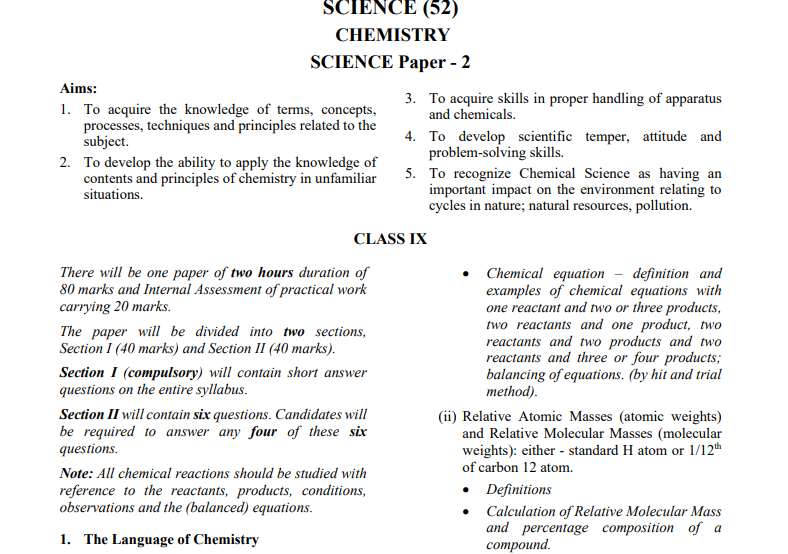
The ICSE Class 10 Chemistry syllabus for 2026-27 covers critical concepts that bridge theoretical knowledge with hands-on experiments. Students will gain insights into atomic structure, chemical bonding, stoichiometry, and electrolysis, preparing them for advanced studies in chemistry. With a balance of practical assessments and structured theory, this syllabus builds a strong foundation in chemistry, emphasizing observation, analysis, and experimental accuracy.
ICSE Class 10 Chemistry Syllabus 2026-27
The ICSE Class 10 Chemistry Syllabus 2026-27 provides students with a comprehensive understanding of fundamental chemistry concepts, including chemical bonding, periodicity, acids, bases, salts, electrolysis, metallurgy, and organic chemistry. The syllabus emphasizes theoretical knowledge alongside practical applications, allowing students to explore chemical reactions, stoichiometry, and real-world chemical processes. Divided into two sections, the syllabus focuses on short-answer questions covering the entire curriculum and in-depth questions that encourage a deeper understanding of specific topics.
ICSE Class 10 Chemistry Syllabus 2026 In Detail
1. Periodic Properties and Variations of Properties (Physical and Chemical)
- Periodic Properties: This section covers fundamental periodic properties, such as atomic size, metallic and non-metallic character, ionization potential, electron affinity, and electronegativity. Students will study how these properties vary across groups and periods in the periodic table.
- Modern Periodic Table: Special focus is given to the elements up to Period 3, with an emphasis on understanding trends in the alkali metals and halogens.
2. Chemical Bonding
- Electrovalent Bonding: Students will explore the electron dot structures of electrovalent compounds (e.g., NaCl, MgCl₂, CaO), focusing on the properties like state of existence, melting and boiling points, and conductivity.
- Covalent Bonding: The syllabus includes electron dot structures of covalent molecules (e.g., H₂, Cl₂, NH₃, CH₄), examining the concept of polar covalent bonds (HCl, H₂O) and comparing them with electrovalent compounds.
- Coordinate Bonding: Key focus on the formation of hydronium (H₃O⁺) and ammonium (NH₄⁺) ions, along with understanding lone pairs and bond formation through electron dot diagrams.
3. Study of Acids, Bases, and Salts
- Definitions and Properties: Acids, bases, and salts are defined in terms of their molecular characteristics, with explanations of ions in solutions, such as the hydronium and hydroxyl ions.
- pH Scale: Students learn to use pH paper and universal indicators to identify acidity, neutrality, or alkalinity.
- Reactions and Preparation: This includes the action of dilute acids on salts, preparation methods for normal salts, and types of salts (normal, acidic, and basic).
4. Analytical Chemistry
- Reactions with NaOH and NH₄OH: Focus is placed on the reaction of sodium hydroxide and ammonium hydroxide with various metal salts, observing color changes and precipitate formation.
- Alkalis on Metals: The syllabus also examines the amphoteric behavior of metals like aluminum, zinc, and lead when reacting with strong alkalis such as NaOH and KOH.
5. Mole Concept and Stoichiometry
- Mole and Avogadro’s Law: Key concepts include Avogadro’s Law, Gay Lussac’s Law of Combining Volumes, and the idea of the mole as a counting unit, with practical applications in calculating molar volume.
- Calculations: Students learn to perform simple calculations involving molar volume, mass, volume, and Avogadro’s number, as well as deducing empirical and molecular formulas.
6. Electrolysis
- Electrolytes and Electrodes: Definitions and classifications of electrolytes and non-electrolytes, including substances with only molecules, only ions, or both.
- Electrolytic Processes: Focus on selective ion discharge, with practical examples like molten lead bromide and aqueous copper(II) sulfate.
- Applications: Includes electroplating and electro-refining processes, especially nickel and silver electroplating, and the refining of copper.
7. Metallurgy
- Extraction of Metals: Introduction to ore dressing and metal extraction methods like roasting, calcination, and reduction, using examples like copper oxide and lead (II) oxide.
- Extraction of Aluminum: Detailed study of the Baeyer’s Process for purifying bauxite and the Hall-Héroult Process for electrolytic extraction.
- Alloys: Composition and uses of alloys such as stainless steel, brass, bronze, and solder.
8. Study of Compounds
- Hydrogen Chloride: Covers preparation, properties, and reactions, including the fountain experiment and preparation of hydrochloric acid.
- Ammonia: Explores laboratory preparation, solubility, reactions (e.g., with HCl and copper oxide), and uses in fertilizers and refrigerants.
- Nitric Acid: Laboratory preparation and large-scale production through the Ostwald process, with reactions as an oxidizing agent.
- Sulphuric Acid: Focus on its preparation, reactions as an acid, oxidizing agent, and dehydrating agent, as well as non-volatile nature.
9. Organic Chemistry
- Introduction: Concepts of carbon’s tetravalency, formation of single, double, and triple bonds, and hydrocarbons like alkanes, alkenes, and alkynes.
- Homologous Series and Isomerism: Structural formulae and isomerism, with examples for alkanes, alkenes, and alkynes.
- Alcohols and Carboxylic Acids: Study of ethanol and acetic acid, covering preparation, properties, and practical uses.
Practical Work
In addition to the theoretical study, the syllabus mandates practical assessments, where students identify gases and ions and observe chemical reactions. Experiments include:
- Heating substances like copper and zinc carbonates, identifying products, and drawing deductions.
- Observing the reaction of dilute acids and alkalis with certain compounds.
- Testing with indicators and performing simple qualitative analysis.
ICSE Class 10 Chemistry Syllabus 2026-27 PDF Download
Students can download the complete ICSE Class 10 Chemistry Syllabus 2026 PDF for easy reference. This downloadable syllabus is a valuable resource, detailing all topics, practical experiments, and exam requirements. From chemical bonding to organic chemistry, each section is covered in detail, ensuring students have access to all the essential information for successful preparation.
ICSE Class 10 Chemistry Syllabus-Click Here To Download PDF
ICSE Class 10 Chemistry Exam Pattern 2026
The ICSE Class 10 Chemistry Exam Pattern for the 2026 board exams (Academic Session 2026–27) as per the latest available details from the Council for the Indian School Certificate Examinations (CISCE) and specimen papers:
ICSE Class 10 Chemistry Exam Pattern Details
Total Marks
-
Theory (External Written Exam): 80 marks
-
Internal Assessment / Practical Work: 20 marks
Total: 100 marks for the subject.
Exam Duration
-
2 hours (120 minutes) for the theory paper.
Mode of Exam
-
Pen and paper (Offline) written examination.
Theory Paper Structure
The Chemistry paper is typically divided into two main sections:
Section A (Compulsory)
-
Short-answer questions
-
Covers the entire syllabus
-
Usually includes objective-style items, short-format questions
-
Approx. 40 marks in total.
Section B
-
Long-answer/structured questions
-
Students must attempt a specified number from a given set (e.g., answer 4 out of 6).
-
Also generally carries 40 marks.
The official specimen (Sample) paper for 2026 confirms Section A is compulsory and Section B requires choices from structured questions.
Internal Assessment / Practical (20 Marks)
This component is evaluated by schools and usually includes:
-
Practical experiments
-
Lab work performance
-
Record/book/project submissions
This makes up 20 marks separate from the written exam.
Question Types You Can Expect
-
Multiple-choice questions (MCQs)
-
Short-answer and fill-in-the-blank type questions
-
Structured long answers
-
Numerical problems (e.g., mole concept, equations)
-
Application-based and reasoning-based questions
Key Topic Weightage (Approximate Based on Recent Trends & Blueprints)
While exact chapter weights vary slightly each year, important topics commonly carry the following approximate marks:
| Topic | Typical Marks Range |
|---|---|
| Mole Concept & Stoichiometry | 10–12 marks |
| Acids, Bases & Salts | 8–10 marks |
| Electrolysis | 8–10 marks |
| Organic Chemistry | 8–10 marks |
| Periodic Properties | 6–8 marks |
| Chemical Bonding | 6–8 marks |
| Metallurgy | 6–8 marks |
| (Source: based on weightage guides and specimen trends) |
Important Notes for 2026
-
Answering Strategy: Focus first on Section A, then choose the best questions in Section B based on strength.
-
Practicals: Complete and maintain good practical records — these marks are separate from theory and can boost the overall score.
-
Specimen Papers: Refer to the official CISCE specimen paper for exact formats and example questions for practice.
ICSE 10th Chemistry Marking Scheme
Overall Marks Distribution
| Component | Marks |
|---|---|
| Theory (Written Exam) | 80 Marks |
| Internal Assessment / Practical | 20 Marks |
| Total | 100 Marks |
The board follows this 80 + 20 pattern for all science subjects.
Theory Paper Pattern (80 Marks)
Section I (Compulsory)
- Marks: 40
- Type: Short answer questions
- Includes:
- Fill in the blanks
- MCQs / objective
- Very short answers
- Definitions & reasoning
Section II (Optional)
- Marks: 40
- Pattern: Attempt any 4 out of 6 questions
- Type: Descriptive / Long answer questions
- Includes:
- Chemical equations
- Numericals (Mole concept)
- Reasoning-based questions
- Structured questions
This section gives choice, so students can skip weaker topics.
Internal Assessment (20 Marks)
| Component | Marks |
|---|---|
| Practical Experiments | — |
| Lab Record / File | — |
| Viva Voce | — |
| Project Work | — |
| Total | 20 Marks |
Internal marks are given by the school based on performance.
Chapter-wise Weightage (Expected Trend)
| Chapter | Approx Marks |
|---|---|
| Periodic Table | 8–10 |
| Chemical Bonding | 6–8 |
| Acids, Bases & Salts | 10–12 |
| Analytical Chemistry | 3–5 |
| Mole Concept | 10–12 |
| Electrolysis | 6–8 |
| Metallurgy | 8–10 |
| Study of Compounds | 15–20 |
| Organic Chemistry | 12–15 |
“Study of Compounds” + “Organic Chemistry” are high-scoring areas.
Exam Details
- Duration: 2 Hours
- Paper Type: Theory + Application-based
- Focus on:
- Balanced chemical equations
- Reasoning answers
- Numericals
FAQs Based on ICSE Class 10 Chemistry Syllabus
Q1. How many chapters are there in the ICSE Class 10 Chemistry syllabus?
The ICSE Class 10 Chemistry syllabus generally consists of 9 major chapters, covering physical, inorganic, and organic chemistry topics prescribed by CISCE.
Q2. Which chapters carry the highest weightage in ICSE Class 10 Chemistry?
Chapters like Chemical Bonding, Acids Bases and Salts, Electrolysis, Metallurgy, Organic Chemistry, and Analytical Chemistry are considered high-scoring and frequently tested in board exams.
Q3. Is Organic Chemistry compulsory in ICSE Class 10 Chemistry?
Yes, Organic Chemistry is compulsory. Students must study topics such as alkanes, alkenes, alkynes, alcohols, carboxylic acids, and polymers, including their preparations, properties, and uses.
Q4. Are numerical problems asked in the ICSE Class 10 Chemistry exam?
Yes, numerical problems are mainly asked from Stoichiometry, Electrolysis, and Acids, Bases and Salts, and they carry significant marks.
Q5. How important is Chemical Bonding for the board exam?
Chemical Bonding is very important. Questions related to covalent and ionic bonding, molecular structure, and properties are frequently asked in both short and long-answer formats.
Q6. What is the importance of Analytical Chemistry in ICSE Class 10?
Analytical Chemistry is a high-scoring chapter. Students must learn tests for acids, bases, radicals, gases, and salts, which are commonly asked in theory and practical-based questions.
Q7. Is Metallurgy a difficult chapter for ICSE Class 10 students?
Metallurgy is considered moderate in difficulty. With clear understanding of ore concentration, extraction, and refining processes, students can score well.
Q8. Are practical-based questions asked in the ICSE Chemistry board exam?
Yes, ICSE includes practical-oriented and application-based questions, especially from Analytical Chemistry, Electrolysis, and Organic Chemistry.
Q9. How should students prepare ICSE Class 10 Chemistry effectively?
Students should focus on clear concepts, balanced chemical equations, diagrams, reactions, and regular practice of numericals, along with revising previous years’ question papers.
Q10. Is the ICSE Class 10 Chemistry syllabus useful for competitive exams?
Yes, the syllabus builds a strong foundation for exams like JEE (basic level), NEET fundamentals, and Olympiads, especially in chemical reactions and organic chemistry basics.
About The Author
