
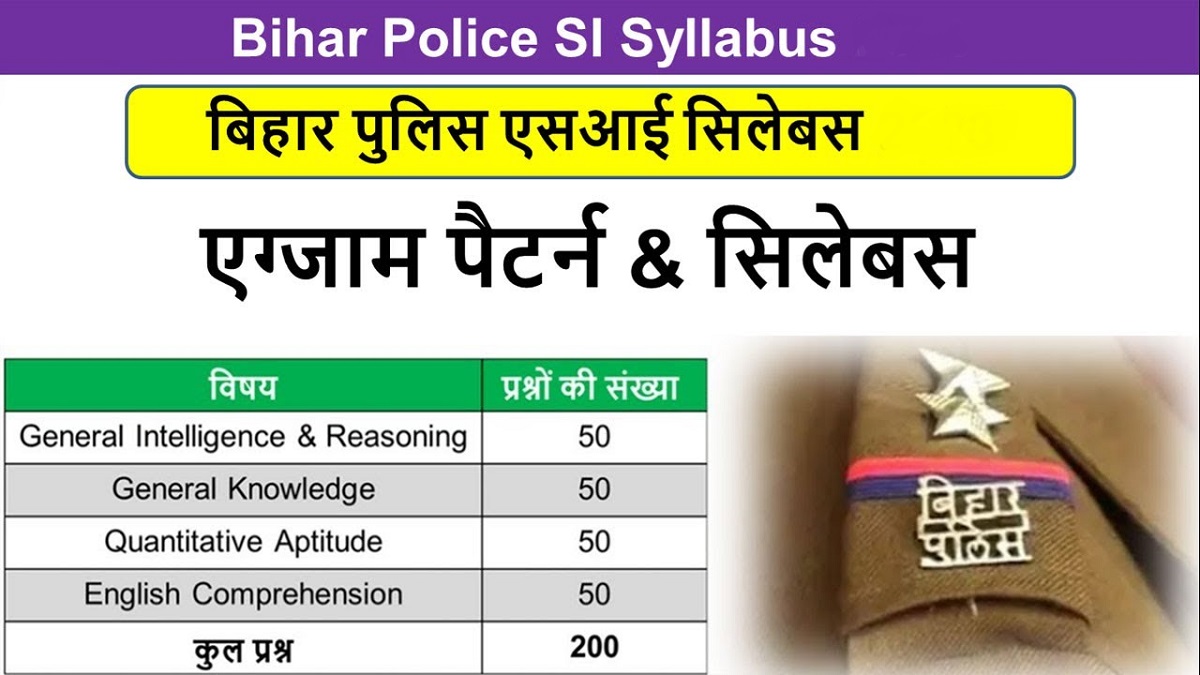
The Bihar Daroga (Sub-Inspector) Exam is a prestigious recruitment exam conducted by the Bihar Police Subordinate Services Commission (BPSSC). Aspirants aiming for a career in law enforcement and public service appear for this highly competitive exam. The selection process involves multiple stages, including a written test (preliminary and mains), physical efficiency test (PET), and medical examination. Check Latest Bihar Daroga Syllabus in details here in this post.
Bihar Daroga Syllabus 2026
To succeed, candidates must thoroughly understand the Bihar Daroga syllabus, which covers a wide range of subjects such as General Knowledge, Current Affairs, General Science, Indian History, Geography, Civics, and Mathematics. A focused preparation based on the detailed syllabus is essential for success.
The Bihar Daroga (Bihar Police Sub-Inspector) recruitment exam is conducted by the Bihar Police Subordinate Services Commission (BPSSC). The exam typically consists of two stages: Preliminary Examination and Main Examination. Here is a detailed syllabus for both stages.
Bihar Daroga Exam Pattern 2026
Exam Pattern of Bihar Daroga Exam for Prelims and Mains Exam is given below:
Bihar Daroga Preliminary Exam Pattern
The preliminary exam is of 200 marks and consists of one paper with objective-type questions. The duration of the exam is 2 hours.
- Total Questions: 100 (Each question carries 2 marks)
- Negative Marking: 0.2 marks for each incorrect answer
- Qualifying Marks: 30%
Bihar Daroga Mains Exam Pattern
Paper 1 Hindi paper
- Duration: 2 hours
- Marks: 200
- Qualifying Marks: 30%
Paper 2 General Studies
- Duration: 2 hours
- Marks: 200
- Total Questions: 100 (Each question carries 2 marks)
- Negative Marking: 0.2 marks for each wrong answer
Bihar Daroga Syllabus 2026 for Prelims Exam
- General Knowledge:
- Current events of national and international importance
- History of India and Indian National Movement
- Indian and World Geography (physical, social, economic geography)
- Indian Polity and Economy
- General mental ability
- General Science:
- General appreciation and understanding of science, including everyday observations and experience, particularly related to topics such as:
- Physics
- Chemistry
- Biology
- Important developments in Science & Technology
- General appreciation and understanding of science, including everyday observations and experience, particularly related to topics such as:
- Indian History:
- Emphasis on the modern period (after 1857)
- Indian independence movement
- Growth of nationalism
- Social, economic, and political history of India
- Indian Polity and Economy:
- Constitution of India
- Political System in India
- Panchayati Raj, community development
- Economic reforms and policy changes in India post-independence
- Indian Geography:
- Geographical features of India
- Climate, physical features, rivers, and topography
- Natural resources
- Agriculture, industry, and trade
- Current Events:
- National and international current events
- Political, social, and economic events
Bihar Daroga Mains Syllabus 2026
The main exam is divided into two papers, each of 200 marks.
Bihar Daroga Paper I: General Hindi Syllabus
This paper is qualifying in nature, and the marks obtained in it will not be counted for the final merit list. The following sections are generally covered:
- Grammar:
- Noun, Pronoun, Adjective, Verb, Adverb, Tense, Voice, Direct and Indirect speech, Synonyms, Antonyms, etc.
- Sentence formation
- Vocabulary
- Error detection
- Essay and comprehension
Bihar Daroga Paper II: General Studies
Syllabus for Paper II:
- General Knowledge:
- Current affairs of national and international importance
- Major events in Indian history
- Bihar history and culture
- Indian National Movement
- Bihar’s role in the freedom struggle
- Geography of Bihar
- Indian and Bihar economy
- General Science:
- Basic concepts of Physics, Chemistry, and Biology
- Scientific developments and research
- Recent advancements in Science & Technology
- Indian History:
- Indian civilization, culture, and history
- Freedom struggle and post-independence developments
- Indian national movements
- Indian Polity and Economy:
- Constitution of India, political system, and governance
- Panchayati Raj system
- Economic policies and reforms in India
- Five-year plans and economic development
- Geography:
- Physical, social, and economic geography of India
- Natural resources, industries, and agricultural practices
- Geography of Bihar
- Current Events:
- National and international current affairs
- Socio-economic issues
- Important government schemes
- Mental Ability Test (Reasoning):
- Logical and analytical reasoning
- Decision making and problem-solving
- Series completion, coding-decoding, puzzles
Bihar Daroga Running Time
The Bihar Police Daroga (Sub-Inspector) Physical Efficiency Test (PET) includes a running test, which is one of the most important qualifying stages. Below are the latest detailed running time standards for 2026 recruitment.
Running Time for Male Candidates
- Distance: 1.6 km (1600 meters / 1 mile)
- Time Limit: 6 minutes to 6 minutes 30 seconds
- Candidates must complete the race within the given time, otherwise they are disqualified.
This is a high-speed endurance run, requiring both stamina and pace.
Running Time for Female Candidates
- Distance: 1 km
- Time Limit: 5 minutes to 6 minutes (depending on notification variation)
- Must finish within the time limit to qualify.
Summary Table
| Category | Distance | Time Limit |
|---|---|---|
| Male Candidates | 1.6 km | 6 – 6.5 minutes |
| Female Candidates | 1 km | 5 – 6 minutes |
Important Rules
- The running test is qualifying in nature (pass/fail).
- Usually conducted before other physical events like long jump, high jump, and shot put.
- No second chance if you fail the race.
- Timing is strictly monitored by officials.
Tips to Clear Bihar Daroga Running
- Practice 1600m daily with a stopwatch
- Aim for 5:30 minutes (male) for safety margin
- Do interval training (400m × 4 rounds)
- Improve stamina with jogging + sprint mix
- Maintain proper breathing rhythm
Bihar Daroga Physical Efficiency Test (PET)
The PET is conducted for candidates who qualify in the main exam. This test assesses the physical fitness of the candidates.
- For Male Candidates:
- Running: 1.6 km in 6 minutes
- High Jump: Minimum 4 feet
- Long Jump: Minimum 12 feet
- Shot Put: 16 pounds, 16 feet
- For Female Candidates:
- Running: 1 km in 6 minutes
- High Jump: Minimum 3 feet
- Long Jump: Minimum 9 feet
- Shot Put: 12 pounds, 10 feet
Bihar Daroga Medical Test
Candidates must be in good physical and mental health and free from any physical deformity. Specific vision and height requirements may also apply.
Bihar Daroga Negative Marking
For the Bihar Police Sub-Inspector (Daroga) Exam, the negative marking rule is as follows:
Negative Marking Rule
- 0.2 marks (1/5 mark) are deducted for every wrong answer.
Applies To:
- Preliminary Exam → Yes (–0.2 per wrong answer)
- Mains Exam (Objective Papers) → Yes (–0.2 per wrong answer)
Important Points:
- Each correct answer = +2 marks (Prelims)
- Each wrong answer = –0.2 marks
- Unattempted questions = No penalty
So, if you attempt 10 questions wrong, you will lose 2 marks (0.2 × 10).
How to Prepare for the Bihar Daroga Exam?
Preparing for the Bihar Daroga (Police Sub-Inspector) exam requires a structured approach, focusing on both the syllabus and the exam pattern. Here’s a comprehensive guide to help you prepare effectively:
Understand the Exam Pattern
- Preliminary Exam: Objective type questions covering General Studies, General Science, Mathematics, and Reasoning.
- Main Exam: Descriptive type questions with sections on General Studies, Hindi, and optional subjects.
- Physical Efficiency Test (PET): Tests your physical fitness and includes running, high jump, long jump, etc.
- Interview: Assessing your personality and suitability for the role.
Syllabus Overview
Preliminary Exam:
- General Studies: Current affairs, History, Geography, Indian Polity, Economy, and Environment.
- General Science: Basic Physics, Chemistry, Biology.
- Mathematics: Number systems, Algebra, Geometry, Statistics, and Mensuration.
- Reasoning: Verbal and Non-Verbal reasoning.
Main Exam:
- General Studies: In-depth study of the subjects mentioned above.
- Hindi: Proficiency in Hindi language, comprehension, and essay writing.
- Optional Subjects: Choose based on your strengths (like sociology, history, etc.).
Study Materials
- Books: Use standard textbooks for each subject (like NCERTs for basic concepts and reference books for competitive exams).
- Current Affairs: Newspapers (like The Hindu or Indian Express) and monthly magazines (like Pratiyogita Darpan).
- Online Resources: Websites and YouTube channels offering lectures and study materials.
Create a Study Plan
- Daily Schedule: Allocate specific hours for each subject. Include breaks to avoid burnout.
- Weekly Goals: Set targets for completing chapters and topics.
- Mock Tests: Regularly take practice tests to assess your preparation and get familiar with the exam pattern.
Physical Preparation
- Fitness Routine: Include running, strength training, and flexibility exercises.
- Practice for PET: Focus on the specific requirements for the physical tests.
Revision Strategy
- Regular Revisions: Set aside time weekly to review what you’ve studied.
- Short Notes: Make concise notes for quick revision before the exam.
Stay Motivated
- Group Study: Join a study group for motivation and different perspectives.
- Positive Mindset: Stay focused on your goals and believe in your preparation.
Practice Previous Year Papers
- Solve past year question papers to understand the exam’s difficulty level and question types.
Time Management
- Practice managing your time effectively during mock tests to ensure you can complete the exam within the allotted time.
Health and Well-being
- Maintain a balanced diet, get adequate sleep, and manage stress through relaxation techniques or hobbies.
By following these steps and maintaining discipline in your studies, you can effectively prepare for the Bihar Daroga exam. Good luck!
Related Posts:
Rajasthan Jail Prahari Syllabus
Allahabad High Court Group D Syllabus
CG Prayogshala Paricharak Syllabus
FAQs Based on Bihar Daroga Syllabus
Q1. What is the Bihar Daroga syllabus?
The Bihar Daroga syllabus mainly includes General Hindi, General Knowledge, Current Affairs, Mathematics, and Mental Ability. The syllabus is designed to test candidates’ language skills, reasoning ability, numerical aptitude, and awareness of national and state-level issues.
Q2. How many papers are there in the Bihar Daroga exam?
The Bihar Daroga exam is conducted in two written papers:
-
Paper 1: General Hindi
-
Paper 2: General Studies (GK, Current Affairs, Maths, Reasoning)
Q3. Is General Hindi qualifying or scoring?
General Hindi is qualifying in nature. Candidates must score the minimum qualifying marks, but its marks are not added to the merit list.
Q4. What topics are covered in the General Hindi syllabus?
The General Hindi syllabus includes:
-
Grammar
-
Vocabulary
-
Sentence formation
-
Synonyms & Antonyms
-
Comprehension passages
-
Error correction
Q5. What are the major topics in Bihar Daroga General Knowledge syllabus?
Important GK topics include:
-
Indian History & Geography
-
Indian Polity & Constitution
-
Indian Economy
-
Bihar-specific GK
-
Science & Technology
-
Sports and Awards
Q6. Does Bihar Daroga syllabus include Current Affairs?
Yes, Current Affairs are an important part of the syllabus. Questions are asked from:
-
National & International events
-
Bihar state current affairs
-
Government schemes
-
Appointments, summits, and reports
Q7. What is the Mathematics syllabus for Bihar Daroga?
The Mathematics section covers:
-
Percentage
-
Profit & Loss
-
Ratio & Proportion
-
Simple & Compound Interest
-
Time & Work
-
Time, Speed & Distance
-
Average and Number System
Q8. What topics are included in Mental Ability?
Mental Ability includes:
-
Logical reasoning
-
Series (number & alphabet)
-
Coding-decoding
-
Direction sense
-
Blood relations
-
Analogy and classification
Q9. Is the Bihar Daroga syllabus same as other police exams?
The syllabus is similar but slightly more advanced compared to constable-level exams, especially in GK and reasoning sections.
Q10. Is there any negative marking in Bihar Daroga exam?
Yes, negative marking is applicable for incorrect answers, so candidates should attempt questions carefully.
Q11. Does Bihar-specific GK have high weightage?
Yes, Bihar-related questions on history, geography, economy, and current affairs carry significant weightage in the exam.
Q12. Is the Bihar Daroga syllabus difficult?
The syllabus is of moderate level. With regular practice and proper coverage of static GK and current affairs, candidates can score well.
Q13. What is the best way to cover the Bihar Daroga syllabus?
-
Start with General Hindi qualifying preparation
-
Focus on Bihar GK and Current Affairs
-
Practice Maths and Reasoning daily
-
Solve previous year question papers and mock tests
About The Author

1 thought on “Bihar Daroga Syllabus 2026, Exam Pattern, Running Time, Negative Marking”