
The CBSE Class 10 National Cadet Corps (NCC) Syllabus 2025–26 is designed to instill discipline, leadership, patriotism, and a spirit of service among students. The syllabus focuses on developing character, teamwork, and a sense of responsibility through a blend of theoretical knowledge and practical activities. It introduces cadets to basic military concepts, drill, weapon training, social service, adventure activities, and national integration. Emphasis is also placed on health, fitness, and community engagement. By following the NCC syllabus, students gain confidence, life skills, and a strong foundation for future careers in defense and civil services.
CBSE Class 10 NCC Syllabus 2025-26
The CBSE Class 10 National Cadet Corps (NCC) syllabus for the 2024-25 academic year is designed to instill discipline, leadership, and patriotism among students. The curriculum emphasizes both theoretical knowledge and practical skills, promoting values like responsibility, teamwork, and self-reliance. It covers topics such as drill training, social service, adventure activities, and awareness of national defense. By engaging in physical activities, students not only enhance their physical fitness but also develop a sense of civic duty and national pride. The NCC program plays a vital role in shaping students into responsible citizens and future leaders.
CBSE Class 10 National Cadet Corps Syllabus 2025-26: Unitwise
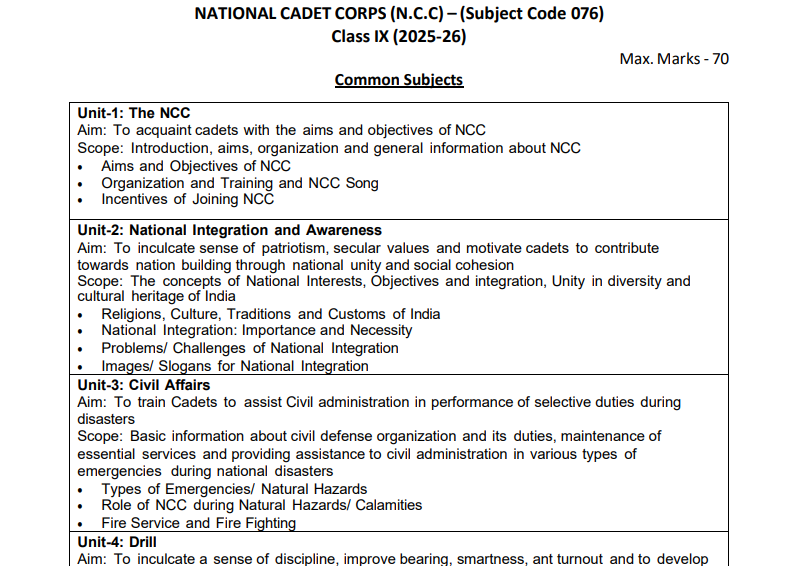
| Unit-1: The NCC
Aim: To acquaint cadets with the aims and objectives of NCC
|
| Unit-2 : National Integration and Awareness
Aim: To inculcate sense of patriotism, secular values and motivate cadets to contribute towards nation building through national unity and social cohesion Scope: The concepts of National Interests, Objectives and integration, Unity in diversity and cultural heritage of India
|
| Unit-3 : Civil Affairs
Aim: To train Cadets to assist Civil administration in performance of selective duties during disasters Scope: Basic information about civil defense organization and its duties, maintenance of essential services and providing assistance to civil administration in various types of emergencies during national disasters
|
| Unit-4 : Drill
Aim: To inculcate a sense of discipline, improve bearing, smartness, ant turnout and to develop the quality of immediate and implicit obedience to orders Scope: All important basic aspects of drill including ceremonial drill, drill with arms and words of command Drill without Arms
|
| Unit-5 : Weapon Training
Aim: To give elementary knowledge about rifles Scope: Basic knowledge about rifle and firing
|
| Unit-6 : Adventure Training
Aim: To inculcate a sense of adventure and develop confidence, courage and determination Scope: To expose cadets to various adventure activities
|
| Unit-7 : Personality Development and Leadership
Aim: To develop an all-round dynamic personality with adequate leadership traits to deal/ contribute effectively in all walks of life Scope: Basic subjects of leadership with emphasis on self-awareness, life/soft skills, time management and character building
|
| Unit-8 : Social Awareness Community Development
Aim: To teach cadets the values and skills involved in providing voluntary Social Service Scope: Understanding of social service and its needs, knowledge about the weaker sections of our society and their requirements, about NGOs and contribution of youth towards social welfare
|
| Unit-9: Health and Hygiene
Aim: To instill respect and responsibility towards personal health and hygiene Scope: Basic information of the human body, maintenance of health and hygiene, sanitation, disease and an elementary knowledge of First Aid and Nursing
|
| Unit-10 : Environment Awareness and Conservation
Aim: To sensitize the cadets on natural resource conservation and protection of environment Scope: Basic understanding of environment in general and waste management in particular, energy conservation, pollution control and wildlife conservation in particular
|
Specialized Subject (Army)
| Unit-1: Armed Forces
Aim: To acquaint cadets with the Armed Forces Scope: Introductory and general information about the Armed Forces
|
| Unit-2: Military History
Aim: To provide knowledge of renowned Military Generals, PVCs and Indo-Pak Wars Scope: Introduction to biographies, famous Indian battles and gallantry awards
|
| Unit-3:Map Reading
Aim: To teach cadets elementary map reading Scope: Basic understanding of map sheets and map reading instruments and development of capability to use them to carry out simple Map Reading
|
| Unit-4 : Field Craft and Battle Craft
Aim: To teach cadets elementary field craft and battle craft Scope: Basic field craft and battle craft
|
| Unit-5:Communication
Aim: To introduce cadets to the latest trends in the field of communications Scope: Types of communications and future trends
|
Specialized Subject (Navy)
| Unit-1: Naval Orientation
Aim: To impart training on Naval Organization. Scope: History of Indian Naval Organizations, Rank structure, Indo-Pak War- 1971etc.
|
| Unit-2: Naval Communication
Aim: To impart basic knowledge of Naval Communication. Scope: Introduction to visual communication. |
|
| Unit-3:Seamanship
Aim: To impart basic knowledge about Seamanship. Scope: Introduction to rigging, anchor work, parts of boats and accessories etc.
|
| Unit-4: Navigation
Aim: To impart basic knowledge to Naval Communication. Scope: Introduction to visual communication
|
| Unit-5: Ship and Boat Modelling
Aim: To impart basic knowledge about Ship Modelling to cadets Scope: Basic knowledge about reading of Diagrams and constriction of Ship Models
|
Specialized Subject (Air Force)
| Unit-1:Air Campaigns
Aim: To introduce Air Campaigns of Air Force
|
| Unit-2:Aircraft Recognition
Aim: To in traduce various aircrafts of the Air Force Scope: Types, roles, variants of aircraft of the IAF
|
| Unit-3: Aero-modeling
Aim: To provide knowledge about Aero Modelling Scope: History of aero modelling, materials used in different types of models
|
| Unit-4:Atmosphere
Aim: To give basic knowledge of Atmosphere Scope: Use of basic knowledge of Atmosphere
|
| Unit-5:Maps
Aim: To give basic knowledge of Air Navigation Scope: Use of Maps and fundamentals of Map Reading from the air
|
CBSE Class 10 NCC Syllabus 2025-26 PDF Download
To download the CBSE Class 10 NCC syllabus for the 2025-26 academic year, you can visit several educational websites like Adda247 and the CBSE Official website. They provide direct links to the syllabus PDF. You can also access the syllabus from the official CBSE academic website. The syllabus covers all topics from the NCERT NCC book for Class 10, essential for exam preparation.
NCC_Sec_2025-26 PDF
Related Post:
FAQs
1. What is the NCC syllabus for Class 10 (2025-26)?
The syllabus includes Common Subjects covering:
-
The NCC (aims, objectives, organization)
-
National Integration and Awareness
-
Civil Affairs (role in disasters)
-
Drill (military drill commands)
-
Health & Hygiene
-
Environment Awareness & Conservation
There are also specialized wings (Army / Air Force / Navy), each with unit-wise topics related to that wing’s domain.
2. How many marks is the NCC exam and what is the format?
-
Maximum Marks: 70
-
Paper Structure:
-
Part-I (Common Subjects) – 49 marks
-
Part-II (Specialized Wing) – 21 marks
-
-
Questions are divided across multiple formats (MCQs, short & long answers).
3. Where can I get the official NCC syllabus PDF?
The syllabus PDF is available on the CBSE Academic website under Curriculum → Secondary Curriculum (IX-X) → NCC (Subject Code 076). You can download it directly from CBSE’s curriculum portal.
4. What types of topics are included in Common Subjects?
Common topics covered in NCC Class 10 include:
Aims, objectives and organization of NCC
National integration & youth contribution
Civil defence & disaster assistance
Basic drill commands and procedures
Health, hygiene, first aid basics
Environment conservation and pollution control basics
5. Do I have to choose a wing? (Army / Air Force / Navy)
Yes. In Part-II of the question paper you answer questions based on the wing you have been trained in (Army, Air Force, or Navy), each having specialized subject topics.
6. Are there changes from the previous year (2024-25)?
The syllabus for 2025-26 is updated and rationalised by CBSE to focus on more conceptual, relevant topics as per the revised curriculum. It’s important to follow the new PDF release rather than older versions.
7. When are NCC exams conducted?
CBSE follows the board timeline for Class 10 exams (the board exam window generally in Feb–Apr 2026), and NCC is scheduled according to that calendar as a board elective subject. (See CBSE official schedule for Class 10 for exact dates.)
8. What’s the best way to prepare for NCC?
Read each unit of the syllabus thoroughly
Focus on understanding aims, roles, and real-life applications
Practice sample papers and previous year questions
Revise drill terminology and first aid principles regularly
The Sample Question Paper released by CBSE gives a clear idea about question types & marking.
9. Is the NCC syllabus part of internal assessment too?
Yes. For Class 10, NCC includes internal assessment / practicals (20 marks) as per CBSE norms (board subjects are 80 marks written exam + 20 internal).
10. Do NCERT textbooks cover NCC syllabus?
NCC doesn’t have a specific NCERT book — instead, the CBSE syllabus units are usually taught using teacher notes, training manuals, and board-provided materials as per the official curriculum. The NCC syllabus is distinct from standard NCERT textbook content.
11. Is there any deleted or revised portion for 2025-26?
CBSE has rationalized several subject syllabi for 2025-26. For NCC, always follow the latest official syllabus PDF — outdated versions may not reflect the current structure.
About The Author

2 thoughts on “CBSE Class 10 NCC Syllabus 2025-26, Download PDF”