
The Chartered Financial Analyst (CFA) Program is a globally recognized certification for finance and investment professionals. The CFA syllabus 2026 is meticulously designed to enhance expertise in investment management, financial analysis, and ethical standards. It consists of three levels, each focusing on specific aspects of the financial industry. The CFA Level 1 Syllabus emphasizes foundational knowledge in ethical practices, quantitative methods, and financial reporting. The CFA Level 2 Syllabus delves into asset valuation and application, while the CFA Level 3 Syllabus specializes in portfolio management and wealth planning. The CFA syllabus integrates theoretical concepts with practical applications, preparing candidates for the dynamic challenges of the global financial landscape.
CFA Syllabus 2026 for Level 1, 2, 3
For the CFA Level 1 syllabus 2026, the main topics covered are: Quantitative Methods, Economics, Corporate Issuers, Financial Statement Analysis, Equity Investments, Fixed Income, Derivatives, Alternative Investments, Portfolio Management, and Ethical and Professional Standards; with no significant changes from the 2024 curriculum, meaning the same 10 topic areas with similar weightings remain consistent across all levels, with Level 2 and 3 building upon the foundation established in Level 1, delving deeper into each area and adding more complex concepts and application-based questions.
CFA Level 1 Syllabus 2026
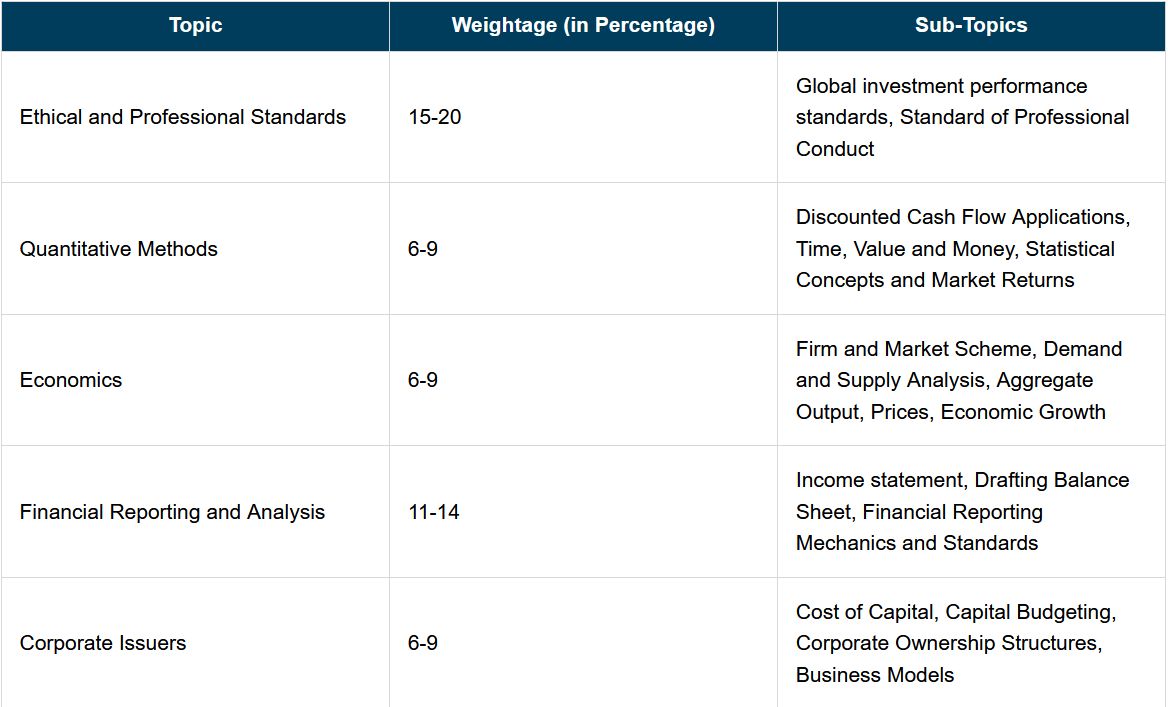
Refer to the table below to know the CFA syllabus for the Level I exam:
| Topic | Weightage (in Percentage) | Sub-Topics |
|---|---|---|
| Ethical and Professional Standards | 15-20 | Global investment performance standards, Standard of Professional Conduct |
| Quantitative Methods | 6-9 | Discounted Cash Flow Applications, Time, Value and Money, Statistical Concepts and Market Returns |
| Economics | 6-9 | Firm and Market Scheme, Demand and Supply Analysis, Aggregate Output, Prices, Economic Growth |
| Financial Reporting and Analysis | 11-14 | Income statement, Drafting Balance Sheet, Financial Reporting Mechanics and Standards |
| Corporate Issuers | 6-9 | Cost of Capital, Capital Budgeting, Corporate Ownership Structures, Business Models |
| Portfolio Management | 8-12 | Basics of Portfolio Planning and Construction |
| Equity Investments | 11-14 | Market Efficiency, Security Market Indices, Market Organization and Structure |
| Fixed Income | 11-14 | Fixed Income Markets, Fixed Income Securities, Introduction to Fixed Income Valuation |
| Derivatives | 5-8 | Derivative Markets and Instruments |
| Alternative Investments | 7-10 | Mutual Funds and Real Estate |
Changes in CFA Level 1 Syllabus
- Many Level I applicants have learned a variety of basic financial concepts throughout their graduation or early professional roles, according to the report. Exam conducting authorities have therefore shifted some of the information and are now offering it separately as reference material for registered candidates in order to streamline the Level I CFA curriculum and prevent duplication.
- The material has been shifted to pre-read subjects that serve as building blocks for subsequent learning, such as time and money value, fundamental statistics, microeconomics, and an introduction to corporate accounts. There is more time for the new practical skills modules and more space for advanced practice concepts because these topic areas are not directly assessed.
- Students who are unfamiliar with these ideas or who only want to go over the content during can use the content as free pre-read materials to help them prepare for the Level I CFA test. These resources can also be used by registered candidates to gauge their exam preparation and identify any knowledge gaps.
CFA Level 2 Syllabus 2026
Refer to the table below to know the CFA syllabus for the Level II exam:
| Topic | Weightage |
|---|---|
| Ethical and Professional Standards | 15 |
| Quantitative Methods | 15 |
| Economics | 10 |
| Financial Reporting and Analysis | 15 |
| Corporate Finance | 10 |
| Portfolio Management | 10 |
| Equity Investments | 15 |
| Fixed Income | 15 |
| Derivatives | 5 |
| Alternative Investments | 5 |
CFA Level 3 Syllabus 2026
Refer to the table below to know the CFA syllabus for the Level III exam:
| CFA Syllabus 2026 Level III | |
|---|---|
| Behavioral Finance | Capital Market Expectations |
| Asset Allocation & Related Decisions in Portfolio Management | Derivatives & Currency Management |
| Fixed-Income Portfolio Management | Equity Portfolio Management |
| Alternative Investments for PM | Private Wealth Management |
| PM- Institutional Trading, Performance Evaluation, and Manager Selection | Cases in Portfolio Management and Risk Management |
| Ethics and Related Topics | |
CFA Syllabus Subject wise and Topics wise Weightage
The Chartered Financial Analyst (CFA) Program’s 2026 curriculum maintains consistent topic weightings across all three levels, with only minor adjustments from previous years. Below is a detailed breakdown of the topic areas and their respective exam weightings for Levels I, II, and III.
Level I:
| Topic Area | Exam Weight (%) |
|---|---|
| Ethical and Professional Standards | 15–20 |
| Quantitative Methods | 6–9 |
| Economics | 6–9 |
| Financial Statement Analysis | 11–14 |
| Corporate Issuers | 6–9 |
| Equity Investments | 11–14 |
| Fixed Income | 11–14 |
| Derivatives | 5–8 |
| Alternative Investments | 7–10 |
| Portfolio Management | 8–12 |
These weightings are consistent with the 2024 curriculum, reflecting a continued emphasis on practical investment topics.
Level II:
| Topic Area | Exam Weight (%) |
|---|---|
| Ethical and Professional Standards | 10–15 |
| Quantitative Methods | 5–10 |
| Economics | 5–10 |
| Financial Statement Analysis | 10–15 |
| Corporate Issuers | 5–10 |
| Equity Investments | 10–15 |
| Fixed Income | 10–15 |
| Derivatives | 5–10 |
| Alternative Investments | 5–10 |
| Portfolio Management | 10–15 |
These weightings remain unchanged from 2024, promoting a balanced approach across all topic areas.
Level III:
| Topic Area | Exam Weight (%) |
|---|---|
| Asset Allocation | 15–20 |
| Portfolio Construction | 15–20 |
| Performance Measurement | 5–10 |
| Derivatives and Risk Management | 10–15 |
| Ethical and Professional Standards | 10–15 |
| Specialized Pathways (Portfolio Management, Private Markets, or Private Wealth) | 30–35 |
The introduction of Specialized Pathways allows candidates to tailor their studies to specific career goals, accounting for 30–35% of the exam weight.
CFA Level 1 Syllabus vs CFA Level 2 Syllabus vs CFA Level 3 Syllabus
Clear comparison of the CFA Program Levels 1, 2, and 3 syllabi in a structured tabular format:
CFA Level 1 vs Level 2 vs Level 3 Syllabus Comparison
| Aspect | CFA Level 1 | CFA Level 2 | CFA Level 3 |
|---|---|---|---|
| Focus | Basic knowledge & concepts | Application & analysis | Portfolio management & wealth planning |
| Exam Objective | Understanding financial tools & concepts | Applying valuation techniques | Synthesizing concepts for real-world portfolio decisions |
| Question Format | MCQs (Multiple Choice Questions) | Item Set (Case-based MCQs) | Constructed Response (Essay) + Item Set |
| Difficulty Level | Moderate (beginner level) | High (analytical) | Very High (practical & subjective) |
| Ethics | Strong emphasis (basic understanding) | Advanced application | Case-based application in real scenarios |
| Quantitative Methods | Basic statistics, probability, time value of money | Advanced applications (regression, time-series) | Limited direct focus (used in portfolio context) |
| Economics | Micro & Macro basics | Applied economics (currency exchange, growth models) | Economics in portfolio context |
| Financial Reporting & Analysis (FRA) | Introductory accounting concepts | Advanced financial analysis & interpretation | Less weight, used in decision-making |
| Corporate Finance | Basic concepts (NPV, IRR, cost of capital) | Advanced corporate finance decisions | Integrated into portfolio management |
| Equity Investments | Basic valuation (DCF, ratios) | Advanced valuation models (FCFF, FCFE) | Portfolio strategies involving equities |
| Fixed Income | Basics of bonds & pricing | Advanced bond valuation & term structure | Fixed income portfolio management |
| Derivatives | Introduction (forwards, futures, options) | Valuation of derivatives | Risk management using derivatives |
| Alternative Investments | Basic concepts (REITs, hedge funds) | Advanced analysis | Portfolio allocation strategies |
| Portfolio Management | Basic concepts (risk-return, CAPM) | Intermediate portfolio theory | Core focus (wealth planning, asset allocation) |
| Weightage of Portfolio Mgmt | Low | Medium | Very High (dominant topic) |
| Real-world Application | Limited | Moderate | Extensive (client-focused scenarios) |
Key Takeaways
- Level 1 → Builds foundation (theory + concepts)
- Level 2 → Focuses on valuation & analysis
- Level 3 → Focuses on portfolio management & practical decision-making
CFA Syllabus PDF Download for Level 1,2,3
Get the CFA Syllabus 2026 PDF by the link:
cfa Syllabus PDF
FAQs
1. What are the core topics covered in the CFA Level 1 syllabus for 2026?
The CFA Level 1 syllabus focuses on building a foundation of investment principles and tools. Key topics include:
- Ethical and Professional Standards
- Quantitative Methods
- Economics
- Financial Statement Analysis
- Corporate Issuers
- Equity Investments
- Fixed Income
- Derivatives
- Alternative Investments
- Portfolio Management and Wealth Planning
2. How does the CFA Level 2 syllabus differ from Level 1?
Level 2 emphasizes the application of concepts and analytical skills. It includes:
- A deeper dive into the same topics covered in Level 1, with a focus on valuation techniques.
- Advanced study of equity and fixed-income investments, derivatives, and alternative investments.
- Intensive use of case studies to test real-world applications of portfolio management.
3. What is the primary focus of the CFA Level 3 syllabus in 2026?
Level 3 is centered on portfolio management and wealth planning:
- Ethical and Professional Standards continue to be a core component.
- A strong focus on integrating knowledge from Levels 1 and 2 into constructing and managing investment portfolios.
- Advanced topics include asset allocation, risk management, private wealth management, and performance evaluation.
4. What are the weightings of topics across the three CFA levels?
While the weights vary slightly year to year, for 2026, they are approximately as follows:
Level 1:
- Ethics: 15–20%
- Quantitative Methods: 8–12%
- Financial Reporting: 13–17%
Level 2:
- Ethics: 10–15%
- Fixed Income and Equity: 30–40% combined
Level 3:
- Portfolio Management: 40–55%
- Ethics: 10–15%
5. Are there any changes in the CFA syllabus for 2026 compared to previous years?
Yes, the CFA Institute has introduced some updates:
- Greater emphasis on environmental, social, and governance (ESG) investing principles.
- New case studies and questions reflecting current market trends and regulatory changes.
- Enhanced focus on technology-driven investment strategies, including fintech and machine learning applications.
About The Author
