
The CSIR NET Physics Syllabus 2026 is designed to evaluate candidates’ conceptual understanding, analytical ability, and problem-solving skills in core areas of Physics. Conducted by the National Testing Agency (NTA), the exam is essential for candidates aspiring to become Junior Research Fellows (JRF) or Lecturers in India. The syllabus broadly covers Classical Mechanics, Electromagnetism, Quantum Mechanics, Thermodynamics, Mathematical Physics, Electronics, and Modern Physics. With a well-structured exam pattern divided into three parts, candidates must focus on both theoretical concepts and numerical applications. A thorough understanding of the syllabus is crucial for effective preparation and achieving a high score.
CSIR Net Physics Syllabus 2026
The CSIR NET Physics (Physical Sciences) Syllabus 2026 is provided in a detailed, unit-wise format, based on the latest pattern followed by NTA/CSIR.
CSIR NET Physics Exam Pattern 2026
- Part A: General Aptitude (common for all subjects)
- Part B: Core Physics concepts
- Part C: Advanced & analytical physics problems
- Total Duration: 3 hours | Total Marks: 200
| Part | Description | Nature |
|---|---|---|
| Part A | General Aptitude (common for all subjects) | Logical reasoning, numerical ability |
| Part B | Subject-based questions (Physical Science) | Concept-based MCQs |
| Part C | Advanced analytical questions | Application & problem-solving |
The exam is a single paper (3 hours, 200 marks) with MCQs only
PART A – General Aptitude
(Common for all subjects)
- Numerical ability
- Logical reasoning
- Data interpretation & graphs
- Series, puzzles
- Quantitative comparison
CSIR Net Physics Syllabus: PART B & C – Physics (Unit-wise)
Unit 1: Mathematical Methods of Physics
Core Topics:
- Dimensional analysis
- Vector algebra & calculus
- Linear algebra, matrices
- Eigenvalues & eigenvectors
- Differential equations (1st & 2nd order)
- Fourier series & transforms
- Laplace transform
- Complex analysis (residue theorem, poles)
- Probability theory (binomial, Poisson, normal distribution)
Advanced Topics:
- Green’s functions
- Partial differential equations (Laplace, Heat, Wave)
- Numerical methods (Runge-Kutta, Simpson rule)
- Finite difference methods
- Tensors
- Group theory (SU(2), O(3))
Unit 2: Classical Mechanics
Core Topics:
- Newton’s laws
- Central force motion
- Rigid body dynamics
- Non-inertial frames
- Variational principle
- Oscillations
Advanced Topics:
- Hamiltonian & Lagrangian formulation
- Poisson brackets
- Canonical transformations
- Hamilton-Jacobi theory
- Phase space & stability
- Noether’s theorem
Unit 3: Electromagnetic Theory
Core Topics:
- Electrostatics & magnetostatics
- Maxwell’s equations
- Boundary conditions
- Electromagnetic waves
Advanced Topics:
- Radiation from moving charges
- Retarded potentials
- Lorentz invariance of Maxwell equations
- Waveguides & transmission lines
- Plasma physics (dispersion relations)
Unit 4: Quantum Mechanics
Core Topics:
- Schrödinger equation
- Operators & observables
- Angular momentum
- Hydrogen atom
- Perturbation theory
Advanced Topics:
- Spin & identical particles
- Relativistic quantum mechanics
- Fine structure & spin-orbit coupling
- Scattering theory
Unit 5: Thermodynamics & Statistical Physics
- Laws of thermodynamics
- Thermodynamic potentials
- Maxwell relations
- Ensembles (microcanonical, canonical, grand canonical)
- Partition function
- Bose-Einstein & Fermi-Dirac statistics
- Phase transitions
Unit 6: Electronics & Experimental Methods
- Semiconductor devices
- Diodes, transistors
- Amplifiers & oscillators
- Digital electronics
- Measurement techniques
- Error analysis
- Data interpretation
Unit 7: Atomic & Molecular Physics
- Atomic spectra
- Zeeman & Stark effects
- Molecular structure
- Rotational & vibrational spectra
- Laser physics
Unit 8: Condensed Matter Physics
- Crystal structure
- X-ray diffraction
- Band theory of solids
- Semiconductors
- Magnetism
- Superconductivity
Unit 9: Nuclear & Particle Physics
- Nuclear structure
- Radioactivity
- Nuclear reactions
- Particle physics basics
- Elementary particles
- Conservation laws
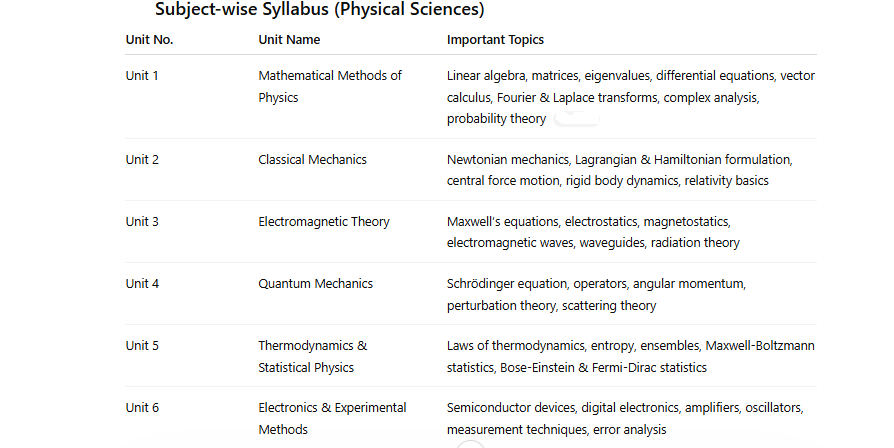
CSIR NET Physical Science Syllabus 2026
CSIR NET Physical Science Syllabus 2026 is presented in a clear table format (based on the latest official structure and standard syllabus followed for 2026).
| Unit No. | Unit Name | Important Topics |
|---|---|---|
| Unit 1 | Mathematical Methods of Physics | Linear algebra, matrices, eigenvalues, differential equations, vector calculus, Fourier & Laplace transforms, complex analysis, probability theory |
| Unit 2 | Classical Mechanics | Newtonian mechanics, Lagrangian & Hamiltonian formulation, central force motion, rigid body dynamics, relativity basics |
| Unit 3 | Electromagnetic Theory | Maxwell’s equations, electrostatics, magnetostatics, electromagnetic waves, waveguides, radiation theory |
| Unit 4 | Quantum Mechanics | Schrödinger equation, operators, angular momentum, perturbation theory, scattering theory |
| Unit 5 | Thermodynamics & Statistical Physics | Laws of thermodynamics, entropy, ensembles, Maxwell-Boltzmann statistics, Bose-Einstein & Fermi-Dirac statistics |
| Unit 6 | Electronics & Experimental Methods | Semiconductor devices, digital electronics, amplifiers, oscillators, measurement techniques, error analysis |
These 6 core units form the complete Physical Science syllabus
Core (Part B) vs Advanced (Part C) Topics
| Section | Level | Coverage |
|---|---|---|
| Core (Part B) | Moderate | Basic concepts from all units |
| Advanced (Part C) | High | Application-based problems, advanced topics like group theory, tensors, Green’s functions, quantum applications |
Key Highlights
- Covers complete postgraduate-level Physics syllabus
- Focus on conceptual clarity + problem-solving ability
- Includes both theoretical & experimental physics
- No major syllabus change confirmed for 2026 (use current syllabus)
Preparation Tip
- Focus more on Mathematical Physics + Quantum Mechanics + Electrodynamics (high weightage)
- Practice previous year questions (PYQs) regularly
- Strengthen numerical problem-solving for Part C
Important Notes
- Questions in Part B = Concept-based,
- Questions in Part C = Analytical & numerical (higher difficulty)
- The syllabus is mostly aligned with M.Sc. Physics level
About The Author
