
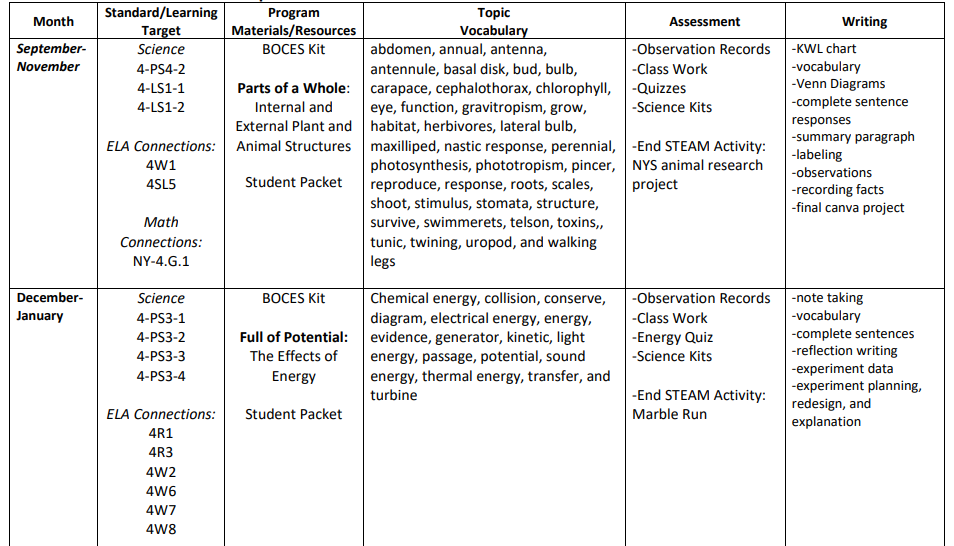
US Grade 4 Science Curriculum 2026 represents a significant evolution in how students engage with scientific concepts. Moving away from passive memorization of facts, the modern curriculum emphasizes active inquiry, hands-on investigation, and the development of critical thinking skills. This shift is largely driven by the adoption of the Next Generation Science Standards (NGSS), which frame science education around three interconnected dimensions: disciplinary core ideas, science and engineering practices, and crosscutting concepts
US Grade 4 Science Syllabus 2026
| Unit / Domain | Topics Covered | Key Concepts / Learning Outcomes |
|---|---|---|
| 1. Scientific Inquiry & Practices | Scientific method, tools, measurement, data collection | Develop observation, experimentation, data recording, and reasoning skills; use graphs and charts |
| 2. Physical Science: Matter | States of matter, properties, mass, volume, density | Understand physical properties, classify matter, measure mass & volume |
| Mixtures & solutions, changes in matter | Learn separation techniques, conservation of matter | |
| 3. Physical Science: Energy & Forces | Types of energy (heat, light, sound), energy transfer | Identify forms of energy and how energy moves |
| Force & motion, gravity, friction | Understand push/pull forces, motion changes, patterns of forces | |
| Magnetism & electricity | Explore magnets, conductors, simple circuits | |
| 4. Life Science | Ecosystems, food chains, food webs | Understand energy flow in ecosystems |
| Plant & animal structures | Learn adaptations and survival mechanisms | |
| Human body systems | Basic functions of digestive, respiratory, circulatory systems | |
| Life cycles | Study growth and development of organisms | |
| 5. Earth Science | Rocks, soil, natural resources | Identify types and uses of Earth materials |
| Water cycle | Understand evaporation, condensation, and precipitation | |
| Weather & climate | Observe weather patterns, use data to predict weather | |
| 6. Space Science | Solar system, Sun, Moon, planets | Compare planets and understand Earth’s position |
| Earth’s rotation & revolution | Understand day/night and seasons | |
| 7. Environmental Science | Conservation, pollution, human impact | Learn sustainable practices and environmental protection |
| 8. STEM & Engineering | Simple machines, problem-solving, design process | Apply science in real-life problem-solving and projects |
Key Features of US Grade 4 Science Curriculum
- Focus on hands-on experiments and inquiry-based learning
- Integration of STEM and real-world applications
- Emphasis on critical thinking and problem-solving skills
- Use of data, models, and scientific explanations
US 4th Grade Science Syllabus 2026
1. Physical Science (PS)
| Unit | Topics Covered | Learning Outcomes |
|---|---|---|
| Energy (PS3) | Forms of energy, speed & energy, collisions | Understand how energy changes and transfers |
| Energy Transfer | Heat, light, sound, electricity | Identify ways energy moves between objects |
| Waves (PS4) | Sound waves, light waves | Learn how waves carry energy and information |
| Light & Vision | Reflection of light | Understand how we see objects |
| Technology & Communication | Signal patterns, coding basics | Explore how information is transmitted |
Students learn that energy can move through sound, light, heat, and electricity and can change forms.
2. Life Science (LS)
| Unit | Topics Covered | Learning Outcomes |
|---|---|---|
| Structure & Function (LS1) | Plants and animals body parts | Understand how structures help survival |
| Internal & External Systems | Organs, roots, stems, skin | Explain functions of body systems |
| Information Processing | Human senses & brain | Learn how organisms respond to stimuli |
Students explore how plants and animals have structures that support survival, growth, and reproduction.
3. Earth & Space Science (ESS)
| Unit | Topics Covered | Learning Outcomes |
|---|---|---|
| Earth’s History (ESS1) | Fossils, rock layers | Understand changes in Earth over time |
| Earth Processes (ESS2) | Weathering, erosion, deposition | Learn how landforms change |
| Earth Features | Maps, mountains, rivers | Identify Earth’s physical patterns |
| Natural Resources (ESS3) | Energy resources, fuels | Understand human use of resources |
| Environment & Climate | Conservation, climate change | Explore human impact on Earth |
Students analyze how weathering, erosion, and natural processes shape Earth.
4. Engineering & Design (ETS)
| Unit | Topics Covered | Learning Outcomes |
|---|---|---|
| Problem Solving | Identify problems | Define real-world challenges |
| Design Process | Plan, build, test solutions | Develop engineering thinking |
| Improvement | Compare solutions | Improve designs based on results |
Students learn to design and test solutions to real-world problems using science concepts.
Key Skills Developed
- Scientific inquiry & experimentation
- Observation and data analysis
- Critical thinking and problem-solving
- Understanding cause & effect
- Applying science to real-life situations
Curriculum Structure (Simple Flow)
- Living things → Structure & function
- Energy → Transfer & motion
- Waves → Light & sound
- Earth → Changes & environment
- Engineering → Problem-solving
The curriculum is designed in conceptual “bundles” connecting energy, organisms, and Earth systems.
An Integrated Approach to Science
In 2026, the fourth-grade science curriculum will not be taught in isolated silos. Instead, it is an integrated program weaving together life science, physical science, and earth and space science. This approach helps students see the connections between different scientific disciplines and understand how they apply to the real world.
The following sections break down the core domains of study, outlining the key topics and skills students are expected to master.
Earth and Space Science: Our Dynamic Planet and Beyond
The Earth and Space Science strand is a cornerstone of the fourth-grade curriculum, focusing on processes that have shaped and continue to shape our planet.
Earth’s Changing Surface: A primary learning objective is for students to understand that Earth has changed over time. Students analyze evidence from rock formations and fossils in rock layers to explain changes in landscapes over time. For example, they might examine how rock layers containing shell fossils above layers with plant fossils indicate a change from a water environment to a land environment. This introduces students to the concept of relative time and the history of our planet.
The Dynamic Earth Systems: Students investigate the interaction of Earth’s four major systems. They make observations and measurements to provide evidence of the effects of weathering and erosion by water, ice, wind, and vegetation. This might involve simple experiments on the angle of a slope and its effect on water flow and soil erosion. Furthermore, they use and analyze maps to describe patterns of Earth’s features, including the locations of mountains, volcanoes, earthquakes, and the ocean floor .
Weather, Water, and Climate: Another major focus is understanding weather and climate. Students learn about Earth’s atmosphere and the water cycle, including its key processes of evaporation, condensation, and precipitation. They are expected to analyze and interpret weather data to find patterns, distinguishing between daily weather and seasonal climate. Hands-on activities often involve using scientific instruments like thermometers and anemometers, and students learn to forecast weather based on observed patterns.
Natural Resources and Hazards: The curriculum also explores how energy and fuels are derived from natural sources and how their use affects the environment. Students learn to differentiate between renewable resources (like wind, water, and solar energy) and non-renewable resources (like fossil fuels). They also investigate natural hazards such as earthquakes, floods, and volcanic eruptions, and they are challenged to generate and compare solutions to reduce the impacts of these hazards on humans, such as designing earthquake-resistant buildings.
Stars and the Solar System: A sense of wonder is cultivated as students explore beyond Earth. They study the Earth-Sun-Moon system, explaining how the Sun appears to move across the sky, how the Moon’s appearance changes through its phases, and why different constellations are visible at different times of the year. Activities often involve observing sunrise and sunset, modeling moon phases, and investigating the relationship between the Sun’s position and shadows.
Physical Science: Energy, Motion, and Waves
Physical science in fourth grade is primarily concerned with energy and its different forms.
Light and Sound: A significant portion of the curriculum is dedicated to the properties of light and sound. Students explore the behavior of light, including how it travels in a straight line and how it interacts with objects (reflection, refraction, and absorption). They also investigate sound as a form of energy, understanding that it is produced by vibrations and that changes in vibration lead to changes in pitch.
Forces and Motion: Students explore concepts of friction, force, and motion. They learn that energy can be transferred and conducted, and they begin to understand concepts like electrical energy, heat, and how they can produce motion, sound, or light.
Life Science: Structure, Function, and Ecosystems
The life science curriculum in fourth grade builds on students’ understanding of living organisms and their environments.
Structure and Function: A key area of study is the structure and function of organisms. Students learn that animals have specialized structures and systems for obtaining and processing energy, and that plants have specific structures for processes like photosynthesis and pollination.
Ecosystems and Adaptations: Students explore the variety of terrestrial and aquatic biomes and learn how organisms within an ecosystem are interconnected through food chains and food webs. They study how environmental conditions influence the traits and survival of living organisms, understanding that some plants and animals survive well in a particular environment while others do not. This may involve place-based learning, where students observe local plants and their adaptations firsthand.
The Importance of Scientific Practices
Across all these domains, the curriculum emphasizes doing science, not just reading about it. Students engage in core scientific and engineering practices, including:
-
Asking questions and defining problems
-
Developing and using models
-
Planning and carrying out investigations
-
Analyzing and interpreting data
-
Constructing explanations and designing solutions
-
Engaging in argument from evidence
-
Obtaining, evaluating, and communicating information
These practices are woven throughout the curriculum, encouraging students to think and act like scientists.
State-Level Variations and Implementation
While the NGSS framework provides a national blueprint, individual states may have specific standards that guide the curriculum. For example, Colorado explicitly outlines its fourth-grade Earth and Space Science standards in detail, emphasizing Earth’s change over time and the interaction of Earth’s systems. Similarly, Mississippi’s 2026 College- and Career-Readiness Standards for Grade 4 Science cover energy and change in physical science and Earth’s systems and cycles in Earth and space science. These state standards often correlate with NGSS, ensuring a consistent, high-quality science education across the country.
Grade 4 Science Curriculum PDF
The US Grade 4 Science Curriculum 2026 focuses on building strong foundational concepts in:
- Energy & waves
- Plants, animals & human body
- Earth systems & environment
- Engineering and innovation
Get US 4th Grade Science Curriculum PDF by clicking on this link.
The fourth-grade science curriculum in 2026 is an exciting and dynamic program designed to inspire the next generation of scientists, engineers, and informed citizens. By integrating core scientific knowledge with hands-on practice, it prepares students to understand the world around them and tackle complex challenges.
About The Author
