
The CBSE Class 10 English Sample Paper 2026 plays a serious role in helping students understand the latest examination pattern and assessment criteria prescribed by the Central Board of Secondary Education. Designed in alignment with the CBSE curriculum 2025–26, the sample paper reflects the board’s focus on competency-based education, testing students’ abilities in reading comprehension, writing skills, grammar usage, and literature analysis.
By practising the official sample paper, students become familiar with the question paper structure, marking scheme, and time management strategies required for the final board examination. It offers valuable insight into the types of questions expected, including case-based questions, short and long answer formats, and creative writing tasks such as letters, analytical paragraphs, and creative compositions.
Moreover, the Class 10 English sample paper 2026 encourages students to strengthen their language proficiency, critical thinking, and interpretation skills, which are essential for scoring well. Regular practice helps reduce exam anxiety, improves confidence, and highlights areas that require additional preparation. Overall, the CBSE Class 10 English Sample Paper 2026 serves as an effective self-evaluation tool, enabling students to revise systematically and perform efficiently in the board examination.
CBSE Class 10 English Sample Paper 2025-26
The CBSE Class 10 English Sample Paper 2026 helps students understand the official exam pattern and marking scheme before the board exams. It’s released by CBSE on the cbseacademic.nic.in the website along with the marking scheme for both English Language & Literature and English Communicative courses. The sample paper follows the latest structure, covering Reading Comprehension, Writing & Grammar, and Literature sections with a total of 80 marks (plus internal assessment where applicable). Practicing it familiarizes you with question types, section-wise weightage, timings, and helps improve time management and answer-writing skills for the actual exam.
Class 10 English Sample Paper 2026 PDF Download
The CBSE Class 10 English Sample Paper 2026 helps students write short and efficient answers. These CBSE Sample Papers for Class 10 help students in improving their overall skills. So download the official PDFs of the Language and communicative paper below.
| CBSE Sample Paper Class 10 PDF | PDF Download |
| English Sample Paper Class 10 2026 | EnglishL-SQP |
| English Communicative Sample Paper Class 10 2026 | EnglishComm-SQP |
CBSE Class 10 English Sample Paper Marking Scheme for Language, Literature, and Communicative
The CBSE Class 10 English marking scheme focuses on assessing students’ language proficiency, literary understanding, and communicative skills. In the Language section, marks are awarded for grammar accuracy, vocabulary, sentence structure, coherence, and correct format in writing tasks. The Literature section evaluates comprehension of prose and poetry, understanding of themes, characters, and use of textual evidence, with emphasis on clarity and relevance of answers. The Communicative aspect cuts across all sections, rewarding fluency, logical expression, tone, and organization of ideas. Internal choices are assessed uniformly, and marks are deducted for spelling, grammatical, and factual errors as per CBSE guidelines.
| CBSE Class 10 English Marking Scheme and Solutions PDF | PDF Download |
| English Language & Literature Class 10 2026 | EnglishL-MS |
| English Communicative Solutions Class 10 2026 | EnglishComm-MS |
English Sample Paper Class 10 2026 With Solutions
Once you understand the terminology of the Class 10th English Subject, you may prepare your own answers. So, develop a habit of writing chapter notes. Read the instructions provided below about the English Sample Paper.
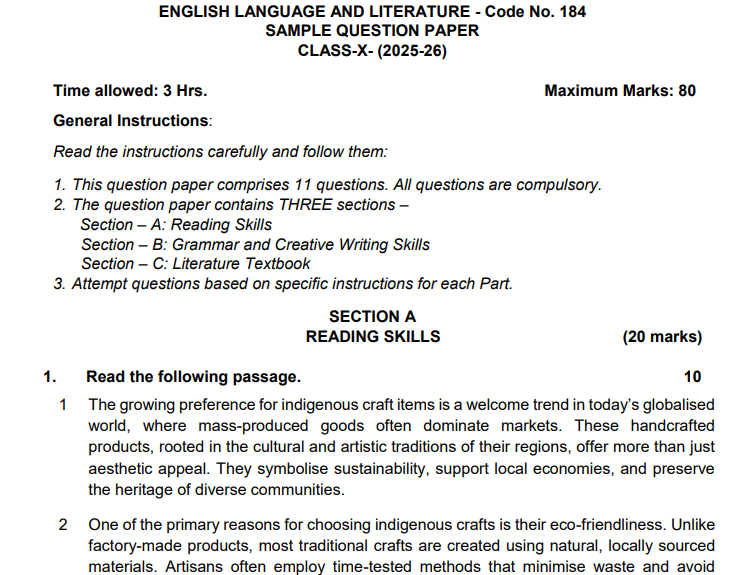
1. This question paper comprises 11 questions. All questions are compulsory.
2. The question paper contains THREE sections –
Section – A: Reading Skills
Section – B: Grammar and Creative Writing Skills
Section – C: Literature Textbook
3. Attempt questions based on specific instructions for each Part.
SECTION A
READING SKILLS (20 marks)
1. Read the following passage. 10
1 The growing preference for indigenous craft items is a welcome trend in today’s globalised world, where mass-produced goods often dominate markets. These handcrafted
products, rooted in the cultural and artistic traditions of their regions, offer more than just aesthetic appeal. They symbolise sustainability, support local economies, and preserve
the heritage of diverse communities.
2 One of the primary reasons for choosing indigenous crafts is their eco-friendliness. Unlike factory-made products, most traditional crafts are created using natural, locally sourced materials. Artisans often employ time-tested methods that minimise waste and avoid harmful industrial processes. For example, pottery made from local clay, handwoven textiles using organic dyes, and bamboo-based crafts all have a much lower environmental footprint compared to their machine-made counterparts. By opting for these items, consumers indirectly contribute to reducing pollution and promoting sustainable practices.
3 Supporting indigenous crafts also strengthens local economies. Many artisans depend solely on their craft for livelihood, often working in small communities where opportunities for other forms of employment are limited. When people purchase their products, it provides a direct income to these artisans, empowering them and encouraging their craftsmanship. Initiatives like fair trade further ensure that artisans receive fair wages, fostering economic stability within their communities.
4 Moreover, indigenous craft items help preserve cultural heritage. Every handcrafted product carries a story—a glimpse into the traditions, beliefs, and skills passed down
through generations. In India, whether it’s paintings, terracotta jewellery, sculptures, athangudi tiles, mud work frames or many others, each item reflects the unique identity of its region. By choosing these crafts, people not only appreciate the artistry but also help keep these traditions alive in an era where cultural homogenisation threatens diversity.
5 In addition to their economic and cultural value, indigenous crafts add a personal touch to homes and wardrobes. Unlike mass-produced items, which often lack individuality,
handcrafted products are unique. Each piece bears the imprint of the artisan’s effort, creativity, and dedication, making it special for the buyer.
6 However, the preference for indigenous crafts requires sustained efforts to thrive. Governments, organisations, and consumers all have roles to play. Policies that promote
local craftsmanship, provide training to artisans, and create global platforms for showcasing their work can boost the visibility and demand for these products. Consumers,
too, must actively seek out and invest in handmade crafts rather than opting for cheaper, factory-made alternatives. Choosing indigenous craft items is a meaningful step toward a more sustainable and culturally enriched world.
Answer the following questions after reading the above passage –
I Why is the growing preference for indigenous craft items described as a ‘welcome trend’ in paragraph 1? 1 Mark
II According to paragraph 1, the indigenous craft items have all of the following qualities EXCEPT being:
A. handcrafted products
B. rooted in artistic traditions
C. aesthetic in appeal
D. easily accessible
III Complete the following by selecting the correct option from those given in the brackets.
The usage of locally sourced materials makes the indigenous crafts ________ (traditional/eco-friendly). (Paragraph 2)
IV Select the option that is True from (a)-(c) given for what the phrase, ‘time-tested methods’ suggests in paragraph 2.
A. Artisans use traditional techniques that have been refined and proven effective over generations
B. Artisans use outdated practices that are no longer relevant in today’s commercial markets.
C. Artisans follow techniques that prioritise speed and mass production over craftsmanship.
V Complete the analogy by selecting one of the two correct options (a), (b) fair trade: fair wages:: _______ : _______ (Paragraph 3)
(a) employment: job security (b) mass production : reduced prices
Answers
I because it counters the dominance of mass-produced goods, supports sustainability, and helps preserve cultural and artistic traditions.
II D. easily accessible 1
III eco-friendly 1
IV (a) Artisans use traditional techniques that have been refined and proven effective over generations
V (a) employment : job security
[(a) is correct. Just as fair trade ensures fair wages, employment aims to provide job security and both relationships focus on fairness and stability. Mass production often prioritises efficiency and cost reduction, sometimes at the expense of fairness, environmental responsibility, or the well-being of workers. Thus, (b) does
not match the context of the analogy.]
English Communicative Sample Paper Class 10 2026
English Communicative Sample Paper Class 10 2026 has 12 questions. All questions are compulsory to attempt. This question paper contains three sections:
Section A: Reading Skills,
Section B: Writing Skills
Section C: Grammar
Section D: Literature.
Attempt all questions based on the specific instructions for each part. Write the correct question number and part thereof in your answer sheet. Separate instructions are given with each question/part, wherever necessary. Adhere to the prescribed word limit while answering the questions.
SECTION A: READING SKILLS (22 marks)
1. Read the following passage carefully: 12
Remote, icy and mostly pristine, Greenland plays an outsized role in the daily weather experienced by billions of people and in the climate changes taking shape all over the planet. Think of Greenland as an open refrigerator door or thermostat for a warming world, and it’s in a region that is warming four times faster than the rest of the globe, said New York University climate scientist David Holland. Locked inside are valuable rare earth minerals needed for telecommunications, as well as uranium, billions of untapped barrels of oil and a vast supply of natural gas that used to be inaccessible but is becoming less so. Many of the same minerals are currently being supplied mostly by an Asian country, so other countries are interested. But more than the oil, gas or minerals, there’s ice — a “ridiculous” amount, said climate scientist Eric Rignot. If that ice melts, it would reshape coastlines across the globe and potentially shift weather patterns in a dramatic manner. Greenland holds enough ice that if it all melts, the world’s seas would
rise by 24 feet.
Since 1992, Greenland has lost about 182 billion tons of ice each year, with losses hitting 489 billion tons a year in 2019. Greenland will be ‘a key focus point’ through the 21st century because of the effect its melting ice sheet will have on sea levels, said Mark Serreze, director of the National Snow and Ice Data Center. “It will likely become a bigger contributor in the future.” That impact is perhaps unstoppable. Greenland is also changing colour as it melts from the white of ice, which reflects sunlight, heat and energy away from the planet, to the blue and green of the ocean and land, which absorb much more energy.
Greenland also serves as the engine and on/off switch for a key ocean current that influences Earth’s climate in many ways, including hurricane and winter storm activity. It’s called the Atlantic Meridional Overturning Circulation, or AMOC, and it’s slowing down because more fresh water is being dumped into the ocean by melting ice in Greenland. A shutdown of the AMOC conveyor belt is a much-feared climate tipping point that could plunge Europe and parts of North America into prolonged freezes. “If this global current system were to slow substantially or even collapse altogether — as we know it has done in the past — normal temperature and precipitation patterns around the globe would change drastically,” said climate scientist Jennifer Francis of the Woodwell Climate Research Center. “Agriculture would be derailed, ecosystems would crash, and ‘normal’ weather would be a thing of the past.”
None of that takes into consideration the unique look of the ice-covered island that has some of the Earth’s oldest rocks. “I see it as insanely beautiful. It’s eye-watering to be there,” said Holland, who has conducted research on the ice more than 30 times since 2007. “Pieces of ice the size of the Empire State Building are just crumbling off cliffs and crashing into the ocean. And also, the beautiful wildlife, all the seals and the killer whales. It’s just breathtaking.”
Answer the following questions – (Questions are based on the passage above)
I Why is Greenland referred to as ‘an open refrigerator door or thermostat for a warming world’? (Paragraph 1)
a) It controls global temperatures directly like a thermostat.
b) It is warming at the same rate as the rest of the globe.
c) It plays a critical role in influencing global weather and climate patterns.
d) It experiences warming but has limited influence on global weather patterns.
II Complete the following with the correct option from those given in the brackets.
In the line ‘Greenland plays an outsized role…’, the word ‘outsized’ indicates ____ (an unusually large impact or importance / a role that exceeds expectations or norms / a disproportionate influence compared to its size). (Paragraph 1)
III Give two reasons why ‘other countries’ might be interested in Greenland’s rare
earth minerals and resources. Answer in 30-40 words. (Paragraph 2)
IV What does Eric Rignot mean by ‘ridiculous’ in the phrase ‘a ridiculous amount’? (Paragraph 2)
Select the correct option to complete the answer.
It means that the ice is ____.
a) unnecessary and excessive
b) vast and overwhelming in quantity.
c) beyond what scientists can measure.
d) challenging to fully comprehend.
Answers
I c) It plays a critical role in influencing global weather and climate patterns. 1
II an unusually large impact or importance 1
III Because these resources are essential for industries like telecommunications and energy. Additionally, reliance on a single major supplier (the Asian country), makes diversifying resource acquisition crucial for economic and geopolitical stability.
2
IV b) vast and overwhelming in quantity
[Option a) is an obvious incorrect. Options c) and d) are plausible but incorrect: Option c) implies a limitation in scientific measurement, which isn’t suggested in the passage. Option d) suggests difficulty in understanding the concept, whereas the passage emphasises the sheer magnitude of the ice, not the inability to comprehend it.]
Related Sample Paper Links:
Class 10 English Sample Paper: FAQs
1. What are the total marks and duration of the Class 10 English exam?
The Class 10 English exam is conducted for 80 marks with a time duration of 3 hours. Internal assessment carries 20 marks.
2. How many sections are there in the English question paper?
The paper is divided into three sections:
-
Section A: Reading Skills
-
Section B: Writing Skills & Grammar
-
Section C: Literature (Prose, Poetry & Supplementary Reader)
3. How many reading passages are asked in Section A?
Section A generally includes two unseen passages:
-
One discursive/factual passage
-
One case-based or literary passage
4. What types of writing tasks are included in Section B?
Section B usually includes:
-
Formal Letter (Complaint, Inquiry, Editor, etc.)
-
Analytical Paragraph / Article / Report
-
Grammar questions such as:
-
Gap filling
-
Editing or omission
-
Sentence transformation
-
5. Is grammar asked separately or integrated?
Grammar is asked in an integrated and application-based format, not as isolated rules.
6. Which books are covered in the Literature section?
Section C is based on:
-
First Flight (Prose & Poetry)
-
Footprints Without Feet (Supplementary Reader)
7. What type of questions are asked from literature?
Literature questions include:
-
MCQs
-
Short Answer Questions (30–40 words)
-
Long Answer Questions (100–120 words)
8. Are extract-based questions compulsory?
Yes, extract-based questions from prose or poetry are compulsory and test:
-
Reference to context
-
Literary devices
-
Theme and inference
9. How important are NCERT textbooks for preparation?
NCERT books are very important. Most questions are directly or indirectly based on NCERT content.
10. Does the sample paper follow the latest CBSE exam pattern?
Yes, CBSE sample papers are designed as per the latest blueprint, focusing on:
-
Competency-based questions
-
Case-study based items
-
Higher Order Thinking Skills (HOTS)
11. How can sample papers help in exam preparation?
Sample papers help students:
-
Understand the exam pattern
-
Improve time management
-
Practice important question types
-
Reduce exam stress
12. How many sample papers should a student practice?
Ideally, students should practice 8–10 sample papers before the final exam for best results.
About The Author
