
The APMSRB Staff Nurse recruitment for 2026 has a unique selection process that differs significantly from other nursing exams. Unlike traditional written tests, this selection is entirely merit-based, combining your academic scores with weightage for experience and years since passing.
Below is a comprehensive guide to the syllabus, exam pattern, and selection criteria based on the official notification for 529 vacancies (including 419 Staff Nurse posts) released in June 2026.
APMSRB Staff Nurse Syllabus 2026
The Andhra Pradesh Medical Services Recruitment Board (APMSRB) has released Notification No. 10/2026 for the recruitment of Staff Nurse, Pharmacist, and Multi-Rehabilitation Worker posts under the National Health Mission (NHM). A total of 529 vacancies have been announced, with 419 posts specifically for Staff Nurses. The online application process commenced on 13th June 2026 and will conclude on 30th June 2026.
For candidates aspiring to secure a Staff Nurse position under APMSRB, understanding the selection process is crucial. Unlike traditional recruitment exams that require a separate written test, the APMSRB Staff Nurse selection for 2026 is entirely merit-based. This article provides a detailed overview of the syllabus, the unique “exam pattern” (which relies on academic scoring), important topics for your qualifying degree, and the weightage system.
AP Nurse Syllabus 2026
The syllabus mainly focuses on core nursing subjects, along with basic general awareness and aptitude topics.
Across most staff nurse exams in India, the technical nursing section carries the highest weightage, making it the most important area for preparation.
1. Fundamentals of Nursing
- Nursing principles & ethics
- First aid and emergency care
- Infection control & sterilization
- Vital signs & patient care
- Hospital procedures
This is the base section, asked in almost every exam.
2. Anatomy & Physiology
- Human body structure
- Organ systems (respiratory, digestive, nervous, etc.)
- Functions of organs
- Homeostasis
3. Medical-Surgical Nursing
- Diseases and treatment
- Surgical procedures
- Pre-operative & post-operative care
- ICU and emergency nursing
One of the most important scoring sections.
4. Community Health Nursing
- Public health programs
- National health schemes
- Epidemiology
- Immunization programs
5. Child Health (Pediatric Nursing)
- Growth & development
- Neonatal care
- Pediatric diseases
- Vaccination schedules
6. Obstetrics & Gynecology Nursing
- Pregnancy & antenatal care
- Labor & delivery
- Postnatal care
- Family planning
7. Mental Health Nursing
- Psychiatric disorders
- Counseling techniques
- Behavioral therapy
- Mental health programs
8. Pharmacology
- Drug classifications
- Dosage & administration
- Side effects
- Nursing responsibilities in medication
9. Nutrition & Dietetics
- Balanced diet
- Therapeutic diets
- Nutritional deficiencies
10. Basic General Subjects (If Included)
General Knowledge
- Current affairs
- Indian polity & economy
- Health schemes
Reasoning & Aptitude
- Number series
- Coding-decoding
- Basic arithmetic
These sections usually carry low weightage but help boost overall score.
APMSRB Staff Nurse Exam Pattern 2026
Although APMSRB may follow a merit/weightage-based selection in some notifications, when a written exam is conducted, the expected pattern is:
| Particulars | Details |
|---|---|
| Exam Mode | Objective Type (MCQ) |
| Duration | 90–120 Minutes |
| Total Questions | 100–150 |
| Total Marks | 100–150 |
| Sections | Nursing + General Subjects |
| Negative Marking | As per notification (may vary) |
Section-wise Weightage (Expected)
| Section | Weightage |
|---|---|
| Nursing Subjects | 70–80% |
| General Knowledge | 10–15% |
| Reasoning / Aptitude | 5–10% |
In most staff nurse exams, professional nursing knowledge dominates the paper, often contributing more than half of the total marks.
The most distinctive feature of the APMSRB Staff Nurse 2026 recruitment is the absence of a written examination. The selection is based entirely on a merit list prepared from a total of 100 marks .
Here is the breakdown of the 100 marks:
| Component | Maximum Marks | Description |
|---|---|---|
| Qualifying Exam Marks | 75 | Marks obtained in GNM or B.Sc Nursing (converted to a 75-point scale). |
| Weightage for Years Since Passing | 10 | 1 mark per completed year since passing the qualifying exam (Max: 10). |
| Contract Service Weightage | 15 | Marks for prior service in NHM/Government (COVID-19, Tribal, Rural, Urban). |
| Total | 100 |
This pattern indicates that your performance in your nursing degree (GNM/B.Sc) is the single most critical factor, contributing 75% of the total selection score .
Detailed Breakdown of Weightage
A. Years Since Passing Weightage (Up to 10 Marks)
-
Candidates receive 1 mark per completed year after passing the qualifying examination (GNM/B.Sc) or Post Graduation.
-
For example, if you passed GNM in 2020, by 2026 you would have completed 6 years, earning you 6 marks .
B. Contract Service Weightage (Up to 15 Marks)
-
COVID-19 Duties: 5.0 marks per six months (0.83 marks per completed month).
-
Tribal Area Service: 2.5 marks per six months.
-
Rural Area Service: 2.0 marks per six months.
-
Urban Area Service: 1.0 mark per six months.
-
*Note: Service less than six months generally gets no weightage, except for COVID-19 duties where monthly completion counts* .
Syllabus for the Qualifying Examination (The 75 Marks)
Since the merit is heavily weighted toward the “Qualifying Exam Marks,” the syllabus for your GNM (General Nursing and Midwifery) or B.Sc Nursing degree is effectively the syllabus for the APMSRB selection.
To maximize your 75 marks, candidates must have strong command over the core nursing subjects taught during their degree. The key topics typically include:
Major Subjects & Important Topics
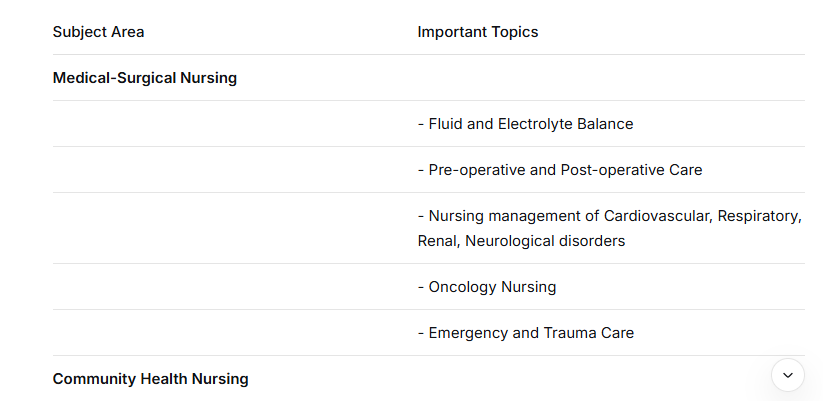
| Subject Area | Important Topics |
|---|---|
| Medical-Surgical Nursing | |
| – Fluid and Electrolyte Balance | |
| – Pre-operative and Post-operative Care | |
| – Nursing management of Cardiovascular, Respiratory, Renal, Neurological disorders | |
| – Oncology Nursing | |
| – Emergency and Trauma Care | |
| Community Health Nursing | |
| – Epidemiology and Communicable Diseases (TB, Malaria, HIV/AIDS) | |
| – Family Welfare Programs (MCH, RCH) | |
| – National Health Programs (NPCDCS, NUHM, NRC, SNCU – as these are mentioned in the vacancy structure) | |
| – Primary Health Centre (PHC) functioning | |
| Obstetrics and Gynecological Nursing | |
| – Antenatal, Intranatal, and Postnatal Care | |
| – Management of High-Risk Pregnancies | |
| – Contraceptive methods | |
| Child Health Nursing (Pediatrics) | |
| – Growth and Development milestones | |
| – Common childhood diseases (Malnutrition, Diarrhea, ARI) | |
| – Newborn care (especially SNCU/NICU protocols, as specific vacancies exist) | |
| Mental Health Nursing | |
| – Therapeutic communication | |
| – Management of psychiatric disorders (Depression, Schizophrenia, Anxiety) | |
| Nursing Foundation | |
| – Fundamentals of Nursing (Bed making, vital signs, injection techniques) | |
| – First Aid and Basic Life Support (BLS) | |
| – Infection Control (Standard precautions, Biomedical waste management) | |
| Professional Trends & Administration | |
| – Ethics in Nursing | |
| – Legal aspects (APNMC registration, Indian Nursing Council norms) | |
| – Ward management and leadership |
Important Topics for Document Verification (DV)
While there is no written exam, candidates who apply must undergo Document Verification. The “important topics” here refer to the crucial documents you must prepare to prove your merit.
Key Documents for Staff Nurse (As per Notification)
-
Academic Certificates:
-
B.Sc Nursing OR GNM mark sheets and degree/diploma certificate .
-
-
Registration Certificate:
-
Valid registration with the Andhra Pradesh Nursing & Midwifery Council (APNMC) with up-to-date renewal . This is mandatory.
-
-
Age Proof:
-
SSC/10th Certificate (Minimum age 18, Max 42 as of 01/01/2026) .
-
-
Contract Service Proof:
-
If claiming weightage: Contract appointment orders, Service certificates (Annexure V format), and for COVID-19 weightage: Bank statements and monthly attendance sheets.
-
-
Local Candidature Certificate:
-
Proof of study in Andhra Pradesh from Class 4th to 10th.
-
Preparation Strategy for APMSRB Staff Nurse 2026
Since there is no written exam, your strategy needs to be different from typical competitive exams.
1. Calculate Your “Cut-off” Score
You need to estimate your total out of 100.
-
Step 1: Calculate your percentage in GNM/B.Sc. Multiply it by 0.75 (e.g., 80% = 60 Marks out of 75).
-
Step 2: Calculate Years since passing (e.g., 2022 pass out = 4 Years = 4 Marks).
-
Step 3: Calculate Contract Service marks (e.g., 1 year Rural = 4 Marks).
-
Total = 60 + 4 + 4 = 68/100. Compare this to previous trends (though exact cut-offs vary by category).
2. Focus on Your Degree Marks
Because 75 marks come from your degree, candidates with higher percentages (above 75-80%) have a significant advantage. If your academic percentage is low, you must compensate with high weightage from the contract service (Max 15 marks) .
3. Verify Eligibility Strictly
-
Registration: Ensure APNMC registration is active. Lapsed registration leads to disqualification.
-
Local Status: Only Andhra Pradesh candidates are eligible. Verify your local status based on the 4th to 10th class study rule.
Summary of Key Dates and Facts
| Particulars | Details |
|---|---|
| Organization | Andhra Pradesh Medical Services Recruitment Board (APMSRB) |
| Post | Staff Nurse |
| Total Vacancies | 419 |
| Application Period | 13th June 2026 to 30th June 2026 |
| Selection Process | Merit-Based (No Written Exam) |
| Merit Components | Qualifying Exam Marks (75) + Years Weightage (10) + Service Weightage (15) |
| Qualification Required | B.Sc Nursing / GNM + APNMC Registration |
| Monthly Salary | Rs. 27,675/- (Contractual) |
| Official Website | https://apmsrb.ap.gov.in/ |
Conclusion
The APMSRB Staff Nurse Recruitment 2026 offers a direct pathway for nursing professionals in Andhra Pradesh, prioritizing academic merit and relevant work experience over a separate written test . Candidates should focus on ensuring their GNM/B.Sc scores are accurately calculated, their APNMC registration is valid, and they have documented proof of any contract service (especially COVID-19 duty, which carries high weightage).
With the application window closing on 30th June 2026, interested candidates should promptly gather their documents and apply online to avoid last-minute technical issues.
About The Author
