
The Madhya Pradesh Judicial Services Examination (also known as MP Civil Judge or MPCJ exam) is conducted by the High Court of Madhya Pradesh to recruit Civil Judges (Junior Division). The selection process has three stages: Preliminary Examination (screening), Main Examination (merit-determining), and Interview (Viva-Voce). Only marks from the Mains and Interview count toward the final merit list. Prelims marks are not added.
MP Judiciary Syllabus 2026
The MP Civil Judge syllabus traditionally references the Indian Penal Code (IPC), Code of Criminal Procedure (CrPC), and Indian Evidence Act. With the introduction of the Bharatiya Nyaya Sanhita (BNS), Bharatiya Nagarik Suraksha Sanhita (BNSS), and Bharatiya Sakshya Adhiniyam (BSA) from 2024, candidates must verify the latest official notification on the Madhya Pradesh High Court website (mphc.gov.in) for any updates. Local laws and civil statutes remain largely unchanged. Always cross-check the current year’s advertisement for exact details, weightage, and any additions (such as specific chapters or new special laws).
MP Judiciary Exam Pattern 2026
| Stage | Nature | Marks | Duration | Mode | Purpose |
|---|---|---|---|---|---|
| Preliminary Exam | Objective (MCQs) | 150 | 2 hours | Online | Qualifying / Screening |
| Main Exam | Descriptive | 400 (4 × 100) | 3 hours per paper | Offline (written) | Merit-determining |
| Interview | Personality Test | 50 | — | Oral | Merit-determining |
- Marking in Prelims: +1 for correct answer; no negative marking.
- Language: Papers generally available in Hindi and English (except language/translation components).
- Final selection: Based on Mains + Interview scores. Candidates typically need to secure minimum qualifying marks in the Interview (often around 40%, i.e., 20/50).
MP Civil Judge Preliminary Examination Syllabus 2026
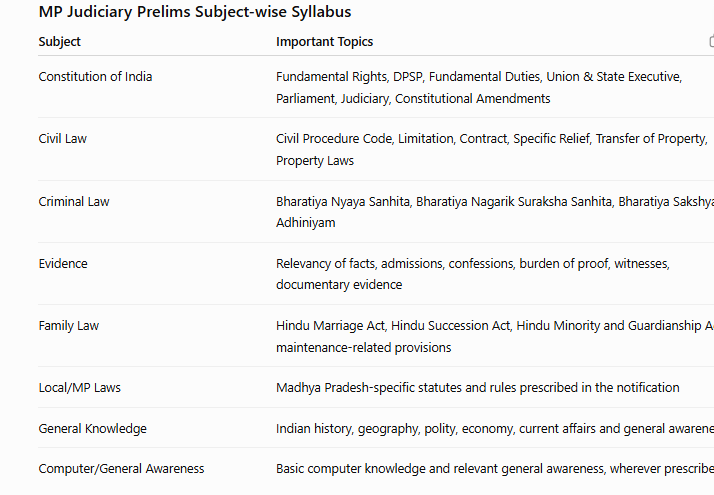
MP Judiciary Prelims Subject-wise Syllabus
| Subject | Important Topics |
|---|---|
| Constitution of India | Fundamental Rights, DPSP, Fundamental Duties, Union & State Executive, Parliament, Judiciary, Constitutional Amendments |
| Civil Law | Civil Procedure Code, Limitation, Contract, Specific Relief, Transfer of Property, Property Laws |
| Criminal Law | Bharatiya Nyaya Sanhita, Bharatiya Nagarik Suraksha Sanhita, Bharatiya Sakshya Adhiniyam |
| Evidence | Relevancy of facts, admissions, confessions, burden of proof, witnesses, documentary evidence |
| Family Law | Hindu Marriage Act, Hindu Succession Act, Hindu Minority and Guardianship Act, maintenance-related provisions |
| Local/MP Laws | Madhya Pradesh-specific statutes and rules prescribed in the notification |
| General Knowledge | Indian history, geography, polity, economy, current affairs and general awareness |
| Computer/General Awareness | Basic computer knowledge and relevant general awareness, wherever prescribed |
Important Criminal Laws for 2026
A major point for MP Judiciary aspirants is the transition from the old criminal-law framework to the new criminal laws. Therefore, preparation should focus particularly on:
- Bharatiya Nyaya Sanhita, 2023 (BNS)
- Bharatiya Nagarik Suraksha Sanhita, 2023 (BNSS)
- Bharatiya Sakshya Adhiniyam, 2023 (BSA)
The MPSJA’s 2026 preparatory programme also specifically provides reading material on BNS, demonstrating the importance of the new criminal laws in current judicial preparation.
The Prelims consists of 150 multiple-choice questions for 150 marks, to be completed in 2 hours. It is divided into law subjects and general subjects. The exact question distribution can vary slightly by year, but the following is the commonly reported pattern based on recent cycles:
Part 1 – Law Subjects (approx. 120 questions)
| Subject | Approx. Questions |
|---|---|
| Constitution of India | 5–10 |
| Code of Civil Procedure, 1908 | 15–20 |
| Transfer of Property Act, 1882 | 7 |
| Indian Contract Act, 1872 | 8 |
| Specific Relief Act, 1963 | 6 |
| Limitation Act, 1963 | 4 |
| MP Accommodation Control Act, 1961 | 5 |
| MP Land Revenue Code / Act, 1959 | 5 |
| Indian Evidence Act, 1872 (or BSA equivalent) | 15 |
| Indian Penal Code, 1860 (or BNS equivalent) | 15 |
| Code of Criminal Procedure, 1973 (or BNSS) | 15 |
| Negotiable Instruments Act, 1881 | 5 |
| Information Technology Act, 2000 | 3–4 |
| Juvenile Justice (Care and Protection of Children) Act | 3 |
| Protection of Children from Sexual Offences (POCSO) Act, 2012 | 3 |
Part 2 – General Subjects (approx. 30 questions)
| Subject | Approx. Questions |
|---|---|
| General Knowledge | 10–20 |
| Computer Knowledge | 10 |
| English Knowledge | 10 |
Key focus areas for Prelims: Procedural laws (CPC, CrPC/BNSS, Evidence/BSA) carry high weightage. Local MP laws (Accommodation Control and Land Revenue) are important. GK usually covers current affairs, Indian polity, history, geography (with some MP-specific focus), and basic computer awareness (MS Office, internet, basics of hardware/software). English tests grammar, vocabulary, and comprehension.
MP Judiciary Mains Syllabus 2026
The Mains examination is substantially different from Prelims because candidates have to demonstrate legal reasoning, analytical ability, drafting skills, and written expression.
1. Civil Law
Important areas include:
- Code of Civil Procedure
- Indian Contract Act
- Specific Relief Act
- Limitation Act
- Transfer of Property Act
- Property-related laws
- Partnership law
- Sale of Goods
- Civil Court procedures
- Jurisdiction of courts
- Suits, pleadings and appeals
- Temporary and permanent injunctions
- Execution of decrees
Candidates should not merely memorise provisions. They should practise applying statutory provisions to factual situations.
2. Criminal Law
The criminal-law portion should primarily be prepared using the current statutory framework:
- Bharatiya Nyaya Sanhita, 2023
- Bharatiya Nagarik Suraksha Sanhita, 2023
- Bharatiya Sakshya Adhiniyam, 2023
- Criminal procedure
- Arrest and custody
- Bail
- Investigation
- Charges
- Trial
- Appeals and revisions
- Criminal liability
- Offences against the human body
- Offences against property
- Offences against women and children
The MPSJA’s current programmes also include training on e-Sakshya and related digital judicial applications, reflecting the growing importance of technology in the contemporary criminal-justice system.
3. Constitution of India
Important topics include:
- Preamble
- Fundamental Rights
- Directive Principles of State Policy
- Fundamental Duties
- Constitutional remedies
- Judicial review
- Separation of powers
- Writ jurisdiction
- Supreme Court and High Courts
- Centre-State relations
- Constitutional amendments
- Independence of judiciary
- Basic Structure Doctrine
4. Local and Madhya Pradesh Laws
Candidates should give special attention to Madhya Pradesh-specific legislation, rules and court procedures prescribed in the recruitment notification.
Important areas may include:
- Madhya Pradesh Land Revenue Code
- Madhya Pradesh Civil Court Rules
- Madhya Pradesh Rules and Orders (Criminal)
- Local revenue and procedural laws
- Court-fee and valuation-related provisions
- Other MP-specific statutes mentioned in the official syllabus
The MPSJA conducted a specialised 2026 programme specifically covering M.P. Civil Court Rules, 1961 and M.P. Rules and Orders (Criminal).
MP Judiciary Language Syllabus
Language and writing skills are important for the Mains examination. Candidates should prepare:
- Essay writing
- Precis writing
- Translation
- Grammar
- Sentence correction
- Vocabulary
- Legal terminology
- Hindi ↔ English translation, wherever prescribed
- Drafting and legal expression
A candidate may know the law very well but still lose marks if answers lack proper structure, legal reasoning and clarity.
MP Judiciary Mains: Answer Writing Preparation
For Mains preparation, candidates should practise writing answers in the following format:
Issue → Relevant Law/Provision → Legal Principle → Application to Facts → Conclusion
For example, while answering a problem-based question, simply mentioning the relevant section is generally insufficient. Explain the applicable principle and then connect it to the facts given in the question.
Most Important Topics for MP Judiciary 2026
| Priority | Subject | Topics to Focus On |
|---|---|---|
| Very High | BNS | General exceptions, offences, punishments, abetment, attempt |
| Very High | BNSS | FIR, arrest, investigation, bail, trial, appeals |
| Very High | BSA | Relevancy, admissions, confessions, burden of proof, witnesses |
| Very High | CPC | Jurisdiction, pleadings, injunctions, execution, appeals |
| High | Constitution | Fundamental Rights, writs, judiciary, judicial review |
| High | Contract | Essentials, breach, damages, indemnity, guarantee |
| High | Specific Relief | Injunctions and specific performance |
| High | TPA | Transfer, sale, mortgage, lease, gift |
| High | MP Laws | MPLRC and MP-specific procedural rules |
| Medium | Family Law | Marriage, divorce, succession, maintenance |
| Medium | GK | MP GK, Indian polity, history, geography, current affairs |
The Mains is a descriptive written examination consisting of four papers of 100 marks each (total 400 marks). Each paper lasts 3 hours. Papers 1 and 2 are usually held on one day, and Papers 3 and 4 on another day.
Paper I – Civil Law & Procedure (100 Marks)
- Constitution of India
- Code of Civil Procedure, 1908
- Transfer of Property Act, 1882
- Indian Contract Act, 1872
- Specific Relief Act, 1963 (Chapters I, II and VI to VIII)
- Limitation Act, 1963 (Parts II & III)
Candidates are expected to answer analytical and problem-based questions demonstrating conceptual clarity and application of law.
Paper II – Court Practice, Writing Skill, Current Legal Topics & Translation (100 Marks)
Typical breakup (may vary slightly):
- Writing on a Social Issue – 20–30 marks
- Writing on a Legal Issue – 20 marks
- Precis / Summary Writing (legal) – 20 marks
- Translation (Hindi to English) – 15–20 marks
- Translation (English to Hindi) – 15–20 marks
This paper tests language proficiency, clarity of expression, summarisation skills, and ability to handle legal and social topics. Practice writing concise, structured answers is essential.
Paper III – Criminal Law, Procedure & Local Laws (100 Marks)
- Indian Penal Code, 1860 (or BNS)
- Code of Criminal Procedure, 1973 (or BNSS)
- Indian Evidence Act, 1872 (or BSA)
- Negotiable Instruments Act, 1881
- MP Accommodation Control Act, 1961
- MP Land Revenue Code, 1959
Focus is on substantive criminal law, procedure, evidence rules, and MP-specific statutes frequently applied in civil/criminal courts.
Paper IV – Judgment Writing (100 Marks)
Typical components:
- Framing of Issues – 10 marks
- Framing of Charges – 10 marks
- Judgment / Order Writing (Civil) – 40 marks (Civil Judge level)
- Judgment / Order Writing (Criminal) – 40 marks (Judicial Magistrate First Class level)
This is a highly practical paper. Candidates must demonstrate the ability to frame proper issues/charges and write reasoned, structured judgments based on given facts.
Interview / Viva-Voce (50 Marks)
The final stage assesses personality, legal knowledge, analytical ability, communication skills, current legal awareness, and suitability for judicial office. A minimum qualifying score (commonly 20 marks) is required. Final ranking is prepared on the basis of Mains + Interview marks only.
Preparation Tips
- Master the bare acts thoroughly, especially procedural laws and local MP statutes.
- Practice previous years’ papers and mock tests for both objective and descriptive formats.
- Develop answer-writing and judgment-writing skills through regular practice under timed conditions.
- Stay updated on recent Supreme Court and High Court judgments, amendments, and (if applicable) the new criminal laws.
- For language papers, work on translation accuracy and concise essay/précis writing.
- Refer only to the official notification released by the Madhya Pradesh High Court for the exact syllabus, scheme, eligibility, vacancies, and any changes in a particular recruitment cycle.
About The Author
