
The British Year 1 Maths syllabus (2026–27) is based on the UK National Curriculum for Key Stage 1 (Years 1–2). It focuses on building strong foundational numeracy skills, helping children (ages 5–6) develop confidence in numbers, basic operations, shapes, and measurements.
According to the UK curriculum, the main goal at this stage is to ensure mental fluency with numbers, counting, and problem-solving using practical methods.
Overview of British Year 1 Maths Curriculum
At Year 1, maths learning is structured around four key domains:
- Number (Place Value, Addition & Subtraction)
- Measurement
- Geometry (Shape & Position)
- Basic Problem Solving & Reasoning
Students learn through hands-on activities, visual aids, and real-life examples, rather than abstract theory.
British Year 1 Maths Syllabus 2026–27
The British Year 1 Maths Syllabus (2026–27) is based on the UK National Curriculum (Key Stage 1). The content is aligned with official programme-of-study objectives such as number, operations, measurement, geometry, and basic statistics.
(Based on UK National Curriculum – Key Stage 1)
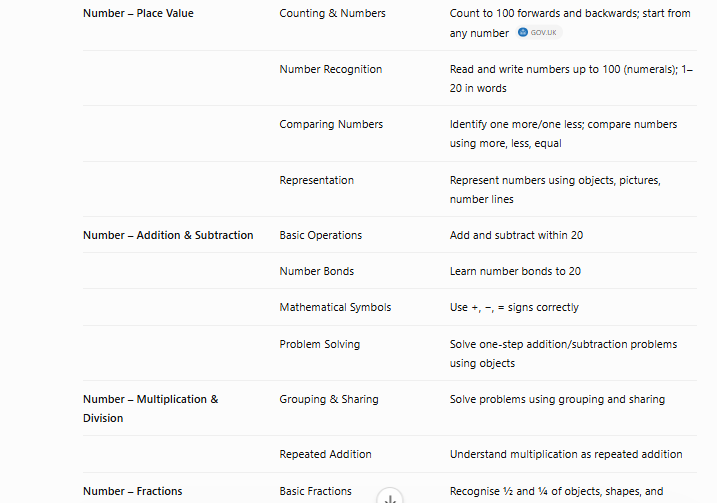
| Strand / Topic | Sub-Topics | Learning Outcomes / Skills |
|---|---|---|
| Number – Place Value | Counting & Numbers | Count to 100 forwards and backwards; start from any number |
| Number Recognition | Read and write numbers up to 100 (numerals); 1–20 in words | |
| Comparing Numbers | Identify one more/one less; compare numbers using more, less, equal | |
| Representation | Represent numbers using objects, pictures, number lines | |
| Number – Addition & Subtraction | Basic Operations | Add and subtract within 20 |
| Number Bonds | Learn number bonds to 20 | |
| Mathematical Symbols | Use +, −, = signs correctly | |
| Problem Solving | Solve one-step addition/subtraction problems using objects | |
| Number – Multiplication & Division | Grouping & Sharing | Solve problems using grouping and sharing |
| Repeated Addition | Understand multiplication as repeated addition | |
| Number – Fractions | Basic Fractions | Recognise ½ and ¼ of objects, shapes, and quantities |
| Measurement | Length & Height | Compare and measure using standard/non-standard units |
| Mass & Weight | Compare heavy/light objects | |
| Capacity & Volume | Compare full/empty, more/less | |
| Time | Tell time to the hour and half-hour | |
| Money | Recognise coins and notes; simple money problems | |
| Geometry – Shape | 2D Shapes | Recognise and name common 2D shapes (circle, square, etc.) |
| 3D Shapes | Recognise and name common 3D shapes (cube, sphere, etc.) | |
| Geometry – Position & Direction | Spatial Awareness | Describe position, direction, and movement (left/right, forwards/backwards) |
| Statistics (Data Handling) | Data Representation | Interpret simple pictograms, tally charts, and tables |
| Mathematical Reasoning | Logical Thinking | Explain answers, solve simple real-life problems |
| Mathematical Vocabulary | Language Skills | Use correct maths terms (more, fewer, equal, etc.) |
Key Highlights of Year 1 Maths Curriculum
- Strong focus on counting, place value, and basic operations.
- Emphasis on hands-on learning using objects and visuals.
- Introduction to problem-solving and reasoning skills early.
- Covers both numeracy and real-life maths (time, money, measurement).
Aims of the UK Maths Curriculum
The National Curriculum aims to ensure that pupils:
- Develop fluency in basic mathematical skills
- Build logical reasoning and thinking ability
- Solve real-life mathematical problems
These aims help children become confident learners and prepare them for advanced topics in later years.
Detailed UK Year 1 Maths Syllabus 2026–27
1. Number & Place Value
Students learn to:
- Count forwards and backwards up to 100
- Count in multiples (2s, 5s, 10s)
- Read and write numbers (numerals and words)
- Understand place value (tens and ones)
- Compare numbers using >, <, =
- Identify numbers on a number line
Focus: Building a strong number sense and understanding how numbers work.
2. Addition & Subtraction
Students are taught to:
- Add and subtract numbers up to 20
- Use number bonds (e.g., 10 = 7 + 3)
- Solve one-step problems
- Use symbols: +, −, =
- Work with missing numbers (e.g., 7 = ? − 9)
Children use objects, pictures, and mental maths strategies to understand concepts.
3. Measurement
Students learn to:
- Measure length, height, weight, and capacity
- Understand and use time (days, months, o’clock, half past)
- Recognise and use money (coins and notes)
- Compare quantities (longer/shorter, heavier/lighter)
Learning is practical, using real-life tools like rulers, clocks, and coins.
4. Geometry (Shape)
Students are introduced to:
- 2D shapes (circle, square, triangle, rectangle)
- 3D shapes (cube, sphere, cone, cuboid)
- Recognising and describing shapes
- Creating and identifying patterns
Focus: Visual understanding and shape recognition.
5. Position & Direction
Students learn to:
- Describe position (left, right, above, below)
- Understand direction (forwards, backwards)
- Use terms like clockwise and anticlockwise
Teaching Approach in Year 1 Maths
The UK curriculum emphasizes:
- Concrete → Pictorial → Abstract learning
- Use of objects (counters, blocks)
- Visual tools like number lines and diagrams
- Encouraging discussion to explain thinking
This ensures children understand concepts deeply, not just memorize answers.
Assessment in Year 1
- No formal national exams
- Continuous teacher-based assessment
- Optional Key Stage 1 tests may be used for progress tracking
Suggested Term-wise Breakdown (2026–27)
| Term | Key Topics Covered |
|---|---|
| Autumn | Numbers to 10, basic addition, shapes |
| Spring | Numbers to 20, subtraction, measurement |
| Summer | Numbers to 100, time, money, problem-solving |
Key Skills Students Develop
By the end of Year 1, students should:
- Confidently count and work with numbers up to 100
- Perform basic addition and subtraction
- Recognize shapes and patterns
- Understand time, money, and measurement
- Solve simple real-life maths problems
Conclusion
The British Year 1 Maths Syllabus 2026–27 builds a strong mathematical foundation by focusing on numeracy, reasoning, and practical learning. Instead of rote memorization, the UK system emphasizes understanding, exploration, and real-world application, ensuring children develop lifelong mathematical skills.
About The Author
