
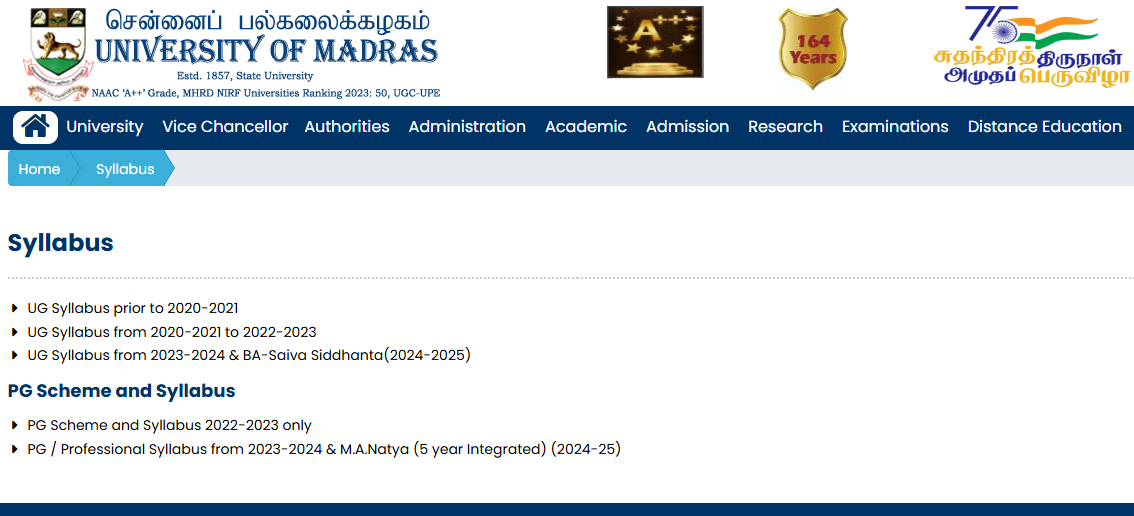
Madras University Syllabus 2026: The University of Madras (UNOM), one of India’s oldest and most prestigious state universities established in 1857, continues to offer a comprehensive curriculum under the Choice Based Credit System (CBCS) for the 2026 academic session. Students pursuing undergraduate (UG) and postgraduate (PG) programmes can access detailed syllabi in PDF format from the official website (unom.ac.in) and related portals such as egovernance.unom.ac.in. These syllabi outline core subjects, electives, practical components, soft skills, and credit distributions, helping learners plan their studies, prepare for semester examinations, and understand evaluation patterns. The curriculum aligns with University Grants Commission (UGC) guidelines and Tamil Nadu State Council for Higher Education (TANSCHE) recommendations, incorporating updates for relevance in emerging fields while maintaining academic rigor across arts, science, commerce, and professional streams. Regular and distance education modes (via the Institute of Distance Education) follow largely similar structures to ensure parity in quality.
About the University of Madras and Its Academic Framework
Founded in 1857, the University of Madras holds NAAC A++ accreditation and features in national rankings such as NIRF. It operates multiple campuses in Chennai and affiliates numerous colleges, offering programmes through university departments and the Institute of Distance Education (IDE). The CBCS framework, in place for many years and detailed in handbooks such as the 2025-2026 version, emphasizes flexibility through core courses, electives, soft skills, and internships. Credits are assigned based on instructional hours, with typical requirements of around 140 credits for three-year UG degrees and 90–100 credits for two-year PG programmes. Evaluation combines continuous internal assessment (usually 25 marks) and end-semester external exams (75 marks), using a 10-point grading scale that converts marks into letter grades from Outstanding (O) to Average (B). Students must meet minimum attendance and credit thresholds for degree eligibility. The university regularly revises syllabi to include contemporary topics, environmental studies, value education, and skill-based components. Official announcements, academic calendars, and prospectus documents for 2025-26 and 2026-27 provide the latest programme lists and examination schemes.
Overview of Madras University Syllabus 2026
The 2026 syllabus continues the CBCS pattern with semester-wise organisation. Undergraduate programmes generally span three years (six semesters), while postgraduate courses last two years (four semesters). Common elements include foundation courses in languages and English, major/core subjects, allied or complementary papers, non-major electives, soft skills, and environmental studies or value education. Practical laboratories, projects, and internships feature prominently in science, computer applications, and professional courses. Distance education programmes under IDE mirror regular syllabi where possible, with scheme-of-examination annexures detailing paper codes, credits, and examination schedules. Students should verify the exact version applicable to their year of admission, as minor revisions occur periodically. Syllabi are downloadable as PDFs organised by degree and branch, covering BA, BSc, BCom, BBA, BCA, MA, MSc, MCom, MBA, MCA, and specialised programmes. Always cross-check the official university portal for the most current files, as third-party sites may host older or incomplete versions.
Madras University Undergraduate (UG) Courses Syllabus 2026
| Course | Core Subjects | Key Topics Covered | Practical / Electives |
|---|---|---|---|
| B.A. (English, History, Economics, etc.) | Literature / Social Sciences | Poetry, Drama, Prose, Indian History, Micro & Macro Economics, Political Theory | Language electives, project work |
| B.Com / B.Com (CS, ISM, Co-op) | Commerce & Finance | Accounting, Business Law, Taxation, Auditing, Banking, Corporate Law | Tally, GST, Financial Analysis |
| B.Sc (Maths, Physics, Chemistry, CS, IT, etc.) | Science Subjects | Algebra, Calculus, Mechanics, Organic Chemistry, Programming, Data Structures | Lab work, project, internships |
| BBA | Business Administration | Management Principles, HR, Marketing, Finance, Entrepreneurship | Case studies, industrial training |
| BCA | Computer Applications | Programming (C, Java), DBMS, Networking, Web Development | Software projects |
| B.S.W. (Social Work) | Social Sciences | Community Development, Sociology, Human Rights, Counseling | Field work, NGO training |
| B.Sc (Visual Communication / Criminology / ISM) | Specialized Subjects | Media Studies, Film Making, Cyber Crime, Journalism | Media lab / field exposure |
UG exams include courses like BA, BCom, BSc, BBA, BCA, etc. as per official timetable listings
Undergraduate programmes at Madras University follow a structured CBCS design that balances foundational knowledge with specialised learning. Part I typically covers Tamil or other Indian languages (or communicative English options), while Part II focuses on English communication skills across multiple semesters. Core papers form the backbone of the major subject, progressing from introductory concepts in the first year to advanced topics and applications in later semesters. Allied subjects provide interdisciplinary support—for example, mathematics for computer science or economics for commerce streams. Non-major electives and soft-skill courses enhance employability, covering areas such as personality development, quantitative aptitude, and digital literacy. Environmental studies and value education are compulsory components in most programmes. Credit distribution usually allocates higher credits to core papers (4–5 credits each) and lower credits to electives and skills (2–3 credits). Practical components carry separate credits and marks, often with internal and external evaluation. Examination schemes list paper codes, maximum marks (typically 100 per paper), and duration. Popular UG courses include BA English, BA Economics, BA Historical Studies, BCom (General, Bank Management, Computer Applications), BBA, BSc Mathematics, BSc Computer Science, and BCA. For instance, BCA syllabi emphasise programming languages (Python, C++, Java), data structures, operating systems, web technologies, software engineering, and mathematics, with mandatory lab sessions each semester. Students can download branch-specific PDFs from the university’s curriculum or e-governance portals.
Popular UG Programmes and Sample Subject Coverage
BA programmes in arts and humanities cover literature, history, economics, sociology, political science, philosophy, journalism, and languages such as Tamil, English, and Sanskrit. Core papers explore literary periods, economic theories, historical methodologies, and social structures, supplemented by electives in tourism, media, or cultural studies. Commerce streams (BCom variants) include financial accounting, business law, cost accounting, banking, marketing, and computer applications, with progressive complexity across semesters. Science and computer programmes integrate theory and practicals: BSc Mathematics builds from calculus and algebra to advanced analysis and statistics; BCA and BSc Computer Science progress through programming fundamentals, object-oriented concepts, databases, networks, and emerging areas such as AI or data science where offered. Soft skills and language papers remain consistent across streams, ensuring communication proficiency. Credit requirements and examination patterns are detailed in official schemes, enabling students to track progress toward the degree. Affiliated colleges implement these syllabi with possible minor variations approved by the university. Regular updates incorporate NEP-aligned flexibility and skill enhancement courses. Learners should consult the latest prospectus or department pages for exact paper titles and unit-wise content.
Madras University Postgraduate Courses Syllabus 2026
| Course | Core Subjects | Key Topics Covered | Practical / Specialization |
|---|---|---|---|
| M.A. (English, HRM, Economics, etc.) | Humanities & Social Sciences | Literary Theory, Advanced Economics, HR Development, Research Methods | Dissertation, seminars |
| M.Com | Commerce | Advanced Accounting, Financial Management, Banking, Taxation | Research project |
| M.Sc (Maths, Physics, Chemistry, CS, IT, etc.) | Science & Technology | Advanced Algebra, Quantum Physics, Organic Chemistry, AI, Data Science | Lab work, thesis |
| MBA | Management | Marketing, Finance, HR, Operations, Strategy | Internship, case studies |
| MCA | Computer Applications | Advanced Programming, Software Engineering, AI, Cloud Computing | Major project |
| MSW (Master of Social Work) | Social Sciences | Social Policy, NGO Management, Community Practice | Field training |
| M.Tech / Professional Courses | Technical Subjects | Engineering Mathematics, Core specialization topics | Research / project |
PG programmes include MA, MSc, MCom, MBA, MCA, MTech, etc. offered by university departments
Postgraduate programmes under CBCS typically require 90–100 credits over four semesters, with a strong emphasis on advanced core courses, specialised electives, research methodology, and a project or dissertation in the final semester. University departments offer MA, MSc, MCom, MBA, MCA, and other specialised degrees, while IDE provides parallel distance options. Core papers deepen disciplinary knowledge, while electives allow specialisation—for example, in econometrics within economics or nanotechnology within physical sciences. Soft skills, internship, and open electives promote interdisciplinary exposure. Evaluation follows the same internal-external split and grading scale as UG programmes, with a higher passing threshold (usually 50%) for PG courses. Project work often carries substantial credits and involves viva-voce assessment. The CBCS handbook for 2025-2026 lists school-wise and department-wise programmes, including historical studies, social sciences, economics, information and communication studies, and pure and applied sciences. Admission for many PG courses is merit-based, with entrance tests for select programmes. Syllabi PDFs detail unit-wise topics, recommended reading, and course outcomes. Distance education prospectuses for 2026-2027 outline schemes of examination for MA, MSc, MCom, and professional programmes.
Popular PG Programmes and Sample Subject Coverage
MA programmes cover English, Economics, Historical Studies, Political Science, Tamil, Journalism and Communication, Philosophy, and specialised areas such as Defence and Strategic Studies or Saiva Siddhanta. Core papers examine advanced literary theory, economic models, historiographical methods, and political thought, often including research components. MSc offerings span Mathematics, Physics, Chemistry, Computer Science, Statistics, Applied Geology, Biophysics, and emerging fields such as Nanoscience. Typical structures begin with foundational advanced topics (mathematical methods, classical mechanics, quantum mechanics) and progress to specialised electives and laboratory or computational work. MCom and MBA curricula focus on advanced accounting, financial management, organisational behaviour, marketing, and strategic management, frequently incorporating case studies and projects. MCA syllabi emphasise software development, databases, networks, and modern computing paradigms. Many programmes include soft-skill papers and internships. Students can access department-specific or programme-specific PDFs from the university website. The curriculum supports both academic research pathways and professional readiness, with flexibility for electives aligned to career goals.
How to Download Madras University Syllabus 2026
Visit the official University of Madras website (unom.ac.in). Navigate to the academics, colleges, or syllabus section, or use the e-governance portal (egovernance.unom.ac.in) for curriculum downloads. Select the relevant degree (UG or PG), branch, and year of regulation. PDF links appear for individual programmes. For distance education, refer to IDE prospectuses (ideunom.ac.in) that include examination schemes. Third-party educational portals compile many of these links but may not always reflect the absolute latest revisions—always prefer official sources. Save the PDFs for offline reference and note any amendments published in university notifications. Students admitted in a particular academic year should follow the syllabus applicable to their batch.
Importance of the Syllabus and Examination Preparation Tips
The detailed syllabus serves as the primary roadmap for academic success. It clarifies learning outcomes, unit-wise topics, recommended textbooks, and weightage, enabling systematic study planning and time management. Understanding credit distribution helps prioritise high-credit core papers. Continuous internal assessment rewards consistent performance through tests, assignments, and seminars. End-semester examinations test comprehensive understanding; practising previous patterns and focusing on practical or project components is essential. Soft skills and electives enhance overall profile for placements or higher studies. Regular review of official updates ensures alignment with any curriculum revisions for 2026. Students in affiliated colleges should also consult college-specific academic calendars. Combining syllabus study with reference books, online resources, and peer discussion maximises preparation effectiveness.
Conclusion
The Madras University Syllabus 2026 for UG and PG courses provides a robust, flexible framework under the CBCS that balances depth in specialised subjects with breadth through electives and skill development. By downloading official PDFs and following the prescribed structure of languages, cores, allied papers, electives, soft skills, and projects, students can navigate their academic journey effectively. Whether pursuing arts, science, commerce, or professional programmes in regular or distance mode, the curriculum supports both intellectual growth and career readiness. Always rely on the university’s official portals for the most accurate and up-to-date documents, and stay informed through academic calendars and notifications for a successful 2026 academic year.
About The Author
