
The ONGC Engineers Trainee Syllabus and Exam Pattern 2026 is a crucial guide for aspirants aiming to secure a prestigious position in Oil and Natural Gas Corporation (ONGC), one of India’s leading public sector enterprises. Every year, ONGC conducts recruitment for Engineers Trainees across various disciplines such as Mechanical, Electrical, Civil, Chemical, and others through a structured selection process. Understanding the latest syllabus and exam pattern is essential for candidates to plan an effective preparation strategy and stay ahead in the competition.
The recruitment process is expected to focus on evaluating candidates’ technical knowledge, problem-solving ability, and overall aptitude. The written examination generally includes subject-specific questions based on the candidate’s engineering discipline, along with sections that may assess general awareness or reasoning skills. In addition, the selection process may also involve shortlisting through GATE scores, followed by interviews.
Having a clear understanding of the syllabus helps candidates identify important topics, prioritize subjects, and manage their time efficiently. This article provides a detailed overview of the ONGC Engineers Trainee Syllabus and Exam Pattern 2026, enabling aspirants to prepare with confidence and clarity.
ONGC Engineers Trainee Exam Pattern 2026
| Particulars | Details |
|---|---|
| Exam Mode | Computer-Based Test (CBT) |
| Total Questions | 85 |
| Total Marks | 85 |
| Duration | 2 Hours |
| Question Type | Objective (MCQs) |
| Negative Marking | No Negative Marking |
| Selection Process | CBT + Interview + Medical |
| Weightage | CBT (85%) + Interview (15%) |
The exam is divided into 4 sections, with the technical subject carrying the highest weightage.
Section-wise Exam Pattern
| Section | Subject | No. of Questions | Marks |
|---|---|---|---|
| Part I | Concerned Engineering Discipline (Technical) | 40 | 40 |
| Part II | General Awareness | 10 | 10 |
| Part III | Aptitude (Quantitative + Reasoning) | 25 | 25 |
| Part IV | English Language | 10 | 10 |
| Total | — | 85 | 85 |
The technical section is based largely on GATE-level concepts.
ONGC Engineers Trainee Syllabus 2026 (Detailed)
1. Technical (Core Engineering Subjects)
| Discipline | Important Topics |
|---|---|
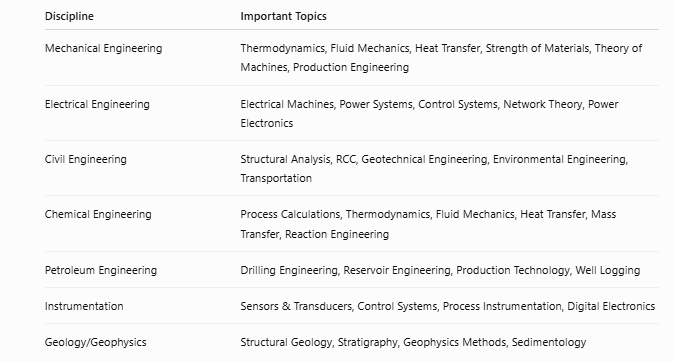
| Mechanical Engineering | Thermodynamics, Fluid Mechanics, Heat Transfer, Strength of Materials, Theory of Machines, Production Engineering |
| Electrical Engineering | Electrical Machines, Power Systems, Control Systems, Network Theory, Power Electronics |
| Civil Engineering | Structural Analysis, RCC, Geotechnical Engineering, Environmental Engineering, Transportation |
| Chemical Engineering | Process Calculations, Thermodynamics, Fluid Mechanics, Heat Transfer, Mass Transfer, Reaction Engineering |
| Petroleum Engineering | Drilling Engineering, Reservoir Engineering, Production Technology, Well Logging |
| Instrumentation | Sensors & Transducers, Control Systems, Process Instrumentation, Digital Electronics |
| Geology/Geophysics | Structural Geology, Stratigraphy, Geophysics Methods, Sedimentology |
Syllabus is discipline-specific and aligned with graduation + GATE syllabus.
2. General Awareness
| Topics |
|---|
| Current Affairs (National & International) |
| Indian Economy |
| Geography & Polity |
| Science & Technology |
| Oil & Gas Industry Basics |
3. Aptitude (Quantitative + Reasoning)
| Topics |
|---|
| Number System |
| Percentage, Profit & Loss |
| Time & Work, Time & Distance |
| Data Interpretation |
| Logical Reasoning |
| Analytical Ability |
4. English Language
| Topics |
|---|
| Reading Comprehension |
| Grammar (Error Detection, Sentence Correction) |
| Vocabulary |
| Synonyms & Antonyms |
| Para Jumbles |
Key Highlights
- No negative marking – attempt all questions
- Technical section = most important (≈50% weightage)
- Based on engineering fundamentals + GATE level
- Final selection includes Interview (15 marks)
ONGC Engineers Trainee Syllabus 2026 (Branch-wise Detailed)
Branch-wise detailed ONGC Engineers Trainee (AEE) Syllabus 2026 in a PDF-style structured format (subject → topics → subtopics) for Mechanical, Civil, and Electrical Engineering.
The technical syllabus is based on core engineering subjects (GATE-level + graduation concepts)
Mechanical Engineering Syllabus
| Subject | Detailed Topics |
|---|---|
| Engineering Mechanics | Laws of motion, equilibrium, friction, work-energy, impulse |
| Strength of Materials | Stress-strain, bending, torsion, shear force & bending moment |
| Theory of Machines | Gears, cams, vibrations, kinematics of machines |
| Machine Design | Design of shafts, gears, bearings, springs |
| Thermodynamics | Laws of thermodynamics, entropy, cycles (Carnot, Rankine) |
| Fluid Mechanics | Fluid properties, statics, dynamics, flow measurement |
| Heat Transfer | Conduction, convection, radiation, heat exchangers |
| IC Engines | Petrol & diesel engines, performance, combustion |
| Refrigeration & AC | Refrigeration cycles, air conditioning systems |
| Manufacturing Engineering | Casting, welding, machining, CNC, production systems |
| Industrial Engineering | Work study, inventory, optimization |
Civil Engineering Syllabus
| Subject | Detailed Topics |
|---|---|
| Engineering Mechanics | Forces, equilibrium, trusses, frames |
| Structural Analysis | Bending moments, deflection, indeterminate structures |
| RCC & Steel Design | Limit state design, beams, slabs, columns |
| Geotechnical Engineering | Soil mechanics, foundation engineering, bearing capacity |
| Fluid Mechanics | Properties of fluids, flow, hydraulics |
| Environmental Engineering | Water supply, sewage treatment, solid waste |
| Transportation Engineering | Highway design, traffic engineering |
| Surveying | Leveling, theodolite, total station |
| Construction Planning | CPM, PERT, project management |
| Engineering Mathematics | Probability, statistics, numerical methods |
Electrical Engineering Syllabus
| Subject | Detailed Topics |
|---|---|
| Electrical Circuits | Network theorems, AC/DC circuits, transient analysis |
| Electrical Machines | Transformers, motors, generators |
| Power Systems | Generation, transmission, distribution, load flow |
| Control Systems | Feedback systems, stability, transfer functions |
| Power Electronics | Rectifiers, inverters, converters |
| Measurements | Instruments, errors, bridges |
| Analog Electronics | Diodes, transistors, amplifiers |
| Digital Electronics | Logic gates, flip-flops, microprocessors |
| Signals & Systems | Fourier series, Laplace transform |
| Electrical Engineering Materials | Conductors, insulators |
Summary Table (All Branches)
| Branch | Core Focus |
|---|---|
| Mechanical | Thermal + Design + Production |
| Civil | Structures + Soil + Environment |
| Electrical | Power + Machines + Control |
The Oil and Natural Gas Corporation (ONGC) conducts recruitment for GET posts at E1 level. The 2026 recruitment has started from July 2026, and selection may include CBT + Interview or GATE-based shortlisting (depending on notification).
ONGC GET Selection Process 2026
The selection process generally includes:
- Shortlisting (via GATE score or application screening)
- Computer-Based Test (CBT) (if conducted)
- Personal Interview / Group Discussion
- Final Merit List
GATE score often plays an important role in shortlisting candidates.
ONGC GET Exam Pattern 2026 (CBT)
| Particulars | Details |
|---|---|
| Mode of Exam | Online (CBT) |
| Duration | 120 minutes (approx.) |
| Total Questions | ~85 (objective type) |
| Sections | Technical + Aptitude + English + GK |
| Negative Marking | No (generally) |
| Difficulty Level | GATE-level (Technical) |
Technical section carries the highest weightage in the exam.
Section-wise Weightage (Expected)
| Section | Weightage |
|---|---|
| Technical Subject | 60–70% |
| General Awareness | 10–15% |
| Aptitude & Reasoning | 10–15% |
| English Language | 5–10% |
ONGC GET Syllabus 2026
The syllabus is mainly divided into two parts:
Technical Subjects (Branch-wise)
Based on GATE syllabus of your discipline
Common Engineering Branch Topics
Mechanical Engineering
- Engineering Mechanics
- Thermodynamics
- Fluid Mechanics
- Strength of Materials
- Machine Design
- Production Engineering
Electrical Engineering
- Power Systems
- Control Systems
- Electrical Machines
- Power Electronics
- Network Theory
Civil Engineering
- Structural Analysis
- Geotechnical Engineering
- Environmental Engineering
- Surveying
- RCC & Steel Structures
Computer Science / IT
- Data Structures & Algorithms
- DBMS
- Operating Systems
- Computer Networks
- Software Engineering
Chemical Engineering
- Process Calculations
- Thermodynamics
- Heat Transfer
- Mass Transfer
- Chemical Reaction Engineering
Technical syllabus is largely aligned with GATE-level concepts.
Non-Technical Syllabus
General Awareness
- Current Affairs (National & International)
- Indian Economy
- Environment & Ecology
- Science & Technology
- Polity & Governance
Aptitude & Reasoning
- Quantitative Aptitude
- Logical Reasoning
- Data Interpretation
English Language
- Reading Comprehension
- Grammar
- Vocabulary
- Error Detection
Role of GATE in ONGC GET
- GATE score is often used for shortlisting candidates
- Technical syllabus = same as GATE exam
- GATE pattern includes:
- General Aptitude (15 marks)
- Engineering Maths
- Core Subject
Preparation Strategy (Quick Tips)
- Focus heavily on core engineering subjects
- Practice GATE-level questions
- Revise current affairs (last 6–8 months)
- Improve speed for aptitude & English
About The Author
