
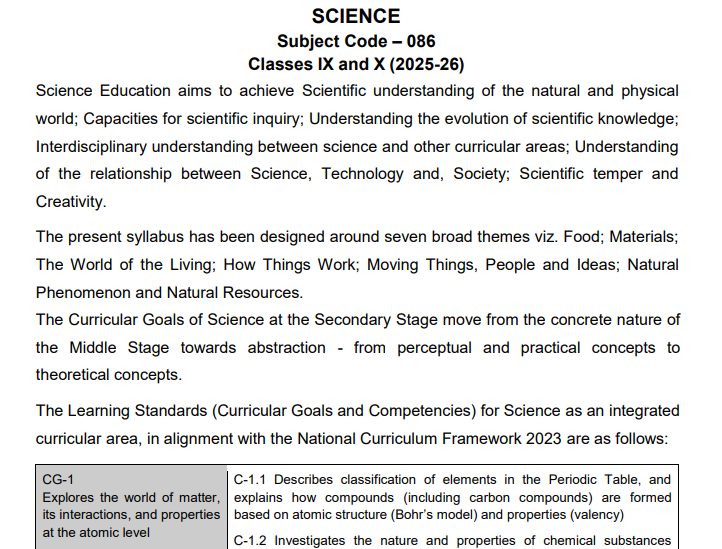
The CBSE (Central Board of Secondary Education) Class 10 Science Syllabus for the academic year 2025-26 has been updated, and it’s important for students to be aware of the changes so they can plan their studies accordingly. I’ll explain the syllabus in simple and easy-to-understand terms, breaking it down into the different units and chapters included, along with the assessment pattern.
CBSE Class 10 Science Syllabus 2025-26
This article contains the CBSE Class 10 Science syllabus for the 2024-2025 academic session. The syllabus has been officially issued on the board’s website, cbse.gov.in. Knowing the most recent syllabus is very important since it gives students a clear picture of the topics and concepts they must cover throughout the year. Keeping up with the syllabus will allow them to better plan their study, stay organized, and focus on the areas that require more attention.
CBSE Class 10 Science Syllabus: Overview
The CBSE Class 10 Science Syllabus is divided into five units, covering key concepts from Physics, Chemistry, and Biology. The subject also includes practical experiments, which help students understand the scientific concepts better. Here’s how the syllabus is structured:
- Unit 1: Chemical Substances – Nature and Behaviour
- Unit 2: World of Living (Biology)
- Unit 3: Natural Phenomena (Physics)
- Unit 4: Effects of Current (Physics)
- Unit 5: Natural Resources (Biology & Environmental Science)
CBSE Class 10 Science Syllabus 2025-26: Unit-Wise Breakdown and Key Topics
Unit 1: Chemical Substances – Nature and Behaviour (25 Marks)
This unit focuses on Chemistry and includes the following key topics:
- Chemical Reactions and Equations:
- Balancing chemical reactions
- Types of chemical reactions (e.g., combination, decomposition, displacement, etc.)
- Acids, Bases, and Salts:
- Properties of acids and bases
- Indicators (like litmus paper)
- pH scale and importance of pH in everyday life
- Metals and Non-metals:
- Physical and chemical properties of metals and non-metals
- Corrosion and its prevention
- Carbon and its Compounds:
- Covalent bonding in carbon compounds
- Homologous series and nomenclature of organic compounds
- Periodic Classification of Elements:
- Mendeleev’s Periodic Table and Modern Periodic Table
- Trends in the periodic table (like atomic size, valency, etc.)
World of Living (25 Marks)
This unit deals with Biology and covers:
- Life Processes:
- Nutrition, respiration, transportation, and excretion in plants and animals
- Control and Coordination:
- Nervous system and endocrine system in humans
- Control in plants (tropism)
- Reproduction:
- Asexual and sexual reproduction in plants and animals
- Reproductive health and family planning
- Heredity and Evolution:
- Mendel’s laws of inheritance
- Evolution and its mechanisms
Unit 3: Natural Phenomena (20 Marks)
This unit focuses on Physics:
- Light: Reflection and Refraction:
- Laws of reflection and refraction
- Image formation by spherical mirrors and lenses
- Human eye and defects of vision (myopia, hypermetropia, etc.)
- The Human Eye and the Colourful World:
- Refraction of light through a prism
- Dispersion of light, scattering of light, and its applications (like why the sky is blue)
Unit 4: Effects of Current (13 Marks)
This unit is also related to Physics and includes:
- Electricity:
- Electric current, potential difference, and Ohm’s law
- Series and parallel circuits
- Heating effect of electric current
- Magnetic Effects of Electric Current:
- Magnetic field, field lines, and properties of magnets
- Electromagnetic induction and its applications (like electric motor and generator)
Unit 5: Natural Resources (7 Marks)
This unit combines topics from Biology and Environmental Science:
- Sources of Energy:
- Renewable and non-renewable energy sources (like fossil fuels, solar energy, wind energy)
- Environmental consequences of energy use
- Sustainable Management of Natural Resources:
- Conservation of forests and wildlife
- Water conservation, dams, water harvesting
- The importance of the 3Rs (Reduce, Reuse, Recycle)
Internal Assessment
The total marks for the Science paper are 100, divided as follows:
- Theory Paper: 80 Marks (from the topics mentioned above)
- Internal Assessment: 20 Marks, which includes:
- Periodic Tests: Three tests conducted during the year (average of the best two considered)
- Practical Work: Experiments based on the syllabus, recorded in a laboratory manual
- Class Assignments/Activities: Subject enrichment activities like models, charts, or presentations
- Portfolio: Maintaining a portfolio of work, which includes assignments, projects, and feedback
Practical Experiments
Practical experiments are a crucial part of the syllabus. Students are required to perform various experiments in the lab, and some of the important ones include:
- Determining the pH of different substances using indicators
- Studying the properties of acids and bases
- Investigating the refraction of light through a glass slab
- Studying the laws of reflection using mirrors
- Experimenting with the magnetic effect of electric current
- Testing the presence of starch in a leaf and other biology-related experiments
Changes in Syllabus Made by CBSE for 2025-26
There are minor updates or revisions in certain topics, and CBSE has also continued the trend of emphasizing skill-based questions. This means that questions might be more practical or application-based, rather than purely theoretical.
Tips for Preparation
- Understand Concepts: Don’t just memorize, but focus on understanding the core concepts, especially in Physics and Chemistry.
- Practice Diagrams: Diagrams are important in both Biology and Physics. Practice drawing them neatly and labeling them correctly.
- Solve Sample Papers: CBSE releases sample papers every year. Practice them to get a feel of the exam pattern and type of questions.
- Work on Practical Skills: Don’t ignore the experiments. Knowing how to perform the practicals will help you with both the practical exam and theoretical understanding.
Assessment Pattern
- Objective Questions: Multiple-choice questions, fill-in-the-blanks, and very short answers will test basic concepts.
- Subjective Questions: Short and long-answer questions will test deeper understanding and analytical skills.
- Practical-based Questions: Questions based on the practical experiments will also be included in the theory exam.
This syllabus emphasizes both theoretical knowledge and practical application, ensuring that students have a well-rounded understanding of Science.
CBSE Class 10 Science Syllabus 2025-26 PDF
To understand better all topics of class 10 science, student can download full and detailed CBSE Class 10 Science Syllabus 2025-26 by clicking on the below link:
Related Post:
FAQs Based On Class 10 Science Syllabus
1. What are the main subjects included in Class 10 Science?
Class 10 Science is divided into three major branches:
-
Physics – Light, Human Eye, Electricity, Magnetism, Sources of Energy
-
Chemistry – Chemical Reactions, Acids-Bases-Salts, Metals & Non-Metals, Carbon Compounds
-
Biology – Life Processes, Control & Coordination, Reproduction, Heredity, Environment
2. Which unit carries the highest weightage in the Class 10 Science exam?
Generally, Biology carries the highest weightage, followed by Chemistry, then Physics. Chapters like Life Processes, Heredity & Evolution, Carbon and its Compounds, and Electricity are considered high-scoring.
3. Is Class 10 Science syllabus difficult compared to Class 9?
Yes, Class 10 Science is conceptually more advanced than Class 9. It focuses more on:
-
Numerical problems (Physics)
-
Chemical equations and reactions
-
Diagrams and explanations in Biology
However, with regular practice, it becomes manageable.
4. Are numerical questions important in Class 10 Science?
Absolutely. Numerical questions are mainly asked from:
-
Electricity
-
Magnetic Effects of Current
-
Light (Ray Diagrams & Formula-based questions)
Practicing numericals is essential for scoring well.
5. Which chapters are most important for board exams?
Frequently asked chapters include:
-
Life Processes
-
Heredity and Evolution
-
Carbon and its Compounds
-
Electricity
-
Light – Reflection and Refraction
-
Chemical Reactions and Equations
6. How important are diagrams in Class 10 Science?
Diagrams are very important, especially in Biology and Physics. Neat, well-labelled diagrams can fetch full marks even if the explanation is brief.
7. Are practicals included in the Class 10 Science syllabus?
Yes. The Science syllabus includes:
-
Practical experiments
-
Project work
-
Internal assessmentPractical knowledge helps in understanding concepts and scoring better.
8. How should students prepare for Class 10 Science effectively?
Effective preparation includes:
-
Understanding concepts instead of rote learning
-
Regular numerical practice
-
Revising chemical equations
-
Drawing diagrams daily
-
Solving sample papers and previous year questions
9. Is NCERT enough for Class 10 Science?
For CBSE students, NCERT textbooks are sufficient if studied thoroughly. Reference books can be used only for additional practice, not as a replacement.
10. How many chapters are there in the Class 10 Science syllabus?
On average:
-
Physics – 5 chapters
-
Chemistry – 5 chapters
-
Biology – 5 chapters
(Total around 15 chapters, depending on the board)
11. Do assertion–reason questions come from the Science syllabus?
Yes. Assertion–Reason and case-based questions are increasingly common, especially in CBSE exams, and are strictly based on the prescribed syllabus.
12. Which section of Science is easiest to score?
This depends on the student, but many find:
-
Biology easiest due to theory-based questions
-
Chemistry scoring with practice
-
Physics challenging but high-scoring with numericals
About The Author

1 thought on “CBSE Class 10 Science Syllabus 2025-26, Download Free PDF”