
US Grade 2 Mathematics Curriculum 2026-27: As an educator, I’ve seen many curriculum changes, but the shifts we’re seeing for the 2026-2027 school year are particularly exciting. We’re moving beyond just “doing math” and focusing on helping students truly understand it. This means building deep number sense and strong problem-solving skills right from the start.
Here’s a teacher’s guide to the Grade 2 Mathematics curriculum for the upcoming year, designed to help you support your child.
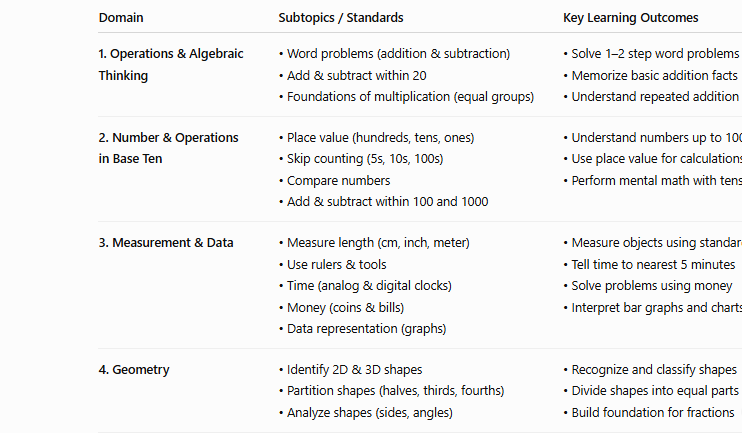
US Grade 2 Mathematics Curriculum 2026–27
| Domain | Subtopics / Standards | Key Learning Outcomes |
|---|---|---|
| 1. Operations & Algebraic Thinking | • Word problems (addition & subtraction) • Add & subtract within 20 • Foundations of multiplication (equal groups) |
• Solve 1–2 step word problems within 100 • Memorize basic addition facts • Understand repeated addition as groups |
| 2. Number & Operations in Base Ten | • Place value (hundreds, tens, ones) • Skip counting (5s, 10s, 100s) • Compare numbers • Add & subtract within 100 and 1000 |
• Understand numbers up to 1000 • Use place value for calculations • Perform mental math with tens/hundreds |
| 3. Measurement & Data | • Measure length (cm, inch, meter) • Use rulers & tools • Time (analog & digital clocks) • Money (coins & bills) • Data representation (graphs) |
• Measure objects using standard units • Tell time to nearest 5 minutes • Solve problems using money • Interpret bar graphs and charts |
| 4. Geometry | • Identify 2D & 3D shapes • Partition shapes (halves, thirds, fourths) • Analyze shapes (sides, angles) |
• Recognize and classify shapes • Divide shapes into equal parts • Build foundation for fractions |
| 5. Mathematical Practices | • Problem-solving • Logical reasoning • Use of tools • Precision & structure |
• Develop critical thinking • Explain reasoning • Apply math in real-life situations |
Key Focus Areas (Grade 2 Highlights)
- Strong foundation in place value and number sense
- Fluency in addition & subtraction (especially within 100)
- Introduction to measurement, time, and money
- Early understanding of geometry and fractions concepts
- Emphasis on problem-solving and reasoning skills
The Core Focus: Four Key Domains
While specific standards can vary by state, the core areas of focus for Grade 2 math are remarkably consistent across the country . The curriculum is built around four main pillars:
-
Operations and Algebraic Thinking
-
Number and Operations in Base Ten (Place Value)
-
Measurement and Data
-
Geometry
1. Number Sense and Place Value: The Foundation
In second grade, we take the concept of place value to the next level. Students will work with numbers up to 1,000 . They will learn to:
-
Compose and Decompose: Understand that a number like 345 is made of 3 hundreds, 4 tens, and 5 ones. They’ll be able to break numbers apart in different ways (e.g., 439 is 400 + 39, or 435 + 4) .
-
Count: Count forward and backward within 1,000, and skip-count by 2s, 5s, 10s, and 100s .
-
Compare: Compare two numbers using the symbols
>,<, and=.
A crucial new addition in some updated standards, like Maryland’s for 2026-2027, is learning to estimate quantities and assess the reasonableness of sums and differences . This builds a “number sense” that helps children check their own work.
2. Building Fluency with Addition and Subtraction
This is where we see the biggest shift towards a more flexible approach. The goal is for students to fluently add and subtract within 100 . We’ll achieve this by:
-
Mastering Facts: Recalling or quickly deriving addition and subtraction facts within 20 .
-
Using Strategies: Moving away from just one method. Students will learn multiple strategies like counting on, making tens, and using partial sums, and will understand which strategy is most efficient for a given problem .
For example, for the problem 28 + 15, a student might use “partial sums” (20 + 10 = 30 and 8 + 5 = 13, for a total of 43) or “compensation” (adjusting 28 to 30, then 30 + 15 = 45, then subtracting the extra 2 to get 43) . We also introduce the foundations of multiplication by working with equal groups and arrays .
3. Measurement, Data, and Real-World Math
Second grade is when math becomes a powerful tool for understanding the world. Your child will:
-
Measure Lengths: Use rulers, yardsticks, and tape measures to measure and compare lengths in inches, centimeters, etc. .
-
Work with Money: Solve word problems involving dollar bills, quarters, dimes, nickels, and pennies .
-
Tell Time: Tell and write time to the nearest five minutes on both analog and digital clocks .
-
Analyze Data: Create and interpret bar graphs and picture graphs to represent data .
4. Geometry and Fractions
We explore the world of shapes and their attributes. Students will:
-
Identify Shapes: Recognize and draw shapes like rectangles, triangles, and pentagons .
-
Partition Shapes: Divide circles and rectangles into equal parts (halves, thirds, fourths), which builds an intuitive understanding of fractions.
How You Can Help at Home
Supporting your child’s math journey is easier than you might think. Here are a few practical tips:
-
Embrace Mental Math: Encourage your child to solve problems mentally. Instead of grabbing a pencil, ask them, “What’s 10 more than 85?” or “What is 100 less than 350?” .
-
Play “Real-World” Math: Let them count change at the store, measure ingredients while cooking, or tell you what time it will be in 15 minutes.
-
Make it a Conversation: Don’t just focus on the answer. Ask, “How did you figure that out?” and “Why did you choose that strategy?” This helps them verbalize their reasoning .
-
Practice Skip Counting: Count by 2s, 5s, and 10s while doing chores, or going for a walk. This is a fun way to build a foundation for multiplication .
The Grade 2 math curriculum for 2026-27 is designed to create confident, flexible, and resilient problem-solvers. By focusing on the why behind the how, we are setting students up for a lifetime of success in mathematics.
About The Author

Brajesh
Brajesh (MCA, M.Tech (IT)) is a passionate education and career content creator with a strong academic background in Computer Applications (MCA) and Technology (M.Tech). With years of hands-on experience in exam preparation strategies, syllabus analysis, and government job updates, he helps students and aspirants navigate their academic and professional journeys with clarity and confidence.