
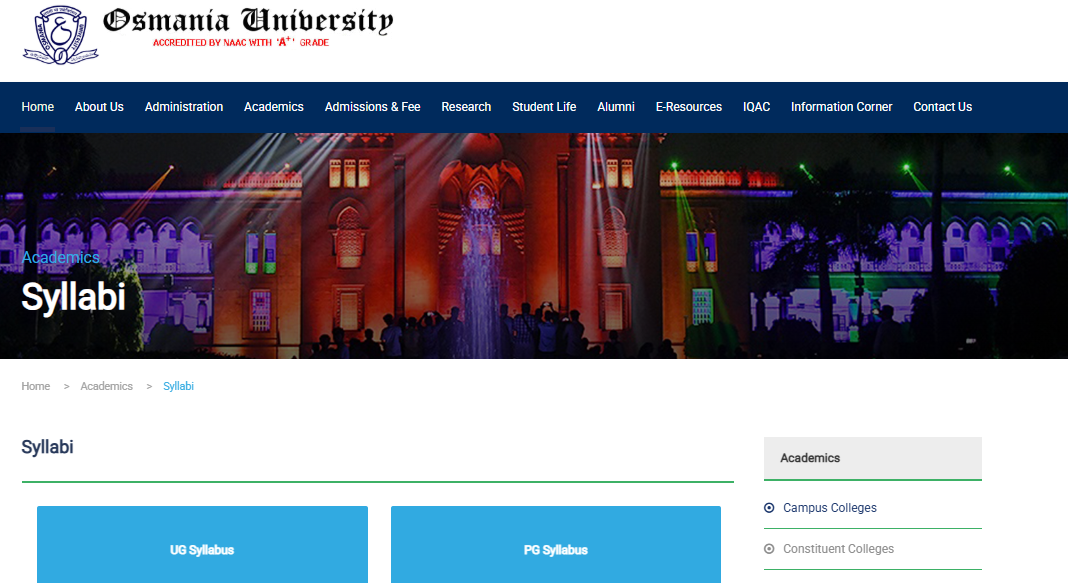
Osmania University is one of India’s oldest and most reputed universities, offering a wide range of undergraduate (UG), postgraduate (PG), professional, and diploma programs. The university follows a CBCS (Choice-Based Credit System) with a semester-wise syllabus structure, enabling students to choose electives and skill-based courses.
The Osmania University Syllabus 2026 includes updated curricula for courses like BA, BSc, BCom, BBA, BCA, BE/B.Tech, MA, MSc, MBA, MCom, and more, with detailed subject-wise topics for each semester.
Osmania University Syllabus PDF Download (Direct Links)
- PG Courses Syllabus (MA, MSc, MBA, MCom, etc.)
Download PG Syllabus PDFs - UG Courses Syllabus (BA, BSc, BCom, BBA, BCA, etc.)
Download UG Syllabus PDFs
Osmania University B.Tech (B.E) Syllabus 2026 (All Semesters)
Semester-wise tabular syllabus overview (2026) for Osmania University covering B.Tech (B.E), BCA, and MBA programs.
(Note: OU follows CBCS system; exact subjects may vary slightly by branch/specialization, but the core structure below is based on the latest 2025–26 syllabus updates )
B.Tech / B.E (CSE / ECE / ME / Civil – Common Pattern)
| Semester | Subjects / Topics |
|---|---|
| Sem 1 | Engineering Mathematics-I, Engineering Physics, Basic Electrical Engineering, Engineering Graphics, Programming (C), Workshop |
| Sem 2 | Mathematics-II, Chemistry / Environmental Science, Basic Electronics, Data Structures, Engineering Mechanics |
| Sem 3 | Discrete Mathematics, Digital Logic Design, OOP (Java/C++), Signals & Systems / Core Branch Subject |
| Sem 4 | Operating Systems, Database Management Systems, Microprocessors, Control Systems / Core Subjects |
| Sem 5 | Computer Networks, Software Engineering, Elective-I, Open Elective, Labs |
| Sem 6 | Artificial Intelligence / Machine Learning, Compiler Design, Elective-II, Industrial Training |
| Sem 7 | Major Project Phase-I, Elective-III, Cyber Security / Professional Elective |
| Sem 8 | Major Project Phase-II, Seminar, Internship / Viva |
OU provides branch-specific syllabus (CSE, ECE, Mechanical, Civil, etc.) for later semesters (III–VIII)
Osmania University BCA Syllabus 2026 (All Semesters)
Bachelor of Computer Applications (CBCS Pattern)
| Semester | Subjects / Topics |
|---|---|
| Sem 1 | Fundamentals of IT, Programming in C, Mathematics, English, Computer Lab |
| Sem 2 | Data Structures, Digital Electronics, Business Communication, Lab |
| Sem 3 | Object-Oriented Programming (C++/Java), Operating Systems, DBMS |
| Sem 4 | Software Engineering, Web Technologies, Computer Networks |
| Sem 5 | Python Programming, Mobile App Development, Elective-I |
| Sem 6 | Project Work, Internship, Advanced Elective (AI/Data Science) |
OU offers BCA full syllabus (Sem I–VI) under CBCS system
Osmania University MBA Syllabus 2026 (All Semesters)
Master of Business Administration (2 Years / 4 Sem)
| Semester | Subjects / Topics |
|---|---|
| Sem 1 | Managerial Economics, Accounting, Organizational Behavior, Marketing Management |
| Sem 2 | Financial Management, HRM, Operations Management, Business Research Methods |
| Sem 3 | Specialization Subjects (Finance/HR/Marketing), Strategic Management, Electives |
| Sem 4 | Project Work, Internship, Viva, Advanced Specialization Papers |
OU provides MBA syllabus (Day/Evening programs) for all 4 semesters
Osmania University UG Syllabus 2026 (Semester-wise)
BA / BCom / BSc (General Degree Programs)
Semester 1 & 2 (Foundation Stage)
- English & Second Language (Telugu/Hindi/Urdu)
- Environmental Studies
- Core Subject 1 & 2 (e.g., History, Economics, Mathematics, Commerce)
- Skill Enhancement Courses
Example: BA includes History, Political Science, Economics
Example: BSc includes Physics, Chemistry, Mathematics
UG courses follow CBCS with core + elective + skill courses
Semester 3 & 4 (Core Development)
- Advanced core subjects
- Practical/Lab work (for science streams)
- Generic Electives
- Internship/Project (in some courses)
Semester 5 & 6 (Specialization Stage)
- Discipline-specific electives
- Project work / Dissertation
- Industry-oriented courses
Programs like B.Com (Finance, BFSI, Business Analytics) offer specialization papers
BBA / BCA Syllabus 2026
Key Subjects (Semester-wise)
- Sem 1–2: Principles of Management, Business Communication, Computer Fundamentals
- Sem 3–4: Marketing, Financial Management, Data Structures
- Sem 5–6: HRM, Entrepreneurship, Project Work
Specialized BBA programs include Logistics, Healthcare, E-Commerce, etc.
B.E / B.Tech Syllabus 2026
Semester-wise Structure
1st Year (Sem 1 & 2)
- Engineering Mathematics
- Physics / Chemistry
- Programming Basics
- Engineering Drawing
2nd Year (Sem 3 & 4)
- Core branch subjects (CSE, ECE, Civil, Mechanical)
- Labs & Workshops
3rd Year (Sem 5 & 6)
- Advanced technical subjects
- Mini Project
4th Year (Sem 7 & 8)
- Major Project
- Electives (AI, Data Science, IoT, etc.)
OU provides separate syllabi for each branch like CSE, Civil, IT
Osmania University PG Syllabus 2026 (Semester-wise)
MA / MSc Programs
Semester 1 & 2
- Core theory papers
- Research methodology
- Practical/Lab (for science courses)
Semester 3 & 4
- Specialization papers
- Dissertation / Project
Popular courses: MA English, MA Economics, MSc Physics, MSc Chemistry, MSc Data Science
MBA Syllabus 2026
Semester 1
- Management Principles
- Accounting
- Business Communication
Semester 2
- Marketing Management
- HRM
- Financial Management
Semester 3
- Specialization (Finance / Marketing / HR)
- Internship
Semester 4
- Project Report
- Strategic Management
MBA (Day & Evening) syllabi are updated for 2025–26 batches
3. MCom / MCA / Other PG Courses
Key Subjects
- MCom: Accounting, Taxation, Finance
- MCA: Programming, DBMS, Software Engineering
- MSc: Subject-specific advanced topics
The semester-wise structure follows 4 semesters (2 years) format
Osmania University Exam Pattern 2026
| Component | Weightage |
|---|---|
| Internal Assessment | 20–30% |
| Semester Exam | 70–80% |
| Practical / Viva | Course-based |
| Project Work | Final semesters |
Key Features of OU Syllabus 2026
- Based on CBCS (Choice-Based Credit System)
- Includes Skill Enhancement Courses (SEC)
- Focus on practical learning & internships
- Updated with industry-oriented subjects
- Semester-based evaluation system
How to Download Osmania University Syllabus PDF
- Visit the official OU website
- Go to the “Academics” section
- Select UG or PG Syllabus
- Choose your course
- Click on the PDF link
- Download and save
The Osmania University Syllabus 2026 is designed to provide a balanced mix of theoretical knowledge, practical exposure, and skill development. With semester-wise structure, CBCS flexibility, and updated industry-relevant topics, students can build strong academic and professional foundations.
FAQs Based on Osmania University Syllabus
FAQs on Osmania University (OU) Syllabus
Here are frequently asked questions based on the official Osmania University syllabus pages and related academic information (primarily from osmania.ac.in UG/PG syllabus sections and supporting details). Syllabi follow the Choice Based Credit System (CBCS) in most programmes and are revised periodically (often aligned with UGC/AICTE/NEP guidelines). Always verify the latest version on the official site, as updates occur for specific academic years (e.g., w.e.f. 2025-26 or later).
Where can I find/download the official Osmania University syllabus?
Visit the official website:
- UG Syllabus: https://www.osmania.ac.in/syllabus-ug.php
- PG Syllabus: https://www.osmania.ac.in/syllabus-Pg.php
- Older/archived listings: https://www.osmania.ac.in/oldsite/syllabi.php
Syllabi are typically available as PDF downloads, listed by course, semester/year, and effective academic year (e.g., “B.Sc Computer Science Syllabus (Semesters I–VI) w.e.f. Academic Year 2025-26”). Third-party education forums sometimes mirror recent releases, but I prefer the official site.
What is the structure of OU syllabi (CBCS)?
Most UG and PG programs use CBCS. A typical syllabus includes the following:
- Course structure/scheme of instruction and examination (hours per week/HPW, credits, marks split).
- Detailed units/topics per paper.
- Course objectives/outcomes (in newer versions).
- References/recommended books.
- Internal assessment + End Semester Examination (ESE) details.
- Skill Enhancement Courses (SEC), Ability Enhancement Courses (AEC), Value-Added Courses (VAC), Multidisciplinary Courses (MDC), etc., in reorganized CBCS structures (especially from 2025-26 onward in many programmes).
Marks often follow patterns such as 80 (University) + 20 (Internal) or Continuous and Comprehensive Evaluation (CCE) components.
How often is the syllabus revised?
Boards of Studies revise syllabi periodically (commonly every few years) based on UGC/AICTE/PCI/NCTE guidelines, industry needs, NEP 2020 alignment, stakeholder feedback, and employability considerations. New or revised syllabi clearly state the effective academic year (e.g., “w.e.f. Academic Year 2025-26”) and apply to the batch admitted from that year. Older batches generally follow the syllabus under which they were admitted, unless notified otherwise.
Which courses have recently updated syllabi?
Recent listings (as of available data) cover many programs effective 2025-26 or later, including:
- UG: B.Com (various streams – General, CA, Hons, Tax, Finance, BFSI, etc.); BBA (Regular and specialized); BCA; B.Sc (Computer Science, Microbiology, Mathematics, Zoology, etc.); BA subjects (History, Political Science, Economics, Journalism, languages); English (First Language); second languages (Telugu, Hindi, Urdu, etc.); and Engineering (B.E. various branches).
- PG: MA (English, History, Telugu, Economics, Psychology, etc.), M.Sc. (various sciences), M.Com, MCA, MBA-related, and Ph.D. coursework in select faculties.
- Specialized/professional: B.Pharmacy, law programs, B.Ed. specializations, etc.
Check the official UG/PG pages for the complete current list and exact PDFs.
What is the evaluation pattern (internal + external)?
Many programs use Continuous and Comprehensive Evaluation (CCE). Typical split:
- Continuous Assessment/Internal: Often 20–30 marks (tests, assignments, seminars, attendance, etc.).
- End Semester Examination: 70–80 marks. Attendance of at least 75% is commonly required for eligibility to appear in ESE. Exact patterns are specified in the individual syllabus or CCE regulations documents.
Do old batch students follow the new syllabus?
Generally no. Students follow the syllabus applicable to their year of admission. When a syllabus changes, supplementary/backlog candidates may need to check notifications carefully, as some transitions require appearing under the new scheme for specific papers. Always confirm with the college or controller of examinations.
Are there syllabi for distance education / PGRRCDE programs?
Yes. Some PG and other programs under Prof. G. Ram Reddy Centre for Distance Education (PGRRCDE) have separate or parallel listings. Check the main syllabus pages and the OUCDE website (oucde.net) for distance-mode-specific details.
How can I get the syllabus for a specific course/semester if it is not listed?
- Search the official UG or PG syllabus page by course name.
- Contact the concerned board of studies/department/college academic section.
- Check recent circulars or the old site archive for previous years.
- University update-type forums often post newly released PDFs quickly after official notification.
What additional documents accompany the syllabus?
Newer syllabi often include the following:
- Full course structure/credit summary.
- Scheme of examination.
- Practical question banks (for relevant subjects like B.Com Computer Applications).
- Guidelines (e.g., for BBA CBCS).
About The Author
