
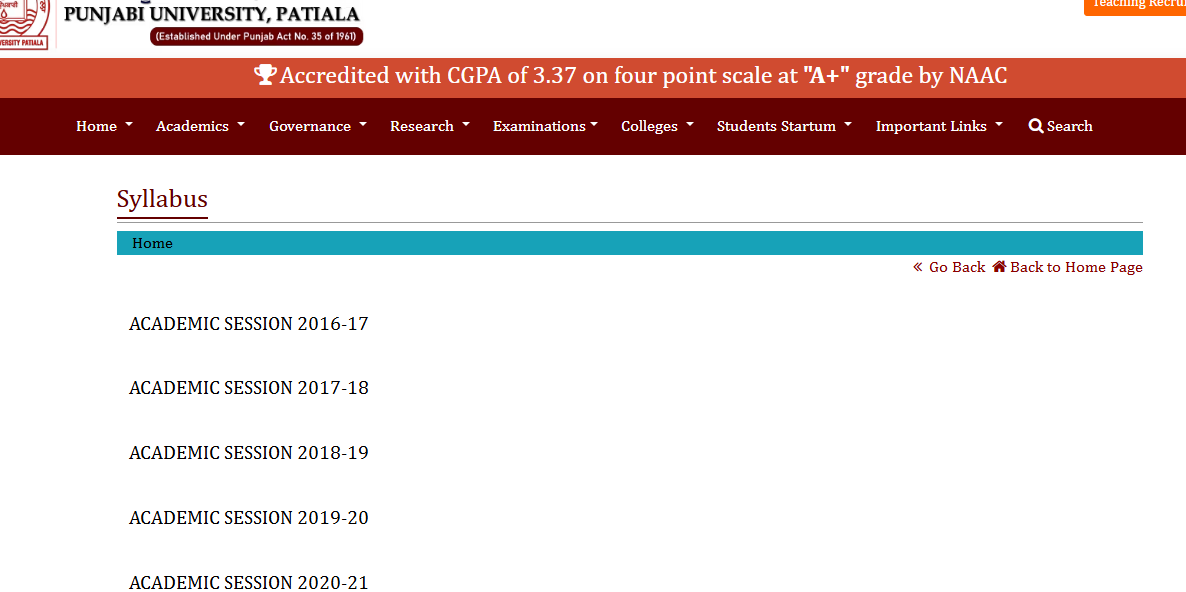
The PUP Syllabus 2026 has been carefully designed to align with modern academic standards, industry requirements, and skill-based learning approaches. It covers undergraduate and professional programs like BA, B.Sc, B.Com, and B.Ed with a structured semester-wise curriculum. Students gain both theoretical knowledge and practical exposure through updated subjects, projects, and assessments. This syllabus also emphasizes interdisciplinary learning, communication skills, and digital literacy. Overall, it prepares students for higher education, competitive exams, and career opportunities.
Overview of PUP Courses & Curriculum Structure
The PUP curriculum follows a semester-based system, generally divided into 6 semesters for undergraduate courses and 4 semesters for B.Ed. Each program includes core subjects, elective papers, and skill enhancement courses to ensure holistic development. Continuous internal assessment, practical exams, and final semester exams form the evaluation process. The syllabus integrates research-based learning, assignments, and presentations. This approach helps students build conceptual clarity along with real-world application skills.
PUP Syllabus 2026
Overview of PUP (Panjab University / Punjab University) Syllabus 2026 covering all major courses & faculties. The university offers a wide range of UG, PG, Diploma, and Professional programs across multiple disciplines.
| Faculty / Stream | Courses Offered (Examples) | Core Subjects in Syllabus | Program Duration | Level |
|---|---|---|---|---|
| Arts & Humanities | BA, BA (Hons), MA, Diploma in Social Work, Human Rights | History, Political Science, Sociology, Psychology, Philosophy, Geography | 3–4 Years (UG), 2 Years (PG) | UG / PG |
| Science | B.Sc, B.Sc (Hons), M.Sc, Biotechnology, Physics, Chemistry | Physics, Chemistry, Mathematics, Botany, Zoology, Environmental Science | 3–4 Years (UG), 2 Years (PG) | UG / PG |
| Commerce & Management | B.Com, BBA, MBA, M.Com | Accounting, Business Law, Economics, Marketing, Finance, HRM | 3 Years (UG), 2 Years (PG) | UG / PG |
| Engineering & Technology | B.E/B.Tech, M.E/M.Tech, Computer Science, AI, Cyber Security | Programming, Data Structures, AI, Machine Learning, Electronics, Mechanics | 4 Years (UG), 2 Years (PG) | UG / PG |
| Law | LLB, BA LLB, LLM | Constitutional Law, Criminal Law, Corporate Law, Legal Studies | 3–5 Years | UG / PG |
| Medical & Health Sciences | BPT, B.Sc Nursing, Medical Lab Tech, Audiology, Optometry | Anatomy, Physiology, Biochemistry, Clinical Training | 4–5 Years | UG |
| Pharmaceutical Sciences | B.Pharm, Pharm-D, M.Pharm | Pharmacology, Pharmaceutical Chemistry, Drug Formulation | 4–5 Years | UG / PG |
| Education | B.Ed, M.Ed, Diploma in Education, Special Education | Teaching Methods, Educational Psychology, Curriculum Studies | 1–2 Years | UG / PG |
| Languages | BA in English, Hindi, Punjabi, Urdu, MA Languages | Literature, Grammar, Linguistics, Writing Skills | 3 Years (UG), 2 Years (PG) | UG / PG |
| Fine Arts & Design | BFA, MFA, Fashion Designing | Drawing, Painting, Sculpture, Design Theory | 3–4 Years | UG / PG |
| Agriculture & Allied | B.Sc Agriculture, Dairy, Animal Husbandry | Agronomy, Soil Science, Animal Science, Dairy Technology | 4 Years | UG |
| Multi-Faculty / Interdisciplinary | BA/BSc (Hons with Research), Social Sciences | Major-Minor system, Research Methodology, Skill Courses | 4 Years | UG |
| Diploma & Certificate Courses | PG Diploma, Advanced Diploma (Disaster Mgmt, Library Science etc.) | Skill-based subjects, Practical training | 6 Months – 2 Years | Certificate / Diploma |
Course-wise Syllabus Structure (NEP 2026 Pattern)
| Component | Description |
|---|---|
| Core Subjects (DSC) | Main discipline-specific subjects (e.g., Physics, Economics, Law) |
| Major / Minor Courses | Students choose specialization + additional minor subject |
| AEC (Ability Enhancement Courses) | Language (Hindi/Punjabi/English), Communication Skills |
| SEC (Skill Enhancement Courses) | Practical skills, IT tools, entrepreneurship |
| VAC (Value Added Courses) | Ethics, Environmental Studies, Indian Knowledge System |
| Internship / Project | Practical exposure, research, industrial training |
| Research Component (4th Year) | Dissertation / thesis (for Hons with Research) |
Popular Courses & Key Subjects (Quick Table)
| Course | Important Subjects Covered |
|---|---|
| BA | History, Polity, Economics, Sociology |
| B.Sc | Physics, Chemistry, Maths / Biology |
| B.Com | Accounting, Business Studies, Taxation |
| BBA | Marketing, HR, Finance, Entrepreneurship |
| B.Tech / BE | Programming, AI, Data Science, Electronics |
| LLB | Constitutional Law, IPC, Contract Law |
| B.Ed | Pedagogy, Teaching Practice |
| MBA | Finance, Marketing, Operations |
| M.Sc | Advanced Science specialization subjects |
Panjab University Patiala Syllabus 2026 Course wise
course-wise detailed semester-wise syllabus for PUP (Panjab University) 2026 based on the latest NEP pattern + official syllabus structure. The university follows a semester system (UG = 6–8 semesters depending on course) with core, elective, skill, and value-added subjects.
BA Syllabus 2026 (Semester-wise)
| Semester | Subjects / Topics |
|---|---|
| Sem 1 | Discipline Core (History/Pol Science/Economics), English/Punjabi Communication, Environmental Studies |
| Sem 2 | Core Subject-II, Sociology Basics, Language Course, Computer Fundamentals |
| Sem 3 | Major Subject-I (Advanced Topics), Minor Subject, Skill Enhancement Course (SEC) |
| Sem 4 | Major Subject-II, Indian Society & Culture, Ability Enhancement Course (AEC) |
| Sem 5 | Specialization Papers (e.g., Political Theory, Modern History), Internship / Field Work |
| Sem 6 | Advanced Major Papers, Research Project / Dissertation |
BA is a 3-year (6 semester) program with multiple subject combinations.
BSc Syllabus 2026 (Semester-wise)
| Semester | Subjects / Topics |
|---|---|
| Sem 1 | Physics-I / Chemistry-I / Maths-I or Biology-I, Communication Skills |
| Sem 2 | Physics-II / Chemistry-II / Maths-II / Zoology, Environmental Science |
| Sem 3 | Core Science Papers (Organic Chemistry / Mechanics / Algebra), Practical Lab |
| Sem 4 | Advanced Topics (Thermodynamics / Genetics / Calculus), Skill Course |
| Sem 5 | Specialization (Physics / Chemistry / Botany / Zoology), Internship |
| Sem 6 | Advanced Practical + Project / Research |
Includes lab work + practical exams each semester.
BCom Syllabus 2026 (Semester-wise)
| Semester | Subjects / Topics |
|---|---|
| Sem 1 | Financial Accounting-I, Business Law, Business Communication |
| Sem 2 | Financial Accounting-II, Micro Economics, IT Tools |
| Sem 3 | Corporate Accounting, Business Statistics, Cost Accounting |
| Sem 4 | Income Tax, Company Law, Management Principles |
| Sem 5 | Auditing, Financial Management, Marketing |
| Sem 6 | GST, Entrepreneurship, Project Work |
Same syllabus structure continues for multiple sessions with minor updates.
BTech / BE Syllabus 2026 (Semester-wise)
| Semester | Subjects / Topics |
|---|---|
| Sem 1 | Engineering Mathematics-I, Physics, Basic Electrical Engg, Engineering Drawing |
| Sem 2 | Engineering Mathematics-II, Chemistry, Programming (C/Python), Workshop |
| Sem 3 | Data Structures, Digital Electronics, OOPs, Signals |
| Sem 4 | Operating Systems, DBMS, Microprocessors, Control Systems |
| Sem 5 | Core Branch Subjects (AI / Mechanical / Civil), Minor Subject |
| Sem 6 | Advanced Topics (Machine Learning / Structural Analysis), Internship |
| Sem 7 | Electives (Cloud, Cyber Security, Robotics), Major Project-I |
| Sem 8 | Final Project-II, Industrial Training, Seminar |
Engineering courses are 4 years (8 semesters) with specialization.
MBA Syllabus 2026 (Semester-wise)
| Semester | Subjects / Topics |
|---|---|
| Sem 1 | Management Principles, Economics, Accounting, Marketing |
| Sem 2 | HRM, Financial Management, Operations Management |
| Sem 3 | Specialization (Finance/HR/Marketing), Research Methods |
| Sem 4 | Project Report, Internship, Strategic Management |
LLB Syllabus 2026 (Semester-wise)
| Semester | Subjects / Topics |
|---|---|
| Sem 1 | Constitutional Law-I, Law of Contracts |
| Sem 2 | Family Law, Torts |
| Sem 3 | Criminal Law (IPC), Property Law |
| Sem 4 | Administrative Law, Company Law |
| Sem 5 | Labour Law, Environmental Law |
| Sem 6 | Moot Court, Internship, Drafting |
Common NEP Syllabus Components (All Courses)
| Component | Details |
|---|---|
| DSC (Core Subjects) | Main subject papers |
| Major / Minor | Interdisciplinary choice system |
| SEC | Skill-based subjects (IT, communication, entrepreneurship) |
| AEC | Language & communication |
| VAC | Ethics, environment, Indian knowledge system |
| Internship | From 3rd semester onward in many courses |
| Project / Research | Final semester dissertation |
PUP BA Syllabus 2026 (Bachelor of Arts)
The BA syllabus focuses on humanities and social sciences, offering subjects such as History, Political Science, Sociology, Economics, and English Literature. In the first year, students learn foundational concepts, while advanced topics are introduced in later semesters. Elective subjects allow specialization based on student interests and career goals. The syllabus also includes communication skills, environmental studies, and general awareness topics. Practical assignments, essays, and presentations play an important role in student evaluation.
Key Subjects in BA Syllabus
The BA course includes core and elective subjects that build analytical and critical thinking skills. Common subjects include Indian History, World Politics, Micro & Macro Economics, and Cultural Studies. Language papers like English and regional languages are compulsory in early semesters. Skill-based subjects such as Public Administration and Journalism may also be included. Students are encouraged to engage in research-based projects and fieldwork for deeper understanding.
PUP B.Sc Syllabus 2026 (Bachelor of Science)
The B.Sc syllabus is designed for science stream students with subjects like Physics, Chemistry, Mathematics, Biology, and Computer Science. It focuses on both theoretical knowledge and laboratory-based practical learning. The curriculum is divided into core science subjects and optional specializations depending on the chosen stream. Students are trained in experimentation, data analysis, and scientific research methods. This prepares them for careers in research, healthcare, IT, and technical fields.
Key Subjects in B.Sc Syllabus
Major subjects include Mechanics, Organic Chemistry, Algebra, Genetics, and Programming Languages. Practical lab work is a compulsory part of each semester to enhance experimental skills. Environmental science and basic computer applications are also included in the curriculum. Advanced topics like Data Science, Biotechnology, and Electronics may be offered as electives. The syllabus emphasizes innovation, problem-solving, and analytical thinking.
PUP B.Com Syllabus 2026 (Bachelor of Commerce)
The B.Com syllabus focuses on business, finance, and accounting principles essential for commerce students. It includes subjects like Financial Accounting, Business Law, Economics, Taxation, and Auditing. The course is structured to build strong foundations in commerce along with practical financial knowledge. Students also learn about modern business tools, e-commerce, and digital finance systems. The syllabus ensures readiness for careers in banking, corporate sectors, and entrepreneurship.
Key Subjects in B.Com Syllabus
Core subjects include Accountancy, Cost Accounting, Business Mathematics, and Corporate Law. Students also study Income Tax, GST, and Financial Management in advanced semesters. Practical components like case studies and financial statement analysis are included. Computerized accounting tools such as Tally and Excel are also part of the curriculum. This combination of theory and practice helps students gain industry-relevant skills.
PUP B.Ed Syllabus 2026 (Bachelor of Education)
The B.Ed syllabus is designed for aspiring teachers, focusing on pedagogy, teaching methods, and classroom management. It includes both theoretical subjects and practical teaching training in schools. The course emphasizes child psychology, educational philosophy, and modern teaching technologies. Students undergo internships and teaching practice sessions to gain real classroom experience. This program prepares candidates for teaching careers in schools and educational institutions.
Key Subjects in B.Ed Syllabus
Important subjects include Educational Psychology, Teaching Aptitude, Curriculum Development, and Classroom Management. Pedagogy of specific subjects like Mathematics, Science, or Social Studies is also covered. Practical teaching sessions and internships form a major part of the course. Students are trained in lesson planning, evaluation techniques, and student engagement strategies. The syllabus also includes ICT (Information and Communication Technology) in education.
Semester-wise Evaluation & Exam Pattern
The PUP syllabus follows a semester system with internal and external assessments. Internal evaluation includes assignments, presentations, quizzes, and mid-term exams. External exams are conducted at the end of each semester covering the entire syllabus. Practical exams are mandatory for science and professional courses. The grading system is based on marks obtained in both internal and external assessments. This ensures continuous performance tracking and academic improvement.
How to Download PUP Syllabus 2026 PDF
Students can easily download the official PUP syllabus PDF from the university’s official website. Visit the academic or syllabus section and select your course (BA, B.Sc, B.Com, or B.Ed). Choose the relevant year or semester to access the detailed syllabus. The PDF includes subject-wise topics, exam patterns, and credit structure. It is recommended to download and keep a copy for regular study reference. Always verify updates to ensure you have the latest syllabus version.
You can get a free PDF from this link: Syllabus of Punjab University Patiala PDF
Conclusion
The PUP Syllabus 2026 provides a well-structured and comprehensive academic framework for students across multiple disciplines. It combines theoretical knowledge with practical exposure, ensuring career readiness and skill development. Whether pursuing BA, B.Sc, B.Com, or B.Ed, students benefit from updated subjects and modern teaching methodologies. The inclusion of electives and practical training enhances overall learning outcomes. By following the syllabus and accessing the official PDF, students can plan their studies effectively and achieve academic success.
About The Author

Brajesh
Brajesh (MCA, M.Tech (IT)) is a passionate education and career content creator with a strong academic background in Computer Applications (MCA) and Technology (M.Tech). With years of hands-on experience in exam preparation strategies, syllabus analysis, and government job updates, he helps students and aspirants navigate their academic and professional journeys with clarity and confidence.