BPUT Syllabus 2026: Biju Patnaik University of Technology (BPUT), Odisha, follows a semester system for its 4-year B.Tech programmes (8 semesters). The curriculum aligns with AICTE guidelines, incorporating outcome-based education, professional cores, electives, labs, projects, and mandatory courses (e.g., Universal Human Values, sports/yoga/NCC/NSS). Syllabi are revised periodically by the admission batch. As of 2026, key references include the common 1st-year structure for the 2026-27 batch onward, revised CSE (and allied) curricula for 3rd–5th semesters from the 2026-27 batch, and branch-specific higher-semester syllabi for the 2026-27 batch.
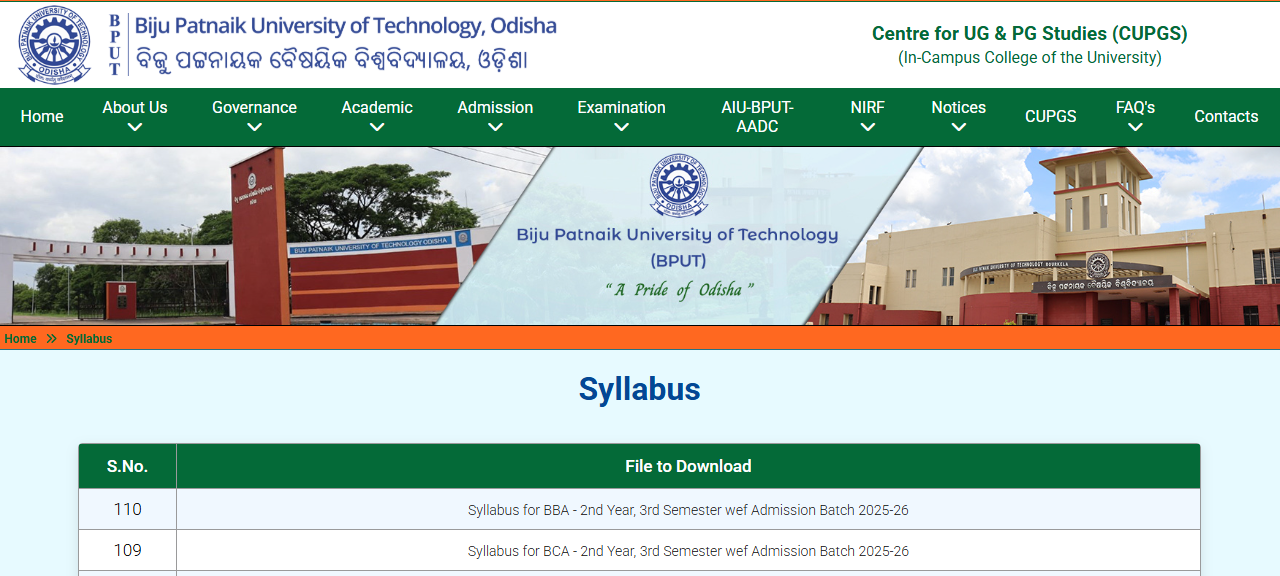
Full official documents (course structures, detailed module-wise syllabi, credit distributions, and reading lists) are available on the BPUT website (bput.ac.in/syllabus.html or /syllabus.php) and linked Google Drive PDFs. Always verify the exact document matching your admission batch, as minor updates occur. Total credits typically range around 160–180+, with theory, practicals, and project components.
Note: “Circuit branches” (e.g., CSE, Electrical, ECE) and “non-circuit branches” (e.g., Mechanical, Civil) often have swapped subject groups in the 1st year. Higher semesters become highly branch-specific with professional cores, electives (department/open), labs, seminars, and major projects/internships.
BPUT Syllabus 2026: Common First Year (Semesters 1 & 2) – Effective from 2026-27 Batch
The 1st year is largely common (with circuit/non-circuit variations). Total credits per semester: ~22.
Semester 1 (Circuit Branch example; non-circuit swaps some subjects):
- Theory: Mathematics-I (3 credits), Physics/Chemistry (3), Basic Electrical Engineering/Basic Electronics (2), Programming in C and Data Structure/Engineering Mechanics (3), Basic Civil Engineering/Basic Mechanical Engineering (2), Universal Human Values/English for Technical Writing (2).
- Practicals/Sessional: Physics/Chemistry Lab (1.5), Basic Electrical/Electronics Lab (1.5), Programming Lab/Communicative English & Report Writing Lab (1.5), Engineering Graphics & Design Lab/Workshop & Digital Manufacturing Lab (1.5), Sports/Yoga/NCC/NSS (1).
Semester 2:
- Mathematics-II, the swapped science subject (Chemistry/Physics), swapped engineering basics, and corresponding labs.
- Mathematics covers calculus (single/multivariable), linear algebra (matrices, eigenvalues), series, etc.
- Physics includes oscillations, waves/optics, electromagnetism, quantum physics, lasers.
- Similar depth in Chemistry, basic electrical/electronics circuits, programming fundamentals, mechanics, and human values/communication skills.
Detailed module objectives, contact hours, essential/supplementary readings (e.g., Kreyszig for Maths, Ghatak for Optics), and CO-PO mappings are provided in the official 1st-year PDF.
BPUT B.Tech Computer Science & Engineering (CSE) and Allied Branches Syllabus
CSE (and variants such as CSE-Data Science, AI/AI & ML, IoT, IT, CST) has frequent updates. Revised curricula exist for 3rd, 4th, and 5th semesters (admission batch 2024-25 onward). Higher semesters (6th–8th) follow 2023-24 batch structures with professional cores, electives, and projects.
Typical Progression (indicative subjects; confirm official PDFs):
- Semesters 3–4: Data Structures, Object-Oriented Programming, Discrete Mathematics, Digital Logic, Computer Organization & Architecture, Database Management Systems, Operating Systems basics, Mathematics (probability/statistics or advanced), labs in programming/DS/DBMS, and emerging topics (e.g., intro to AI/ML in specialized tracks).
- Semesters 5–6: Design & Analysis of Algorithms, Computer Networks, Software Engineering, Compiler Design, Theory of Computation, Web Technologies/Database advanced, electives (e.g., Machine Learning, Distributed Systems, Wireless Sensor Networks, Information Retrieval), labs, and mini-projects.
- Semesters 7–8: Advanced electives (AI/ML, Data Science, Cybersecurity, Cloud Computing, IoT, etc.), major project/internship, seminar, open electives, and industry-oriented courses. Specialized tracks emphasize Data Science, AI/ML, or IoT electives.
CSE emphasizes programming, algorithms, systems, and modern computing (AI, data, networks). Full module details (e.g., Compiler Design phases, lexical analysis, intermediate code; Software Engineering process models including Agile) appear in semester-specific PDFs.
BPUT B.Tech Electrical Engineering (EE) Syllabus
EE focuses on circuits, machines, power systems, control, electronics, and power electronics. Structures draw from AICTE models and BPUT updates. Higher-semester PDFs (including 7th semester for 2023-24 batch) list specific courses.
Typical Progression:
- Semesters 3–4: Electrical Circuit Analysis/Network Theory, Analog Electronics, Digital Electronics/System Design, Electrical Machines-I, Electromagnetic Fields, Signals & Systems, Mathematics, labs (circuits, electronics, machines).
- Semesters 5–6: Electrical Machines-II, Power Systems (generation/transmission/distribution), Power Electronics, Control Systems, Measurements & Instrumentation, Microprocessors/Embedded systems, labs, and electives.
- Semesters 7–8: Advanced Power Systems (protection, dynamics, HVDC/FACTS), Power System Control, Utilization of Electrical Energy, Switchgear & Protection, electives (e.g., Renewable Energy, Electric Drives, Power Quality), major project, seminar, and industrial training.
Core themes include circuit theorems, machine characteristics (DC/AC/synchronous/induction), power system analysis, control theory, and power converters. Labs reinforce theory with practical measurements and simulations.
BPUT B.Tech Mechanical Engineering (ME) Syllabus
ME covers design, thermal sciences, manufacturing, materials, and industrial engineering. 1st year is common (non-circuit orientation); higher semesters are specialized. 7th-semester syllabus is available for the 2023-24 batch.
Typical Progression:
- Semesters 3–4: Engineering Thermodynamics, Mechanics of Solids/Materials, Fluid Mechanics & Hydraulic Machines, Manufacturing Processes, Machine Drawing/CAD, Kinematics of Machines, Engineering Materials, labs (thermo, fluid, manufacturing, material testing).
- Semesters 5–6: Dynamics of Machines, Heat Transfer, IC Engines, Machine Design, Production Technology/Metal Cutting & Forming, Industrial Engineering/Quality Control, Control Systems or Mechatronics intro, labs, and electives.
- Semesters 7–8: Advanced Design (CAD/CAM/FEA), Refrigeration & Air Conditioning, Automobile Engineering, Operations Research, elective specializations (Robotics, Renewable Energy, Additive Manufacturing, etc.), major project, seminar, and internship.
Emphasis is on applied mechanics, thermal-fluid sciences, manufacturing processes, and design optimization. Workshop and CAD labs are integral from early semesters.
Key Features Across Branches
- Credits & Evaluation: Theory (University + Internal), Practicals (Internal-heavy), projects/seminars. Pass grades and CGPA conversion rules are published by BPUT.
- Electives & Flexibility: Professional electives, open electives, minors/honours (including MOOCs/SWAYAM/Coursera options), and add-on courses.
- Mandatory/Soft Skills: Universal Human Values, communication, environmental studies, sports/yoga, induction programme.
- Projects & Industry: Mini-projects, major project (often in final year), industrial training/internship.
- Updates for 2026: Students admitted in 2023–25 batches follow the corresponding revised documents. Newer batches (2025–26+) should check for further AICTE/NEP-aligned updates on the official site.
How to Download BPUT Syllabus PDF
- Visit bput.ac.in/syllabus.html or the syllabus page.
- Download PDFs for your batch and semester/branch (e.g., 1st-year 2023-24 detailed syllabus, revised CSE 3rd/4th/5th semester 2024-25, B.Tech 6th/7th semester 2023-24 branch-wise links).
- Affiliated college websites or notice boards often mirror official documents.
Recommendations for Students: Start with the official PDFs for exact modules, textbooks, and outcomes. Combine with previous years’ question papers, lab manuals, and NPTEL/SWAYAM resources. Focus on strong fundamentals in mathematics, programming (CSE), circuits/machines (EE), and mechanics/thermo (ME). Track BPUT notices for any mid-year revisions.
About The Author
