
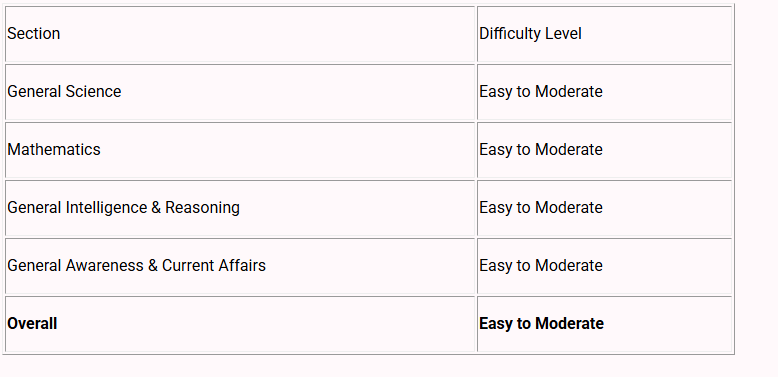
The Railway Recruitment Board (RRB) held the RRB Group D Level 1 Exam (CEN 09/2025) on 3rd, 4th, 5th, 6th, 9th, 10th, 11th, 12th, 13th and 14th August 2026. The exam was conducted in three shifts every day.
Shift 1 has already finished. The exam analysis for this shift is now available for candidates who appeared in the computer-based test. The exam is being held in many cities across India.
This analysis tells you how difficult the paper was (both overall and for each section). The computer-based test is worth 100 marks. Only those who clear this stage will move to the next round. The exam will continue till 25th August 2026. Keep checking this page for the latest exam analysis updates.
RRB Group D Exam Analysis 2026
The Railway Recruitment Board is conducting the RRB Group D exam from 3rd August to 25th August 2026. It is held in three shifts every day:
- Shift 1: 9:00 AM to 10:30 AM
- Shift 2: 12:45 PM to 2:15 PM
- Shift 3: 4:30 PM to 6:00 PM
About 58 lakh candidates are appearing for this exam to get jobs in the Indian Railways.
In this article, we share a detailed analysis of the exam based on feedback from candidates. You will find information about:
- How difficult the paper was
- How many questions are considered good attempts
- Which topics were asked in each section
Candidates can read the full RRB Group D Exam Analysis 2026 here to understand the exam pattern and the type of questions asked.
The exam is held in three shifts daily, testing candidates on General Science, Mathematics, General Intelligence & Reasoning, and General Awareness & Current Affairs. Based on candidate feedback from the completed shifts, the overall paper was rated Easy to Moderate, with some time-consuming questions in certain sections. This detailed analysis covers the difficulty level, good attempts, section-wise trends, and key observations to help candidates appearing in later shifts prepare effectively.
Check: RRB Grade B Question Paper 2026
RRB Group D Exam Analysis 2026
The RRB Group D CBT consists of 100 objective-type questions carrying a total of 100 marks, to be attempted in 90 minutes (120 minutes for eligible PwBD candidates). There is no sectional timing, allowing candidates flexibility in managing their attempt strategy. Negative marking of one-third mark applies for every incorrect answer, while unattempted questions carry no penalty. The four sections are distributed as follows: General Science (25 questions), Mathematics (25 questions), General Intelligence & Reasoning (30 questions), and General Awareness & Current Affairs (20 questions). The examination is conducted in three shifts each day, with reporting times starting early morning for the first shift. Official guidelines strictly prohibit sharing of exact questions, so analyses rely on candidate reviews regarding difficulty, topic weightage, and overall experience. The revised schedule includes exam days from 3–6 August, 9–14 August, 17–21 August, and 25 August 2026.
Candidates must reach centres well before reporting time to complete biometric verification and other formalities. Gate closing times are enforced strictly, and late entry is not permitted. The first day saw large turnouts across centres, with feedback highlighting a balanced paper that rewarded conceptual clarity and speed rather than rote learning alone. Upcoming aspirants should note the consistent Easy-to-Moderate trend observed so far and focus on accuracy to maximise scores under negative marking. This pattern is expected to continue with minor variations across remaining shifts.
RRB Group D Exam Analysis 2026: Shift Timings
Shift 1 requires reporting by 7:30 AM, with gates closing at 8:30 AM and the exam running from 9:00 AM to 10:30 AM. Shift 2 has a reporting time of 11:15 AM, gate closure at 12:15 PM, and exam duration from 12:45 PM to 2:15 PM. Shift 3 reporting is around 3:00 PM or 3:30 PM, gates close by 4:00 PM or 4:30 PM, and the exam is held from approximately 4:30/5:00 PM to 6:00/6:30 PM, depending on the exact centre notification. These timings are printed on the admit card, and candidates must follow them precisely to avoid disqualification. Early arrival is advised because of security checks, document verification, and seating arrangements. Weather and local traffic conditions on exam day can affect travel, so candidates should plan accordingly and carry only permitted items. The multi-shift format helps accommodate the large number of applicants while maintaining fairness through normalisation later.
RRB Group D 14th August Exam Analysis 2026
The RRB Group D exam on 14th August was held in three shifts. Candidates gave mixed reactions. Overall, the paper was moderately tough.
Reasoning was easy for most students, while Maths was a bit difficult. The exam had a mix of easy, moderate, and hard questions across all shifts.
RRB Group D 13th August Exam Analysis 2026
As per student feedback, the RRB Group D exam on 13th August was moderately tough. Many candidates found Reasoning and General Awareness a little difficult. Maths and General Science were comparatively easier, though some Reasoning questions needed extra thinking.
Stay tuned to this page for more updates.
RRB Group D 12th August Exam Analysis 2026
The RRB Group D exam on 12th August was conducted in three shifts. According to the analysis received so far, the paper was moderately tough and contained a mix of easy, moderate, and difficult questions in every shift.
More detailed difficulty updates will be added soon.
RRB Group D 11th August Exam Analysis 2026
Candidates appearing for the RRB Group D 2026 exam can check shift-wise student reviews on this page. After every shift, our experts collect feedback and share the analysis here.
The exam consists of 100 multiple-choice questions to be solved in 90 minutes. There is negative marking of 1/3 mark for every wrong answer.
RRB Group D 10th August Exam Analysis 2026
After each shift of the RRB Group D exam on 10th August, experts collected student feedback. Candidates found the paper moderately tough with a mix of questions.
This analysis helps future candidates understand the expected pattern. As per the official schedule, CBT 1 is being held over 16 days (3rd to 25th August 2026) in a total of 48 shifts (3 shifts per day).
RRB Group D 9th August Exam Analysis 2026
The Railway Recruitment Board successfully conducted the RRB Group D exam on 9th August 2026 at centres across the country.
According to students who appeared, the paper was moderately tough and had a mix of easy, moderate, and difficult questions. A total of 100 multiple-choice questions were asked in every shift.
RRB Group D 6th August Exam Analysis 2026
The RRB Group D exam on 6th August is over. The paper had a mix of moderate and difficult questions.
- Shifts 1 and 3 were mostly moderate.
- Shift 2 felt tougher for many students.
Reasoning and General Awareness were manageable. The Science section was harder, and Maths was very challenging. Most students could attempt only 51–61 questions with good accuracy. Overall, the exam was balanced but tiring. Good speed and accuracy were needed to score well.
RRB Group D 5th August Exam Analysis 2026
Student feedback shows that the difficulty level varied across shifts on 5th August:
- Shift 1: Moderate. Reasoning and General Awareness were a bit tough. Most candidates made around 70–80 good attempts.
- Shifts 2 & 3: Easy to moderate. Maths and General Science were easier, but some Reasoning questions still needed extra thinking. Students managed around 60–64 good attempts.
Overall, Shift 1 felt slightly tougher, while Shifts 2 and 3 were smoother but still had some tricky parts.
RRB Group D 4th August Exam Analysis 2026
Candidates who appeared on 4th August found the paper moderately difficult overall.
- Reasoning was scoring and less time-consuming.
- Maths had lengthy calculation-based questions.
- General Science was manageable with a mix of basic and moderate questions.
- In General Awareness, Current Affairs formed an important part.
As per early feedback, around 63–73 good attempts can be considered decent for Shift 1.
RRB Group D Exam Analysis 2026: Overall Difficulty Level of Today’s Exam (3rd August 2026)
Candidates who appeared in the first two shifts described the paper as Easy to Moderate overall. Reasoning emerged as the relatively easier section for many, while Mathematics and General Science contained a mix of straightforward and slightly lengthy calculations or conceptual questions. General Awareness & Current Affairs required familiarity with recent events and static topics, making it moderately challenging for those who had not revised recent affairs thoroughly. Time management played a key role because some questions, especially in Maths and Science, demanded careful reading and calculation. The absence of sectional timers allowed strong candidates to finish easier sections quickly and allocate extra time to tougher ones. Feedback indicated that a balanced attempt with high accuracy was more valuable than attempting every question. This difficulty level is consistent with previous Group D patterns but with updated current-affairs emphasis.
RRB Group D Exam Analysis 2026 – Shift 1 (3rd August)
The first shift (9:00 AM–10:30 AM) was rated Easy to Moderate by the majority of candidates. General Intelligence & Reasoning stood out as the easiest section, while the other three sections fell in the Easy-to-Moderate range. Many aspirants reported that questions were largely concept-based and aligned with the standard syllabus. A few time-consuming problems appeared in Mathematics and Physics portions of General Science. Overall, candidates who maintained composure and prioritised accuracy felt the paper was manageable within the allotted time. Good attempts in this shift are estimated in the range of 69–77 questions with high accuracy. This review helps later-shift candidates understand the expected level and adjust their strategy accordingly.
Section-wise Difficulty Level – Shift 1
General Science was Easy to Moderate, with Biology questions generally accessible and Physics and Chemistry requiring clearer conceptual understanding. Mathematics remained Easy to Moderate, featuring arithmetic topics such as percentages, ratios, time and work, and simplification that most candidates found familiar. General Intelligence & Reasoning was Easy, dominated by coding-decoding, analogy, series, and basic logical puzzles that could be solved quickly. General Awareness and Current Affairs was Easy to Moderate, mixing static GK with recent national and international events from 2025–2026. The overall balance favoured candidates who had practised previous-year patterns and stayed updated on current affairs. Candidates noted that careful reading prevented silly mistakes under the negative-marking scheme.
Good Attempts – Shift 1
In General Science (25 questions), a good attempt range was approximately 18–20 questions. Mathematics (25 questions) saw good attempts around 17–19. General Intelligence & Reasoning (30 questions) allowed 20–22 solid attempts for most. General Awareness and Current Affairs (20 questions) had a good-attempt range of 14–16. Collectively, total good attempts of 69–77 with accuracy above 85–90 percent placed candidates in a competitive position for the next stage. These numbers are based on candidate feedback and expert review; actual safe scores will depend on normalisation across shifts. Aspirants should focus on maximising correct answers rather than attempting the maximum number of questions.
RRB Group D Exam Analysis 2026 – Shift 2 (3rd August)
The second shift (12:45 PM–2:15 PM) also received an Easy-to-Moderate rating from candidates. The paper structure and topic distribution closely mirrored the first shift, with only minor variations in specific question types. Reasoning remained relatively approachable, though some candidates found it slightly more moderate than in Shift 1. Mathematics and General Science continued to include a mix of direct and calculation-based items. Overall feedback suggested that candidates who had analysed the morning shift found the afternoon paper predictable and manageable. Time pressure was similar, rewarding those who practised speed and accuracy under exam conditions. This consistency across the first two shifts is a positive indicator for remaining candidates.
Section-wise Difficulty Level – Shift 2
General Science stayed Easy to Moderate, with Biology questions continuing to be more scoring and Physics questions demanding extra attention. Mathematics retained its Easy-to-Moderate character, focusing on arithmetic and elementary algebra or mensuration. General Intelligence & Reasoning was Easy to Moderate, with a few questions requiring careful logical steps compared with the morning shift. General Awareness and Current Affairs remained Easy to Moderate, testing both static knowledge and recent developments. Candidates reported that the overall balance was fair and that no section was disproportionately difficult. Those who revised high-weightage topics from the syllabus performed comfortably. The pattern reinforces the importance of thorough NCERT-level preparation for Science and regular current-affairs updates.
RRB Group D Exam Analysis 2026: Good Attempts
The expected good attempts for each section help candidates evaluate their performance and understand the safe attempt range. The data will be updated here as soon as the official and student feedback is received for all shifts.
| Sections | Number of Questions | Good Attempts |
| General Science | 25 | 18-20 |
| Mathematics | 25 | 20-25 |
| General Intelligence and Reasoning | 30 | 20-25 |
| General Awareness and Current Affairs | 20 | 22-23 |
| Total | 100 | 90-100 |
Expected Topics and Trends Across Sections
In General Science, Biology questions on human physiology, plants, and basic life processes were common and relatively easier, while Physics covered laws of motion, electricity, and optics at a moderate level, and Chemistry included basic reactions and properties. Mathematics emphasised simplification, percentage, ratio and proportion, time and work, profit and loss, and simple interest, with fewer advanced geometry or trigonometry items. Reasoning featured coding-decoding, analogy, odd-one-out, blood relations, direction sense, and simple puzzles. General Awareness combined static topics such as history, polity, and geography with current affairs covering national schemes, sports, awards, and international events from recent months. These trends are drawn from candidate recollections and align with the official syllabus. Future shifts are likely to follow a similar distribution with possible variations in exact questions.
Key Takeaways for Upcoming Shifts and Candidates
Candidates appearing in Shift 3 today or on subsequent days should treat the paper as Easy to Moderate and prioritise accuracy over volume of attempts. Strong performance in Reasoning can provide a scoring cushion, while consistent practice in Mathematics and Science will help manage time-consuming questions. Regular revision of current affairs from 2025–2026 remains essential for the General Awareness section. Time management without sectional limits requires a clear attempt order based on individual strengths. After the exam, candidates should await the official answer key and raise objections if needed within the stipulated window. Normalisation will be applied across shifts to ensure fairness. Overall, a calm approach, conceptual clarity, and high accuracy remain the best strategy for clearing the CBT and progressing to the Physical Efficiency Test (PET) stage.
This analysis is compiled from candidate feedback and educational portals reporting on the day’s examination. It will be updated as more detailed reviews from all shifts become available. Aspirants are advised to continue systematic preparation and stay updated through official RRB websites for further notifications on answer keys, results, and subsequent stages.
RRB Group D Exam Analysis 2026: FAQs
Q1. What was the overall difficulty level of RRB Group D 2026 exam?
The overall difficulty level of the exam was easy to moderate in most shifts, although some shifts were reported as moderate to slightly difficult depending on question patterns and time pressure.
Q2. Which section was the toughest in RRB Group D 2026?
- Mathematics: Slightly time-consuming and calculative
- General Awareness (GA): Moderate to difficult due to current affairs
- General Science: Moderate (NCERT-based)
- Reasoning: Mostly easy and scoring
Overall, GA + Maths were considered the most challenging sections.
Q3. What were the good attempts in RRB Group D 2026?
- Easy shifts: 75–85 questions
- Moderate shifts: 70–75 questions
- Tough shifts: 65–72 questions
A good attempt depends on accuracy, but 70+ attempts with high accuracy is considered safe.
Q4. Was the paper lengthy in 2026?
Yes, in some shifts candidates reported the paper as slightly lengthy, especially due to:
- Calculation-heavy maths
- Time-consuming reasoning questions
However, overall it was manageable with proper time management.
Q5. What type of questions were asked in General Science?
General Science questions were mostly:
- Based on Class 10 NCERT concepts
- Covered Physics, Chemistry, Biology basics
- Included factual + conceptual questions
This section was scoring for well-prepared candidates.
Q6. What topics were asked in Reasoning section?
Common topics included:
- Coding-Decoding
- Syllogism
- Analogy
- Series
- Blood Relation
- Direction Sense
Most questions were easy to moderate and predictable.
Q7. How important was Current Affairs in 2026 exam?
Very important.
- GA section had significant weightage of current affairs (2025–2026)
- Static GK + current events both were asked
Candidates with strong current affairs performed better.
Q8. Were questions repeated in different shifts?
Yes, many candidates reported:
- Repeated questions from previous shifts
- Similar pattern questions
Practicing previous papers helped save time.
Q9. How many shifts were conducted per day?
The exam was conducted in 3 shifts daily:
- Shift 1: Morning
- Shift 2: Afternoon
- Shift 3: Evening
Q10. What is the key takeaway from RRB Group D 2026 analysis?
- Exam is not very difficult but highly competitive
- Speed + accuracy + current affairs = success
- Practicing mock tests and previous papers is essential
Q11. When was the RRB Group D 2026 exam conducted?
The CBT exam was conducted over multiple dates from November 2025 to February 2026 to accommodate a large number of candidates.
Q12. What should candidates focus on for future exams?
- Revise NCERT Science (Class 10)
- Prepare last 6–8 months current affairs
- Practice Maths speed questions
- Solve previous year papers & mock tests
About The Author
