
Israel has a network of diplomatic, military, economic and strategic relationships stretching across North America, Europe, Asia, Latin America and parts of Africa. However, the phrase “support Israel” can mean different things. Some countries provide military assistance, some strongly defend Israel at international forums, while others maintain diplomatic and economic relations but openly criticize Israeli policies.
As of September 2026, the picture is more complicated than a simple list of “pro-Israel” and “anti-Israel” countries. The United States remains Israel’s most important military partner, while Germany continues to describe its relationship with Israel as unique and historically rooted. Greece has recently deepened defence cooperation with Israel through a major €3 billion air-defence agreement. Argentina under President Javier Milei has also developed particularly close political ties with Israel.
At the same time, several traditional Western partners—including the UK, Canada and European countries—have become more critical of Israeli actions in Gaza and the West Bank.
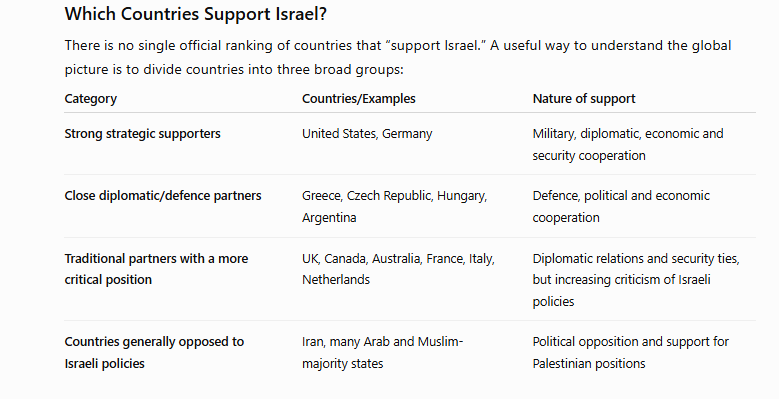
Which Countries Support Israel?
There is no single official ranking of countries that “support Israel.” A useful way to understand the global picture is to divide countries into three broad groups:
| Category | Countries/Examples | Nature of support |
|---|---|---|
| Strong strategic supporters | United States, Germany | Military, diplomatic, economic and security cooperation |
| Close diplomatic/defence partners | Greece, Czech Republic, Hungary, Argentina | Defence, political and economic cooperation |
| Traditional partners with a more critical position | UK, Canada, Australia, France, Italy, Netherlands | Diplomatic relations and security ties, but increasing criticism of Israeli policies |
| Countries generally opposed to Israeli policies | Iran, many Arab and Muslim-majority states | Political opposition and support for Palestinian positions |
The important point is that support for Israel’s right to exist is not necessarily the same as support for every decision made by the Israeli government.
1. United States – Israel’s Most Important Ally
The United States is by far Israel’s most important international strategic partner.
The relationship extends across:
- Military assistance
- Missile defence
- Intelligence sharing
- Advanced weapons
- Diplomatic cooperation
- Counterterrorism
- Technology
- Defence research
- Regional security
According to SIPRI, the US accounted for approximately 68% of Israel’s major arms imports during 2021–25, making it overwhelmingly Israel’s largest supplier. Germany was a distant second at 31%.
However, American support is not completely uniform. Political divisions within the US have grown considerably over Israel’s military operations and humanitarian situation in Gaza. A Reuters report in July 2026 noted that support for Israel has become increasingly contentious within the Democratic Party, with nearly half of House Democrats recently voting for a measure to reduce military assistance.
Why does the US support Israel?
The relationship is based on several factors:
- Long-standing strategic cooperation.
- Israel’s importance to US Middle East policy.
- Intelligence and counterterrorism cooperation.
- Shared defence and technological interests.
- Strong political and historical ties.
- Domestic political support for the US-Israel relationship.
So, while American public opinion and political debate are changing, the US remains Israel’s central international ally.
2. Germany – One of Israel’s Strongest European Partners
Germany occupies a particularly important position in Israel’s international network.
The German government describes its relationship with Israel as a “unique relationship”, rooted partly in Germany’s responsibility for the Holocaust. Diplomatic relations between the two countries were established in 1965.
Germany has repeatedly emphasized Israel’s right to exist and has maintained substantial security and defence cooperation.
SIPRI estimates that Germany supplied around 31% of Israel’s major arms imports during 2021–25, making it Israel’s second-largest supplier after the United States.
In 2026, Germany has continued to publicly emphasize its support for Israel while simultaneously criticizing certain Israeli policies. Chancellor Friedrich Merz’s government has stressed that Germany stands by Israel while also calling for a negotiated two-state solution and expressing concern over Israeli settlement expansion and the humanitarian situation in Gaza.
This makes Germany an interesting example: strongly supportive of Israel’s security and existence, but not uncritical of the Israeli government’s policies.
3. Greece – A Growing Defence Partner
Greece has developed increasingly close defence and strategic relations with Israel.
The relationship received a major boost in August 2026 when Israel and Greece signed an approximately €3 billion defence agreement.
Under the deal, Israel will build a comprehensive multi-layered air-defence system for Greece known as the Achilles Shield. It includes Israeli systems such as David’s Sling, SPYDER and BARAK MX.
The agreement is significant because it demonstrates that Israel’s defence industry is also becoming an important component of the security strategies of other countries.
Why is Greece cooperating with Israel?
The two countries share interests in:
- Eastern Mediterranean security
- Defence technology
- Air defence
- Energy cooperation
- Intelligence
- Regional security
Greece’s relationship with Israel therefore goes beyond political statements—it includes substantial defence cooperation.
4. Argentina – One of Israel’s Closest Partners in Latin America
Argentina has become one of Israel’s most supportive partners in Latin America under President Javier Milei.
In August 2026, Milei reaffirmed Argentina’s strategic relationship with Israel and expressed support for Israel’s right to defend itself under international law.
Earlier in April 2026, Argentina and Israel launched the Isaac Accords, a framework intended to increase cooperation in areas including:
- Counterterrorism
- Security
- Technology
- Trade
- Innovation
- Combating antisemitism
- Opposition to Iranian influence
The agreement is designed to bring together Israel, Argentina and other countries that share similar strategic and political priorities.
Argentina therefore stands out as one of Israel’s strongest political supporters in Latin America.
5. Czech Republic – A Consistently Friendly European Partner
The Czech Republic has traditionally maintained a relatively friendly position toward Israel compared with several other European countries.
Its relationship with Israel includes:
- Diplomatic cooperation
- Defence cooperation
- Economic relations
- Technology
- Security cooperation
The Czech Republic has also appeared among countries supplying military-related goods to Israel. World Bank trade data shows Czech exports of arms and ammunition to Israel in 2025.
However, Czech support should still be understood as support for Israel’s security and bilateral relationship rather than automatic endorsement of every Israeli government policy.
6. Hungary – A Strong Political Supporter
Hungary has generally maintained a particularly close political relationship with Israel within the European Union.
Prime Minister Viktor Orbán has frequently taken positions sympathetic to Israel and has emphasized:
- Israel’s right to defend itself
- Opposition to terrorism
- Strong bilateral relations
- Cooperation against antisemitism
Hungary’s position is notably different from several Western European governments that have become increasingly critical of Israeli policies.
7. Australia – A Traditional Ally, but With a More Nuanced Position
Australia has historically maintained close relations with Israel and cooperates with it in areas including defence, intelligence, trade and technology.
However, Australia’s position has become more nuanced as the Gaza conflict has continued.
Like several other Western countries, Australia has simultaneously:
- Recognized Israel’s security concerns
- Condemned Hamas attacks
- Called for humanitarian assistance to Palestinians
- Supported a two-state solution
- Criticized settlement activity and aspects of Israeli policy
Australia is therefore better described as a traditional partner with a more balanced and increasingly critical diplomatic position, rather than an unconditional supporter.
8. Canada – Historically Close, but Increasingly Critical
Canada has traditionally been an important Western partner of Israel.
The two countries have extensive economic and diplomatic relations, and Canada has historically supported Israel’s security.
However, Canada’s position has shifted substantially amid the Gaza conflict.
This illustrates why simply putting Canada into a “countries supporting Israel” list can be misleading. A country can maintain strong diplomatic relations with Israel while simultaneously opposing particular military actions or government policies.
9. United Kingdom – From Traditional Ally to Increasingly Critical Partner
The UK has historically been one of Israel’s important Western partners.
The relationship includes:
- Defence
- Intelligence
- Trade
- Diplomatic cooperation
- Counterterrorism
But relations have deteriorated sharply in 2026.
The UK government has become increasingly critical of Israeli settlement expansion and policies in the West Bank. Britain has also considered additional measures against Israeli settlement-related activities.
At the same time, Britain continues to cooperate with Israel on security and regional issues.
Therefore, the UK is not accurately described as simply “pro-Israel” or “anti-Israel.” It remains a major diplomatic and security partner while taking a much harder position against certain Israeli government policies.
10. Italy – A Partner With Growing Reservations
Italy has historically maintained good diplomatic relations with Israel.
Rome cooperates with Israel in areas such as:
- Trade
- Defence
- Technology
- Security
- Research
But Italy has also joined other European countries in criticizing Israeli settlement expansion and expressing concern about the situation in the Palestinian territories.
In May 2026, Italy was among countries joining a joint statement warning about the situation in the West Bank and opposing settlement development.
Thus, Italy remains an important partner but is not an unconditional supporter of Israeli government policies.
11. France – Diplomatic Relations but Increasingly Critical
France has maintained diplomatic relations with Israel for decades and recognizes Israel’s right to security.
However, Paris has increasingly criticized Israeli policies concerning:
- Gaza
- Humanitarian access
- West Bank settlements
- Palestinian statehood
- Civilian protection
France has therefore moved closer to the position of several European countries that distinguish between support for Israel’s existence and security and support for the policies of its current government.
Countries That Have Supported Israel in Different Ways
A broader list of countries with significant diplomatic, defence, economic or political links with Israel includes:
| Country | Relationship with Israel in 2026 | General character |
|---|---|---|
| 🇺🇸 United States | Very strong | Strategic and military ally |
| 🇩🇪 Germany | Very strong | Historical, diplomatic and defence partnership |
| 🇬🇷 Greece | Strong | Growing defence partnership |
| 🇦🇷 Argentina | Very strong politically | Strategic and political partnership |
| 🇭🇺 Hungary | Strong | Strong political support |
| 🇨🇿 Czech Republic | Strong | Diplomatic and defence cooperation |
| 🇦🇺 Australia | Strong but nuanced | Security and diplomatic partnership |
| 🇨🇦 Canada | Traditional partner | Increasingly critical |
| 🇬🇧 UK | Traditional partner | Security ties but major policy disagreements |
| 🇮🇹 Italy | Diplomatic partner | Cooperation plus criticism |
| 🇫🇷 France | Diplomatic partner | Increasingly critical |
| 🇳🇱 Netherlands | Diplomatic/economic partner | Increasing criticism of settlement policy |
| 🇵🇱 Poland | Diplomatic partner | Complex relationship |
| 🇷🇴 Romania | Diplomatic/defence ties | Significant military-related trade |
| 🇮🇳 India | Strategic partner | Defence, technology and trade |
| 🇨🇾 Cyprus | Regional partner | Energy and security cooperation |
What About India?
India deserves special attention because its relationship with Israel has expanded dramatically over the past few decades.
India and Israel cooperate in:
- Defence
- Agriculture
- Water management
- Cybersecurity
- Technology
- Innovation
- Counterterrorism
India has also been an important source of military-related goods entering Israel. An investigation published in 2026 identified India as the second-largest source of military-related goods entering Israel in the period examined, behind the United States.
However, India’s foreign policy remains distinct from that of the United States or Argentina. India maintains relations with Israel while also maintaining important relationships with Arab countries and supporting a negotiated two-state solution.
So India is best described as a strategic partner of Israel rather than an unconditional political supporter.
Why Do Countries Support Israel?
Different countries have different reasons. There is no single explanation.
1. Security and Defence
Israel has a highly developed defence industry, particularly in:
- Missile defence
- Drones
- Cybersecurity
- Radar
- Intelligence
- Air defence
- Surveillance
Countries interested in these technologies have strong incentives to maintain relations with Israel.
The new Greece-Israel €3 billion defence agreement is a good example of this trend.
2. Counterterrorism Cooperation
Israel has extensive experience dealing with armed groups and security threats. Some countries therefore cooperate with Israel on intelligence and counterterrorism.
3. Technology
Israeli companies are active in areas such as:
- Cybersecurity
- Artificial intelligence
- Agriculture
- Water technology
- Medical technology
- Defence technology
This creates commercial reasons for countries to maintain strong relationships.
4. Historical Factors
Germany’s relationship with Israel is particularly influenced by the Holocaust and Germany’s historical responsibility.
The German government explicitly describes Israel’s security and right to exist as important elements of its foreign policy.
5. Geopolitical Interests
Some countries see Israel as an important strategic partner because of its position in the Middle East.
The relationship can provide benefits in:
- Intelligence
- Regional security
- Defence
- Technology
- Energy
- Diplomacy
Is the World Becoming More Pro-Israel or Less Pro-Israel?
This is where the picture becomes complicated.
Israel continues to have powerful allies, especially the United States and Germany, and it has recently strengthened strategic relationships with countries such as Greece and Argentina.
But international criticism of Israeli policies has also increased.
A 2026 Pew Research Center survey found unfavorable views of Israel in many countries surveyed. For example, 60% of Americans surveyed expressed an unfavorable view of Israel, while the figures were 73% in Germany, 75% in Italy, 76% in the Netherlands and 78% in both Spain and Sweden.
This doesn’t necessarily mean these populations support Hamas or oppose Israel’s existence. It demonstrates that public attitudes toward the Israeli government and its actions have become much more negative in many countries.
Countries Supporting Israel vs Supporting Israeli Policies
This distinction is extremely important.
A country may:
Support Israel’s existence
but oppose Israeli settlement expansion.
A country may:
Support Israel’s right to self-defence
but demand greater protection for Palestinian civilians.
A country may:
Trade with Israel and cooperate militarily
but vote for Palestinian-related resolutions at the United Nations.
Therefore, a simple “Israel allies list” can hide important differences.
Israel’s Strongest International Supporters in 2026
If we are looking specifically at the strength and depth of the relationship, the following countries stand out:
Tier 1 – Core strategic supporters
- United States
- Germany
Tier 2 – Strong strategic and political partners
- Argentina
- Greece
- Hungary
- Czech Republic
Tier 3 – Important partners with more independent policies
- India
- Australia
- Italy
- Canada
- United Kingdom
- France
- Netherlands
- Romania
- Cyprus
This is not an official ranking. It is a practical way of comparing the depth and character of countries’ relationships with Israel.
Frequently Asked Questions
Which country supports Israel the most?
The United States is Israel’s most important international supporter, particularly in military, defence and strategic terms. It supplied about 68% of Israel’s major arms imports during 2021–25.
Is Germany a supporter of Israel?
Yes. Germany strongly supports Israel’s right to exist and maintains close diplomatic and defence relations with it. At the same time, Germany has criticized Israeli settlement policies and called for a two-state solution.
Does Greece support Israel?
Greece maintains a close and increasingly important strategic relationship with Israel. In August 2026, the two countries signed a roughly €3 billion air-defence agreement.
Does Argentina support Israel?
Yes. Argentina under President Javier Milei has developed particularly close relations with Israel. Milei has publicly reaffirmed support for Israel’s right to self-defence, while the two countries launched the Isaac Accords in 2026.
Does India support Israel?
India is a major strategic partner of Israel, particularly in defence, technology, agriculture and security. However, India’s foreign policy is independent and it also maintains strong relations with Arab countries and supports a two-state solution.
Is the UK still an ally of Israel?
The UK remains an important diplomatic and security partner of Israel, but relations have become considerably more difficult. Britain has taken increasingly critical positions on Israeli settlement expansion and the Gaza conflict.
Does supporting Israel mean supporting the Israeli government?
No. Countries can support Israel’s existence and security while opposing specific actions by the Israeli government. This distinction is particularly important when comparing European countries in 2026.
Final Takeaway
The international picture surrounding Israel in 2026 is far more complicated than a simple list of countries that support or oppose it.
The United States remains Israel’s central strategic ally, while Germany continues to maintain a uniquely close relationship rooted in historical responsibility. Greece is deepening defence cooperation, and Argentina has emerged as one of Israel’s strongest political supporters in Latin America. India remains an important strategic and defence partner.
At the same time, traditional partners such as the UK, France, Italy, Canada and Australia have become more critical of Israeli policies, particularly concerning Gaza and settlements in the West Bank.
In other words, Israel still has powerful allies around the world, but support for Israel’s security should not automatically be interpreted as support for every policy of the Israeli government. That distinction is essential for understanding the current global geopolitical landscape.
About The Author
