
When we hear the word desert, most of us imagine endless sand dunes, scorching temperatures and camels walking across a dry landscape. But geography has a surprising answer: the largest desert in the world is not hot and sandy—it is Antarctica.
A desert is primarily defined by its extremely low precipitation, not by high temperature. That is why the frozen Antarctic landscape qualifies as a desert. In fact, both Antarctica and the Arctic are larger than the Sahara when deserts are ranked by total area. The Sahara Desert, however, is the largest hot desert in the world.
Largest Desert in the World 2026
The Antarctic Desert is the largest desert on Earth, covering roughly 14.2 million square kilometres. It occupies virtually the entire Antarctic continent and is classified as a polar desert because of its extremely low precipitation.
The Arctic Desert comes second, followed by the Sahara Desert. Current 2026 rankings generally place the Sahara at around 9.1–9.2 million square kilometres, although the exact figure can vary depending on how desert boundaries are defined.
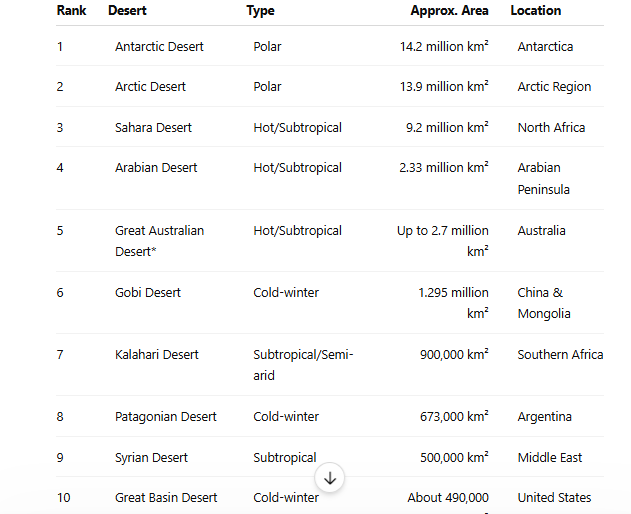
Top 10 Largest Deserts in the World 2026
| Rank | Desert | Type | Approx. Area | Location |
|---|---|---|---|---|
| 1 | Antarctic Desert | Polar | 14.2 million km² | Antarctica |
| 2 | Arctic Desert | Polar | 13.9 million km² | Arctic Region |
| 3 | Sahara Desert | Hot/Subtropical | 9.2 million km² | North Africa |
| 4 | Arabian Desert | Hot/Subtropical | 2.33 million km² | Arabian Peninsula |
| 5 | Great Australian Desert* | Hot/Subtropical | Up to 2.7 million km² | Australia |
| 6 | Gobi Desert | Cold-winter | 1.295 million km² | China & Mongolia |
| 7 | Kalahari Desert | Subtropical/Semi-arid | 900,000 km² | Southern Africa |
| 8 | Patagonian Desert | Cold-winter | 673,000 km² | Argentina |
| 9 | Syrian Desert | Subtropical | 500,000 km² | Middle East |
| 10 | Great Basin Desert | Cold-winter | About 490,000 km² | United States |
*The term Great Australian Desert is sometimes used collectively for Australia’s major desert regions, so rankings can differ depending on the classification used. Different sources also use slightly different boundaries and area estimates.
1. Antarctic Desert – Largest Desert in the World
Area: Approximately 14.2 million km²
Type: Polar desert
Location: Antarctica
The Antarctic Desert holds the title of the largest desert in the world. This may seem strange because Antarctica is covered largely by ice, but the definition of a desert is based on precipitation rather than temperature.
Antarctica receives extremely little precipitation, particularly in its interior. Much of the continent is therefore considered a polar desert. The landscape is dominated by massive ice sheets, glaciers and barren rock rather than traditional sand dunes.
Another remarkable fact is that Antarctica is also the coldest continent on Earth. Its harsh environment makes it difficult for most plants and animals to survive, although species such as penguins, seals and various microorganisms have adapted to the extreme conditions.
2. Arctic Desert
Area: Approximately 13.7–13.9 million km²
Type: Polar desert
Location: Arctic region
The Arctic Desert is the second-largest desert on Earth. It stretches across the high-latitude Arctic region, including parts of Greenland, Canada, Russia and other northern territories.
Unlike the Sahara, the Arctic does not have huge expanses of hot sand. Instead, it is characterised by ice, snow, frozen ground and extremely low precipitation.
The Arctic environment supports specially adapted wildlife, including polar bears, Arctic foxes, seals and several species of seabirds.
3. Sahara Desert
Area: Approximately 9.2 million km²
Type: Hot subtropical desert
Location: North Africa
The Sahara Desert is the largest hot desert in the world and the third-largest desert overall.
It stretches across much of North Africa and covers parts of countries including Algeria, Egypt, Libya, Mali, Mauritania, Morocco, Niger, Chad, Sudan and Tunisia.
The Sahara is famous for its huge sand dunes, but it is important to remember that not the entire desert is covered in sand. Large areas consist of rocky plateaus, gravel plains and dry valleys.
The Sahara’s size is enormous—its area is comparable to that of a major country or region. It is also one of the most recognisable geographical features on the African continent.
4. Arabian Desert
Area: Approximately 2.33 million km²
Type: Hot subtropical desert
Location: Arabian Peninsula
The Arabian Desert occupies much of the Arabian Peninsula and extends across several countries, including Saudi Arabia, Oman, Yemen, the United Arab Emirates, Jordan and Iraq.
One of its most famous regions is the Rub’ al Khali, or Empty Quarter. It is known for enormous sand dunes and extremely dry conditions.
Despite its harsh climate, the Arabian Desert is not completely lifeless. Various reptiles, birds, insects and desert-adapted mammals live in the region.
5. Great Australian Desert
Area: Up to approximately 2.7 million km²
Type: Hot and subtropical desert region
Location: Australia
Australia is home to a large collection of desert landscapes, which are sometimes collectively described as the Great Australian Desert.
The region includes several individual deserts, such as the Great Victoria, Great Sandy, Gibson and Tanami deserts.
Australia’s interior is famous for its dry climate, sparse vegetation and dramatic landscapes. However, these deserts are not simply endless sand dunes. Many areas contain rocky surfaces, grasslands, shrubs and red-earth landscapes.
Because different geographical classifications treat Australia’s deserts differently, the ranking of the Great Australian Desert can vary between lists.
6. Gobi Desert
Area: Approximately 1.295–1.3 million km²
Type: Cold-winter desert
Location: Mongolia and northern China
The Gobi Desert is one of Asia’s best-known deserts. It stretches across southern Mongolia and northern China.
Unlike the popular image of a desert filled with sand dunes, much of the Gobi consists of rocky and gravel-covered terrain.
The Gobi experiences dramatic temperature variations. Winters can be extremely cold, while summers can become quite hot. The region is also famous for its importance in palaeontology, with numerous dinosaur fossils discovered there.
7. Kalahari Desert
Area: Approximately 900,000 km²
Type: Subtropical/semi-arid
Location: Southern Africa
The Kalahari Desert covers large parts of Botswana, Namibia and South Africa.
Although commonly called a desert, some parts of the Kalahari receive more rainfall than extremely dry deserts such as the Sahara. Seasonal rainfall allows grasses and other vegetation to grow in many areas.
The Kalahari is particularly well known for its wildlife, including lions, cheetahs, meerkats and various antelope species.
8. Patagonian Desert
Area: Approximately 673,000 km²
Type: Cold-winter desert
Location: Argentina
The Patagonian Desert is the largest desert in South America by many commonly used rankings.
It lies mainly in Argentina and is influenced strongly by the Andes Mountains. The mountain range creates a rain-shadow effect, reducing precipitation on the eastern side.
Unlike the hot deserts of North Africa, Patagonia can experience cold temperatures and strong winds. Its landscape includes plateaus, rocky terrain and sparse vegetation.
9. Syrian Desert
Area: Approximately 500,000 km²
Type: Subtropical desert
Location: Syria, Jordan, Iraq and Saudi Arabia
The Syrian Desert occupies a large part of the Middle East. It stretches across several modern countries and forms an important geographical zone between the more fertile areas of the region.
The landscape includes rocky plains, gravel surfaces and scattered vegetation. Despite its name, the desert is not confined to Syria.
Its climate is characterised by very hot summers, relatively cold winters and limited rainfall.
10. Great Basin Desert
Area: Approximately 490,000 km²
Type: Cold-winter desert
Location: Western United States
The Great Basin Desert is the largest desert in the United States when considered as a broad cold-desert region.
It covers much of Nevada and extends into parts of neighbouring states. Unlike the classic image of a hot desert, the Great Basin experiences cold winters and can receive snowfall.
The region contains mountain ranges, dry valleys, salt flats and distinctive desert vegetation. The famous Great Basin bristlecone pine, among the world’s oldest living trees, is associated with the region.
Why Is Antarctica Called a Desert?
This is one of the most common questions about the world’s largest desert.
The answer is simple: deserts are defined mainly by a lack of precipitation, not by temperature.
A desert can therefore be extremely hot, moderately cold or completely frozen. Antarctica receives very little precipitation across much of its interior, making it a polar desert.
This is also why the Arctic can appear on lists of the world’s largest deserts. The two polar deserts are so large that they rank above the Sahara when total area is considered.
Largest Desert vs Largest Hot Desert
There is often confusion between these two terms.
| Category | Desert | Approx. Area |
|---|---|---|
| Largest desert overall | Antarctic Desert | 14.2 million km² |
| Second-largest desert | Arctic Desert | 13.9 million km² |
| Largest hot desert | Sahara Desert | 9.2 million km² |
| Largest desert in South America | Patagonian Desert | 673,000 km² |
| Major desert region of Australia | Great Australian Desert | Up to 2.7 million km² |
So, if a question asks “Which is the largest desert in the world?”, the answer is Antarctic Desert.
If the question asks “Which is the largest hot desert in the world?”, the answer is Sahara Desert.
How Are Deserts Formed?
Deserts can develop for several different geographical and climatic reasons.
1. High-pressure zones
Some of the world’s major hot deserts occur around subtropical high-pressure belts. Descending air in these areas makes cloud formation and rainfall less likely.
2. Rain-shadow effect
Mountains can block moisture-laden winds. As air rises over a mountain range, it loses moisture. The area on the opposite side may consequently become extremely dry.
The Patagonian Desert is an important example of a desert influenced by this process.
3. Distance from oceans
Some inland regions are so far from major sources of moisture that very little precipitation reaches them.
4. Cold conditions
Polar regions can also qualify as deserts because extremely cold air holds little moisture. Antarctica demonstrates how a place can be both icy and exceptionally dry.
Interesting Facts About the World’s Largest Deserts
- Antarctica is the world’s largest desert, even though it is covered mostly by ice.
- The Sahara is the largest hot desert on Earth.
- The Arctic is also classified as a polar desert.
- Deserts are found on every continent.
- A desert does not have to be covered in sand.
- Some deserts experience extremely cold winters.
- The Gobi is famous for dinosaur fossil discoveries.
- The Sahara stretches across a huge portion of North Africa.
- Desert plants and animals have developed remarkable ways to conserve water.
- Desert environments can contain mountains, rocky plateaus, salt flats and grasslands in addition to sand dunes.
Frequently Asked Questions
Which is the largest desert in the world in 2026?
The Antarctic Desert is the largest desert in the world in 2026, with an area of roughly 14.2 million square kilometres.
Is the Sahara the largest desert in the world?
No. The Sahara is the largest hot desert, but it is the third-largest desert overall after Antarctica and the Arctic.
Which is the largest hot desert in the world?
The Sahara Desert is the largest hot desert, covering approximately 9.2 million square kilometres.
Why is Antarctica considered a desert?
Antarctica is considered a desert because it receives extremely little precipitation. Desert classification is based primarily on dryness rather than temperature.
Which is the second-largest desert in the world?
The Arctic Desert is generally ranked second, with an area of around 13.7–13.9 million square kilometres.
Which is the largest desert in Asia?
The Arabian Desert is larger than the Gobi and is generally considered Asia’s largest desert region, depending on the geographical classification being used.
Which desert is the largest in Africa?
The Sahara Desert is the largest desert in Africa and the largest hot desert on Earth.
Are all deserts hot?
No. This is one of the biggest misconceptions about deserts. Antarctica and the Arctic are examples of cold or polar deserts, while the Gobi and Great Basin are examples of cold-winter deserts.
Conclusion
In 2026, the Antarctic Desert remains the largest desert in the world, followed by the Arctic Desert and Sahara. The key point to remember is that dryness—not heat—is what makes a region a desert.
For competitive exams and general knowledge, the easiest way to remember the ranking is: Antarctica → Arctic → Sahara. And if the question specifically asks for the largest hot desert, the answer is Sahara.
About The Author
