
The 2026 academic year marks a watershed moment for English language education in Kuwait. The Ministry of Education has completed a comprehensive curriculum overhaul for kindergarten through Grade 9, with the Class 1 English curriculum at the forefront of this educational transformation. This reform represents a decisive shift from traditional rote-learning approaches toward competence-based education aligned with international standards.
Kuwait Class 1 English Curriculum 2026: Reform and Modernization
In April 2025, Minister of Education Jalal Al-Tabtabaei ordered a full curriculum overhaul, which the Ministry completed months later in preparation for the 2025-2026 school year. This ambitious reform initiative addresses longstanding concerns about educational quality and international competitiveness, with the English curriculum receiving particular attention.
The Ministry’s approach has been distinctly Kuwaiti—the entire redesign was developed locally by experienced Kuwaiti educators, supervisors, and subject experts rather than imported wholesale from abroad. This represents a departure from what researchers have identified as a pattern of “policy-borrowing” that characterized earlier reforms, including the Kuwaiti National Curriculum introduced in 2014-2015. The 2026 curriculum thus reflects an effort to balance international best practices with local educational values and cultural context.
Core Principles: Competence-Based Learning
The 2026 Class 1 English curriculum is built on competence-based principles, emphasizing what students can actually do with the language rather than what they can memorize about it. This approach focuses on practical communication skills and the development of functional language proficiency from the earliest stages.
The curriculum is explicitly aligned with the Common European Framework of Reference (CEFR), targeting levels A1 to A2 for the primary stage. This alignment prepares students for international English proficiency examinations such as IELTS and TOEFL later in their academic careers. The framework provides clear benchmarks for listening, speaking, reading, and writing development across the primary years.
Grade 1 Learning Outcomes: What Students Should Achieve
By the end of Grade 1, students are expected to develop foundational language skills across four key domains:
Speaking and Listening
Grade 1 students learn to communicate about themselves and their immediate world. They can introduce themselves, greet others, and provide basic personal information in response to questions such as “What’s your name?” and “How old are you?”. Students begin forming questions and statements about familiar topics, including family members, daily routines, and personal likes and dislikes.
The curriculum develops oral skills through structured activities that encourage students to use simple present tense to talk about needs, wants, and abilities. Students learn to use “I need,” “I like,” “I don’t like,” and “I can” phrases to express themselves meaningfully.
Reading Development
Reading instruction in Grade 1 focuses on building foundational literacy through phonics and sight word recognition. Students learn to distinguish print from pictures, track text direction correctly, and identify spaces between words. They develop phonemic awareness and begin applying phonics knowledge to decode simple words.
Students engage with rhymes, songs, and simple stories featuring patterned and repeated language. Texts are carefully selected to include predictable sequences, strong picture support, and content relevant to students’ interests and experiences. By year’s end, students independently read and respond to simple phrases and sentences containing familiar vocabulary.
Writing Foundations
Beginning writers develop control of basic handwriting patterns and learn to write their own names and high-frequency words. With teacher support, students participate in composing simple sentences of four to six words, linked to vocabulary and reading activities.
Practical exercises include completing missing letters in words, identifying vowels and consonants, and responding to simple comprehension questions about short passages. Creative activities—such as preparing origami and colorful charts—make learning engaging while reinforcing foundational literacy concepts.
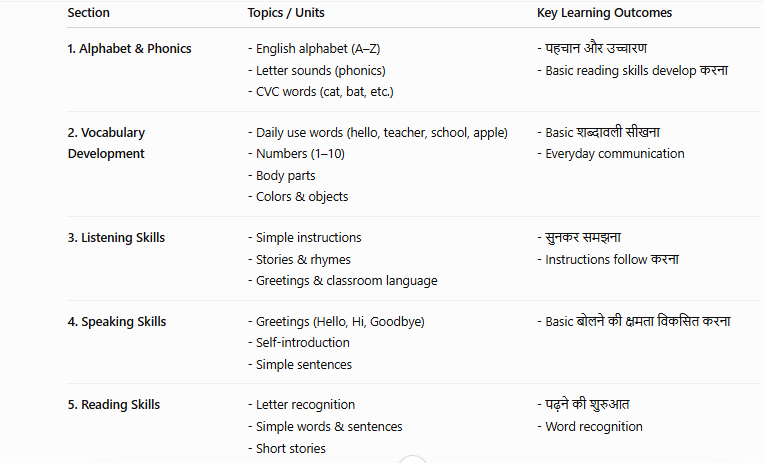
Kuwait Class 1 English Curriculum 2026
| Section | Topics / Units | Key Learning Outcomes |
|---|---|---|
| 1. Alphabet & Phonics | – English alphabet (A–Z) – Letter sounds (phonics) – CVC words (cat, bat, etc.) |
– पहचान और उच्चारण – Basic reading skills develop करना |
| 2. Vocabulary Development | – Daily use words (hello, teacher, school, apple) – Numbers (1–10) – Body parts – Colors & objects |
– Basic शब्दावली सीखना – Everyday communication |
| 3. Listening Skills | – Simple instructions – Stories & rhymes – Greetings & classroom language |
– सुनकर समझना – Instructions follow करना |
| 4. Speaking Skills | – Greetings (Hello, Hi, Goodbye) – Self-introduction – Simple sentences |
– Basic बोलने की क्षमता विकसित करना |
| 5. Reading Skills | – Letter recognition – Simple words & sentences – Short stories |
– पढ़ने की शुरुआत – Word recognition |
| 6. Writing Skills | – Letter writing (A–Z) – Copy writing – Simple words & sentences |
– Writing practice – Handwriting improve करना |
| 7. Grammar Basics | – Pronouns (my, your) – Present simple (basic use) – Yes/No sentences |
– Basic grammar समझना |
| 8. Sentence Formation | – Word arrangement – Sentence making – Fill in the blanks |
– Simple sentence बनाना |
| 9. Story & Comprehension | – Short stories (e.g., school, daily life) – Picture-based questions |
– समझने और जवाब देने की क्षमता |
| 10. Activities & Practice | – Flashcards – Worksheets – Sentence scramble – Picture prompts |
– Interactive learning और practice |
| 11. Themes / Units | – Myself – School – Family – Body parts – Numbers & greetings |
– Theme-based learning |
Key Highlights (Kuwait Curriculum Approach)
- Skill-based learning: Listening, Speaking, Reading, Writing (LSRW)
- Phonics-focused approach for early reading
- Activity-based learning (flashcards, worksheets, storytelling)
- Simple grammar introduction at beginner level
- Real-life vocabulary usage (school, family, greetings)
Kuwait 1st Class English Syllabus 2026
The Kuwait Class 1 English Curriculum 2026 is designed to build a strong foundation in basic language skills among young learners. At this stage, the focus is on developing listening, speaking, reading, and writing abilities through interactive and activity-based learning. The curriculum follows a child-centered approach aligned with international early years practices while being adapted to Kuwait’s educational framework.
1. Overview of Kuwait Class 1 English Curriculum
The Grade 1 English curriculum in Kuwait introduces students to the basics of the English language in a fun and engaging way. It emphasizes:
- Communication skills over rote learning
- Phonics-based language development
- Vocabulary building through real-life contexts
- Interactive classroom activities such as storytelling, songs, and games
The curriculum ensures that children gradually move from recognizing letters and sounds to forming simple words and sentences.
2. Key Learning Objectives
By the end of Class 1, students are expected to:
- Recognize and write English alphabets (A–Z)
- Identify letter sounds and simple phonics patterns
- Understand and use basic vocabulary related to everyday life
- Form simple words and short sentences
- Respond to simple instructions and questions
- Develop confidence in speaking basic English
The emphasis is on early literacy and communication rather than formal grammar rules.
3. Core Components of the Curriculum
(a) Phonics and Alphabet Learning
Phonics is the backbone of the curriculum. Students learn:
- Letter recognition (A–Z)
- Letter sounds (phonemes)
- Blending sounds to form words (CVC words like cat, bat)
- Beginning reading skills
Phonics-based teaching helps children decode words and improves reading fluency.
(b) Vocabulary Development
Students are introduced to everyday vocabulary through themes such as:
- Greetings and introductions
- Numbers (1–10)
- Colors
- Family members
- Body parts
- Animals and birds
- Food items
Activities like flashcards, picture recognition, and word games are commonly used.
(c) Speaking and Listening Skills
The curriculum places strong emphasis on oral communication:
- Listening to stories and instructions
- Responding to simple questions
- Practicing greetings (Hello, Good morning, etc.)
- Participating in classroom conversations
Story-based learning such as simple narratives (e.g., school-related stories) is widely used to enhance listening comprehension.
(d) Reading Skills
Reading development begins with:
- Recognizing letters and sounds
- Reading simple words and short sentences
- Understanding picture-based texts
- Listening to and following short stories
Teachers use illustrated books and visual aids to make reading engaging.
(e) Writing Skills
Writing is introduced gradually:
- Tracing and writing alphabets
- Writing simple words
- Copying short sentences
- Basic sentence formation using familiar vocabulary
Students also engage in activities like sentence rearrangement and picture-based writing.
(f) Grammar (Basic Introduction)
At this level, grammar is introduced informally:
- Use of simple present tense (basic verbs)
- Pronouns (he, she, it)
- Possessive adjectives (my, your)
- Simple sentence structures
The focus is on usage rather than memorization.
4. Unit-Wise Structure (Indicative)
The Kuwait Class 1 English curriculum is typically divided into thematic units such as:
| Unit | Theme | Key Topics |
|---|---|---|
| Unit 1 | All About Me | Alphabet, greetings, numbers |
| Unit 2 | My Body & Family | Body parts, family members |
| Unit 3 | My World | Animals, food, colors |
| Unit 4 | Daily Life | School, routines, simple sentences |
| Unit 5 | Seasons & Environment | Weather vocabulary, basic descriptions |
These themes help children connect language learning with their daily experiences.
5. Teaching Methodology
The curriculum uses modern teaching strategies, including:
- Activity-based learning
- Storytelling and role-play
- Audio-visual aids (videos, songs)
- Group activities and games
- Picture-based learning
Many schools in Kuwait also follow a “reading into writing” approach, where students first explore stories and then express ideas through writing.
6. Assessment Pattern
Assessment in Class 1 is continuous and child-friendly. It includes:
- Oral assessments (speaking and listening)
- Reading aloud
- Writing exercises
- Classroom participation
- Worksheets and simple tests
There are no high-pressure exams; instead, teachers focus on overall development.
7. Importance of the Curriculum
The Kuwait Class 1 English Curriculum 2026 plays a crucial role in:
- Building a strong foundation for future language learning
- Enhancing communication skills from an early age
- Supporting cognitive and social development
- Preparing students for higher grades and international curricula
Kuwait Class 1 English Curriculum Content: Thematic Organization
The 2026 curriculum organizes learning through engaging themes that connect to children’s experiences and foster natural language acquisition. While specific thematic units for Grade 1 continue to be finalized through teacher training and materials development, the approach reflects broader international practices in early English education.
As seen in comparable programs, themes often include personal topics like “All About Me,” “My Family,” and “People Who Help Us,” as well as broader topics such as “Animals,” “Transport,” and “Once Upon a Time” stories. These themes provide meaningful contexts for introducing vocabulary, grammatical structures, and literacy skills.
Phonological Awareness and Early Literacy
Phonics instruction follows a systematic progression through the academic year. Students begin with Phase 1 phonics, developing foundational phonological awareness through environmental sounds, instrumental sounds, body percussion, rhythm, rhyme, and alliteration activities.
As the year progresses, students advance to Phase 2 phonics, learning initial letter sounds and simple blending and segmenting. They learn letter-sound correspondences for consonants and vowels in a structured sequence, beginning with “s,” “a,” “t,” and “p” before proceeding to more complex sounds.
The Shift to Competence: Curriculum Values and Philosophy
The 2026 curriculum embodies three core values shaping English language education in Kuwait:
Competence-based values dominate official policy documents, emphasizing practical language use and communication skills. This represents a departure from traditional grammar-translation approaches and reflects international trends in language teaching.
Islamic values and Arab culture remain integral to curriculum content and implementation. English instruction respects and reinforces Kuwaiti cultural identity while developing global communication skills.
National identity receives deliberate attention through curriculum materials. Social studies content is now introduced from Grade 1, and English materials are designed to strengthen students’ connection to Kuwaiti heritage and values.
Assessment Approaches
Assessment aligns with the competence-based philosophy, focusing on what students can do with the language. Reading and writing assessments include comprehension passages with simple questions, phonics testing, and writing exercises that demonstrate understanding of letters, sounds, and basic sentence formation.
Assessment materials developed for the 2025-2026 academic year include reading tests, writing tests, and worksheets that focus on letter formation, word completion, and vocabulary application. These assessments measure progress toward clearly defined learning outcomes rather than simply testing memorized content.
Teacher Preparation and Implementation
The Ministry of Education has emphasized comprehensive training plans to prepare teachers for the new curriculum. Training sessions commenced before the start of the 2025-2026 school year, ensuring educators understand the curriculum’s philosophy and implementation requirements.
This focus on teacher development addresses challenges identified in previous reform efforts. Research indicates that stakeholder understanding of competence-based values has been limited in the past, with teachers, heads of departments, and supervisors lacking clear comprehension of curriculum aims. The 2026 rollout appears designed to address this gap through systematic professional development.
Resources and Materials
The Ministry has completed 88 textbooks for the first semester of the 2025-2026 academic year, including two for kindergarten, 46 for the primary stage, and 40 for the intermediate stage. All materials undergo final language and design reviews before printing.
To ease student workload and reduce backpack weight, textbooks will be printed in four smaller parts distributed throughout the school year. This practical consideration reflects attention to implementation challenges and student wellbeing.
Challenges and Considerations
The transition to a competence-based curriculum presents ongoing challenges. The Kuwaiti educational system operates hierarchically, with policies originating from the Ministry and passing through district supervisors and head teachers before reaching classroom teachers. This structure can create gaps between policy intentions and classroom implementation.
Research also highlights the need for continued clarity about what competence-based education means in practice. Teachers and supervisors who may not fully understand these values could struggle to implement the curriculum effectively. The Ministry’s emphasis on training and support represents a response to this challenge.
Looking Forward: The Future of English Education in Kuwait
The Class 1 English curriculum for 2026 represents a significant step toward modernizing Kuwait’s educational system. By aligning with international frameworks while maintaining local cultural values, the curriculum aims to prepare students for success in a globalized world while strengthening their Kuwaiti identity.
The reform also introduces 21st-century skills such as critical analysis, self-learning, and problem-solving across the curriculum. For English language learning, this means developing well-rounded learners with strong listening, speaking, reading, and writing skills who can think critically and learn independently.
Conclusion
Kuwait’s 2026 Class 1 English curriculum marks the beginning of a new chapter in the nation’s educational development. Moving beyond traditional approaches, it emphasizes practical language competence, international standards alignment, and the development of critical thinking skills. Through careful implementation, comprehensive teacher preparation, and locally developed materials, the curriculum aims to provide Kuwaiti students with the English language foundation they need for future academic success and global participation.
About The Author
