
The HPCL Junior Executive 2026 exam is approaching, and success starts with knowing the syllabus inside out. This guide covers the latest revised exam pattern, selection process, and detailed syllabus to help you prepare strategically.
HPCL Junior Executive 2026: Key Updates
Hindustan Petroleum Corporation Limited (HPCL) has announced 416 Junior Executive vacancies for 2026. The Computer-Based Test (CBT) is scheduled for 3rd May 2026.
The exam pattern has been revised compared to previous years. Understanding these changes is critical for your preparation strategy.
HPCL Junior Executive Selection Process 2026
The selection process for HPCL Junior Executive positions is comprehensive, evaluating candidates through multiple stages:
-
Computer-Based Test (CBT) – First screening stage
-
Group Task / Skill Test – Evaluates teamwork and practical skills
-
Personal Interview – Assesses technical knowledge and personality
-
Pre-Employment Medical Examination – Final stage for fitness verification
The final merit list is prepared based on performance across all stages, with the CBT carrying significant weight.
HPCL Junior Executive Exam Pattern 2026 (Revised)
The CBT has been revised for 2026 with a new structure. Here’s what you need to know:
| Particulars | Details |
|---|---|
| Total Questions | 170 |
| Total Marks | 170 |
| Exam Duration | 150 minutes |
| Negative Marking | 0.25 marks per wrong answer |
| Language Mode | Bilingual for Aptitude; English-only for Domain Knowledge |
Section-Wise Distribution
| Section | Questions | Marks | Language |
|---|---|---|---|
| General Aptitude | 85 | 85 | Bilingual (Hindi & English) |
| Domain Knowledge | 85 | 85 | English Only |
Qualifying Criteria
-
Overall qualifying marks: 60% for UR/EWS candidates; 54% for SC/ST/OBCNC/PwBD candidates
-
Technical/Professional Knowledge section: 50% qualifying for all categories
Detailed HPCL Junior Executive Syllabus 2026
Section 1: General Aptitude (85 Questions)
This section tests your foundational skills and intellectual potential. It is divided into three components:
English Language
-
Reading Comprehension
-
Spelling Test & Error Spotting
-
Parts of Speech
-
Fill in the Blanks & Sentence Completion
-
Synonyms & Antonyms
-
Active & Passive Voice, Direct & Indirect Speech
-
Para Jumbles & Sentence Arrangement
-
Idioms & Phrases
-
Homonyms & Word Formation
Quantitative Aptitude
-
Average, Percentage, Ratio & Proportion
-
Time & Work, Time & Distance
-
Simple & Compound Interest
-
Profit & Loss, Partnership
-
Number System, HCF & LCM
-
Mensuration & Trigonometry
-
Permutations & Combinations
-
Boats & Streams, Pipes & Cisterns
Intellectual Potential Test (Logical Reasoning & Data Interpretation)
-
Number Series & Coding-Decoding
-
Sitting Arrangement & Puzzle Test
-
Analogy & Classification
-
Syllogism & Logical Venn Diagrams
-
Blood Relations & Data Sufficiency
-
Direction Sense Test
-
Alphabet & Logical Sequence Tests
-
Sequential Output Tracing
Section 2: Domain Knowledge (85 Questions)
This section focuses on your engineering discipline. Below are syllabus highlights for key disciplines:
For Instrumentation Candidates
-
Fundamentals of Instrumentation & Transducers
-
Control Systems & Process Control
-
Industrial Instrumentation & Automation
-
Electrical Circuits, Networks & Machines
-
Digital & Power Electronics
-
Microprocessors & Telemetry
-
Electrical & Electronic Measurements
For Civil Candidates
-
Construction Technology & Materials
-
Concrete Technology & RCC Design
-
Steel Structure Design & Theory of Structures
-
Soil Mechanics & Geotechnical Engineering
-
Surveying & Transportation Engineering
-
Hydraulics & Water Resource Engineering
-
Environmental Science & Solid Waste Management
For Electrical Candidates
-
Electric Circuits & Fields
-
Electrical Machines & Power Systems
-
Control Systems & Power Electronics
-
Electrical & Electronic Measurements
-
Analog & Digital Electronics
For Quality Control Candidates
-
Inorganic & Organic Chemistry: Atomic structure, bonding, functional groups, polymers
-
Analytical Chemistry: Gravimetric and volumetric analysis, instrumental methods (UV-Vis, IR, AAS, GC, HPLC)
-
QA/QC & Lab Management: GLP, ISO/IEC 17025, calibration, validation, NABL requirements
-
Petroleum Product Testing: ASTM/BIS methods for fuels, lubricants, bitumen
For Fire & Safety Candidates
-
Fire Engineering Fundamentals
-
Fire Detection & Control Systems
-
Fire Fighting Chemicals & Equipment
-
Fire Service Hydraulics & Rescue
-
Safety Engineering & Fire Investigation
HPCL Junior Executive Syllabus 2026 (Section-wise Important Topics)
The syllabus is divided into two major parts:
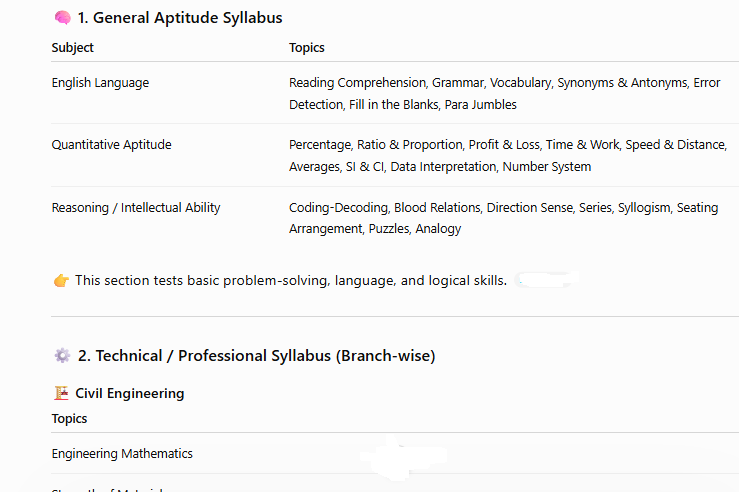
1. General Aptitude Syllabus
This section tests your basic reasoning, numerical ability, and language skills.
English Language
- Reading Comprehension
- Grammar & Error Detection
- Vocabulary (Synonyms & Antonyms)
- Fill in the Blanks
- Sentence Rearrangement
Quantitative Aptitude
- Percentage
- Ratio & Proportion
- Profit & Loss
- Time & Work
- Time, Speed & Distance
- Averages
- Simple & Compound Interest
- Data Interpretation
- Number System
Logical / Intellectual Ability
- Coding-Decoding
- Blood Relations
- Direction Sense
- Series (Number & Alphabet)
- Seating Arrangement
- Puzzles
- Syllogism
- Analogy
2. Technical / Professional Knowledge Syllabus
This section depends on your engineering discipline.
Civil Engineering
- Engineering Mechanics
- Strength of Materials
- Structural Analysis
- RCC & Steel Structures
- Geotechnical Engineering
- Environmental Engineering
- Transportation Engineering
- Fluid Mechanics
- Surveying
Mechanical Engineering
- Engineering Mechanics
- Thermodynamics
- Fluid Mechanics
- Heat Transfer
- Theory of Machines
- Production Engineering
- Power Engineering
- Refrigeration & AC
Electrical Engineering
- Electrical Circuits & Network Theory
- Electrical Machines
- Power Systems
- Control Systems
- Measurements & Instrumentation
- Power Electronics
Instrumentation Engineering
- Analog & Digital Electronics
- Control Systems
- Process Control
- Sensors & Transducers
- Microprocessors
Chemical Engineering
- Thermodynamics
- Fluid Mechanics
- Heat & Mass Transfer
- Chemical Reaction Engineering
- Process Calculations
- Plant Design & Safety
Quality Control (Specialized Stream)
- Quality Management Basics
- Statistical Quality Control
- Six Sigma & TQM
- ISO Standards
- Process Capability Analysis
- Lean Manufacturing
The technical section carries maximum weight (50%), making it crucial for selection.
Preparation Strategy for HPCL JE 2026
1. Understand the Weightage
With 85 questions each in Aptitude and Domain Knowledge, both sections deserve equal attention. Don’t neglect one for the other.
2. Focus on Accuracy
The 0.25 negative marking means accuracy is crucial. Avoid random guessing. Practice mock tests to develop a strategy for managing uncertainty.
3. Practice Technical Fundamentals
Domain Knowledge is tested in English only. Review core engineering concepts and practice objective-type questions specific to your discipline.
4. Master Aptitude Basics
The bilingual option for Aptitude sections can be a comfort, but don’t rely on it. Practice both languages to build speed and confidence.
5. Time Management
With 150 minutes for 170 questions, you have approximately 53 seconds per question. Practice pacing yourself during mock tests.
Frequently Asked Questions
Q: What is the total number of questions in the HPCL JE 2026 exam?
A: The exam has 170 questions in total.
Q: Is there negative marking in HPCL JE 2026?
A: Yes, 0.25 marks are deducted for every wrong answer.
Q: What is the duration of the HPCL JE CBT exam?
A: Candidates get 150 minutes (2.5 hours) to complete the exam.
Q: Is the Domain Knowledge paper available in Hindi?
A: No, the Domain Knowledge paper is only available in English.
Q: When is the HPCL Junior Executive Exam 2026 scheduled?
A: The CBT exam is scheduled for 3rd May 2026.
Q: What is the qualifying percentage for UR candidates?
A: UR/EWS candidates need 60% overall, with 50% required in the Technical section.
About The Author
