
The US Grade 1 Science Syllabus 2026 represents a sophisticated approach to early science education, moving beyond simple facts to engage young learners in authentic scientific practices. Across the United States, states have adopted frameworks—many based on the Next Generation Science Standards (NGSS)—that emphasize hands-on investigation, cross-cutting concepts, and real-world problem-solving. This article provides a detailed exploration of the Standard 1 Science Curriculum, outlining its core domains, key standards, and the skills first-graders are expected to develop.
US Grade 1 Science Syllabus 2026: Learning by Doing
The driving force behind the 2026 Grade 1 curriculum is the belief that science is a verb. Rather than simply memorizing that sound comes from vibrations, students actively plan and conduct investigations to prove it . Rather than being told that animals resemble their parents, they make observations to construct evidence-based accounts of inheritance .
According to the framework, by the end of Grade 1, students are expected to be able to:
-
Investigate the relationship between sound and vibration, and the connection between light and our ability to see objects.
-
Increase understanding of how plants and animals use the outermost parts of their bodies to help them survive, grow, and meet their needs.
-
Examine the ways parents help their offspring survive and study how young plants and animals are similar to, but not exactly the same as, their parents.
-
Observe, describe, and predict patterns in the movement of objects in the sky .
This approach is organized around three interconnected dimensions: Science and Engineering Practices (like asking questions and analyzing data), Crosscutting Concepts (like patterns and cause and effect), and Disciplinary Core Ideas (the key content knowledge)
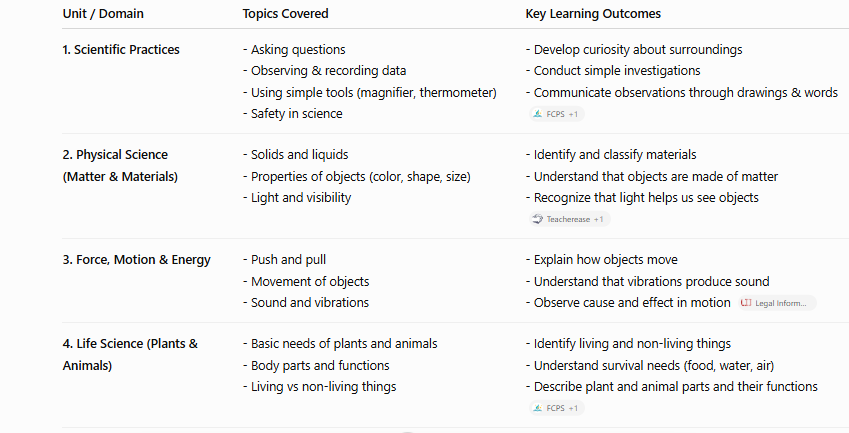
USA Grade 1 Science Syllabus 2026 (Standard 1)
| Unit / Domain | Topics Covered | Key Learning Outcomes |
|---|---|---|
| 1. Scientific Practices | – Asking questions – Observing & recording data – Using simple tools (magnifier, thermometer) – Safety in science |
– Develop curiosity about surroundings – Conduct simple investigations – Communicate observations through drawings & words |
| 2. Physical Science (Matter & Materials) | – Solids and liquids – Properties of objects (color, shape, size) – Light and visibility |
– Identify and classify materials – Understand that objects are made of matter – Recognize that light helps us see objects |
| 3. Force, Motion & Energy | – Push and pull – Movement of objects – Sound and vibrations |
– Explain how objects move – Understand that vibrations produce sound – Observe cause and effect in motion |
| 4. Life Science (Plants & Animals) | – Basic needs of plants and animals – Body parts and functions – Living vs non-living things |
– Identify living and non-living things – Understand survival needs (food, water, air) – Describe plant and animal parts and their functions |
| 5. Human Body & Senses | – Five senses – Body parts and uses |
– Understand how senses help us explore the world – Recognize body functions for survival |
| 6. Earth & Space Science | – Sun, Moon, and stars – Day and night – Weather and seasons |
– Identify patterns of sun and moon – Understand weather changes – Recognize seasonal variations |
| 7. Environment & Natural Resources | – Natural resources (water, air, soil) – Conservation – Human impact on environment |
– Understand importance of natural resources – Learn basic conservation practices |
| 8. Engineering & Technology | – Simple problem-solving – Designing simple models/devices – Use of everyday tools |
– Apply science to solve problems – Build simple devices (e.g., sound/light tools) |
Typical Unit-wise Distribution (Optional Planning)
| Term / Quarter | Units |
|---|---|
| Quarter 1 | Scientific Skills + Matter |
| Quarter 2 | Motion, Energy, Sound |
| Quarter 3 | Plants, Animals, Human Body |
| Quarter 4 | Earth Science + Environment |
Key Features of USA Grade 1 Science
- Focus on activity-based learning
- Emphasis on observation & experimentation
- Introduction to STEM and engineering concepts
- Development of critical thinking & curiosity
The Four Core Disciplinary Domains
The Grade 1 curriculum is structured around four primary domains that provide a lens for students to explore their world.
1. Physical Science: Waves: Light and Sound
This unit harnesses students’ natural curiosity about their senses to explore fundamental physics concepts. The core idea is that light and sound are waves that transfer information and interact with materials in predictable ways .
Key performance expectations include:
-
Sound and Vibration: Students plan and conduct investigations to provide evidence that vibrating materials can make sound and that sound can make materials vibrate . This often involves simple experiments with rubber bands, tuning forks, or drums.
-
Light and Sight: Students make observations to construct an evidence-based account that objects can be seen only when illuminated . This addresses the common misconception that we can see in the dark without a light source.
-
Materials and Light: Students investigate the effect of placing different materials (e.g., clear plastic, wax paper, cardboard) in the path of a beam of light. This is an introduction to the concepts of transparency, translucency, and opacity .
-
Engineering with Waves: Students design and build a device that uses light or sound to solve the problem of communicating over a distance. This introduces the engineering design process and the practical applications of science . An example could be creating a simple “telephone” using cups and string or a flashing light signal.
2. Life Science: Structure, Function, and Information Processing
This domain explores the incredible diversity of life and how organisms survive. It is broken down into two main strands: the structure and function of organisms, and heredity.
Structure and Function (1-LS1):
-
Biomimicry: Students use materials to design a solution to a human problem by mimicking how plants and/or animals use their external parts to help them survive, grow, and meet their needs . For example, they might design a model of a “burr” to mimic a seed’s dispersal method or design a “bird beak” tool to pick up different types of “food” .
-
Inherited Behaviors: Students obtain information from media/text to determine patterns in the behavior of plants and animals that help offspring survive . This includes exploring how parents protect, feed, and care for their young .
Heredity: Inheritance and Variation of Traits (1-LS3):
-
Family Resemblance: Students make observations to construct an evidence-based account that young plants and animals are like, but not exactly like, their parents . This lays the groundwork for understanding genetic inheritance and variation. They might compare pictures of puppies to their parents or leaves from the same tree .
3. Earth and Space Science: Space Systems: Patterns and Cycles
This domain is designed to help students notice and predict the regular patterns in their environment, fostering a sense of the Earth as a dynamic system .
Key performance expectations include:
-
Sky Patterns: Students use observations of the Sun, Moon, and stars to describe patterns that can be predicted . They learn about the apparent movement of these objects in the sky.
-
Seasonal Changes: Students make observations at different times of the year to relate the amount of daylight to the time of year . This connects directly to their own experiences of longer days in summer and shorter days in winter.
4. Earth and Human Activity (and Engineering Design)
-
Human Impact: Students communicate solutions that will reduce the impact of humans on the land, water, air, and/or other living things in the local environment . This age-appropriate standard introduces conservation and stewardship, often through activities like recycling or reducing waste .
-
Engineering Design (K-2-ETS1): While not a separate domain, the engineering design process is woven throughout. Students are expected to define problems, develop simple models, and analyze data from tests of two objects designed to solve the same problem . This reinforces that science and engineering are connected processes.
A Closer Look: How the Curriculum is Structured
The standards are designed to be flexible in their sequence, but a typical Unit Progression might organize the content thematically . A sample 2026 progression from one state illustrates this well:
-
Unit 1: Light (6-8 weeks): Focuses entirely on 1-PS4.2 and 1-PS4.3, with a driving question like, “Why can’t we see in the dark?” .
-
Unit 2: Waves (4-6 weeks): Combines sound (1-PS4.1) with the engineering challenge of communication (1-PS4.4) .
-
Unit 3: Heredity (4-6 weeks): Explores the similarities and differences between parents and offspring (1-LS1.2 and 1-LS3.1) .
-
Unit 4: Biomimicry (3-5 weeks): Ties together structure and function (1-LS1.1) .
-
Unit 5: Environmental Impact (3-5 weeks): Addresses human impact on the environment (1-ESS3.1) .
Grade 1 Science Syllabus (NGSS-Aligned 2026–27)
This structure allows teachers to create coherent storylines that build upon each other, helping students see the connections between concepts rather than learning them in isolation.
| Term / Unit | Domain | Topic / Standard Code | Key Concepts | Learning Outcomes (Students will be able to…) | Suggested Activities |
|---|---|---|---|---|---|
| Term 1 | Earth & Space Science | 1-ESS1-1 | Patterns in the sky | Observe sun, moon, stars; identify patterns | Shadow tracking, sky journal |
| Earth & Space Science | 1-ESS1-2 | Day & seasonal patterns | Describe changes in daylight over time | Chart sunrise/sunset | |
| Engineering | K-2-ETS1-1 | Asking questions | Ask questions about natural events | Class discussion, inquiry wall | |
| Term 2 | Physical Science | 1-PS4-1 | Sound & vibration | Understand that vibrating objects produce sound | Rubber band guitar experiment |
| Physical Science | 1-PS4-2 | Light & visibility | Explain that objects are seen when illuminated | Light/dark box exploration | |
| Engineering | K-2-ETS1-2 | Designing solutions | Develop simple solutions using observations | Build simple flashlight model | |
| Term 3 | Life Science | 1-LS1-1 | Structure & function | Identify external parts of plants/animals | Plant observation, labeling |
| Life Science | 1-LS1-2 | Parent & offspring | Recognize similarities between parents and young | Matching activity (animals & babies) | |
| Engineering | K-2-ETS1-3 | Testing solutions | Compare and improve designs | Build protective structures | |
| Term 4 | Integration Unit | Crosscutting Concepts | Patterns & Cause-Effect | Identify patterns in nature and explain simple causes | Sorting, classification tasks |
| All Domains | Review & Projects | STEM Integration | Apply knowledge in real-world problems | Mini science fair/project | |
| Engineering | K-2-ETS1-4 | Communicating ideas | Share solutions and findings | Poster presentations |
NGSS Three-Dimensional Learning Integration
| Dimension | Application in Grade 1 |
|---|---|
| Science & Engineering Practices (SEP) | Asking questions, making observations, designing simple solutions |
| Disciplinary Core Ideas (DCI) | Light, sound, plants, animals, space patterns |
| Crosscutting Concepts (CCC) | Patterns, cause & effect, structure & function |
Conclusion
The 2026 Grade 1 Science Syllabus represents a significant and effective shift in how young children learn science. It reframes science as an active process of investigation and discovery, aligning with the most current educational research. By focusing on core concepts in Physical, Life, and Earth Sciences through the lens of inquiry and engineering, it equips first graders not just with knowledge, but with the critical thinking skills and curiosity they need to understand and interact with the world around them.
About The Author
