
US Grade 2 Science Curriculum 2026-27: As we look toward the 2026-27 school year, the landscape of second-grade science education in the United States continues to evolve, building on the strong foundation established by the Next Generation Science Standards (NGSS). Having worked with this curriculum for years, I can tell you with confidence that it’s an exciting time to be teaching science. We are shifting away from rote memorization and moving toward a dynamic, hands-on, and student-led investigation of the world around us.
So, what does this mean for your second grader or your classroom? This year is a pivotal one. In second grade, students transition from simply observing the world to actively investigating, comparing outcomes, collecting data, and explaining their reasoning based on evidence. The curriculum is designed to nurture a scientific mindset, and it’s structured around a few key “storylines” that connect different areas of science .
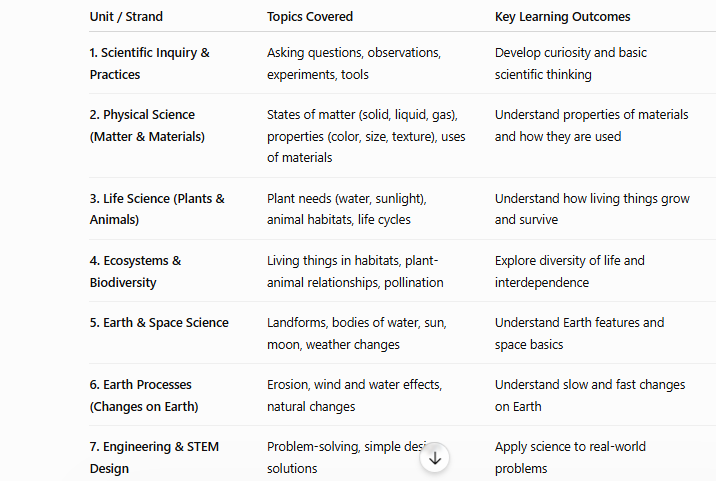
US Grade 2 Science Curriculum 2026–27
| Unit / Strand | Topics Covered | Key Learning Outcomes | Activities / Skills |
|---|---|---|---|
| 1. Scientific Inquiry & Practices | Asking questions, observations, experiments, tools | Develop curiosity and basic scientific thinking | Conduct simple experiments, use tools (thermometer, ruler), record data |
| 2. Physical Science (Matter & Materials) | States of matter (solid, liquid, gas), properties (color, size, texture), uses of materials | Understand properties of materials and how they are used | Classify materials, compare objects, identify uses of materials |
| 3. Life Science (Plants & Animals) | Plant needs (water, sunlight), animal habitats, life cycles | Understand how living things grow and survive | Observe plants, compare habitats, study life cycles |
| 4. Ecosystems & Biodiversity | Living things in habitats, plant-animal relationships, pollination | Explore diversity of life and interdependence | Compare ecosystems, model seed dispersal |
| 5. Earth & Space Science | Landforms, bodies of water, sun, moon, weather changes | Understand Earth features and space basics | Identify landforms, observe sky objects, track weather |
| 6. Earth Processes (Changes on Earth) | Erosion, wind and water effects, natural changes | Understand slow and fast changes on Earth | Design solutions to prevent erosion |
| 7. Engineering & STEM Design | Problem-solving, simple design solutions | Apply science to real-world problems | Build models, test solutions, improve designs |
| 8. Data & Measurement | Graphs, charts, measurement tools | Represent and interpret data | Create bar graphs, pictographs, measure accurately |
Key Features of US Grade 2 Science Curriculum
- Inquiry-based learning: Students learn by asking questions and exploring concepts.
- Three Core Domains:
- Physical Science
- Life Science
- Earth & Space Science
- Hands-on activities: Experiments, observations, and STEM projects
- Real-world application: Focus on solving practical problems
- Skill development: Data analysis, critical thinking, and communication
Learning Outcomes by End of Grade 2
Students will be able to:
- Identify properties of materials and their uses
- Explain basic needs of plants and animals
- Describe Earth features and changes
- Understand simple ecosystems and biodiversity
- Conduct basic scientific investigations
- Use data and tools for observation and measurement
The Three Core Disciplines
The 2026-27 Grade 2 curriculum is organized into three main areas of study: Physical Science, Life Science, and Earth and Space Science . Let’s break down what your student will explore in each.
Physical Science: The Properties and Changes of Matter
In this unit, students become material scientists. The focus is on understanding that matter—the “stuff” that makes up everything—has observable properties. Your child will learn to:
-
Classify Materials: Plan and conduct investigations to describe and classify different kinds of materials by their observable properties. This means they might be sorting objects based on whether they are flexible, hard, or transparent .
-
Test Materials for a Purpose: Analyze data from testing different materials to determine which are best suited for an intended purpose. Why is a metal spoon better for cooking than a wooden one? These are the questions they’ll be exploring .
-
Understand How Things Are Made: Make observations to construct an evidence-based account of how an object made of a small set of pieces can be disassembled and made into a new object, much like building with LEGOs .
-
Explore Irreversible and Reversible Changes: Construct an argument with evidence that some changes caused by heating or cooling can be reversed and some cannot. A classic experiment is melting and freezing water versus cooking an egg .
Life Science: Habitats, Ecosystems, and Plant Survival
This unit takes students outdoors to explore the fascinating web of life. The key concepts include:
-
Plant Needs: Planning and conducting an investigation to determine if plants need sunlight and water to grow. This is often a favorite, as students can plant seeds and watch them sprout under different conditions .
-
Biodiversity: Making observations of plants and animals to compare the diversity of life in different habitats. They’ll learn that a desert ecosystem is vastly different from a forest .
-
Ecosystem Interactions: Developing a simple model that mimics the function of an animal in dispersing seeds or pollinating plants. This could involve creating a model of a bee or building a “burr” that sticks to clothing to represent seed dispersal .
Earth and Space Science: The Dynamic Earth
This unit focuses on the processes that shape our planet. Students will become young geologists and learn about:
-
Rapid and Slow Changes: Using information from several sources to provide evidence that Earth events can occur quickly or slowly. For example, comparing the immediate destruction of a volcanic eruption to the slow, patient work of a river carving a canyon over millions of years .
-
Preventing Erosion: Comparing multiple solutions designed to slow or prevent wind or water from changing the shape of the land. This is where engineering comes in, as students might design a barrier to prevent erosion .
-
Modeling Landforms: Developing a model to represent the shapes and kinds of land and bodies of water in an area. This could be a simple map or a 3D clay model .
-
Water on Earth: Obtaining information to identify where water is found on Earth and that it can be solid or liquid .
The Engineering Design Process is the Glue
What makes this curriculum truly special is how engineering is woven throughout. It’s not a separate subject but a lens through which students solve problems. The K-2 Engineering Design standards ask students to :
-
Define a problem: Ask questions, make observations, and gather information about a situation people want to change .
-
Develop solutions: Create a simple sketch, drawing, or model to illustrate how the shape of an object helps it function to solve a problem .
-
Test and compare: Analyze data from tests of two objects designed to solve the same problem to compare their strengths and weaknesses .
This process is hands-on, encourages persistence, and teaches students that failure is just another step toward a better solution.
What This Looks Like in the Classroom
Gone are the days of simply reading from a textbook. In a 2026-27 second-grade science classroom, you’ll see students actively engaged in investigations and experiments. The learning is inquiry-based and driven by “phenomena”—observable events that spark curiosity .
For example, a teacher might introduce a lesson on plant survival by presenting a head of romaine lettuce and asking, “Where does the water inside this plant come from?” . This leads to student questions, which then fuel an investigation where they plan an experiment to see what happens when a plant is given light but no water, or water but no light.
Activities you might see include:
-
Building a Filter: Students are given various materials to build a water filtration system .
-
Testing Insulation: Students test which material (foil, bubble wrap, paper) keeps an ice cube from melting the longest .
-
Young Geologist: Students pour water on different trays of sand, dirt, and rocks to model erosion .
-
Strength Test: Students test a variety of materials to see if they are movable, breakable, or sturdy, and connect the function of the material to the evidence they gathered.
A Note on Standards and Assessment
While the 2026-27 curriculum is heavily influenced by NGSS, it’s important to remember that specific standards and their implementation can vary slightly by state or district . However, the core concepts and the shift toward inquiry-based, three-dimensional learning are widely adopted .
For Teachers: The resources available today are better than ever. From detailed unit progressions that include driving questions and phenomena ideas to standard-aligned practice activities, the support is there to help you bring these concepts to life . Don’t be afraid to let the students lead and to learn alongside them—the most powerful moments often come from shared discovery.
For Parents: You can reinforce these concepts at home by encouraging curiosity. When your child asks a “why” question, try to turn it into an investigation. “I don’t know, how can we find out?” Ask them to observe the world around them, ask questions, and make predictions. Simple activities like cooking, planting a garden, or noticing the weather can be rich learning opportunities.
Conclusion
The Grade 2 Science Curriculum for 2026-27 is a robust and engaging program that sets students up for success in science and beyond. By focusing on doing science—investigating, modeling, and explaining—we are not just teaching facts; we are cultivating the critical thinkers and problem-solvers of tomorrow. It’s a curriculum that recognizes the innate curiosity of a seven-year-old and provides the tools to turn that curiosity into genuine scientific understanding.
About The Author
