
In the United States, second-grade social studies acts as an immersive tool for 7-to-8-year-olds to explore how they fit into their local communities and the wider world. The curriculum framework for the 2026–2027 academic year builds on primary concepts from Kindergarten and Grade 1, shifting from self-reflection to basic regional comparison, mapping, and civic participation.
The core US Grade 2 Social Studies curriculum is structured around four major pillars: Geography, Civics, Economics, and History.
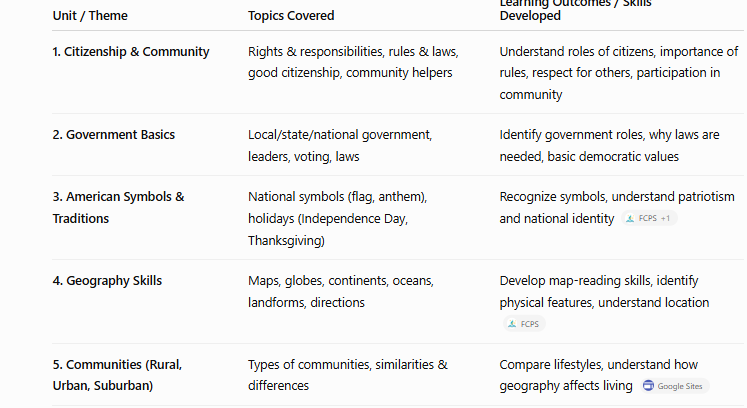
US Grade 2 Social Studies Curriculum 2026–27
| Unit / Theme | Topics Covered | Learning Outcomes / Skills Developed |
|---|---|---|
| 1. Citizenship & Community | Rights & responsibilities, rules & laws, good citizenship, community helpers | Understand roles of citizens, importance of rules, respect for others, participation in community |
| 2. Government Basics | Local/state/national government, leaders, voting, laws | Identify government roles, why laws are needed, basic democratic values |
| 3. American Symbols & Traditions | National symbols (flag, anthem), holidays (Independence Day, Thanksgiving) | Recognize symbols, understand patriotism and national identity |
| 4. Geography Skills | Maps, globes, continents, oceans, landforms, directions | Develop map-reading skills, identify physical features, understand location |
| 5. Communities (Rural, Urban, Suburban) | Types of communities, similarities & differences | Compare lifestyles, understand how geography affects living |
| 6. Culture & Traditions | Family traditions, cultural diversity, celebrations | Appreciate diversity, compare cultures, understand heritage |
| 7. History & Time | Past vs present, timelines, historical figures, local history | Understand change over time, sequencing events, importance of history |
| 8. Indigenous Peoples & Early Americans | Native American tribes, early settlers, explorers | Learn about early inhabitants and cultural contributions |
| 9. Economics Basics | Needs vs wants, goods & services, money, saving | Understand basic economic concepts and decision-making |
| 10. Global Awareness | World communities, migration, global citizenship | Develop awareness of other cultures and global connections |
| 11. Change & Interdependence | Community changes over time, cooperation, interdependence | Understand how communities evolve and depend on each other |
| 12. Environment & Resources | Natural resources, human impact, conservation | Learn sustainability and responsible resource use |
Key Highlights of Grade 2 Social Studies
- Focus shifts from family → community → nation → world
- Strong emphasis on:
- Citizenship & values
- Basic geography skills
- Introductory history concepts
- Economic awareness
- Learning is mostly activity-based, story-based, and project-based
Skills Developed
- Critical thinking (compare communities, past vs present)
- Map & spatial skills
- Social responsibility & civic sense
- Cultural awareness
- Basic decision-making (economics)
1. Geography: Mapping the World and Communities
Geography in second grade transitions from simple classroom sketches to exploring the physical structure of the Earth and understanding different types of human settlements.
-
Map and Globe Skills: Students master basic map keys/legends, letter-number coordinate grids, and the four cardinal directions (North, South, East, West) using a compass rose. They learn to differentiate between a flat map and a round globe.
-
The Global Picture: Identifying the 7 continents and 5 major oceans. Students pinpoint the location of the United States and North America on a world map.
-
Physical Features & Landforms: Recognizing natural structures like mountains, valleys, plains, plateaus, lakes, and rivers using photographs and models.
-
Human Geography: Comparing and contrasting three foundational community settings:
-
Urban: Busy cities with high populations and skyscrapers.
-
Suburban: Residential areas outside a city.
-
Rural: Open countryside, agricultural zones, and farming communities.
-
2. Civics & Government: Rules, Leadership, and Citizenship
Civics teaches students why rules exist and introduces them to the structure of authority that keeps societies running safely and fairly.
-
Purpose of Government: Learning that governments exist to maintain order, provide public safety, and protect citizens’ rights (like freedom of speech).
-
Three Levels of Government: Understanding the hierarchy of American leadership:
-
Local: Mayors and city councils.
-
State: Governors and state legislatures.
-
Federal: The President and Congress.
-
-
American Symbols & Landmarks: Recognizing the core visual identity of the nation. Students learn the history and meaning behind:
-
The American Flag and the Pledge of Allegiance.
-
The White House, Capitol Building, and Supreme Court.
-
National monuments like the Statue of Liberty, Lincoln Memorial, and Mount Rushmore.
-
-
Good Citizenship: Discussing character traits like honesty, respect, and responsibility, alongside actions like voting, recycling, or volunteering.
3. Economics: Wants, Needs, and Marketplace Choices
The second-grade economics curriculum introduces basic financial literacy, helping children see the link between labor, resources, and the items they use daily.
-
Scarcity and Choice: Understanding that resources are limited. If a family or business cannot have everything they want, they must make choices.
-
Producers vs. Consumers: Learning that producers make goods or provide services, while consumers buy and use them. Students explore how an individual can be both.
-
Goods and Services: Differentiating between tangible physical items (goods like food, toys, and cars) and actions performed by others (services like medical care, teaching, or mail delivery).
-
Financial Basics: Discussing how people earn an income through work, the different methods used to pay for items (cash, checks, cards), and the structural purpose of saving money in a bank.
4. History: Past, Present, and Cultural Heritage
History at this age focuses on timelines, local origins, and the diverse historical figures whose contributions shaped modern life.
-
Chronology and Change: Using timelines to map out sequences of historical events. Students compare daily life long ago to life today, observing shifts in transportation, communication, and household technology.
-
Cultural Traditions: Learning about diverse national and international holidays (such as Thanksgiving, Día de los Muertos, Lunar New Year, Ramadan, and Hanukkah) to understand how different cultures pass down customs.
-
Historical Biographies: Reading primary and secondary sources about prominent inventors, reformers, and leaders. Standard figures studied include:
-
Founding Figures: George Washington, Benjamin Franklin, Thomas Jefferson.
-
Innovators: Thomas Edison, George Washington Carver, Amelia Earhart, Neil Armstrong.
-
Civil Rights Leaders: Abraham Lincoln, Harriet Tubman, Rosa Parks, Jackie Robinson, Dr. Martin Luther King Jr., and Thurgood Marshall.
-
This holistic, four-pillar framework ensures that by the end of the second grade, students can look at an object, a map, a law, or a holiday and understand the historical, economic, or geographic context behind it.
For a closer look at common curriculum materials and a real-world look at lesson choices for this specific school cycle, check out this guide on Second Grade Curriculum Planning. It provides an overview of lesson strategies and supplemental resource options that match the core skills expected for this grade level.
About The Author
