
The NEET Syllabus 2026 is designed to assess a student’s understanding of core concepts in Physics, Chemistry, and Biology based on the NCERT curriculum of Classes 11 and 12. It serves as the foundation for India’s largest medical entrance exam, guiding aspirants toward MBBS, BDS, and other medical courses. The syllabus emphasizes conceptual clarity, problem-solving skills, and application-based learning. With a structured approach and focused preparation, candidates can effectively cover all topics. Staying updated with the latest syllabus changes and weightage is crucial for scoring well and securing admission to top medical colleges.
The NEET Syllabus 2026 has been officially released by the National Testing Agency (NTA) based on the NCERT Class 11 and 12 curriculum. It includes three core subjects: Physics, Chemistry, and Biology (Botany + Zoology).
There are no major changes to the syllabus, so students must focus strictly on the NCERT textbooks and on conceptual clarity.
NEET Syllabus 2026 Analysis
Complete NEET Syllabus Analysis 2026 in tabular form based on the latest NMC/NTA syllabus (Class 11 & 12 NCERT-based).
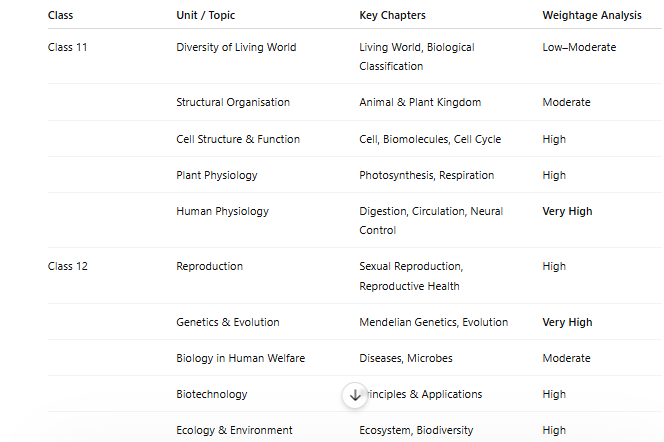
Biology (Most Important – 50% Weightage)
| Class | Unit / Topic | Key Chapters | Weightage Analysis |
|---|---|---|---|
| Class 11 | Diversity of Living World | Living World, Biological Classification | Low–Moderate |
| Structural Organisation | Animal & Plant Kingdom | Moderate | |
| Cell Structure & Function | Cell, Biomolecules, Cell Cycle | High | |
| Plant Physiology | Photosynthesis, Respiration | High | |
| Human Physiology | Digestion, Circulation, Neural Control | Very High | |
| Class 12 | Reproduction | Sexual Reproduction, Reproductive Health | High |
| Genetics & Evolution | Mendelian Genetics, Evolution | Very High | |
| Biology in Human Welfare | Diseases, Microbes | Moderate | |
| Biotechnology | Principles & Applications | High | |
| Ecology & Environment | Ecosystem, Biodiversity | High |
Biology contributes 90 questions (360 marks) and is the scoring backbone.
Physics (Concept + Numerical Based)
| Class | Unit / Topic | Key Chapters | Weightage Analysis |
|---|---|---|---|
| Class 11 | Mechanics | Kinematics, Laws of Motion, WEP | Very High |
| Rotational Motion & Gravitation | Circular Motion, Gravitation | High | |
| Properties of Matter | Solids, Fluids | Moderate | |
| Thermodynamics | Heat, Kinetic Theory | High | |
| Oscillations & Waves | SHM, Waves | Moderate | |
| Class 12 | Electrostatics | Charges, Capacitors | Very High |
| Current Electricity | Ohm’s Law, Circuits | Very High | |
| Magnetism & EMI | Magnetic Effects, AC | High | |
| Optics | Ray & Wave Optics | High | |
| Modern Physics | Atoms, Nuclei, Semiconductors | High Scoring |
Physics requires strong concepts + practice, especially from Electrodynamics & Mechanics.
Chemistry (Balanced Subject)
| Section | Unit / Topic | Key Chapters | Weightage Analysis |
|---|---|---|---|
| Physical | Basic Concepts | Mole Concept | Moderate |
| Atomic Structure | Quantum Numbers | High | |
| Thermodynamics | Laws, Enthalpy | High | |
| Equilibrium | Chemical & Ionic | Very High | |
| Electrochemistry & Kinetics | Rate, Cells | High | |
| Inorganic | Periodic Table | Trends | Moderate |
| Chemical Bonding | Hybridization | Very High | |
| p-block / d-block | Elements | High | |
| Coordination Compounds | Complexes | Very High | |
| Organic | GOC | Basics, Mechanism | Very High |
| Hydrocarbons | Alkanes, Alkenes | High | |
| Functional Groups | Alcohols, Aldehydes, Amines | High | |
| Biomolecules | Proteins, Carbs | Moderate |
Chemistry is NCERT-based, especially Inorganic & Organic.
Overall NEET 2026 Paper Analysis
| Subject | Questions | Marks | Difficulty Level |
|---|---|---|---|
| Physics | 45 | 180 | Moderate–Difficult |
| Chemistry | 45 | 180 | Moderate |
| Biology | 90 | 360 | Easy–Moderate |
| Total | 180 | 720 | — |
Marking Scheme:
- +4 for correct
- −1 negative marking
High-Weightage Topics (Quick Analysis)
| Subject | Most Important Topics |
|---|---|
| Biology | Human Physiology, Genetics, Ecology |
| Physics | Current Electricity, Mechanics, Modern Physics |
| Chemistry | Chemical Bonding, GOC, Coordination Compounds |
NEET 2026 Biology Syllabus
Biology is the most important subject, carrying 50% weightage (90 questions) in NEET.
Class 11 Biology Topics
1. Diversity in Living World
- Classification of organisms
- Five Kingdom system
- Plant & Animal Kingdom
Helps understand biological classification and evolution basics
2. Structural Organisation in Animals & Plants
- Morphology and anatomy of plants
- Animal tissues
Focus on diagrams and structural differences
3. Cell Structure & Function
- Cell theory, organelles
- Biomolecules (proteins, carbohydrates, lipids)
Foundation of modern biology
4. Plant Physiology
- Photosynthesis
- Respiration in plants
- Plant growth & hormones
Important for conceptual questions
5. Human Physiology
- Digestion, breathing, circulation
- Nervous system & endocrine system
Highly scoring and frequently asked
Class 12 Biology Topics
1. Reproduction
- Human reproduction
- Reproductive health
Diagram-based questions are common
2. Genetics & Evolution
- Mendel’s laws
- DNA replication
- Evolution theories
One of the most important NEET topics
3. Biology in Human Welfare
- Human diseases
- Microbes in human welfare
4. Biotechnology
- Genetic engineering
- Biotech applications
Modern and application-based questions
5. Ecology & Environment
- Ecosystem
- Biodiversity
- Environmental issues
NEET 2026 Chemistry Syllabus (Detailed Explanation)
Chemistry is divided into Physical, Organic, and Inorganic Chemistry.
Physical Chemistry Topics
- Some Basic Concepts (Mole Concept)
- Atomic Structure
- States of Matter (Gas Laws)
- Thermodynamics
- Equilibrium
- Redox Reactions
- Electrochemistry
- Chemical Kinetics
- Solutions
- Surface Chemistry
Explanation:
Physical chemistry focuses on numericals and formulas. Questions are mostly calculation-based and require strong conceptual clarity.
Organic Chemistry Topics
- General Organic Chemistry (GOC)
- Hydrocarbons
- Haloalkanes & Haloarenes
- Alcohols, Phenols & Ethers
- Aldehydes, Ketones, Carboxylic Acids
- Amines
- Biomolecules
- Polymers
- Chemistry in Everyday Life
Explanation:
- Focus on reaction mechanisms
- Learn named reactions & conversions
- Practice multiple reaction-based MCQs
Inorganic Chemistry Topics
- Periodic Table
- Chemical Bonding
- s, p, d, f Block Elements
- Coordination Compounds
- Metallurgy
Explanation:
- NCERT line-by-line is crucial
- Questions are mostly fact-based
NEET 2026 Physics Syllabus (Detailed Explanation)
Physics is considered the toughest subject due to numerical problems.
Class 11 Physics Topics
- Units & Measurements
- Kinematics
- Laws of Motion
- Work, Energy & Power
- Rotational Motion
- Gravitation
- Properties of Matter
- Thermodynamics
- Kinetic Theory
- Oscillations & Waves
Explanation:
- Focus on basic concepts + derivations
- Practice numerical problems daily
Class 12 Physics Topics
- Electrostatics
- Current Electricity
- Magnetism & EMI
- Alternating Current
- Electromagnetic Waves
- Optics (Ray & Wave)
- Modern Physics
- Semiconductor Electronics
Explanation:
- Modern Physics is highly scoring
- Optics and Electricity are frequently asked
NEET 2026 Subject-Wise Weightage
| Subject | No. of Questions | Marks |
|---|---|---|
| Biology | 90 | 360 |
| Chemistry | 45 | 180 |
| Physics | 45 | 180 |
Biology dominates the exam, so prioritize it.
Key Preparation Insights
- Follow NCERT strictly (80–90% questions come from it)
- Focus more on Biology + Organic Chemistry
- Practice Physics numericals daily
- Revise diagrams, formulas, and reactions regularly
Conclusion
The NEET Syllabus 2026 is comprehensive but completely manageable if approached strategically. Since it is fully based on NCERT Class 11 & 12, students should focus on concept clarity, revision, and practice. Biology remains the scoring subject, while Physics demands consistent problem-solving, and Chemistry requires a balanced approach across all three sections.
FAQs
Q1. What is the syllabus of NEET 2026 based on?
The NEET 2026 syllabus is primarily based on NCERT Class 11 and Class 12 subjects including Physics, Chemistry, and Biology.
Q2. Has the NEET 2026 syllabus changed?
As per recent trends, the syllabus remains mostly aligned with NCERT, but minor additions or deletions may be introduced by the National Medical Commission (NMC).
Q3. Which subjects are included in the NEET syllabus?
The NEET syllabus includes:
- Physics
- Chemistry
- Biology (Botany + Zoology)
Q4. Which subject carries the highest weightage in NEET?
Biology carries the highest weightage with 50% of the total questions, making it the most important subject.
Q5. Is NCERT enough to cover the NEET syllabus?
Yes, NCERT books are the foundation. However, for better practice and conceptual clarity, students should also refer to additional reference books.
Q6. What are the important topics in Physics for NEET 2026?
Important topics include:
- Mechanics
- Thermodynamics
- Current Electricity
- Modern Physics
- Laws of Motion
Q7. What are the important topics in Chemistry?
Key topics include:
- Organic Chemistry (Reactions & Mechanisms)
- Chemical Bonding
- Thermodynamics
- Equilibrium
- Coordination Compounds
Q8. What are the most scoring topics in Biology?
High-weightage topics include:
- Human Physiology
- Genetics and Evolution
- Ecology
- Cell Structure & Function
- Biotechnology
Q9. Is Class 11 syllabus important for NEET 2026?
Yes, Class 11 syllabus is equally important and contributes around 45–50% of the questions.
Q10. How many questions are asked from each subject?
- Physics: 45 questions
- Chemistry: 45 questions
- Biology: 90 questions
Q11. Does NEET include practical-based questions?
Yes, NEET may include conceptual and application-based questions, some derived from practical knowledge.
Q12. Is there negative marking in NEET 2026?
Yes, 1 mark is deducted for each wrong answer.
Q13. How should I complete the NEET syllabus on time?
- Follow NCERT thoroughly
- Make a study timetable
- Practice previous year papers
- Revise regularly
Q14. Are deleted NCERT topics included in NEET?
Generally, removed NCERT topics are not included, but students should confirm with the official syllabus.
Q15. Where can I download the official NEET syllabus 2026?
You can download it from the official website of the National Testing Agency (NTA) or NMC.
About The Author
