
The global economic map is changing quickly in 2026. The United States and China continue to dominate the world economy, while India is strengthening its position among the largest economies. At the same time, countries such as Germany, Japan, the United Kingdom and France remain major economic powers because of their strong industrial, financial and technological bases.
For this ranking, nominal GDP at current market exchange rates is used. This is different from GDP based on purchasing power parity (PPP), which can produce a different ranking. The IMF’s World Economic Outlook database uses GDP at current prices in U.S. dollars as one of its standard indicators.
Top 10 Economies in the World 2026 – Quick List
| Rank | Country | Approx. GDP in 2026 | 2026 Real GDP Growth* |
|---|---|---|---|
| 1 | United States | $31+ trillion | 2.3% |
| 2 | China | $20+ trillion | 4.6% |
| 3 | Germany | $5.45 trillion | 0.7% |
| 4 | India | Around $4.3 trillion | 6.4% |
| 5 | Japan | Around $4.3 trillion | 0.6% |
| 6 | United Kingdom | Around $4 trillion | 1.0% |
| 7 | France | Around $3.6 trillion | 0.6% |
| 8 | Italy | Around $2.7 trillion | 0.5% |
| 9 | Russia | Around $2.5 trillion | 1.1% |
| 10 | Canada | Around $2.4 trillion | 1.1% |
*Growth figures are IMF July 2026 projections. GDP figures are rounded and can change with exchange-rate movements and subsequent revisions. The IMF’s latest July 2026 update projects global growth of 3.0% in 2026.
Important: Rankings based on nominal GDP can change during the year because exchange rates influence the U.S.-dollar value of each country’s economy. Therefore, the figures above should be treated as 2026 estimates rather than final full-year results.
1. United States
The United States remains the world’s largest economy in 2026 by nominal GDP. Its economic strength comes from a combination of consumer spending, advanced technology, financial services, manufacturing, energy production and a huge domestic market.
American companies also have an enormous global footprint. Technology companies, financial institutions, pharmaceutical firms, automobile manufacturers and other multinational businesses contribute significantly to the country’s economic output.
The IMF’s July 2026 outlook puts U.S. real GDP growth at 2.3% for 2026.
Why is the U.S. economy so large?
- World’s largest financial markets
- Strong technology and AI sector
- Large consumer market
- Major global corporations
- High productivity
- Significant energy production
- Dollar’s central role in international finance
The United States therefore continues to have a sizeable lead over the second-largest economy.
2. China
China remains the second-largest economy in the world in 2026.
Its economic model combines manufacturing, exports, infrastructure investment, technology and a massive domestic market. China is particularly important in global supply chains for electronics, machinery, electric vehicles, batteries, solar equipment and numerous industrial products.
According to the IMF’s July 2026 update, China’s real GDP is projected to grow by 4.6% in 2026.
China’s economic story, however, is not simply about rapid growth. The country is also dealing with challenges involving domestic consumption, property-sector weakness, demographics and global trade tensions.
Major strengths of China
- World’s largest manufacturing base
- Huge domestic consumer market
- Strong export sector
- Large infrastructure network
- Growing technology industry
- Major electric-vehicle and battery production
China’s position as the world’s manufacturing powerhouse keeps it firmly in second place.
3. Germany
Germany is the largest economy in Europe and ranks among the world’s biggest economies in 2026.
The German economy is heavily connected with manufacturing and exports. Automobiles, machinery, chemicals, industrial equipment and advanced manufacturing remain important pillars.
The IMF’s April 2026 DataMapper puts Germany’s 2026 GDP at approximately $5.45 trillion, with GDP per capita around $65,300.
The July IMF outlook projects German real GDP growth of 0.7% in 2026.
Germany’s economic strengths
- Automobile manufacturing
- Engineering
- Chemicals
- Machinery and industrial equipment
- High-skilled workforce
- Strong export network
Germany’s relatively slow growth does not diminish its overall economic size.
4. India
India has become one of the most closely watched economies in the world.
With a huge population, expanding middle class, rising digital economy and growing manufacturing base, India is increasingly important to global businesses.
The IMF projects 6.4% real GDP growth for India in 2026, making it one of the fastest-growing major economies in this top-10 group.
India’s economy is supported by:
- Information technology
- Financial services
- Manufacturing
- Construction and infrastructure
- Telecommunications
- Pharmaceuticals
- Retail and consumer markets
- Digital services
India’s position is particularly interesting because its economy is growing considerably faster than most of the mature economies above and around it.
Is India the 4th-largest economy in 2026?
Based on the latest 2026 nominal-GDP estimates, India is around the fourth position, very close to Japan. However, the exact order can move because both countries’ GDP values in U.S. dollars are affected by currency movements and updated IMF estimates.
The IMF itself has noted India’s rise from the fifth-largest economy and its growing possibility of overtaking Japan.
5. Japan
Japan remains one of the world’s most technologically advanced economies and is still among the top five largest economies by nominal GDP.
Its major industries include automobiles, electronics, machinery, robotics, chemicals and high-end manufacturing.
The IMF’s April 2026 data shows Japan with GDP per capita of about $35,700 and projects real GDP growth of 0.6% for 2026 in its July update.
Japan’s major economic strengths
- Automobile industry
- Robotics
- Electronics
- Precision manufacturing
- Research and development
- Advanced infrastructure
- Strong corporate sector
Japan faces challenges such as an ageing population and relatively low population growth, but its productivity, technology and industrial capabilities keep it among the world’s economic giants.
6. United Kingdom
The United Kingdom remains one of the world’s largest economies in 2026.
London is one of the world’s leading financial centres, while the broader UK economy is supported by financial services, professional services, pharmaceuticals, technology, manufacturing and education.
The IMF projects UK real GDP growth of 1.0% in 2026.
Key strengths
- London financial centre
- Banking and insurance
- Professional services
- Pharmaceuticals
- Technology
- Higher education
- Aerospace and advanced manufacturing
Although the UK has a smaller population than many countries above it, its high-value service economy gives it a very large overall GDP.
7. France
France is another major European economic power and ranks among the world’s top economies.
Its economy has a broad base rather than depending on just one industry. Aerospace, tourism, luxury goods, agriculture, financial services, manufacturing and energy all play important roles.
The IMF expects France to record 0.6% real GDP growth in 2026.
France’s economic strengths
- Aerospace
- Tourism
- Luxury goods
- Nuclear energy
- Agriculture
- Financial services
- Automobile manufacturing
France also benefits from its position within the European Union and the euro area.
8. Italy
Italy remains one of Europe’s largest economies and is expected to be among the world’s top 10 economies in 2026.
The Italian economy has a strong manufacturing base, particularly in machinery, automobiles, fashion, food products and industrial goods.
The IMF projects Italian real GDP growth of 0.5% in 2026.
Italy’s economic strengths
- Manufacturing
- Fashion and luxury goods
- Tourism
- Food and beverages
- Machinery
- Automotive industry
- Small and medium-sized businesses
Italy’s economy may not grow as rapidly as India’s or China’s, but its established industrial base keeps its total economic output high.
9. Russia
Russia continues to rank among the world’s largest economies when measured by nominal GDP.
The Russian economy has substantial natural resources, particularly oil and natural gas. Energy, mining, manufacturing and agriculture are important parts of its economic structure.
The IMF projects Russian real GDP growth of 1.1% in 2026.
Major strengths of Russia
- Oil and natural gas
- Mining
- Metals
- Agriculture
- Defence-related industries
- Large domestic market
However, sanctions, geopolitical tensions, investment constraints and changes in global energy markets continue to influence Russia’s economic outlook.
10. Canada
Canada completes the top 10 list of the world’s largest economies in 2026.
Canada has a resource-rich economy with strong links to the United States. Energy, mining, manufacturing, financial services, real estate and agriculture all contribute to its GDP.
The IMF projects Canada’s real GDP growth at 1.1% in 2026.
Canada’s economic strengths
- Oil and natural gas
- Mining
- Banking and financial services
- Agriculture
- Manufacturing
- Technology
- Strong U.S. trade relationship
Canada’s relatively small population compared with the United States and China does not prevent it from maintaining a place among the world’s largest economies.
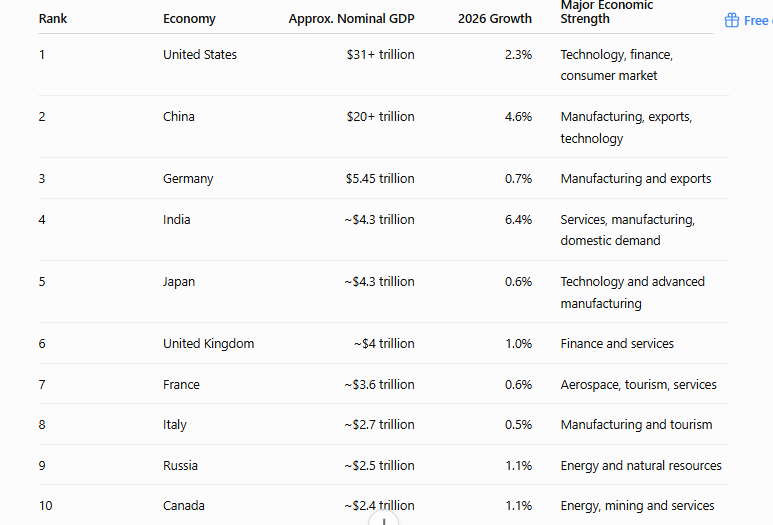
Top 10 Economies in the World 2026: Detailed Comparison
| Rank | Economy | Approx. Nominal GDP | 2026 Growth | Major Economic Strength |
|---|---|---|---|---|
| 1 | United States | $31+ trillion | 2.3% | Technology, finance, consumer market |
| 2 | China | $20+ trillion | 4.6% | Manufacturing, exports, technology |
| 3 | Germany | $5.45 trillion | 0.7% | Manufacturing and exports |
| 4 | India | ~$4.3 trillion | 6.4% | Services, manufacturing, domestic demand |
| 5 | Japan | ~$4.3 trillion | 0.6% | Technology and advanced manufacturing |
| 6 | United Kingdom | ~$4 trillion | 1.0% | Finance and services |
| 7 | France | ~$3.6 trillion | 0.6% | Aerospace, tourism, services |
| 8 | Italy | ~$2.7 trillion | 0.5% | Manufacturing and tourism |
| 9 | Russia | ~$2.5 trillion | 1.1% | Energy and natural resources |
| 10 | Canada | ~$2.4 trillion | 1.1% | Energy, mining and services |
Note: GDP values are rounded 2026 estimates based primarily on IMF WEO data and should not be interpreted as final year-end figures.
Which Is the Fastest-Growing Major Economy in the Top 10?
Among these ten largest economies, India stands out for its growth rate.
The IMF’s July 2026 forecast puts India’s real GDP growth at 6.4%, ahead of China’s 4.6% and well above the growth rates expected for most advanced economies in the list.
This difference is important. GDP size tells us how large an economy is today, while economic growth tells us how quickly it is expanding.
For example:
- The United States is much larger than India.
- India is growing substantially faster.
- Germany has a much larger GDP than many countries but a slower growth rate.
- China remains both enormous and relatively fast-growing.
That is why economic rankings can look quite different when comparing size today with future growth potential.
Nominal GDP vs PPP GDP: Why the Rankings Differ
One common source of confusion is the difference between nominal GDP and PPP GDP.
Nominal GDP
Nominal GDP converts a country’s economic output into U.S. dollars using market exchange rates. This is the measure generally used when people ask for the world’s “largest economies.”
GDP at PPP
Purchasing power parity adjusts for differences in the prices of goods and services between countries.
As a result, developing countries often rank higher under PPP than they do under nominal GDP.
For example, India and China have significantly larger shares of world output when measured using PPP. The IMF’s WEO database separately reports nominal GDP, PPP GDP and GDP per capita.
So, the biggest economy by nominal GDP is not necessarily the biggest economy by PPP.
Why Does the United States Remain Number 1?
Several factors explain America’s continued dominance:
- Large domestic market: Hundreds of millions of consumers generate enormous demand.
- Technology leadership: AI, software, semiconductors and digital services remain major economic drivers.
- Financial power: Wall Street and U.S. financial institutions have global influence.
- Multinational companies: Many of the world’s most valuable corporations are American.
- Energy production: The U.S. is also a major producer of oil and natural gas.
- Innovation: Strong universities, venture capital and private-sector research support new industries.
The IMF projects U.S. real GDP growth of 2.3% in 2026.
Why Is India Rising So Quickly?
India’s rise is one of the biggest economic stories of the 2020s.
A combination of demographic scale, digitalisation, infrastructure investment, services exports, manufacturing initiatives and rising domestic consumption is supporting growth.
The IMF’s latest 2026 projection puts India’s real GDP growth at 6.4%.
India’s future ranking will depend on whether it can maintain high productivity growth, create enough jobs, increase manufacturing competitiveness and continue attracting investment.
Global Economic Outlook for 2026
The world economy is entering 2026 with a mixture of opportunities and risks.
The IMF’s July 2026 World Economic Outlook Update forecasts 3.0% global growth in 2026 and 3.4% in 2027. It also highlights the influence of technology investment, particularly AI-related demand, alongside geopolitical and energy risks.
The major issues likely to influence the world’s largest economies include:
- Artificial intelligence and automation
- Energy prices
- Global trade policies
- Geopolitical conflicts
- Interest rates
- Inflation
- Supply-chain restructuring
- Semiconductor demand
- Government debt
- Climate and energy transition
These factors could significantly influence the rankings over the next several years.
Frequently Asked Questions
Which is the largest economy in the world in 2026?
The United States is the world’s largest economy in 2026 when measured by nominal GDP.
Which is the second-largest economy in 2026?
China is the second-largest economy by nominal GDP.
Is India among the top 5 economies in 2026?
Yes. India is around the fourth-largest economy by nominal GDP in current 2026 estimates, although its exact position relative to Japan can change with exchange rates and revisions.
Which major economy is growing fastest in 2026?
Among the top 10 economies, India has the highest projected real GDP growth at 6.4%, according to the IMF’s July 2026 outlook.
What is the richest economy in the world?
If “richest” means largest total economic output, the United States is number one. If it means GDP per person, the ranking is completely different.
Is GDP the same as wealth?
No. GDP measures economic production during a period, while national wealth includes accumulated assets such as property, infrastructure, financial assets and natural resources.
Final Takeaway
The Top 10 Economies in the World 2026 continue to be dominated by the United States, China and the major economies of Europe and Asia. What makes 2026 particularly interesting is the changing position of India, whose growth rate is considerably higher than that of most established economic powers.
The United States remains comfortably ahead in overall economic size, China continues to be its closest competitor, while Germany, India and Japan form the next major group. The UK, France, Italy, Russia and Canada round out the top 10.
However, these rankings are not permanent. Currency movements, inflation, investment, productivity and economic growth can move countries up or down the table. The IMF itself updates its economic projections as new data becomes available, so the final 2026 ranking may differ from today’s estimates.
About The Author
