
The Kerala Teacher Eligibility Test (KTET) is an important eligibility examination for candidates who want to pursue teaching opportunities in Kerala. The test is conducted to assess whether candidates have the required teaching aptitude, subject knowledge and understanding of children and classroom learning.
For candidates preparing for KTET 2026, knowing the syllabus before starting preparation is extremely important. The examination is divided into four categories, and each category is designed for a different level or type of teaching.
The official KTET website lists separate syllabi for Category I, Category II, Category III and Category IV.
In this article, candidates can check the Kerala KTET Syllabus 2026, category-wise exam pattern, important topics, preparation strategy and other useful details.
Kerala KTET Syllabus 2026: Overview
| Particulars | Details |
|---|---|
| Exam Name | Kerala Teacher Eligibility Test (KTET) |
| Full Form | Kerala Teacher Eligibility Test |
| Conducting Authority | Kerala Pareeksha Bhavan |
| Exam Level | State Level |
| Categories | Category I, II, III and IV |
| Category I | Classes I to V |
| Category II | Classes VI to VIII |
| Category III | Classes VIII to X |
| Category IV | Specialised teachers/other categories |
| Mode of Exam | Offline/OMR-based |
| Question Type | Objective Type |
| Official Website | ktet.kerala.gov.in |
The official KTET portal describes the examination as a test intended to assess the quality and suitability of teacher candidates for different school levels in Kerala.
KTET 2026 Important Update
The official notification for the February 2026 cycle stated that applications were accepted from February 26 to March 21, 2026, while the examination was subsequently scheduled for August 8 and 9, 2026. The official website has also published a September 2026 notification, so candidates should check the latest notification before applying for or appearing in a particular cycle.
KTET Exam Pattern 2026
One thing candidates should understand at the beginning is that KTET does not have one common syllabus for everyone. The syllabus changes according to the category selected by the candidate.
The broad structure covers areas such as Child Development and Pedagogy, Language, Mathematics, Science, Social Science and subject-specific content, depending on the category.
KTET Category I Exam Pattern
Category I is meant for candidates preparing for teaching at the Lower Primary level, Classes I to V.
The official Category I syllabus begins with Child Development and Pedagogy and allocates 30 questions to this section.
| Section | Questions |
|---|---|
| Child Development and Pedagogy | 30 |
| Language I | 30 |
| Language II | 30 |
| Mathematics | 30 |
| Environmental Studies | 30 |
| Total | 150 |
Thus, candidates preparing for Category I should not concentrate only on general teaching concepts. Language, Mathematics and Environmental Studies also form a substantial portion of the paper.
KTET Category I Syllabus 2026
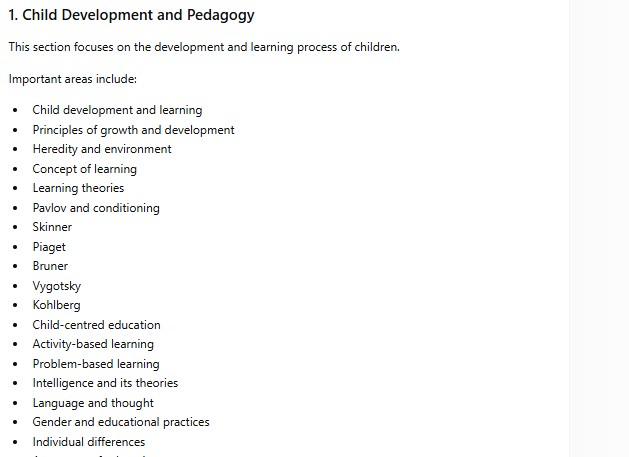
1. Child Development and Pedagogy
This section focuses on the development and learning process of children.
Important areas include:
- Child development and learning
- Principles of growth and development
- Heredity and environment
- Concept of learning
- Learning theories
- Pavlov and conditioning
- Skinner
- Piaget
- Bruner
- Vygotsky
- Kohlberg
- Child-centred education
- Activity-based learning
- Problem-based learning
- Intelligence and its theories
- Language and thought
- Gender and educational practices
- Individual differences
- Assessment for learning
- Assessment of learning
- School-based assessment
- Continuous and comprehensive evaluation
- Personality development
- Inclusive education
- Children with special needs
The official Category I syllabus specifically includes topics such as child development, learning theories, inclusive education and children with special needs.
2. Language I
Language I generally tests the candidate’s understanding of language, comprehension and language-teaching principles.
Preparation should cover:
- Reading comprehension
- Grammar
- Vocabulary
- Language development
- Language learning
- Principles of language teaching
- Listening and speaking
- Reading and writing
- Language skills
- Teaching-learning materials
- Evaluation of language proficiency
- Remedial teaching
- Inclusive language classrooms
3. Language II
Language II also focuses on language proficiency and pedagogy.
Candidates should prepare:
- Comprehension
- Grammar
- Vocabulary
- Language acquisition
- Language teaching
- Communication skills
- Reading skills
- Writing skills
- Listening skills
- Speaking skills
- Assessment
- Remedial teaching
4. Mathematics
The Mathematics section generally focuses on elementary-school mathematics and the methods used to teach it.
Important areas include:
- Numbers
- Basic arithmetic
- Addition and subtraction
- Multiplication and division
- Fractions
- Decimals
- Geometry
- Measurement
- Data handling
- Patterns
- Time
- Money
- Mathematical reasoning
- Mathematics pedagogy
- Learning difficulties in mathematics
- Evaluation and remedial teaching
5. Environmental Studies
EVS combines basic concepts related to the child’s surroundings and everyday life.
Important areas include:
- Family and friends
- Food
- Shelter
- Water
- Travel
- Plants
- Animals
- Human body
- Environment
- Natural resources
- Health and hygiene
- Pollution
- Conservation
- Local environment
- EVS teaching methods
- Classroom activities
- Evaluation
KTET Category II Exam Pattern 2026
Category II is associated with teaching at the Upper Primary level, Classes VI to VIII.
The official Category II syllabus contains Child Development and Pedagogy, language development and subject-specific sections. The syllabus document allocates 30 questions to Child Development and Pedagogy and 30 questions to Language Development, followed by a 60-question subject section.
| Section | Questions |
|---|---|
| Child Development and Pedagogy | 30 |
| Language I | 30 |
| Language II | 30 |
| Mathematics & Science or Social Science | 60 |
| Total | 150 |
The final subject choice depends on the candidate’s teaching stream.
Mathematics & Science
The Mathematics and Science portion covers the concepts expected at the upper-primary level along with their pedagogical aspects.
Social Science
The Social Science syllabus includes subjects such as:
- History
- Geography
- Civics
- Economics
- Social science pedagogy
The official syllabus, for example, divides the Social Science content into areas including History and Geography. History topics include ancient civilisations, colonialism in India, the Revolt of 1857, social reform movements and the Indian national movement. Geography includes the Earth, maps, climate, India’s physical features, resources and Kerala’s geography.
KTET Category III Exam Pattern 2026
Category III is designed for candidates seeking eligibility for teaching at the High School level, Classes VIII to X.
The paper places greater emphasis on the candidate’s subject knowledge along with pedagogy and language.
| Major Area | Questions/Weightage* |
|---|---|
| Child Development & Pedagogy | 30 |
| Language | 40 |
| Subject-specific content and pedagogy | 80 |
| Total | 150 |
*Candidates should refer to the category-specific official syllabus PDF and latest notification for the exact subject-wise distribution applicable to their paper.
The important point for Category III aspirants is that preparation should be strongly subject-oriented. A candidate appearing for a Mathematics-related paper, for example, should give substantial preparation time to both the prescribed Mathematics content and teaching methodology.
KTET Category III Syllabus 2026
The syllabus varies according to the subject selected by the candidate. Therefore, candidates should download the relevant subject syllabus rather than relying on a generic KTET preparation list.
Broadly, preparation can include:
Mathematics
- Arithmetic
- Algebra
- Geometry
- Mensuration
- Statistics
- Number system
- Mathematical reasoning
- Teaching methodology
Science
Depending on the subject, preparation can include:
- Physics
- Chemistry
- Biology
- Basic scientific concepts
- Environmental science
- Science pedagogy
- Laboratory and activity-based learning
Social Science
Candidates may need to prepare:
- History
- Geography
- Political science
- Economics
- Kerala-related topics
- Indian national movement
- Social science pedagogy
KTET Category IV Exam Pattern 2026
Category IV is intended for candidates belonging to specified specialised teacher categories.
Unlike Categories I–III, Category IV is not simply a general primary, upper-primary or high-school teaching paper. The syllabus depends heavily on the particular subject/category.
The official KTET website provides separate Category IV syllabus material, including subject-specific papers.
For example, the official Category IV syllabus includes specialised language papers such as Arabic and Urdu. The Urdu syllabus includes areas such as Urdu poetry, prose, grammar, journalism, research and translation.
Therefore, Category IV candidates should check the exact syllabus corresponding to their specialised qualification before preparing.
KTET Syllabus 2026: Important Topics
Although the syllabus differs by category, a few areas deserve special attention because they repeatedly form an important part of teacher eligibility preparation.
| Area | What to Prepare |
|---|---|
| Child Development | Growth, development, learning and individual differences |
| Learning Theories | Piaget, Vygotsky, Bruner, Skinner, Pavlov and others |
| Inclusive Education | CWSN, learning disabilities and diverse classrooms |
| Language Pedagogy | Language acquisition, skills and teaching methods |
| Assessment | Formative/summative assessment and evaluation |
| Mathematics | Concepts, problem solving and pedagogy |
| Science | Core concepts and teaching methodology |
| Social Science | History, Geography, Civics and Economics |
| Kerala Topics | Relevant Kerala history, geography and social topics |
| Subject Pedagogy | Methods of teaching the chosen subject |
How to Prepare for KTET 2026
A common mistake among KTET candidates is to start solving questions immediately without understanding the syllabus. A better approach is to divide preparation into manageable stages.
1. Start With the Official Syllabus
First download the syllabus for your category from the official KTET website. Pareeksha Bhavan provides separate syllabus links for Categories I, II, III and IV.
Make a checklist of every topic and tick it off as you complete it.
2. Give Proper Attention to Pedagogy
KTET is not simply a subject-knowledge examination. A candidate also needs to understand how children learn and how teachers should respond to different classroom situations.
Topics such as:
- Child-centred education
- Inclusive education
- Learning theories
- Individual differences
- Assessment
- Language development
- Remedial teaching
should therefore be studied conceptually rather than memorised.
3. Read NCERT/SCERT-Level Material
For subject sections, candidates can use school-level textbooks relevant to their category. Kerala SCERT material can be particularly useful for understanding the state-specific school curriculum.
4. Practise Previous Questions
Previous KTET papers and official model questions are useful for becoming familiar with the question style. The official KTET website provides model-question sections for the examination categories.
Try solving questions without looking at the answer first. After each test, spend time understanding your mistakes.
5. Make Short Revision Notes
Do not try to revise the entire textbook a day before the examination.
Prepare short notes for:
- Learning theories
- Important psychologists
- Pedagogy concepts
- Grammar rules
- Formulas
- Important facts
- Subject-specific concepts
- Frequently repeated mistakes
These notes become particularly useful during the final week.
KTET 2026 Preparation Strategy
A simple study routine can make preparation much more manageable.
| Preparation Stage | Focus |
|---|---|
| First 2 weeks | Understand syllabus and complete basic concepts |
| Weeks 3–5 | Complete subject-wise syllabus |
| Weeks 6–7 | Pedagogy + language revision |
| Weeks 8–9 | Previous papers and model questions |
| Weeks 10–11 | Mock tests |
| Final week | Revision and error correction |
Candidates who have limited preparation time should avoid trying to study everything equally. Identify the topics where you repeatedly lose marks and devote additional practice time to those areas.
KTET Previous Year Questions and Model Papers
Practising previous questions is useful for two reasons. First, it gives candidates an idea about the style of questions. Second, it exposes weak areas that may not become obvious during textbook study.
The official KTET portal has a dedicated Model Questions section for different categories.
A good routine is to solve one paper under exam-like conditions and then analyse:
- Which questions were wrong?
- Why was the answer wrong?
- Was the problem conceptual or due to careless reading?
- Which topic produced the most mistakes?
- How much time was spent on each section?
This analysis is often more useful than simply counting the number of questions answered correctly.
Is KTET Syllabus Difficult?
The difficulty of KTET preparation depends largely on the category and the candidate’s academic background.
Category I candidates have to balance pedagogy with elementary-level subjects. Category II requires a stronger understanding of upper-primary subjects, while Category III is more subject-focused. Category IV preparation can vary considerably because of its specialised nature.
The syllabus itself should not be treated as something to memorise. Teacher-eligibility examinations often test whether candidates can apply concepts in classroom situations.
KTET Syllabus 2026: FAQs
What is the KTET syllabus for 2026?
The KTET syllabus is divided into four categories: Category I, Category II, Category III and Category IV. Each category has a separate syllabus based on the relevant teaching level or specialised teaching area.
How many questions are asked in KTET?
The standard KTET papers for the main categories are structured around 150 questions, with the exact section-wise distribution depending on the category and paper.
What is Category I in KTET?
Category I is intended for candidates seeking eligibility to teach at the Lower Primary level, generally Classes I to V. The official syllabus identifies it as Paper I for Classes I to V.
What is Category II in KTET?
Category II is associated with teaching at the Upper Primary level, generally Classes VI to VIII.
What is Category III in KTET?
Category III is associated with High School teaching, generally Classes VIII to X.
What is Category IV in KTET?
Category IV covers specified specialised teacher categories. Candidates should check the official Category IV syllabus corresponding to their particular subject or qualification.
Where can I download the KTET syllabus PDF?
Candidates can download the category-wise syllabus from the official Kerala Teacher Eligibility Test website maintained by Pareeksha Bhavan. The official portal provides separate download options for Categories I, II, III and IV.
Does KTET have Child Development and Pedagogy?
Yes. Child Development and Pedagogy is an important component of the KTET syllabus. For example, the official Category I syllabus allocates 30 questions to this area.
Final Words
The Kerala KTET Syllabus 2026 becomes much easier to handle once candidates understand which category they are applying for. Instead of treating KTET as one large examination, break the preparation into three parts: pedagogy, language and subject-specific preparation.
Start with the official syllabus, understand the concepts, practise model and previous questions, and regularly revise your weak areas. Most importantly, candidates should keep checking the official KTET website for the latest notification, syllabus updates, examination dates and other instructions because the examination schedule can change between cycles. The official website currently carries information for the 2026 examination cycles.
About The Author
